How Long Does It Actually Take to Charge a Tesla Model 3?
If you own or are considering a 2025–2026 Tesla Model 3, the single most practical question is how long charging takes — and the answer depends entirely on which charging level you use. A Model 3 Long Range with its 75 kWh (usable) LFP or NMC battery can take anywhere from 12 hours on a standard wall outlet to under 20 minutes at a V4 Supercharger. Understanding these differences is the key to making EV ownership effortless rather than frustrating.
This guide breaks down every charging scenario a Model 3 owner will encounter: overnight home charging, road-trip DC fast charging, and the real cost of each. We'll also cover what it takes to install a Level 2 charger at home, which equipment to buy, and how charging cost per mile stacks up against gasoline.
- Model 3 RWD: ~57.5 kWh usable, LFP chemistry, EPA 272 mi
- Model 3 Long Range AWD: ~75 kWh usable, NMC chemistry, EPA 341 mi
- Model 3 Performance: ~75 kWh usable, NMC chemistry, EPA 315 mi
Real-world highway range at 75 mph: expect ~10–15% below EPA. Cold weather (below 32°F): expect 20–30% reduction without preconditioning. Source: fueleconomy.gov
Charging Levels Explained: Speed in kW and Miles Per Hour
The most common mistake new EV owners make is confusing kW (kilowatts, a measure of power or charge rate) with kWh (kilowatt-hours, a measure of energy or battery capacity). Think of kW as the speed of water flowing through a hose, and kWh as the size of the bucket you're filling. A 75 kWh battery charged at 11.5 kW takes roughly 6.5 hours from empty to full; at 1.4 kW, it takes over 50 hours.
| Level | Voltage / Amps | Power (kW) | Miles of Range / Hour | 0–80% Time (LR 75 kWh) |
|---|---|---|---|---|
| Level 1 (120V outlet) | 120V / 12A | ~1.4 kW | 3–5 mi/hr | ~45+ hours |
| Level 2 (240V home) | 240V / 48A | ~11.5 kW | 30–44 mi/hr | ~5–6 hours |
| Level 2 (240V / 32A) | 240V / 32A | ~7.7 kW | 20–29 mi/hr | ~8–9 hours |
| DC Fast (Supercharger V3) | DC / up to 250 kW | Peak 250 kW | ~170 mi in 15 min | 10–80% in ~25 min |
| DC Fast (Supercharger V4) | DC / up to 350 kW | Peak ~350 kW* | Varies by pack | 10–80% in ~18–22 min |
*V4 peak rates depend on Model 3 battery architecture and state of charge. The Model 3's onboard charge curve tapers significantly above 80% SoC — expect the last 20% to take nearly as long as the first 70%.
Home Charger Installation: Electrical Requirements and Real Costs
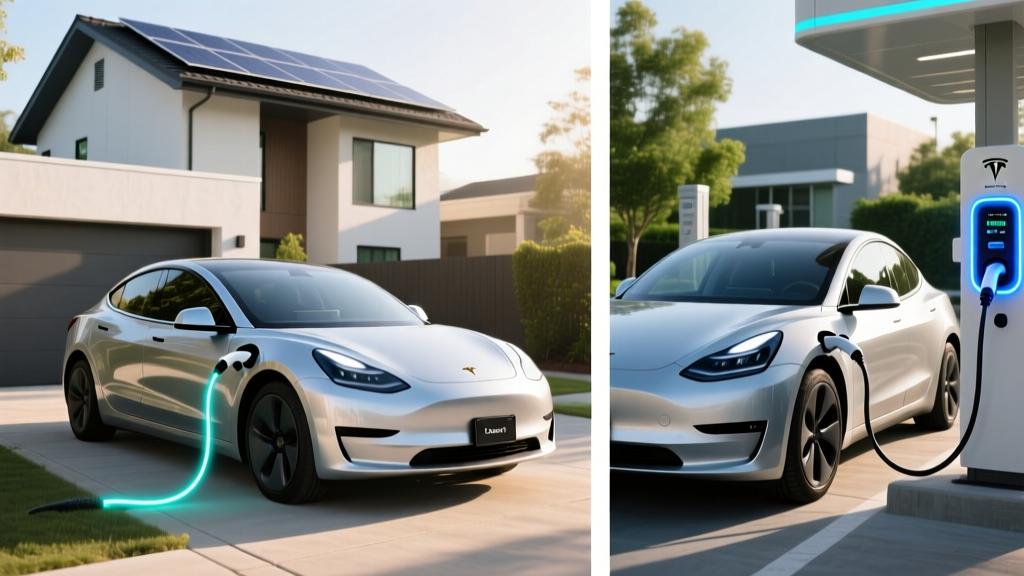
Most Model 3 owners will want a 240V Level 2 home charger — it's the sweet spot for overnight replenishment. A typical commute of 30–40 miles round trip requires only 2–3 hours of Level 2 charging to fully recover, meaning you wake up every morning with a "full tank." But installation isn't as simple as plugging into a wall outlet.
Electrical Requirements for a Model 3 Home Charger
The Tesla Wall Connector (Gen 3) supports up to 48 amps continuous draw, which requires a 60-amp dedicated circuit on a 240V line (NEMA 14-60 or hardwired). National Electrical Code (NEC) requires that continuous loads not exceed 80% of a circuit's rated capacity — hence a 48A charger needs a 60A breaker.
- Ideal setup: 240V / 60A dedicated circuit, hardwired, delivering 48A / 11.5 kW to the car
- Common alternative: 240V / 50A circuit (NEMA 14-50 outlet), delivering 40A / 9.6 kW — still adds ~29 mi/hr
- Budget option: 240V / 30A circuit (NEMA 14-30 or 10-30), delivering 24A / 5.8 kW — adds ~17 mi/hr
Do You Need a Panel Upgrade?
This is the question that separates a $500 installation from a $3,000+ one. Most homes built after 2000 have a 200-amp main electrical panel with enough spare capacity for a 60A EV circuit. Older homes with 100-amp or 150-amp panels, or panels already near capacity (electric range, dryer, HVAC, water heater), may need a panel upgrade to 200A or a smart load-management device like the Span smart panel or Emporia VUE with auto-shedding.
A licensed electrician will perform a load calculation (NEC Article 220) to determine whether your panel can handle the additional draw. Don't skip this step — overloading a panel is a fire hazard and will fail inspection.
| Component | Low-End | Typical | High-End |
|---|---|---|---|
| Level 2 Charger Equipment | $250 | $450 | $650 |
| Electrician Labor (run + mount) | $300 | $750 | $1,500 |
| Permit & Inspection | $50 | $150 | $350 |
| Panel Upgrade (if needed) | $0 | $0 | $2,000–$4,000 |
| Total (no panel upgrade) | $600 | $1,350 | $2,500 |
| Total (with panel upgrade) | $2,600 | $3,500 | $6,500 |
Note: Some utilities offer rebates of $200–$500 for EV charger installation. The federal §30C alternative fuel refueling property credit covers up to 30% of equipment and installation costs (max $1,000) through 2032, subject to census-tract eligibility. Consult a tax professional for your situation.
Connector Compatibility: NACS, CCS, and What Model 3 Owners Need to Know
Tesla vehicles use the North American Charging Standard (NACS) connector — now the dominant EV charging connector in North America. Starting in 2025, most non-Tesla automakers (Ford, GM, Rivian, Hyundai, and others) have adopted NACS as well, which means the Supercharger network is increasingly open to all EVs.
For Model 3 owners, the practical reality is simple: your car has a native NACS port. You plug directly into any Tesla Supercharger or Destination Charger without adapters. For non-Tesla public Level 2 stations with J1772 connectors, Tesla includes a J1772-to-NACS adapter in the glovebox.
| Connector Type | Where You'll Find It | Model 3 Compatible? | Adapter Needed? |
|---|---|---|---|
| NACS (Tesla) | Superchargers, Tesla Destination, many new public stations | ✅ Native | No |
| J1772 (Level 2) | Most public Level 2 (ChargePoint, Blink, workplaces) | ✅ Yes | Included with car |
| CCS1 (DC Fast) | Electrify America, EVgo, some ChargePoint DC | ⚠️ With adapter | Tesla CCS adapter (~$175) or Magic Dock at select EA stations |
| CHAdeMO | Legacy DC stations (declining) | ❌ Not practical | No reliable adapter exists |
Pro tip: If you frequently road-trip through areas with sparse Supercharger coverage, the Tesla CCS1 adapter (available from Tesla's shop) unlocks Electrify America's network as a backup. Set your Model 3's navigation to "include CCS adapters" in charging settings to see both networks in route planning.
Cost to Charge a Model 3: Home vs. Public vs. Gas
One of the strongest ownership arguments for the Model 3 is fuel cost savings — but only if you're charging at home on off-peak electricity rates. Public DC fast charging narrows that gap significantly.
| Scenario | Rate ($/kWh) | Efficiency (kWh/mi) | Cost / Mile | Cost for 341-mi "Fill-Up" |
|---|---|---|---|---|
| Home (off-peak TOU) | $0.10 | 0.27 | $0.027 | $9.21 |
| Home (avg US rate) | $0.17 | 0.27 | $0.046 | $15.69 |
| Public Level 2 (workplace/mall) | $0.25 | 0.27 | $0.068 | $23.19 |
| Tesla Supercharger (avg) | $0.32 | 0.27 | $0.086 | $29.33 |
| Electrify America (DC) | $0.43 | 0.27 | $0.116 | $39.56 |
| Gas car (27 MPG avg, $3.40/gal) | — | — | $0.126 | $42.97 |
Model 3 LR AWD efficiency: ~3.7 mi/kWh (EPA combined), or 0.27 kWh/mi. Highway driving at 75 mph reduces efficiency to ~0.30–0.33 kWh/mi. Source: EPA fueleconomy.gov
The takeaway: home charging on off-peak rates makes the Model 3 roughly 4–5× cheaper per mile than a comparable gas sedan. Even at average residential rates, you're paying less than half. But exclusive Supercharger use — as an apartment dweller might face — erodes savings to near parity with gasoline.
Best Home Chargers for Tesla Model 3: Equipment Picks for 2025–2026
Not all Level 2 chargers are created equal. Here are the top options for Model 3 owners, ranked by real-world utility:
🏆 Tesla Wall Connector (Gen 3)
- Power: Up to 11.5 kW (48A)
- Connector: Native NACS — no adapter
- Cable length: 24 ft
- Smart features: Wi-Fi, OTA updates, power-sharing with 2nd unit, access control
- Price: ~$420
- Best for: Dedicated Tesla households; cleanest integration
ChargePoint Home Flex
- Power: Up to 12 kW (50A), configurable 16–50A
- Connector: NACS or J1772 (select at purchase)
- Cable length: 23 ft
- Smart features: App scheduling, Alexa, flexible amperage to match panel capacity
- Price: ~$550 (NACS version)
- Best for: Multi-EV households (Tesla + non-Tesla)
Emporia Vue Level 2 Charger
- Power: Up to 11.5 kW (48A)
- Connector: NACS or J1772
- Cable length: 24 ft
- Smart features: Energy monitoring integration, solar-aware charging, load management
- Price: ~$400
- Best for: Solar panel owners; budget-conscious smart charging
Grizzl-E Smart
- Power: Up to 10 kW (40A)
- Connector: NACS or J1772
- Cable length: 24 ft
- Smart features: OCPP-compatible, adjustable amperage, extreme-temp rated (-40°F)
- Price: ~$450
- Best for: Cold-climate outdoor installs; built like a tank
What we recommend: If every EV in your garage is a Tesla, the Tesla Wall Connector Gen 3 is the obvious pick — native NACS, fast 48A delivery, and Tesla's best-in-class reliability. If you have (or plan to get) a non-Tesla EV, the ChargePoint Home Flex with its configurable amperage is more versatile and can be dialed down to match a smaller electrical panel.
Safety, Code, and Installation Best Practices
EV charging is a continuous high-amperage load — unlike a dryer that cycles on and off, a charger can run at full draw for 6–8 hours straight. This makes proper installation non-negotiable.
- Dedicated circuit: Your Level 2 charger must be on its own dedicated breaker — never shared with other appliances.
- GFCI protection: NEC 2020+ requires GFCI protection for outdoor receptacles. Hardwired installations (recommended) typically use a GFCI breaker at the panel.
- Outdoor rating: If mounting outside, ensure the charger carries a NEMA 4 or NEMA 4X rating. All four picks above are outdoor-rated.
- Wire gauge: A 60A circuit requires 6 AWG copper wire (or 4 AWG aluminum). Your electrician will size this correctly, but verify on the permit paperwork.
- Permit and inspection: Every jurisdiction requires a permit for new 240V circuits. The inspection ensures your installation meets NEC code and protects your homeowner's insurance coverage. Skipping the permit is never worth the risk.
Frequently Asked Questions
How much does it cost to install a home EV charger for a Tesla Model 3?
Expect $600–$2,500 for a standard installation (equipment + electrician + permit) if your electrical panel has sufficient capacity. If a panel upgrade to 200A is needed, add $2,000–$4,000. The federal §30C credit can offset up to $1,000 (30% of total cost) if you're in an eligible census tract. Check IRS.gov §30C guidelines for current eligibility.
How fast will each charging level add range to my Model 3?
Level 1 (120V): 3–5 miles per hour — adequate only for plug-in hybrids or very low daily mileage. Level 2 (240V / 48A): 30–44 miles per hour — fully replenishes a Model 3 Long Range overnight in ~5–6 hours. DC Fast (Supercharger V3): up to 170 miles in 15 minutes — designed for road trips, not daily use.
Which connector and charger is compatible with my Tesla Model 3?
Your Model 3 has a native NACS port. It plugs directly into Tesla Superchargers, Tesla Destination Chargers, and the growing number of NACS-equipped public stations. For J1772 Level 2 public chargers, use the included adapter. For CCS1 DC fast chargers (Electrify America, EVgo), you'll need Tesla's CCS adapter (~$175) or use Electrify America stations equipped with the built-in "Magic Dock" NACS connector.
How much does charging a Model 3 cost per mile vs. a gas car?
At home on off-peak electricity ($0.10/kWh), a Model 3 Long Range costs roughly $0.027/mile — about 4.6× cheaper than a 27 MPG gas sedan at $3.40/gallon ($0.126/mile). Even at average Supercharger rates ($0.32/kWh), the Model 3 costs $0.086/mile — still 30% less than gasoline. The savings are greatest when you charge at home overnight.
What electrical upgrades might I need for a home charger?
If your home has a 200A panel with spare capacity, you likely only need a new 60A breaker and a wire run to the garage — a straightforward job. If your panel is 100A or already near capacity, you may need a panel upgrade ($2,000–$4,000) or a smart load-management system that temporarily reduces charger power when other appliances draw heavily. Always get a load calculation from a licensed electrician before committing.
Does frequent DC fast charging degrade the Model 3 battery?
Modern Tesla battery thermal management keeps DC fast charging degradation modest. Tesla's battery warranty covers 8 years / 120,000 miles (Long Range) or 100,000 miles (RWD) with a guaranteed minimum 70% capacity retention. Real-world data from high-mileage Teslas shows ~10–12% degradation at 100,000 miles with mixed charging habits. For daily use, home Level 2 charging is gentler on the pack; reserve Supercharging for road trips when possible.
Sources: EPA fueleconomy.gov, Tesla Home Charging, IRS §30C Credit. Prices and rates reflect 2025–2026 data; verify current figures before purchasing.