Why Charging Strategy Matters for Tesla's Longest-Range EVs
If you own or are shopping for the Tesla longest range EV model — currently the 2026 Model S Long Range with an EPA-estimated 402 miles of range and a 100 kWh (usable) battery pack — you've already solved the range equation. But maximizing that advantage requires a charging setup that matches the vehicle's capability. A 402-mile EPA rating shrinks to roughly 320–350 miles in sustained 75 mph highway driving and can dip below 300 miles in sub-freezing temperatures, making efficient, fast home charging and reliable public DC fast-charging access essential.
This guide breaks down exactly how to charge a long-range Tesla (or any NACS-equipped EV) at every level, what it costs to install, and which equipment delivers the best value in 2026.
- EPA sticker: 402 miles
- Highway (70–80 mph, 65°F): ~330–350 miles
- Cold weather (30°F, highway): ~280–310 miles
- Combined mixed driving: ~350–370 miles
Source: EPA / fueleconomy.gov
Understanding Charging Levels: kW, kWh, and Miles Per Hour
Before selecting equipment, the distinction between kW (kilowatts) and kWh (kilowatt-hours) must be clear. kW measures power — the rate at which energy flows into your battery, like water pressure from a hose. kWh measures energy — the total capacity stored, like the size of the tank. A 100 kWh battery charged at 11.5 kW (Level 2) takes roughly 8.7 hours from empty; that same battery at 250 kW (DC fast) can go from 10–80% in about 25–30 minutes.
| Level | Voltage | Max Power (kW) | Miles of Range Added Per Hour | Typical Use Case |
|---|---|---|---|---|
| Level 1 | 120V AC | 1.0–1.4 kW | 3–5 mi/hr | Overnight trickle; emergency top-off |
| Level 2 | 240V AC | 7.2–19.2 kW | 25–70 mi/hr | Daily home & workplace charging |
| DC Fast Charge | 400–800V DC | 50–350 kW | 150–1,000+ mi/hr (peak) | Road trips; rapid top-ups |
For a Tesla Model S Long Range, a Level 2 home charger delivering 11.5 kW (48A) adds approximately 40–44 miles of range per hour — enough to fully replenish a 402-mile battery in about 9–10 hours. At a Tesla V4 Supercharger (up to 250 kW peak for Model S), the 10–80% charge takes roughly 25–30 minutes, though the charge curve tapers significantly above 80% to protect the battery cells.
Home Charger Installation: Electrical Requirements and Costs
Installing a Level 2 home charger is the single highest-impact upgrade for any EV owner. For Tesla's longest-range models, a 240V / 48A dedicated circuit on a 60A breaker is the optimal configuration, matching the Model S's onboard charger capacity of 11.5 kW.
Electrical Requirements
- Circuit: Dedicated 60A double-pole breaker (for 48A continuous charging load; NEC requires 125% overhead)
- Wire gauge: 6 AWG copper (THHN in conduit or NM-B depending on run)
- Panel capacity: Minimum 100A service panel; 200A strongly recommended for homes with EV + electric appliances
- Outlet vs. hardwired: NEMA 14-50 outlet offers portability; hardwired Wall Connector avoids GFCI nuisance tripping (2023+ NEC requires GFCI on receptacles, not hardwired units)
- Permit: Required in most jurisdictions; electrical inspection included
Installation Cost Breakdown
Costs vary dramatically based on panel-to-charger distance, existing panel capacity, and local labor rates. Here is a realistic 2026 range:
| Component | Basic Install (Short run, adequate panel) | Complex Install (Long run, panel upgrade) |
|---|---|---|
| Level 2 Charger (equipment) | $400–$600 | $400–$600 |
| Electrician labor (2–4 hrs basic / 6–12 hrs complex) | $600–$1,200 | $1,800–$3,500 |
| Permit & inspection | $50–$150 | $100–$300 |
| Electrical panel upgrade (if needed, 200A) | $0 | $1,500–$3,500 |
| Conduit, wire, fittings | $100–$300 | $400–$800 |
| Total estimated cost | $1,150–$2,250 | $4,200–$8,700 |
Panel upgrade reality: Homes built before 2000 often have 100A panels. Adding a 60A EV circuit to an already loaded 100A panel may require a service upgrade to 200A, which alone costs $1,500–$3,500. Always have a licensed electrician perform a load calculation before committing to equipment.
Connector Compatibility: NACS, CCS, and Adapters
Tesla's North American Charging Standard (NACS) has become the dominant connector in North America as of 2026, with Ford, GM, Rivian, Volvo, Hyundai, and most other manufacturers adopting it. This means Tesla owners charge natively at home and at the Supercharger network (25,000+ stalls in the US), while non-Tesla NACS vehicles now also access Superchargers.
| Connector | Standard On | Max DC Fast kW | Adapter Needed? |
|---|---|---|---|
| NACS (Tesla) | All Tesla models; Ford, GM, Rivian, Volvo, Hyundai (2025+) | Up to 350 kW (V4 Supercharger) | CCS-to-NACS adapter for non-Tesla DC stations (~$200–$250) |
| CCS1 | Legacy non-Tesla EVs (pre-2025); some 2026 models still in transition | Up to 350 kW | NACS-to-CCS adapter for Supercharger access (~$200) |
| CHAdeMO | Nissan Leaf (discontinued); Mitsubishi Outlander PHEV | Up to 100 kW | Limited adapter options; network shrinking |
For Tesla owners: Your Model S Long Range uses NACS natively. At home, the Tesla Wall Connector ships with NACS. For non-Tesla public DC chargers (Electrify America, EVgo), Tesla sells a CCS Combo 1 adapter (~$250) that plugs into your NACS port. Most Tesla infotainment systems now display CCS-network stations in the native navigation.
Equipment Recommendations: Best Level 2 Chargers for Long-Range Teslas
Not all Level 2 chargers are equal. For a 100 kWh battery, you want maximum amperage (48A), a 24-foot cable for garage flexibility, and smart scheduling for off-peak utility rates.
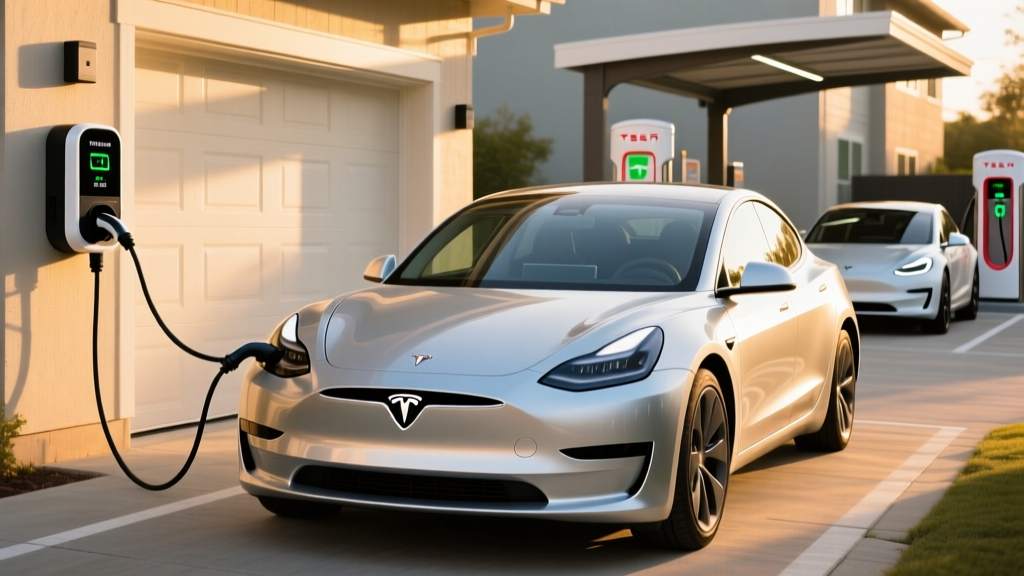
Tesla Wall Connector (Gen 4)
- Power output: 11.5 kW (48A at 240V)
- Connector: NACS native
- Cable length: 24 ft
- Smart features: Wi-Fi, OTA updates, load sharing with second unit, Power-Share for solar integration
- Price: ~$475
- Best for: Tesla-only households; seamless app integration
ChargePoint Home Flex
- Power output: Up to 12 kW (50A at 240V)
- Connector: NACS or J1772 (configurable)
- Cable length: 24 ft
- Smart features: Wi-Fi, Alexa, scheduling, amperage dial adjustable 16–50A
- Price: ~$550–$650
- Best for: Multi-EV households (Tesla + non-Tesla); flexible amperage for older panels
Grizzl-E Smart
- Power output: 10 kW (40A at 240V)
- Connector: J1772 (NACS adapter included)
- Cable length: 24 ft
- Smart features: OCPP-compatible, adjustable amperage, extreme-cold rated (-40°F)
- Price: ~$450–$550
- Best for: Cold-climate garages; budget-conscious buyers
Charging time examples for the Model S Long Range (100 kWh usable):
- Level 1 (120V, 1.2 kW): 10–80% in ~58 hours (emergency only)
- Level 2 (240V, 48A / 11.5 kW): 10–80% in ~6.1 hours
- DC Fast (250 kW Supercharger): 10–80% in ~25–30 minutes (sustained ~170 kW average due to charge curve taper above 50% SoC)
Charging Cost Per Mile: Home vs. Public vs. Gas
One of the strongest economic arguments for a long-range EV is the per-mile energy cost, particularly when charging at home on off-peak utility rates.
| Scenario | Rate | Cost Per Mile (Model S at 3.5 mi/kWh) | Annual Cost (12,000 mi) |
|---|---|---|---|
| Home off-peak (utility TOU rate) | $0.09/kWh | $0.026 | $309 |
| Home standard rate | $0.16/kWh | $0.046 | $549 |
| Public Level 2 (ChargePoint, etc.) | $0.30/kWh | $0.086 | $1,029 |
| DC Fast Charge (Supercharger avg.) | $0.32/kWh | $0.091 | $1,097 |
| Gas vehicle (28 MPG combined, $3.40/gal) | $3.40/gal | $0.121 | $1,457 |
Charging a Model S Long Range at home on off-peak rates costs roughly $0.026 per mile — less than a quarter of the per-mile cost of a 28 MPG gas vehicle. Even at public DC fast-charger rates, the EV saves ~25% per mile over gasoline. For a driver covering 12,000 miles annually, home charging saves approximately $900–$1,150 per year compared to gas.
Utility rate tip: Many utilities offer Time-of-Use (TOU) plans where electricity drops to $0.06–$0.10/kWh between 10 PM and 6 AM. Scheduling your Wall Connector to charge during these windows maximizes savings and reduces grid strain.
Safety, Electrical Code, and Permit Considerations
Level 2 EV charging draws sustained high current for hours — far longer than a dryer or oven cycle. Proper installation is non-negotiable for safety and insurance compliance.
- Dedicated circuit: EV chargers must have their own dedicated breaker — never share with other appliances
- GFCI protection: 2023 NEC (Article 625) requires GFCI on all EV receptacles; hardwired units (like the Wall Connector) are exempt, which is why many electricians recommend hardwiring to avoid nuisance trips
- Outdoor rating: If installing outside, ensure the charger is rated NEMA 3R or 4 (rain and dust resistant); the Tesla Wall Connector and ChargePoint Home Flex both carry outdoor ratings
- Permit & inspection: Required in nearly all US jurisdictions; an unpermitted install may void homeowner's insurance coverage for electrical fires
- Load calculation: A licensed electrician must perform an NEC Article 220 load calculation to confirm your panel can handle the added 60A circuit without overloading the service
Federal Tax Credits and Incentives for Home Charging
The Alternative Fuel Vehicle Refueling Property Credit (IRS §30C) provides up to $1,000 for home EV charger equipment and installation, covering 30% of costs. However, eligibility depends on whether your census tract qualifies as a low-income or non-urban area under the Inflation Reduction Act's targeting rules. Check your eligibility at the IRS §30C page.
Additionally, many utilities and state agencies offer rebates of $200–$500 for Level 2 charger purchases. The Alternative Fuels Data Center maintains a state-by-state incentive database.
- Equipment must be new and installed at your primary residence
- Credit covers 30% of equipment + installation, up to $1,000 maximum
- Your home must be in a qualifying census tract (low-income or non-urban)
- Must be placed in service during the current tax year
- Consult a tax professional — this is non-refundable and cannot exceed your tax liability
Frequently Asked Questions
How much does it cost to install a home EV charger?
A basic Level 2 installation with an adequate 200A panel and a short wire run typically costs $1,150–$2,250 including equipment, electrician labor, and permits. If your home requires a panel upgrade from 100A to 200A, total costs can reach $4,200–$8,700. Always get a load calculation first.
How fast will each charging level add range to a Tesla Model S Long Range?
Level 1 (120V) adds 3–5 miles per hour. Level 2 (240V, 48A) adds approximately 40–44 miles per hour. DC fast charging at a 250 kW Supercharger can add up to 200 miles in about 15 minutes at peak rate, though the charge curve tapers above 50% State of Charge.
Which connector and charger is compatible with my Tesla?
All Tesla vehicles use the NACS connector natively. For home charging, the Tesla Wall Connector is the optimal match. For public charging, Tesla's Supercharger network uses NACS. To charge at non-Tesla DC fast stations (Electrify America, EVgo), you'll need Tesla's CCS Combo 1 adapter (~$250).
How much does charging cost per mile compared to gas?
Home off-peak charging costs approximately $0.026/mile for a Model S Long Range. Standard home rates average $0.046/mile. Public DC fast charging averages $0.091/mile. A comparable 28 MPG gas vehicle costs $0.121/mile at $3.40/gallon. Home charging saves $900–$1,150 annually for a 12,000-mile driver.
What electrical upgrades might I need for a Level 2 charger?
The most common upgrade is a panel service increase from 100A to 200A, required when your existing panel lacks capacity for a dedicated 60A EV circuit. Other potential upgrades include running new conduit from the panel to the garage, upgrading wire to 6 AWG copper, and adding a sub-panel if the charger is far from the main service panel. A licensed electrician will determine requirements during a load calculation.
Does fast charging degrade the Model S battery?
Occasional DC fast charging has minimal impact. Tesla's battery management system actively manages cell temperature and tapers charge rate above 80% State of Charge to reduce stress. Long-term data shows NMC batteries in Teslas retain approximately 88–92% capacity after 100,000 miles. Tesla's battery warranty covers 8 years or 150,000 miles (whichever comes first) with a minimum 70% capacity retention threshold. For daily home charging, setting the charge limit to 80–90% further extends longevity.