If you've invested in a Tesla longer range variant — whether the Model Y Long Range with its EPA-estimated 320 miles or the Model 3 Long Range at 341 miles — your next critical decision is how to keep that large battery charged efficiently at home. A 75 to 82 kWh (usable) battery pack demands a properly spec'd Level 2 charger to wake up to a full charge every morning. Trickle-charging on a standard 120V outlet simply won't cut it when you need the full EPA-rated range available daily.
This guide breaks down exactly what it takes to set up home charging for a Tesla longer range vehicle in 2026: the electrical requirements, real costs, connector standards, equipment picks, and how your per-mile cost compares to gasoline. We'll also cover how to maximize range on public DC fast chargers when road-tripping.
Understanding EV Charging Levels and Real-World Speeds
Before selecting equipment, you need clarity on the three charging levels and what they actually deliver in terms of miles per hour of charging. The distinction between kW (kilowatts — the rate of power delivery) and kWh (kilowatt-hours — the total energy stored in your battery) is foundational. Think of kW as how fast water flows from a hose, and kWh as the size of the bucket you're filling.
| Level | Voltage / Amperage | Max Power (kW) | Miles of Range Added per Hour | Typical Use Case |
|---|---|---|---|---|
| Level 1 | 120V / 12A | ~1.4 kW | 3–5 mi/hr | Overnight top-off, emergencies |
| Level 2 | 240V / 32A–48A | 7.7–11.5 kW | 25–44 mi/hr | Daily home charging (recommended) |
| DC Fast Charging | 400V–800V DC | 50–250+ kW | 150–1,000+ mi/hr (peak) | Road trips, quick top-ups |
Home Charger Installation: Electrical Requirements and Costs
The single biggest variable in home EV charging setup is whether your electrical panel can support a new 240V dedicated circuit. Here's what you need to know before calling an electrician.
Electrical Panel and Circuit Requirements
For a 48-amp Level 2 charger (the sweet spot for Tesla Long Range owners), the National Electrical Code (NEC) requires a dedicated circuit rated at 60 amps — because continuous loads (anything running 3+ hours) can only use 80% of a circuit's rated capacity. That means 48A continuous draw needs a 60A breaker.
Key questions your electrician will assess:
- Panel capacity: Does your main panel have at least 60A of spare capacity? A 200A panel in a home with gas appliances usually has headroom. A 100A panel with electric heat, dryer, and oven likely does not.
- Panel upgrade: If your panel is maxed out, upgrading from 100A to 200A typically costs $1,500–$3,000. In some older homes, a full panel replacement can reach $4,000+.
- Circuit run distance: The farther the charger is from the panel, the heavier the gauge wire needed (6 AWG for 60A up to ~50 feet; 4 AWG or heavier for longer runs), adding material cost.
- Permit requirements: Most jurisdictions require an electrical permit for a new 240V circuit, typically $50–$200. The work must pass inspection.
| Component | Low-End Estimate | High-End Estimate | Notes |
|---|---|---|---|
| Level 2 Charger (hardware) | $350 | $700 | 40A–48A smart charger, NACS connector |
| Electrician labor (install) | $400 | $1,200 | Varies by run distance and wall type |
| Materials (wire, conduit, breaker) | $100 | $400 | Longer runs = more wire cost |
| Electrical permit | $50 | $200 | Varies by municipality |
| Panel upgrade (if needed) | $1,500 | $4,000 | Only if panel lacks capacity |
| Total (no panel upgrade) | $900 | $2,500 | Most homes with 200A panels |
| Total (with panel upgrade) | $2,400 | $6,500 | Older homes with 100A service |
Which Connector Is Compatible With Your Tesla?
As of 2026, the North American Charging Standard (NACS) — originally Tesla's proprietary connector — has become the dominant EV charging connector in North America. If you own a Tesla longer range model, here's your connector landscape:
| Connector Type | Tesla Vehicles | Non-Tesla EVs (Ford, GM, Rivian, etc.) | Legacy EVs (Nissan Leaf, older models) |
|---|---|---|---|
| NACS (Tesla) | Native — no adapter needed | Native on 2025+ models; adapter needed for 2023–2024 | Not compatible |
| CCS1 | Adapter needed (Tesla CCS adapter, ~$175) | Native on most 2019–2024 models | Not compatible |
| CHAdeMO | Not compatible | Not compatible | Native (Nissan Leaf, Mitsubishi) |
| J1772 (Level 2) | Adapter included with vehicle | Native on all non-Tesla EVs | Native |
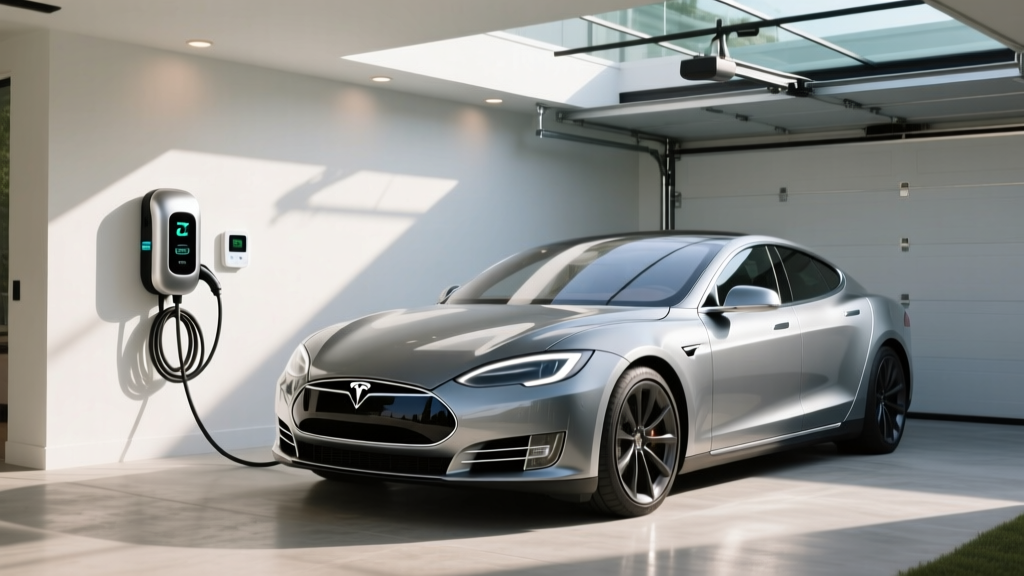
For Tesla Long Range owners: Your vehicle charges natively on NACS at home and at Tesla Superchargers. For Level 2 home charging, you can either install a Tesla Wall Connector (NACS plug) or use a universal J1772 charger with the J1772-to-NACS adapter that ships with your Tesla. At non-Tesla DC fast chargers, the expanding NACS rollout means most new Electrify America and EVgo stations now offer NACS cables alongside CCS1.
Charging Cost Per Mile: Home vs. Public vs. Gasoline
One of the strongest ownership arguments for a Tesla longer range model is the per-mile fueling cost. Let's run real numbers using a Model Y Long Range (approximately 28 kWh per 100 miles, per fueleconomy.gov).
| Charging/Fueling Scenario | Cost per kWh / Gallon | Cost per 100 Miles | Cost per Mile |
|---|---|---|---|
| Home Level 2 (off-peak utility rate) | $0.13/kWh | $3.64 | $0.036 |
| Home Level 2 (national avg residential) | $0.17/kWh | $4.76 | $0.048 |
| Public Level 2 (ChargePoint, EVgo) | $0.25–$0.39/kWh | $7.00–$10.92 | $0.07–$0.11 |
| Tesla Supercharger V3/V4 (DC fast) | $0.28–$0.40/kWh | $7.84–$11.20 | $0.08–$0.11 |
| Non-Tesla DC fast charger | $0.35–$0.55/kWh | $9.80–$15.40 | $0.10–$0.15 |
| Gasoline SUV (25 MPG combined) | $3.40/gallon | $13.60 | $0.136 |
The bottom line: Charging at home on an off-peak utility rate costs roughly $0.04/mile — about one-quarter the cost of gasoline at $3.40/gallon in a comparable 25 MPG SUV. Even at Tesla Supercharger rates ($0.28–$0.40/kWh), you're paying $0.08–$0.11/mile, still below gasoline. The cost advantage only disappears if you rely exclusively on the most expensive public DC fast chargers at $0.55/kWh, which is why home charging is the economic foundation of EV ownership.
Best Level 2 Home Chargers for Tesla Long Range in 2026
For a Tesla Long Range with its 11.5 kW onboard charger, you want a Level 2 unit that delivers at least 48 amps (11.5 kW) to fully utilize the vehicle's charging capacity. Here are top picks based on reliability, smart features, and value.
Tesla Wall Connector (Gen 4)
- Power output: 11.5 kW (48A)
- Connector: NACS native
- Cable length: 24 ft
- Smart features: Wi-Fi, OTA updates, Power Sharing (load-balance multiple units), Tesla app integration
- Price: ~$475
- Best for: Tesla-only households wanting seamless integration
ChargePoint Home Flex
- Power output: Up to 12 kW (50A), configurable 16A–50A
- Connector: J1772 (NACS adapter needed for Tesla) or NACS version available
- Cable length: 23 ft
- Smart features: Wi-Fi, Alexa, scheduling, energy tracking, amperage adjustment
- Price: ~$550–$650
- Best for: Multi-EV households (Tesla + non-Tesla)
Emporia Level 2 EV Charger
- Power output: 11.5 kW (48A)
- Connector: J1772 (NACS adapter needed)
- Cable length: 24 ft
- Smart features: Wi-Fi, solar integration, energy monitoring via Emporia app
- Price: ~$350–$400
- Best for: Budget-conscious owners with solar panels
Grizzl-E Smart
- Power output: 10 kW (40A)
- Connector: J1772 (NACS adapter needed)
- Cable length: 24 ft
- Smart features: Wi-Fi, OCPP protocol, adjustable amperage
- Price: ~$450
- Best for: Extreme cold climates (rated to -40°F), rugged outdoor installs
Our pick for most Tesla Long Range owners: The Tesla Wall Connector at $475 offers native NACS (no adapter fumbling), 48A output matching the car's 11.5 kW onboard charger ceiling, and OTA firmware updates. If you also own or plan to own a non-Tesla EV, the ChargePoint Home Flex with its configurable amperage and available NACS plug provides more flexibility.
DC Fast Charging: Maximizing Speed for Your Tesla Long Range
When road-tripping in a Tesla Long Range, the Supercharger network is your primary DC fast-charging resource. Here's what to expect in real-world conditions:
- Tesla Supercharger V3 (250 kW peak): A Model Y Long Range (~75 kWh usable) will charge from 10% to 80% in approximately 25–28 minutes. Peak rate of 250 kW is only sustained at low states of charge (roughly 5–20%); the charge curve tapers significantly above 50%, dropping to ~60 kW by 80%.
- Tesla Supercharger V4: Newer V4 stalls with integrated CCS/NACS cables offer similar peak speeds but with improved cable management and, at some locations, higher sustained rates.
- Non-Tesla DC fast chargers (350 kW CCS stations): Using a Tesla CCS adapter (~$175), you can access Electrify America or EVgo 350 kW stalls. However, Tesla Long Range models (400V architecture) typically peak around 250 kW regardless of the charger's maximum output. Expect 10–80% in roughly 28–32 minutes.
Safety, Electrical Code, and Installation Best Practices
EV charging is a high-draw, continuous electrical load. Cutting corners on safety creates fire risk. Here's what proper installation looks like:
- Dedicated circuit: Your Level 2 charger must be on its own dedicated circuit — never shared with other appliances.
- GFCI protection: NEC 2020 and later requires GFCI (Ground Fault Circuit Interrupter) protection for all EV charging outlets. Hardwired installations (like the Tesla Wall Connector) typically have GFCI built into the unit. If you install a NEMA 14-50 receptacle instead, your electrician must add a GFCI breaker ($50–$100 more than a standard breaker).
- Outdoor rating: If your charger is installed outside, ensure the unit carries a NEMA 4 (weatherproof) rating. The Tesla Wall Connector and ChargePoint Home Flex are both rated for outdoor use. The receptacle or junction box must also be weather-rated.
- Hardwired vs. plug-in: Hardwired chargers (no plug, direct-wired to the circuit) avoid the NEMA 14-50 receptacle entirely, which eliminates one potential failure point and may not require a GFCI breaker in some jurisdictions (the charger's internal GFCI suffices). Hardwired is generally preferred for 48A+ installations.
- Permit and inspection: Skipping the permit to save $100 is not worth the risk. An unpermitted install can void your homeowner's insurance if an electrical fire occurs, and it will surface during a home sale inspection.
Frequently Asked Questions
How much does it cost to install a home EV charger for a Tesla Long Range?
Expect $900–$2,500 for a complete Level 2 installation (charger + electrician + materials + permit) if your electrical panel has sufficient capacity. If a panel upgrade from 100A to 200A is needed, add $1,500–$4,000. The §30C federal tax credit can offset up to 30% of the cost (max $1,000) if your home is in an eligible census tract.
How fast will Level 2 charging add range to my Tesla Long Range?
At 48 amps / 11.5 kW (the maximum the Tesla onboard charger accepts), you'll add approximately 44 miles of range per hour. A full 10–80% charge takes about 5–6 hours. At 32 amps / 7.7 kW, expect ~30 mi/hr and 7–8 hours for the same session. Level 1 (120V) adds only 3–5 mi/hr — insufficient for daily use on a Long Range battery.
Do I need a special adapter to charge my Tesla at non-Tesla chargers?
Your Tesla ships with a J1772-to-NACS adapter for Level 2 public charging. For DC fast charging at non-Tesla CCS stations, you'll need Tesla's CCS1-to-NACS adapter (sold separately, ~$175). As of 2026, most new public DC fast chargers are adding NACS cables, reducing the need for adapters over time.
How much does charging a Tesla Long Range cost per mile compared to gas?
Home charging at the national average residential rate ($0.17/kWh) costs roughly $0.05/mile. Off-peak utility rates can drop this to $0.03/mile. A comparable gasoline SUV at 25 MPG and $3.40/gallon costs $0.14/mile. Even Tesla Supercharger rates ($0.28–$0.40/kWh) work out to $0.08–$0.11/mile — still below gasoline.
What electrical upgrades might I need for a home charger?
If your home has a 200A electrical panel with gas appliances, you likely have enough spare capacity for a 60A circuit (required for 48A continuous charging). Homes with 100A panels, all-electric appliances, or older wiring may need a panel upgrade ($1,500–$4,000). A licensed electrician can perform a load calculation to determine your panel's available capacity — get this assessment before purchasing a charger.
Should I precondition my Tesla's battery before Supercharging?
Yes. Navigate to a Supercharger using the car's built-in navigation, and the vehicle will automatically precondition (warm or cool) the battery to the optimal temperature for fast charging. Skipping preconditioning — especially in cold weather below 40°F — can reduce peak charge rates by 30–50% and add 10–15 minutes to your charging stop.