Getting the most from your Tesla Long Range miles depends as much on how you charge as on how you drive. A Model Y Long Range carries an EPA-estimated 320 miles of range, while the Model 3 Long Range achieves up to 363 miles on a full charge, according to fueleconomy.gov. But real-world range routinely drops 10–15% at sustained highway speeds and up to 30% in freezing temperatures. Your charging setup—home Level 2, public DC fast charging, and connector compatibility—directly determines whether you recapture those miles efficiently or waste time and money.
This guide breaks down every charging level, home installation costs, connector standards, equipment recommendations, and the per-mile economics of charging versus gasoline, all calibrated for Tesla Long Range owners and anyone driving a NACS-equipped EV in 2026.
Understanding kW vs kWh: The Foundation of EV Charging
Before evaluating chargers, clarify the two units that cause the most confusion:
- kWh (kilowatt-hour) measures energy capacity—how much electricity your battery stores. A Model Y Long Range battery holds approximately 75 kWh of usable energy.
- kW (kilowatt) measures power—the rate at which energy flows into the battery. A 48-amp Level 2 charger delivers up to 11.5 kW; a DC fast charger can deliver 250 kW or more.
Think of kWh as the size of a water tank and kW as the diameter of the hose filling it. Charging time equals battery capacity (kWh) divided by charge rate (kW), adjusted for losses and the charge curve taper above 80% state of charge.
Charging Levels Explained: Speeds, kW Rates, and Miles Per Hour
Every EV owner uses a combination of three charging levels. Here is how each performs on a Tesla Long Range platform with a ~75 kWh battery:
| Level | Voltage / Amperage | Max Power (kW) | Miles Added Per Hour | Typical Use Case |
|---|---|---|---|---|
| Level 1 (120V) | 120V / 12A | ~1.4 kW | 3–5 mi/hr | Emergency / overnight trickle |
| Level 2 (240V) | 240V / 48A | 11.5 kW | 30–44 mi/hr | Daily home charging |
| DC Fast (Supercharger) | 400–800V DC | 250 kW peak | ~200 mi in 15 min | Road trips / rapid top-ups |
A few real-world nuances:
- Level 1 is impractical as a primary strategy. Replenishing a depleted 75 kWh battery at 1.4 kW takes roughly 55+ hours.
- Level 2 at 48A (11.5 kW) fully recharges a Model Y Long Range from 10% to 100% in approximately 7 hours—ideal for overnight recovery.
- DC Fast Charging peaks at 250 kW on Tesla V3/V4 Superchargers but sustains that peak only between roughly 10–30% state of charge. The charge curve tapers significantly above 60%, meaning a 10–80% session takes approximately 25–30 minutes, while 80–100% can take another 20+ minutes.
Model Y Long Range AWD: EPA 320 mi — expect ~270–285 mi at 70 mph highway; ~225–240 mi in sub-freezing weather.
Model 3 Long Range AWD: EPA 363 mi — expect ~305–320 mi at 70 mph highway; ~255–270 mi in sub-freezing weather.
Source: EPA / fueleconomy.gov; real-world estimates based on independent highway and cold-weather testing.
Home Level 2 Charger Installation: Electrical Requirements and Costs
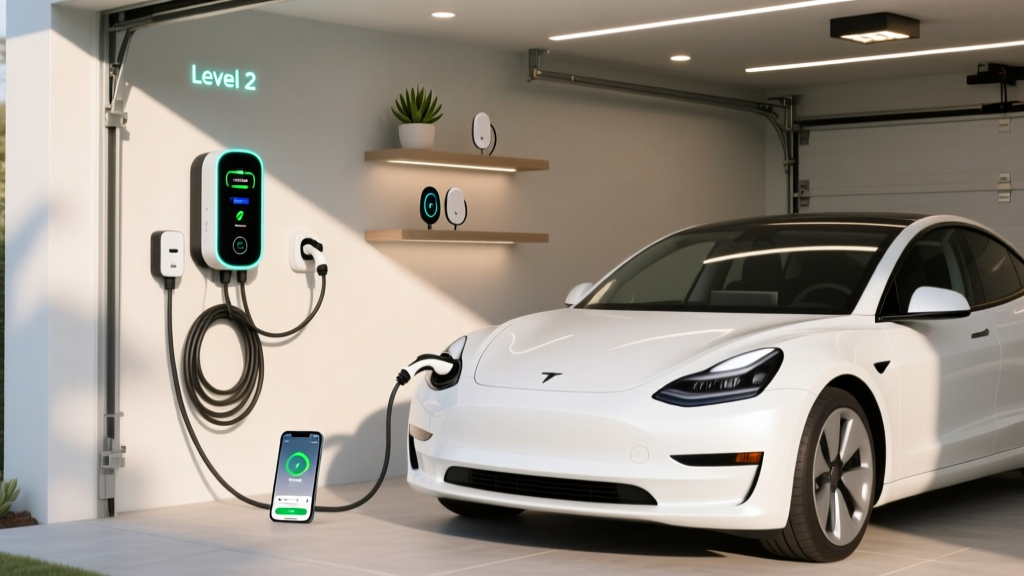
Installing a dedicated Level 2 home charger is the single highest-impact upgrade for daily EV ownership. Here is what the installation entails.
Electrical Requirements
A 48-amp Level 2 charger requires a dedicated 60-amp circuit (National Electrical Code requires continuous loads to use only 80% of circuit capacity, so 48A draw = 60A breaker). The circuit runs from your main electrical panel to a NEMA 14-60 outlet or a hardwired junction box near your parking spot.
- Voltage: 240V split-phase (standard US residential)
- Amperage: 60A breaker for a 48A charger; 50A breaker for a 40A charger
- Wire gauge: 6 AWG copper (THHN in conduit) for 60A; 8 AWG for 50A
- Conduit: Required for exposed runs; type depends on local code
Panel Upgrade Considerations
Many older homes have 100A or 125A main service panels already near capacity. Adding a 60A EV circuit may require:
- A panel upgrade to 200A service: $2,000–$5,000 depending on utility requirements and trenching.
- A load management device (e.g., Emporia Smart Load Management): $300–$500 installed. This throttles charger amperage when household demand spikes, avoiding a panel upgrade.
- A sub-panel near the garage: $500–$1,200 if the main panel is far from the charging location.
Have a licensed electrician perform a load calculation before committing to a circuit size.
Installation Cost Breakdown
| Component | Simple Install (panel nearby) | Complex Install (panel far / upgrade needed) |
|---|---|---|
| Level 2 Charger (hardware) | $400–$700 | $400–$700 |
| Electrician labor (wire run, breaker, outlet/hardwire) | $500–$1,500 | $1,500–$4,000 |
| Permit and inspection | $50–$200 | $50–$200 |
| Panel upgrade (if needed) | $0 | $2,000–$5,000 |
| Conduit / trenching (long runs) | $0–$200 | $500–$2,000 |
| Total Estimated Cost | $950–$2,600 | $4,450–$11,900 |
The IRS Residential Clean Energy Credit (IRC §25D) covers 30% of home charging equipment and installation costs up to $1,000 through 2032. This applies to the charger hardware and electrical work, not a panel upgrade. Confirm eligibility with a tax professional.
Connector Compatibility: NACS, CCS1, and Adapters
The connector landscape shifted dramatically in 2024–2025 when most major automakers adopted the North American Charging Standard (NACS), originally developed by Tesla. Here is the current compatibility matrix:
| Connector | Native Vehicles | Adapter Required? | DC Fast Charger Access |
|---|---|---|---|
| NACS (Tesla) | All Tesla models; 2025+ Ford, GM, Rivian, Volvo, Polestar, others | No for Tesla; CCS-to-NACS adapter for non-Tesla Superchargers | Tesla Supercharger network (25,000+ stalls); third-party NACS stations growing |
| CCS1 | Most pre-2025 non-Tesla EVs (Hyundai, Kia, VW, BMW, etc.) | NACS-to-CCS adapter needed for Tesla Superchargers (Tesla sells official adapter, ~$250) | Electrify America, EVgo, ChargePoint, Ionity |
| CHAdeMO | Nissan Leaf (legacy); being phased out | No direct Tesla adapter available | Limited and shrinking network |
For Tesla Long Range owners: Your vehicle has a native NACS port. You have full access to the Tesla Supercharger network without adapters. If you need to use a CCS-equipped public charger (e.g., Electrify America), Tesla sells a CCS adapter that enables compatibility.
For non-Tesla EVs with NACS ports (2025+ models): You can access Tesla Superchargers with a built-in NACS port, though some Supercharger stalls may have cable lengths optimized for Tesla's charge-port location. Check the Tesla app for station compatibility notes.
Cost to Charge: Per-Mile Economics vs Gasoline
Charging costs vary enormously by location, time of day, and charging level. Here are realistic scenarios for a Tesla Model Y Long Range (approximately 3.5 miles per kWh, or 28 kWh/100 mi):
| Scenario | Rate ($/kWh) | Cost for Full Charge (75 kWh) | Cost Per Mile | Equivalent Gas Price (at 25 MPG) |
|---|---|---|---|---|
| Home off-peak (utility time-of-use) | $0.08–$0.12 | $6.00–$9.00 | $0.023–$0.034 | $0.57–$0.86/gal |
| Home standard rate (national avg) | $0.16 | $12.00 | $0.046 | $1.14/gal |
| Public Level 2 (ChargePoint, etc.) | $0.25–$0.49 | $18.75–$36.75 | $0.071–$0.140 | $1.79–$3.50/gal |
| Tesla Supercharger (avg 2026) | $0.28–$0.36 | $21.00–$27.00 | $0.080–$0.103 | $2.00–$2.57/gal |
| DC Fast (Electrify America peak) | $0.48–$0.58 | $36.00–$43.50 | $0.137–$0.166 | $3.43–$4.14/gal |
Compare this to a gasoline vehicle averaging 25 MPG at $3.50/gallon: $0.14 per mile. Home charging at off-peak rates saves 75–83% per mile. Even Supercharger pricing undercuts gasoline by 25–45%.
Maximize savings: Enroll in your utility's EV time-of-use plan. Most utilities offer super off-peak rates between midnight and 6 AM at $0.06–$0.10/kWh. Schedule charging via the Tesla app to align with these windows.
Recommended Level 2 Home Chargers for Tesla Long Range Owners
These chargers are selected for Tesla NACS compatibility, reliability, smart features, and value. All support the Tesla Mobile Connector's functionality but offer permanent, higher-power wall-mounted solutions.
Tesla Wall Connector (Gen 3)
- Power Output: Up to 11.5 kW (48A at 240V)
- Connector: Native NACS (no adapter needed)
- Cable Length: 24 ft
- Smart Features: Wi-Fi, OTA updates, power sharing between two units, Tesla app integration
- Price: ~$475
- Best For: Tesla-only households seeking seamless integration
ChargePoint Home Flex (NACS)
- Power Output: Up to 12 kW (50A at 240V)
- Connector: NACS (2025+ models); J1772 with adapter for older EVs
- Cable Length: 23 ft
- Smart Features: Wi-Fi, Alexa/Google Home, ChargePoint app scheduling, flexible amperage (16A–50A DIP switch)
- Price: ~$699
- Best For: Multi-EV households with mixed NACS/J1772 vehicles
Emporia Vue Level 2 Charger
- Power Output: Up to 11.5 kW (48A at 240V)
- Connector: J1772 native; NACS adapter included
- Cable Length: 24 ft
- Smart Features: Integrates with Emporia Vue energy monitor, load management, solar-aware charging, app scheduling
- Price: ~$399
- Best For: Solar-equipped homes or budget-conscious buyers
Grizzl-E Smart (NACS Edition)
- Power Output: Up to 10 kW (40A at 240V)
- Connector: NACS (2025+ Smart edition)
- Cable Length: 24 ft
- Smart Features: Wi-Fi, OCPP protocol, adjustable amperage, built in Canada, extreme cold-rated (-40°F)
- Price: ~$549
- Best For: Cold-climate garages and outdoor installations
Charging Time Examples for Tesla Long Range Batteries
Using the ~75 kWh usable battery in the Model Y and Model 3 Long Range, here are charge times for the most common scenarios:
- 10–80% on Tesla V3 Supercharger (250 kW peak): ~25–30 minutes. The charger sustains 200+ kW from 10–30% SoC, then tapers to ~100 kW by 60%, and ~50 kW by 75%. Preconditioning the battery via in-car navigation to a Supercharger is essential for these speeds.
- 10–80% on 48A Level 2 (11.5 kW): ~4.5 hours. This covers approximately 245 miles of recovered range—more than enough for daily driving.
- 20–100% on 48A Level 2 (11.5 kW): ~6.5–7 hours. Schedule to finish at departure time via the Tesla app to minimize time at 100% SoC, which slightly accelerates long-term degradation.
- Overnight recovery (10 hours at 32A / 7.7 kW): ~77 kWh added, or a full charge. Even a 50A circuit (40A continuous, 9.6 kW) fully replenishes the battery in ~8 hours.
Preconditioning matters: On cold mornings, a Tesla battery may accept only 30–50 kW at a Supercharger until the cells warm to ~30°C. Always navigate to a Supercharger via the Tesla app or in-car nav to trigger automatic battery preconditioning 15–25 minutes before arrival. Skipping this step can add 15+ minutes to your charging session.
Safety, Electrical Code, and Installation Best Practices
EV charging draws sustained high current for hours—a load profile most household circuits never experience. Follow these requirements:
- Dedicated circuit: Your Level 2 charger must have its own dedicated breaker. Never share a circuit with other appliances.
- GFCI protection: NEC 2020 and later require GFCI protection for outdoor receptacles used for EV charging. Hardwired chargers (no plug) typically do not require GFCI breakers, which saves $50–$100 on the breaker cost.
- Outdoor rating: If installing outside, use a NEMA 3R-rated enclosure or a charger rated for outdoor use (IP55 or higher). The Tesla Wall Connector and Grizzl-E are both outdoor-rated.
- Permit and inspection: Most jurisdictions require an electrical permit for a new 240V circuit. The inspection verifies wire gauge, breaker sizing, grounding, and conduit. Budget $50–$200 and 1–3 weeks for this process.
- Cable management: Install a cable holster or retractor to prevent tripping hazards and cable damage. Avoid running cables across driveways or sidewalks.
Frequently Asked Questions
How much does it cost to install a home EV charger for a Tesla Long Range?
A straightforward installation with the electrical panel near the garage costs $950–$2,600 total (charger + electrician + permit). Complex installations requiring long wire runs, sub-panels, or a 200A service upgrade can reach $4,500–$12,000. The federal Residential Clean Energy Credit (IRC §25D) covers 30% of equipment and installation up to $1,000 through 2032.
How fast will each charging level add range to my Tesla Long Range?
Level 1 (120V) adds 3–5 miles per hour—unsuitable as a primary strategy. Level 2 (240V, 48A) adds 30–44 miles per hour, fully recharging overnight. DC Fast Charging at a Tesla V3 Supercharger adds approximately 200 miles in 15 minutes, though the rate tapers significantly above 60% SoC.
Which connector and charger is compatible with my Tesla?
All Tesla vehicles use the native NACS connector. The Tesla Wall Connector (Gen 3) is the simplest match, requiring no adapter. For multi-EV households, the ChargePoint Home Flex with a NACS plug or the Emporia Vue with an included NACS adapter provides cross-compatibility. Tesla also sells a CCS adapter (~$250) for accessing non-Tesla DC fast chargers.
How much does charging cost per mile compared to gasoline?
Home charging at off-peak utility rates costs $0.023–$0.034 per mile for a Model Y Long Range—roughly equivalent to $0.57–$0.86 per gallon of gasoline. Supercharger pricing averages $0.080–$0.103 per mile. A comparable gasoline vehicle at 25 MPG and $3.50/gallon costs $0.14 per mile. Home charging saves 75–83% per mile.
What electrical upgrades might I need for a Level 2 charger?
You need a dedicated 60A breaker and 240V circuit for a 48A charger. If your main panel is 100A or 125A and near capacity, you may need a panel upgrade to 200A ($2,000–$5,000) or a smart load management device ($300–$500 installed) that dynamically adjusts charger amperage. Long wire runs from the panel to the garage may require conduit, trenching, or a sub-panel, adding $500–$2,000. A licensed electrician's load calculation determines your exact requirements.
Does charging to 100% every night damage the Tesla Long Range battery?
Tesla Long Range vehicles use NMC (nickel manganese cobalt) battery chemistry, which degrades slightly faster when held at 100% SoC for extended periods. Tesla recommends setting the daily charge limit to 80–90% and charging to 100% only before road trips. The 8-year/120,000-mile battery warranty guarantees at least 70% capacity retention, but keeping SoC between 20–80% for daily use maximizes long-term battery health.