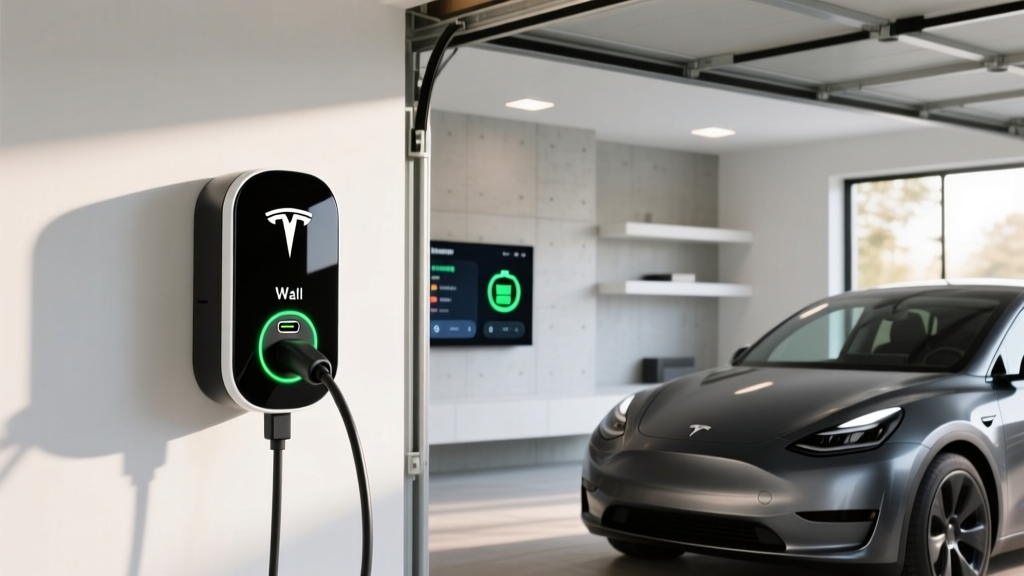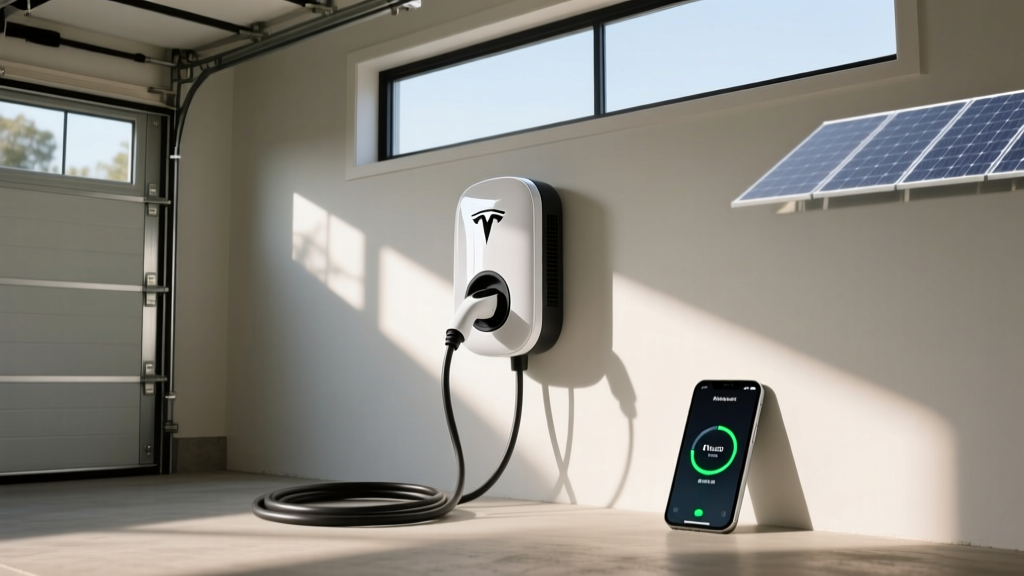
If you own a Tesla or any vehicle with a North American Charging Standard (NACS) port, the Tesla house charger — officially the Tesla Wall Connector — is usually the fastest, most cost-effective way to keep your battery topped up. But installation costs, electrical panel limits, and the 2026 wave of NACS-equipped non-Tesla EVs mean the decision isn't as simple as clicking "buy" on Tesla's website. This guide breaks down the exact numbers on cost, speed, and compatibility so you can spec the right setup for your home.
Tesla Wall Connector: Specs at a Glance
The Tesla Wall Connector (Gen 3) remains the company's flagship home unit. Here is what you are actually getting:
- Max power output: 11.5 kW (48 amps on a 60-amp dedicated circuit)
- Alternate config: 9.6 kW (40A on a 50A circuit) — common for older panels
- Connector: NACS (native Tesla); J1772 adapter available separately (~$150–$250)
- Cable length: 24 feet standard
- Wi-Fi: Yes — enables OTA updates, power sharing, and energy tracking
- Indoor/outdoor: Rated for both (NEMA 3R outdoor rating)
- Price: ~$420 (hardware only, before install)
- Warranty: 4 years
At 11.5 kW, a typical EV adds roughly 35–44 miles of range per hour of charging — enough to fully replenish a Tesla Model Y Long Range (75 kWh usable) from 10% to 80% in about 4.5–5 hours overnight.
How Fast Will Each Charging Level Add Range?
Before committing to a Tesla house charger, understand where Level 2 fits in the broader charging ecosystem. Power is measured in kW (kilowatts), while battery capacity is measured in kWh (kilowatt-hours) — a critical distinction. Think of kW as how fast water flows from a hose, and kWh as how big the bucket is.
| Level | Voltage | Typical Power (kW) | Miles of Range / Hour | Use Case |
|---|---|---|---|---|
| Level 1 | 120V (standard outlet) | 1.2–1.9 kW | 3–5 mi/hr | Emergency, PHEVs, low daily mileage |
| Level 2 (Home/Public) | 240V (dryer-style) | 3.3–19.2 kW | 12–70 mi/hr | Daily home charging, overnight top-ups |
| DC Fast Charging | 400–800V DC | 50–350 kW | 150–1,200 mi/hr | Road trips, rapid replenishment |
Real-world context: A Tesla Model 3 Long Range (75 kWh battery) charging at the Wall Connector's full 11.5 kW will recover about 44 miles per hour. But DC fast charging isn't linear — peak 250 kW at a Supercharger only sustains from roughly 10–30% state of charge before tapering. A 10–80% Supercharger session takes ~25–30 minutes, while the home Wall Connector does the same in ~4.5 hours, which is fine when you're sleeping.
How Much Does It Cost to Install a Tesla House Charger?
The hardware is the cheap part. Installation is where costs diverge wildly depending on your home's electrical panel, distance from panel to garage, and local permit fees. Here is the realistic 2026 breakdown:
| Component | Low-End | High-End | Notes |
|---|---|---|---|
| Wall Connector hardware | $420 | $420 | Fixed Tesla retail price |
| Electrician labor (standard install) | $400 | $1,200 | Depends on run length, wall type, conduit |
| Electrical permit | $50 | $250 | Varies by municipality |
| Panel upgrade (if needed) | $1,500 | $4,000+ | 100A → 200A service; homes built pre-1990 most at risk |
| Additional wiring/conduit (long runs) | $200 | $800 | If panel is far from garage or outdoors |
| Total (no panel upgrade) | $870 | $1,870 | Typical for modern 200A-panel homes |
| Total (with panel upgrade) | $2,370 | $5,870+ | Older homes, high-load households |
What Electrical Upgrades Might I Need?
The Wall Connector at full 11.5 kW draws 48 amps, which requires a 60-amp dedicated breaker (NEC code mandates circuits be rated at 125% of continuous load). If your home has a 100-amp main panel already running electric heat, a dryer, an oven, and A/C, you may not have headroom for another 60A circuit. Signs you'll need an upgrade:
- Main panel is 100A or less (common in homes built before 1990)
- Panel has fewer than 4 open breaker slots
- You already have multiple high-draw 240V appliances
- Your electrician flags a load calculation over 80% of panel capacity
Cost-saving workaround: You can configure the Wall Connector to draw 40A (on a 50A breaker) or even 32A (on a 40A breaker). At 9.6 kW / 40A, you still add ~37 miles per hour — more than enough for overnight charging on most daily commutes. This can avoid a panel upgrade entirely.
Which Connector Is Compatible with My EV?
The NACS connector (native Tesla plug) became the de facto North American standard after Ford, GM, Rivian, Hyundai, and most other automakers adopted it for 2025–2026 model-year vehicles. But not every EV on the road today has one natively.
| Connector | Brands Using It (2026) | Works with Tesla Wall Connector? |
|---|---|---|
| NACS (Tesla) | Tesla (all), Ford (2025+), GM (2025+), Rivian, Hyundai/Kia (2026+), Volvo, Polestar | Yes — native fit |
| CCS1 | Older Ford/GM/Hyundai/VW models (pre-NACS transition), BMW iX/i4, some legacy EVs | Requires NACS-to-CCS adapter (~$150–$250) |
| CHAdeMO | Nissan Leaf (discontinued), Mitsubishi Outlander PHEV (older) | No — adapter not widely available; use a J1772 charger instead |
| J1772 (Level 2 universal) | All non-Tesla EVs pre-2025 | Yes — with Tesla J1772 Wall Connector variant or adapter |
Key takeaway: If you drive a Tesla or any 2025+ NACS-equipped EV, the Tesla Wall Connector plugs in natively. If you have a CCS1 vehicle, Tesla sells a Universal Wall Connector with an integrated J1772 adapter (~$550), or you can use a third-party NACS-to-CCS adapter. For mixed-EV households, the Universal Wall Connector is the pragmatic choice.
Best Home EV Chargers: Tesla Wall Connector vs. Alternatives
The Tesla Wall Connector is excellent but not the only option. Here is how it stacks up against top competitors for 2026:
Tesla Wall Connector (Gen 3)
- Power: 11.5 kW / 48A max
- Connector: NACS native
- Cable: 24 ft
- Smart features: Wi-Fi, OTA updates, power sharing (link 2+ units on one circuit), energy monitoring via Tesla app
- Price: ~$420
- Best for: Tesla owners, NACS-adopters, multi-Tesla households (power sharing is unique)
ChargePoint Home Flex (NACS version)
- Power: Up to 12 kW / 50A (adjustable via DIP switches down to 16A)
- Connector: NACS or J1772 (choose at purchase)
- Cable: 24 ft
- Smart features: Wi-Fi, Alexa, ChargePoint app with scheduling & cost tracking, works with utility demand-response programs
- Price: ~$550–$650
- Best for: Mixed-fleet homes, utility-program participants, those wanting granular amperage control
Emporia Vue EV Charger
- Power: 11.5 kW / 48A
- Connector: J1772 (NACS adapter included in 2026 bundle)
- Cable: 24 ft
- Smart features: Wi-Fi, integrates with Emporia whole-home energy monitor, solar-aware scheduling
- Price: ~$399
- Best for: Budget-conscious buyers, solar-panel owners wanting integrated energy management
How Much Does Charging Cost per Mile vs. Gas?
Home charging is where EVs deliver their biggest economic advantage. But costs vary depending on your electricity rate, time-of-use plan, and whether you charge at home or on the road.
| Scenario | Rate / Price | Cost per Mile (3.5 mi/kWh EV) | Annual Cost (12,000 mi) |
|---|---|---|---|
| Home charging (national avg. electricity) | $0.17/kWh | $0.049/mi | $588 |
| Home charging (off-peak / time-of-use) | $0.09/kWh | $0.026/mi | $312 |
| Public Level 2 (ChargePoint, EVgo L2) | $0.30–$0.45/kWh | $0.086–$0.129/mi | $1,032–$1,548 |
| DC Fast Charging (Supercharger / Electrify America) | $0.35–$0.55/kWh | $0.100–$0.157/mi | $1,200–$1,884 |
| Gas vehicle (27 MPG combined, $3.40/gal) | $3.40/gal | $0.126/mi | $1,512 |
The math: A Tesla Model Y averaging 3.5 miles per kWh (≈ 28 kWh/100 mi, per fueleconomy.gov) charged at home off-peak saves roughly $1,200 per year vs. a 27 MPG gas car. Even at national average electricity rates, home charging cuts fuel cost by about 60%. Public DC fast charging, however, narrows the gap significantly — and in some markets exceeds gas cost per mile.
Tax credit note: The federal Alternative Fuel Vehicle Refueling Property Credit (IRS Form 8911) covers 30% of home charger hardware and installation costs up to $1,000, subject to census-tract eligibility. Check your zip code against the IRS eligibility map before filing — not all areas qualify in 2026.
Charging Time Examples for Common EV Battery Sizes
Here is how long a 10–80% charge takes on the Tesla Wall Connector at 11.5 kW for popular 2026 models. Note: EVs slow charging above 80% to protect battery health — the charge curve tapers significantly, which is why most owners set a daily charge limit to 80% and only charge to 100% before road trips.
| Vehicle | Usable Battery (kWh) | Energy Needed (10–80%) | Time at 11.5 kW | EPA Range (80% SoC) |
|---|---|---|---|---|
| Tesla Model 3 Long Range | 75 kWh | 52.5 kWh | ~4.6 hours | ~275 mi |
| Tesla Model Y Long Range | 75 kWh | 52.5 kWh | ~4.6 hours | ~256 mi |
| Ford F-150 Lightning (Extended) | 131 kWh | 91.7 kWh | ~8.0 hours | ~256 mi |
| Hyundai Ioniq 5 (Long Range AWD) | 84 kWh | 58.8 kWh | ~5.1 hours | ~250 mi |
| Chevrolet Equinox EV (RS) | 85 kWh | 59.5 kWh | ~5.2 hours | ~256 mi |
Cold-weather caveat: In sub-freezing temperatures, expect 15–30% longer charge times and reduced range. Lithium-ion batteries resist accepting charge when cold. The Tesla Wall Connector and Tesla vehicles handle this well via automatic battery preconditioning when a charge session is scheduled through the app — but non-Tesla EVs on a Tesla Wall Connector won't benefit from Tesla's preconditioning logic. Always schedule charging and enable preconditioning in your vehicle's app for best cold-weather results.
Safety, Code & Installation Best Practices
A Level 2 charger is a high-draw, continuous-load appliance running for hours at a time. Cutting corners on installation is a fire and insurance risk. Here is what the National Electrical Code (NEC) and best practice demand:
- Dedicated circuit: The Wall Connector must have its own breaker — not shared with other appliances. A 60A breaker for 48A charging, or 50A breaker for 40A charging.
- GFCI protection: NEC 2020 and later requires GFCI protection for all EV charging outlets. Hardwired Wall Connector installations typically satisfy this via the breaker; plug-in (NEMA 14-50) setups need a GFCI breaker (~$50–$100 more).
- Outdoor rating: The Wall Connector carries a NEMA 3R rating (rain and sleet resistant), suitable for outdoor mounting. However, the connection point and any junction boxes must also be weather-rated.
- Wire gauge: 60A circuits require 4 AWG copper wire; 50A circuits need 6 AWG. Your electrician will calculate this based on run length — longer runs may need thicker wire to prevent voltage drop.
- Permit & inspection: Most jurisdictions require an electrical permit and post-installation inspection. Skipping this can void homeowner's insurance coverage for any related electrical fire.
- Hardwired vs. plug-in: The Wall Connector supports both. Hardwired is preferred for 48A/60A installs (more reliable, no plug wear). Plug-in (NEMA 14-50) offers portability but is limited to 40A continuous per NEC.
Panel-load gotcha: Some homeowners assume a 200A panel can handle a 60A EV circuit. But NEC load calculations consider the total continuous and non-continuous loads. If your panel is already at 75%+ capacity, the inspector may require a panel upgrade or a load-management device (like the Tesla Gateway or a third-party load shedder) that throttles the charger when other appliances kick on.
Frequently Asked Questions
Can I use a Tesla Wall Connector to charge a non-Tesla EV?
Yes — if your non-Tesla EV has a NACS port (most 2025+ Ford, GM, Rivian, and 2026+ Hyundai/Kia models do). For CCS1 vehicles, you'll need a NACS-to-CCS adapter or the Tesla Universal Wall Connector with its built-in J1772 adapter. CHAdeMO vehicles (older Nissan Leaf) are not compatible without a specialized adapter that is difficult to source.
Is the Tesla Wall Connector worth it over cheaper Level 2 chargers?
For Tesla and NACS-equipped vehicles, yes — at $420 with 11.5 kW output and power-sharing capability, it offers the best price-to-performance ratio. For non-NACS vehicles or households wanting utility demand-response integration, the ChargePoint Home Flex or Emporia Vue may offer more flexibility. The Tesla unit's main limitation is its closed ecosystem for energy monitoring (Tesla app only).
Will a Tesla house charger qualify for a tax credit?
The federal Alternative Fuel Vehicle Refueling Property Credit (IRS Form 8911) covers 30% of the hardware and installation cost, up to $1,000, for chargers installed in eligible census tracts. This is separate from the §30D vehicle purchase credit. Check the IRS eligibility tool for your zip code — many suburban and rural tracts qualify, but some urban areas do not. State and utility rebates may stack on top; check your local utility's EV program page.
How long does a Tesla Wall Connector last?
Tesla warranties the Wall Connector for 4 years. In practice, these units commonly last 8–12+ years. The main wear item is the cable and connector plug — keep the connector holstered when not in use and avoid letting the cable sit in standing water. Firmware updates via Wi-Fi keep the unit current with Tesla's evolving charging protocols.
Do I need a 200-amp electrical panel to install a Tesla Wall Connector?
Not necessarily. A 200A panel makes a 60A/48A charger install straightforward. A 100A or 150A panel can still support a Wall Connector configured at a lower amperage (32A or 24A on a 40A or 30A breaker), which adds 23–29 miles of range per hour — still adequate for most daily driving. Your electrician should perform a NEC Article 220 load calculation to determine your available headroom.
Should I charge to 100% every night?
No. For daily driving, Tesla and most EV manufacturers recommend setting a charge limit of 80% to minimize long-term battery degradation. Reserve 100% charges for road trips when you need maximum range. This is especially important for NMC battery chemistries; LFP batteries (used in some Tesla Model 3 RWD variants) tolerate regular 100% charges better — check your specific vehicle's battery type in the Tesla app.