What Does a Tesla Charging Station at Home Actually Cost?
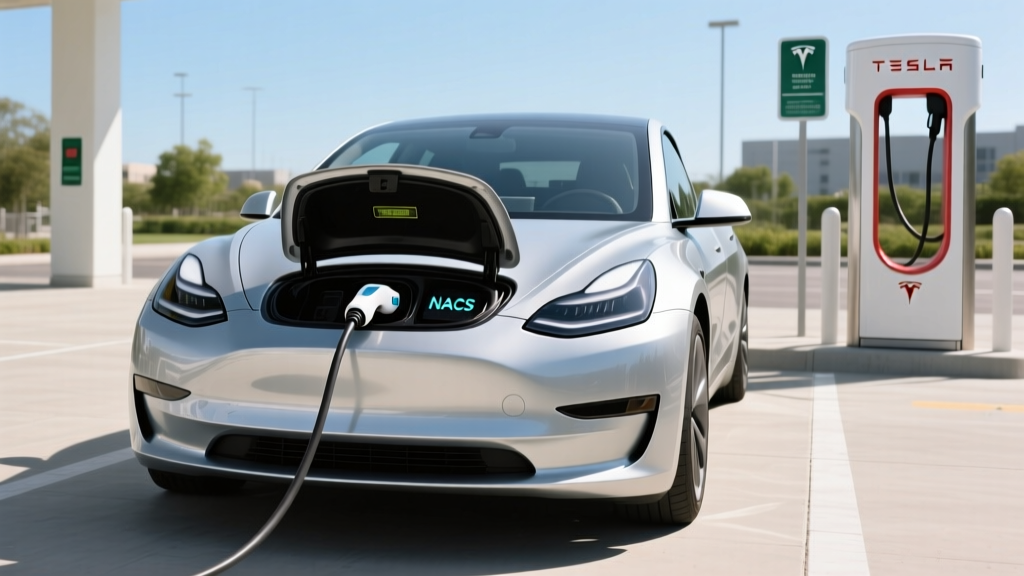
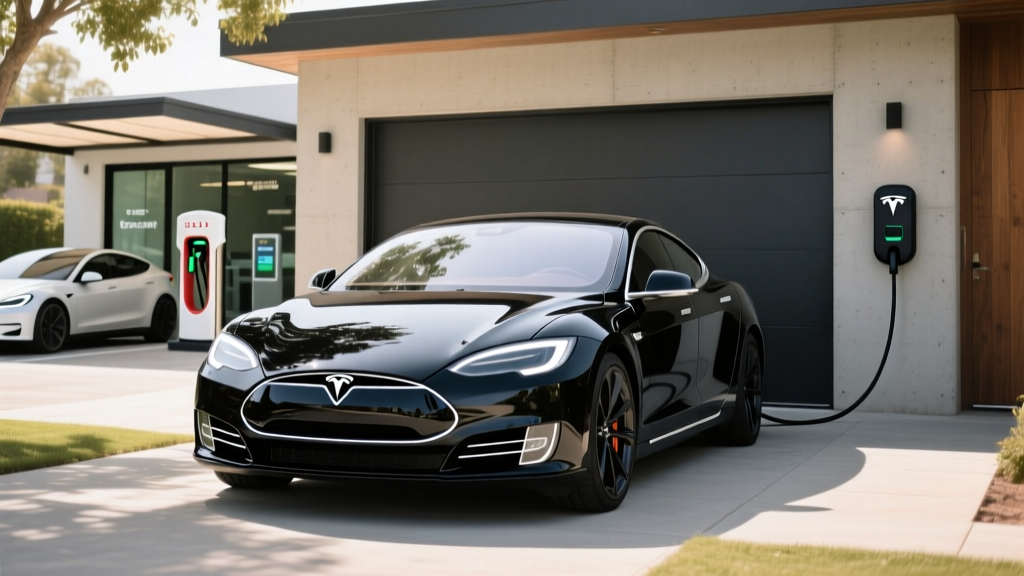
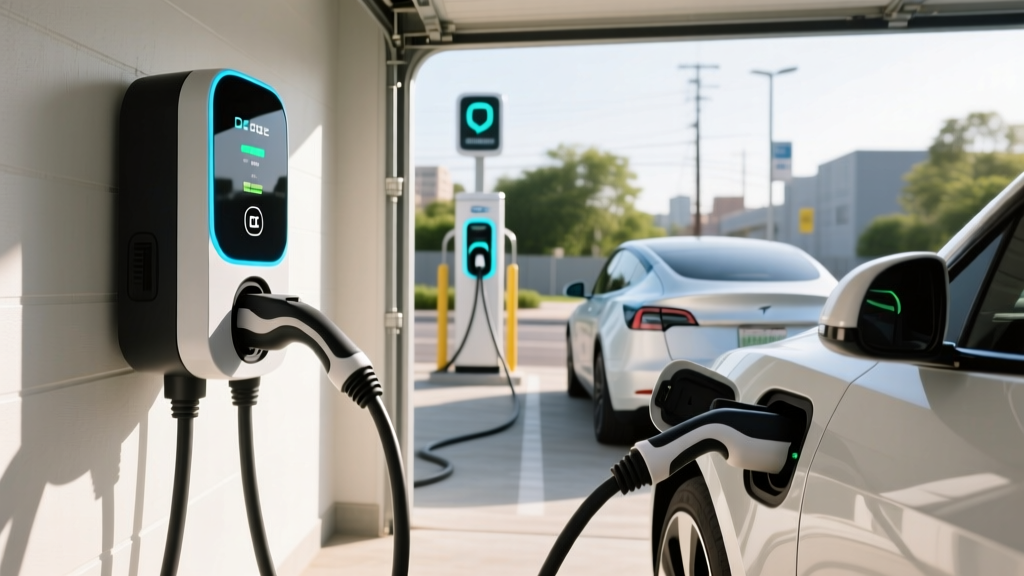
If you own a Tesla or any newer EV equipped with the North American Charging Standard (NACS) port, setting up dedicated Level 2 charging at home is the single highest-impact ownership decision you can make. But the Tesla charging station at home cost varies widely — from under $500 for a simple plug-in setup to over $3,000 if your home's electrical panel needs an upgrade.
This guide breaks down every line item: the charger hardware, the electrician's labor, the permit fees, and the panel-upgrade scenarios that catch many buyers off guard. We'll also compare the Tesla Wall Connector against the best third-party NACS chargers available in 2026, and show you exactly how fast each option will replenish your battery.
Charging Levels Explained: Speed, Power, and Range Added Per Hour
Before evaluating hardware, you need to understand the three charging tiers available to EV owners and what each delivers in practical terms.
| Level | Voltage / Amps | Max Power (kW) | Miles of Range Per Hour | Typical Use |
|---|---|---|---|---|
| Level 1 | 120V / 12A | 1.4 kW | 3–5 mi/hr | Emergency / overnight trickle |
| Level 2 | 240V / 32–48A | 7.7–11.5 kW | 25–44 mi/hr | Daily home charging |
| DC Fast Charging | 400–800V DC | 50–250+ kW | 150–1,000+ mi/hr | Road trips, public stations |
For most Tesla owners, Level 2 at home is the primary charging method. A 48-amp, 11.5 kW Wall Connector can add roughly 44 miles of range per hour of charging to a Model 3 or Model Y — enough to go from 20% to 80% in approximately 4–5 hours. Level 1 is only viable as a backup or for PHEVs with small batteries.
DC fast charging (Tesla Superchargers, Electrify America, EVgo) is not installable at home — it requires commercial-grade power delivery. But it's critical for road trips. A Model 3 Long Range at a V3 Supercharger peaks at 250 kW and reaches 10–80% in roughly 25–30 minutes, though the charge curve tapers significantly above 80% SoC to protect battery health.
Tesla Wall Connector vs. Third-Party NACS Chargers: Equipment Costs and Features
Tesla opened the NACS connector specification to other manufacturers, and by 2026, the entire North American EV market has standardized on it. That means you're not locked into Tesla-branded hardware — several excellent third-party NACS chargers compete directly with the Wall Connector.
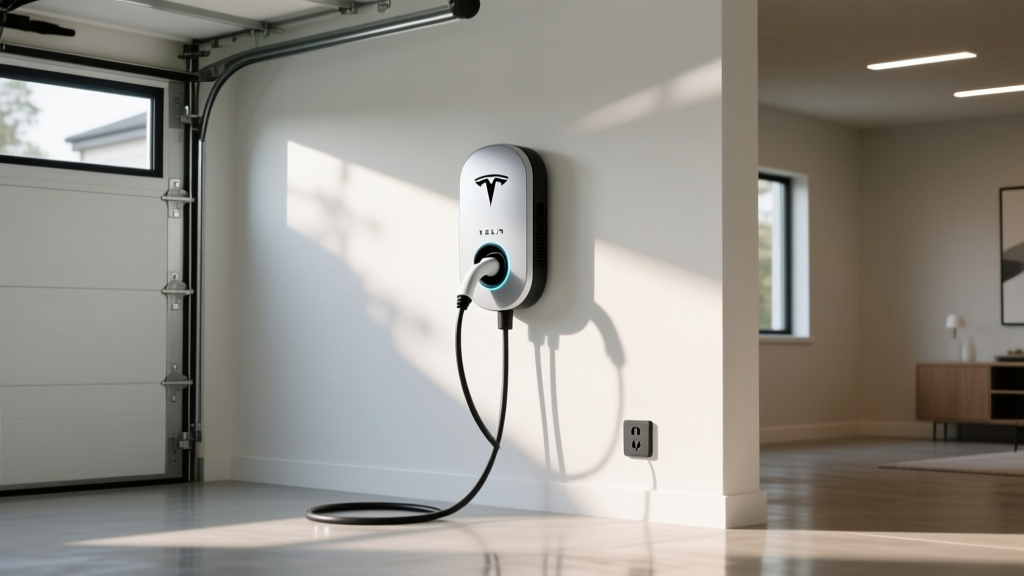
Tesla Wall Connector
- Max output: 11.5 kW (48A)
- Connector: NACS (native)
- Cable length: 24 ft
- Smart features: Wi-Fi, OTA updates, Tesla app integration, Power Sharing (link up to 6 units on one circuit)
- Indoor/outdoor: NEMA 4 rated (outdoor-safe)
- Price: ~$475
- Warranty: 4 years
ChargePoint Home Flex (NACS)
- Max output: 12 kW (50A)
- Connector: NACS (2025+ models)
- Cable length: 23 ft
- Smart features: Wi-Fi, Alexa, ChargePoint app, scheduling, energy tracking
- Indoor/outdoor: NEMA 4 rated
- Price: ~$550
- Warranty: 3 years
Emporia Vue Level 2 (NACS)
- Max output: 11.5 kW (48A)
- Connector: NACS
- Cable length: 24 ft
- Smart features: Wi-Fi, energy monitoring, solar integration, load management
- Indoor/outdoor: NEMA 4 rated
- Price: ~$400
- Warranty: 3 years
Our take: The Tesla Wall Connector remains the best value for Tesla-specific owners at $475 — its Power Sharing feature is uniquely useful if you plan to charge two EVs on a single 60A circuit. If you drive a non-Tesla NACS vehicle (Ford F-150 Lightning, Hyundai Ioniq 5 with NACS adapter, Rivian R1T), the ChargePoint Home Flex or Emporia offer broader app ecosystems and energy monitoring. All three deliver enough power to fully utilize the onboard chargers of most consumer EVs (which typically accept 7.7–11.5 kW AC).
Home Installation Cost Breakdown: Electrician, Permits, and Panel Upgrades
The hardware is only part of the Tesla charging station at home cost. Professional installation by a licensed electrician is where expenses vary most — and where older homes can face surprise charges.
| Line Item | Simple Install | Moderate Install | Complex Install (Panel Upgrade) |
|---|---|---|---|
| Charger hardware | $400–$550 | $400–$550 | $400–$550 |
| Electrician labor (2–8 hrs @ $75–$150/hr) | $150–$400 | $400–$800 | $800–$1,500 |
| Wiring & conduit (50A/60A circuit) | $50–$150 | $150–$500 | $300–$800 |
| Electrical permit | $50–$150 | $50–$200 | $100–$300 |
| Panel upgrade (100A → 200A) | N/A | N/A | $1,500–$3,500 |
| Total Estimated Cost | $650–$1,250 | $1,000–$2,050 | $3,100–$6,650 |
When You'll Need a Panel Upgrade
A Level 2 charger on a 60A breaker (supporting 48A continuous draw) adds significant load to your home's electrical system. Here's the threshold question: if your home has a 100-amp service panel and you're already running central AC, an electric dryer, and an electric oven, you almost certainly need a 200-amp upgrade to safely add EV charging.
Homes built after 2000 typically have 200-amp panels with enough spare capacity for a Level 2 circuit. Homes built before 1990 frequently have 100-amp or even 60-amp panels that cannot accommodate the additional load. Your electrician will perform a load calculation (per NEC Article 220) to determine whether your existing panel has sufficient headroom.
Cost-saving alternative: If a panel upgrade is prohibitively expensive, you can install the Wall Connector on a 30A or 40A circuit instead of 60A. This limits output to 5.8 kW or 7.7 kW respectively — slower, but still delivers 22–30 miles of range per hour, which covers most daily driving needs. An energy management system like the Emporia Vue with smart load monitoring can also dynamically reduce charging amperage when other appliances are running, avoiding the need for a panel upgrade in some cases.
Connector Compatibility: NACS, CCS, and Adapter Requirements
As of 2026, the NACS connector (originally Tesla's proprietary design) has become the dominant North American charging standard. Here's where each vehicle brand stands:
| Vehicle Brand | Native Connector | Adapter Needed for NACS Charger? | Notes |
|---|---|---|---|
| Tesla (all models) | NACS | No | Direct plug-in |
| Ford (2025+ EVs) | NACS | No | F-150 Lightning, Mustang Mach-E updated |
| Rivian (2025+) | NACS | No | R1T, R1S updated |
| Hyundai/Kia (2025+) | NACS | No (new models) | Older CCS models need CCS-to-NACS adapter (~$200) |
| GM (2025+) | NACS | No (new models) | Bolt EUV, Blazer EV, Silverado EV |
| Older CCS vehicles (pre-2025) | CCS1 | Yes — NACS-to-CCS adapter | Lectron, A2Z adapters ~$150–$250; verify kW rating |
Bottom line: If you're installing a home charger in 2026, buy a NACS-native unit. Even if your current EV uses CCS, the market has moved decisively to NACS, and a NACS charger with an adapter will cover both. The reverse — a CCS charger with a NACS adapter — is less common and limits future flexibility.
Cost to Charge: Home Electricity vs. Gas Per Mile
One of the strongest financial arguments for home EV charging is the per-mile fuel cost advantage. Here's how it breaks down across common scenarios, using a Tesla Model Y Long Range (averaging 3.5 miles per kWh) as our baseline:
| Scenario | Rate | Cost per kWh | Cost per Mile | Annual Cost (12,000 mi) |
|---|---|---|---|---|
| Home off-peak (utility TOU rate) | Overnight | $0.08–$0.14 | $0.023–$0.040 | $275–$480 |
| Home standard rate | Anytime | $0.13–$0.22 | $0.037–$0.063 | $445–$755 |
| Public Level 2 (ChargePoint, EVgo) | Varies | $0.25–$0.49 | $0.071–$0.140 | $855–$1,680 |
| DC Fast Charging (Supercharger, EA) | On-demand | $0.28–$0.52 | $0.080–$0.149 | $960–$1,785 |
| Gasoline (25 MPG combined, $3.40/gal) | — | $3.40/gallon | $0.136 | $1,632 |
The verdict: Charging at home on an off-peak rate saves roughly $1,150–$1,350 per year compared to a 25 MPG gas vehicle. Even on a standard residential rate, you'll save $875–$1,190 annually. At those savings, a $1,500 home charger installation pays for itself in 13–16 months. Public DC fast charging is comparable to gas in cost — it's a convenience, not a savings strategy.
To maximize savings, check whether your utility offers a time-of-use (TOU) plan with reduced overnight rates. Many utilities offer rates as low as $0.05–$0.08/kWh between 10 PM and 6 AM. The Tesla app and all major smart chargers let you schedule charging to begin during these off-peak windows automatically.
Charging Time Examples: How Long to Reach 80% at Home
Real-world charging times depend on your battery size, the charger's amperage, and the vehicle's onboard charger capacity. Here's what to expect with common Tesla models on a 48-amp (11.5 kW) Wall Connector:
- Tesla Model 3 RWD (57.5 kWh usable): 10–80% in approximately 4.5 hours. Full 0–100% in roughly 6.5 hours (tapers significantly above 90%).
- Tesla Model Y Long Range (~75 kWh usable): 10–80% in approximately 5.5 hours. Full 0–100% in roughly 8 hours.
- Tesla Model S (100 kWh usable): 10–80% in approximately 7 hours. Full 0–100% in roughly 10.5 hours.
On a reduced 32-amp circuit (7.7 kW), add roughly 40–50% to these times. For most owners who charge overnight (8–10 hours available), even a 32-amp circuit will replenish a Model 3 or Model Y from 10% to 100% by morning.
Safety, Electrical Code, and Permit Requirements
Any hardwired Level 2 charger installation requires a dedicated circuit protected by a correctly sized breaker. For a 48-amp continuous load, the National Electrical Code (NEC) requires a 60-amp breaker (continuous loads cannot exceed 80% of breaker rating: 48A ÷ 0.80 = 60A).
Key code and safety requirements your electrician will follow:
- Dedicated circuit: The EV charger must have its own breaker — it cannot share a circuit with other appliances.
- Wire gauge: A 60A circuit requires 6 AWG copper wire (or 4 AWG aluminum) for typical residential runs. Longer runs (>100 ft from panel) may require upsizing to compensate for voltage drop.
- GFCI protection: NEC 2020 (Article 625.54) requires GFCI protection for all EV charging outlets rated 150V to ground or less and 50A or less. Hardwired installations may be exempt in some jurisdictions — confirm with your local inspector.
- Outdoor rating: If mounting outside, the charger must carry a NEMA 4 or NEMA 4X rating (all recommended units above meet this). Outdoor conduit must be rated for wet locations.
- Permit: Nearly all US jurisdictions require an electrical permit for a new 240V circuit. Permit fees typically range from $50 to $300 depending on locality. Skipping the permit risks insurance claim denial if a fire originates from the circuit.
Do not DIY this installation. A 240V/60A circuit carries enough current to be lethal and enough energy to cause a house fire if wired incorrectly. Always use a licensed electrician and pull the required permit. According to the NHTSA and NFPA data, properly permitted and inspected EV charging installations have an excellent safety record.
Federal and State Incentives for Home Charger Installation
The federal Alternative Fuel Vehicle Refueling Property Credit (IRS §30C) covers 30% of home EV charger hardware and installation costs, up to a maximum of $1,000 per year. However, this credit has significant restrictions:
- The home must be located in a qualified low-income or non-urban census tract — many suburban and urban addresses do not qualify.
- The credit applies to both the charger hardware and installation labor.
- You claim it on IRS Form 8911 with your annual tax return.
- It is non-refundable — you must have sufficient tax liability to benefit.
Check your census tract eligibility using the IRS eligibility tool before counting on this credit in your budget.
Additionally, many utilities and states offer their own rebates. For example, some utility companies offer $250–$500 rebates for installing a smart Level 2 charger on a time-of-use rate plan. Check your local utility's EV program page for current offers.
Frequently Asked Questions
How much does it cost to install a Tesla home charger?
Expect to pay $650–$1,250 for a straightforward installation (short wire run, sufficient panel capacity). If you need a panel upgrade from 100A to 200A, the total can reach $3,100–$6,650. The Tesla Wall Connector itself costs approximately $475.
Can I install a Tesla Wall Connector myself?
Tesla sells a plug-in version with a NEMA 14-50 connector that you can plug into an existing 240V/50A outlet (like a dryer outlet). If that outlet already exists and is on a properly sized circuit, you can use it without an electrician. However, installing a new 240V circuit or hardwiring the unit requires a licensed electrician and a permit in virtually all US jurisdictions.
Will a Tesla Wall Connector work with non-Tesla EVs?
Yes. The Wall Connector uses the NACS connector, which is now the North American standard. Any vehicle with a native NACS port (Ford, Rivian, GM, Hyundai/Kia 2025+ models) can plug in directly. Older CCS vehicles will need a NACS-to-CCS adapter (approximately $150–$250).
How fast does a Tesla Wall Connector charge compared to a Supercharger?
A Wall Connector delivers up to 11.5 kW (AC), adding roughly 44 miles of range per hour. A V3 Supercharger delivers up to 250 kW (DC), adding roughly 1,000 miles per hour at peak. However, home charging is designed for overnight convenience — you wake up to a full battery every morning without detouring to a station. Superchargers are for road trips.
Do I need to upgrade my electrical panel for a Tesla charger?
You'll need a panel upgrade if your home has a 100-amp (or smaller) service and you're already using significant electrical loads (central AC, electric dryer, electric oven). Homes with 200-amp panels built after 2000 usually have sufficient capacity. Your electrician will perform a NEC Article 220 load calculation to determine this definitively.
What's the cheapest way to charge a Tesla at home?
Enroll in your utility's time-of-use (TOU) plan and schedule charging between 10 PM and 6 AM when rates are lowest ($0.05–$0.14/kWh in most markets). Use the Tesla app to set a charging schedule. This can reduce your annual fuel cost to under $400 for 12,000 miles of driving.