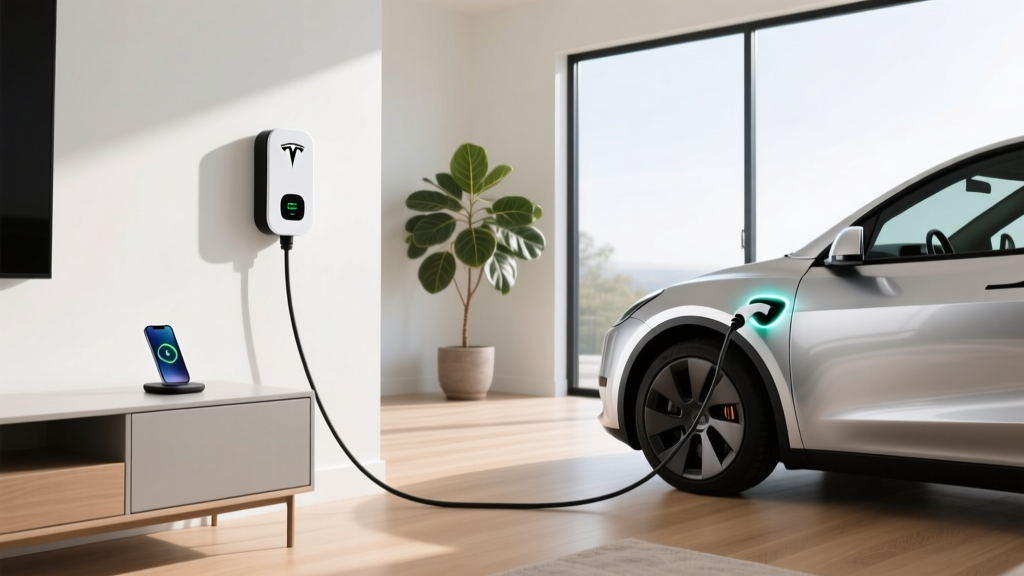
If you've ever dropped your phone onto the wireless phone charger Tesla includes in the Model 3 or Model Y center console, you know the convenience of cord-free power. But when new Tesla owners search for a "wireless EV charger" for their garage, they hit a wall of confusion. Inductive vehicle charging exists in limited commercial fleet applications, but for 2026 Tesla owners, plugging in remains the only way to charge at home. This guide cuts through the noise and gives you exact specs, costs, and equipment picks for setting up Tesla home charging — from the 120V Mobile Connector fallback to a hardwired 48-amp Wall Connector.
The Wireless Phone Charger Tesla Offers vs. Actual Vehicle Charging
Tesla's Qi-based wireless phone charging pad (standard in current Model 3 Highland, Model Y Juniper, Cybertruck, and refreshed Model S/X) delivers up to 15W to a compatible smartphone. That's 0.015 kW — enough to top off a phone battery in roughly two hours. A Tesla Model Y Long Range has a 75 kWh usable battery pack. Charging that battery wirelessly at 15W would take approximately 5,000 hours, or about 208 days of continuous charging.
The physics are unforgiving: wireless power transfer loses 15-30% of energy as heat, and scaling inductive charging to the 11-19 kW needed for practical home EV charging requires precisely aligned coils, active cooling, and ground-clearance modifications that no production Tesla supports. Companies like WiTricity have demonstrated 11 kW inductive charging prototypes, and the SAE J2954 standard exists, but no consumer vehicle sold in the US in 2026 offers factory wireless vehicle charging.
Charging Levels Explained: Speeds, Power, and Range Added Per Hour
EV charging is measured in kilowatts (kW), which represents the rate of power delivery. The energy stored in your battery is measured in kilowatt-hours (kWh). Think of kW as the speed of water flowing through a hose, and kWh as the total gallons in the tank. Here's what each level delivers for Tesla vehicles:
| Level | Voltage / Amps | Max Power (kW) | Miles of Range Per Hour | 10–80% Time (75 kWh Battery) |
|---|---|---|---|---|
| Level 1 (120V) | 120V / 12A | 1.4 kW | 3–5 mi/hr | ~37 hours |
| Level 2 (240V) | 240V / 32–48A | 7.7–11.5 kW | 25–44 mi/hr | 5–7 hours |
| DC Fast Charging | 400V+ / up to 615A | Up to 250 kW (V3 Supercharger) | Up to 1,000+ mi/hr (peak) | ~25–30 minutes |
For daily driving, Level 2 at home is the practical standard. A Tesla Model Y Long Range (EPA 320 miles, real-world highway expect ~270–290 miles) driven 40 miles per day needs roughly 10 kWh replenished overnight — easily handled by even a 7.7 kW Level 2 charger in under two hours.
How Much Does It Cost to Install a Home EV Charger?
Installation costs vary widely depending on your electrical panel's capacity, the distance from panel to charger location, and local permit fees. Here's a realistic breakdown for a Tesla Wall Connector installation in 2026:
| Component | Simple Install (Panel Nearby) | Complex Install (Long Run / Panel Upgrade) |
|---|---|---|
| Tesla Wall Connector (48A, hardwired) | $475 | $475 |
| Electrician labor (licensed) | $300–$600 | $800–$2,000 |
| Materials (conduit, wire, breaker) | $50–$150 | $200–$600 |
| Permit and inspection | $50–$200 | $100–$300 |
| Electrical panel upgrade (100A → 200A, if needed) | N/A | $1,500–$3,500 |
| Total Range | $875–$1,425 | $3,075–$6,875 |
The panel upgrade gotcha: Homes built before 1990 often have 100-amp service. A 48-amp EV charger draws 60 amps of breaker capacity (NEC requires circuits rated at 125% of continuous load). If your panel is already near capacity with HVAC, electric range, and dryer loads, you may need a 200-amp upgrade. Get a load calculation from a licensed electrician before purchasing equipment.
Some utilities offer rebates of $250–$500 for Level 2 installations, and the federal Alternative Fuel Vehicle Refueling Property Credit (IRS Form 8911) covers up to 30% of home charging equipment and installation costs (capped at $1,000), subject to census-tract eligibility. Check your specific location on the IRS site.
Connector Compatibility: NACS, CCS, and What Fits Your Tesla
Tesla uses the North American Charging Standard (NACS) connector — now adopted as the industry standard by Ford, GM, Rivian, Hyundai, and most major automakers through 2025–2026. Here's how connector compatibility breaks down:
| Connector | Vehicles | Tesla Compatibility | Adapter Needed? |
|---|---|---|---|
| NACS (Tesla) | All Teslas, Ford F-150 Lightning, GM Ultium vehicles, Rivian (2025+) | Native — no adapter | None for home or Superchargers |
| CCS1 | Hyundai Ioniq 5/6, VW ID.4, BMW iX, older Ford/GM EVs | Tesla can use CCS stations with adapter | Tesla CCS Adapter (~$175) |
| CHAdeMO | Nissan Leaf (legacy) | Not compatible | No adapter available for Tesla |
| J1772 (Level 2) | All non-Tesla EVs for AC charging | Tesla includes J1772-to-NACS adapter | Included with vehicle |
For home charging, the Tesla Wall Connector ships with a native NACS plug — plug directly into any Tesla without adapters. If you install a third-party J1772 charger (ChargePoint, Emporia, etc.), use the J1772 adapter that Tesla includes in the glovebox of every new vehicle.
Equipment Picks: Best Home Chargers for Tesla in 2026
Tesla Wall Connector (Best Overall)
- Power: Up to 11.5 kW (48A on 60A circuit)
- Connector: NACS native, 24-ft cable
- Smart features: Wi-Fi, OTA updates, Power Sharing (link multiple units on one circuit), Tesla app integration, access control
- Price: $475
- Best for: Tesla-only households wanting maximum charge speed and ecosystem integration
ChargePoint Home Flex (Best Multi-Vehicle)
- Power: Up to 12 kW (50A, configurable 16–50A)
- Connector: J1772 (use Tesla adapter) or NACS version available
- Smart features: Wi-Fi, Alexa, ChargePoint app, scheduling, energy tracking
- Price: $549–$649
- Best for: Mixed-EV households (Tesla + non-Tesla) or those wanting detailed energy reporting
Emporia Vue Level 2 Charger (Best Value)
- Power: Up to 11.5 kW (48A)
- Connector: J1772 or NACS
- Smart features: Wi-Fi, solar integration, load management, Emporia app
- Price: $349–$399
- Best for: Budget-conscious buyers or homes with solar panels wanting EV + energy monitoring
Tesla Mobile Connector (Best Backup)
- Power: 1.4 kW (120V) or up to 7.2 kW (240V NEMA 14-50)
- Connector: NACS with interchangeable plugs
- Smart features: None (dumb charger, no app)
- Price: $200 (included adapters: NEMA 5-15, NEMA 14-50 sold separately at $45)
- Best for: Low-mileage drivers, renters, or travel backup
Cost to Charge: Per-Mile Electricity vs. Gasoline
Electricity costs vary dramatically by location, time of use, and charging method. Here's how the economics stack up for a Tesla Model Y Long Range (efficiency: 28 kWh/100 miles, per fueleconomy.gov):
| Charging Scenario | Rate ($/kWh) | Cost per 100 Miles | Cost per Mile |
|---|---|---|---|
| Home off-peak (utility TOU rate) | $0.08–$0.12 | $2.24–$3.36 | $0.022–$0.034 |
| Home standard rate (national avg) | $0.16 | $4.48 | $0.045 |
| Tesla Supercharger (avg 2026) | $0.28–$0.36 | $7.84–$10.08 | $0.078–$0.101 |
| Third-party DC fast (Electrify America, EVgo) | $0.35–$0.55 | $9.80–$15.40 | $0.098–$0.154 |
| Gasoline baseline (28 MPG vehicle, $3.40/gal) | $3.40/gallon | $12.14 | $0.121 |
Home off-peak charging delivers fuel costs roughly 75–85% lower than a comparable gasoline vehicle. Even Supercharging at peak rates undercuts gasoline per mile in most US markets. The key: set your Tesla to charge during off-peak utility hours (typically 10 PM – 6 AM) using the Scheduled Charging feature in the vehicle or Tesla app.
Electrical Requirements and Safety: What Your Installer Needs to Know
A proper Level 2 installation isn't just plugging into a dryer outlet. Here's what the National Electrical Code (NEC) requires and what a reputable electrician will address:
- Dedicated circuit: Your EV charger must be on its own dedicated breaker — no sharing with other appliances. A 48A Wall Connector requires a 60A breaker (NEC 125% rule for continuous loads exceeding 3 hours).
- Wire gauge: 60A circuits require 6 AWG copper wire (THHN in conduit) or 4 AWG for longer runs to minimize voltage drop. Runs over 100 feet may need 4 AWG even on shorter-rated circuits.
- GFCI protection: NEC 2020 and later require GFCI protection for all EV charging outlets. Hardwired installations (like the Wall Connector) are exempt from the GFCI breaker requirement in most jurisdictions, which is one reason hardwired is preferred — it avoids nuisance tripping and saves $80–$150 on a GFCI breaker.
- Outdoor rating: If mounting outside, the Wall Connector is rated NEMA 3R (rain and sleet resistant). Ensure the conduit entry point is sealed, and use a weatherproof junction box if the run transitions from interior to exterior.
- Permit and inspection: Nearly all jurisdictions require a permit for new 240V circuits. Inspections verify wire gauge, breaker sizing, grounding, and torque specs. Skipping the permit risks insurance claim denial in the event of an electrical fire.
Panel capacity check: Before scheduling installation, locate your main breaker amperage (usually printed on the main breaker: 100A, 150A, or 200A). If you have a 200A panel with significant headroom, a 60A EV circuit is straightforward. If you're on 100A service, ask your electrician for a load calculation — this formal assessment determines whether your panel can handle the additional draw or requires an upgrade.
Frequently Asked Questions
Can I use the Tesla Mobile Connector on a standard 120V outlet?
Yes. The Mobile Connector with the included NEMA 5-15 adapter plugs into any standard household outlet and delivers 1.4 kW (about 3–5 miles of range per hour). For a Tesla Model Y, that's roughly 35–50 miles of range overnight. It's viable for low-mileage drivers (under 20 miles/day) but impractical as a primary charging solution for most owners.
Will a Tesla Wall Connector work with non-Tesla EVs?
Starting in 2024, Tesla introduced a Universal Wall Connector with a built-in J1772 adapter, allowing any EV to charge. The standard Wall Connector ships with a NACS plug only. If your household has mixed EVs, the Universal version ($599) or a third-party J1772 charger with Tesla's included adapter are both viable options.
How fast does a Tesla charge on a NEMA 14-50 outlet vs. hardwired?
A NEMA 14-50 outlet is rated for 50A continuous, but the Mobile Connector limits draw to 32A (7.7 kW) for safety, yielding about 30 miles of range per hour on a Model Y. The hardwired Wall Connector at 48A (11.5 kW) delivers roughly 44 miles per hour — about 50% faster. Hardwired also avoids the $100–$150 cost of a quality 14-50 receptacle and eliminates the risk of outlet overheating during extended charging sessions.
Does Tesla's battery preconditioning affect home charging?
Preconditioning (warming the battery to optimal temperature) primarily impacts DC fast charging speeds in cold weather. For Level 2 home charging, preconditioning has minimal effect on charge speed because AC charging rates are limited by the onboard charger (11.5 kW max), not battery temperature. However, preconditioning via the Tesla app before departure does warm the cabin and battery, improving efficiency and regenerative braking performance on cold mornings.
Is there a federal tax credit for home charger installation?
Yes. The Alternative Fuel Vehicle Refueling Property Credit (Form 8911) provides up to 30% of the cost of home charging equipment and installation, capped at $1,000. Eligibility depends on your home being located in a qualifying census tract (not designated as non-attainment for air quality and meeting certain urban/rural criteria). Consult a tax professional to confirm eligibility for your specific address.