The Real Cost of Charging a Tesla at Home
If you own or are considering a Tesla Model 3, Model Y, Model S, or Model X, one of the first ownership questions is straightforward: how much does charging a Tesla cost at home? The answer depends on your local electricity rate, the charging equipment you install, and your utility's time-of-use pricing. For most US households, home charging a Tesla costs between $0.03 and $0.06 per mile — roughly one-third to one-quarter the per-mile fuel cost of a comparable gasoline sedan.
But that per-mile figure only tells part of the story. To get a complete picture, you need to understand the three charging levels, what a Level 2 home installation actually costs (including potential panel upgrades), which equipment to buy, and how home charging compares to public DC fast charging and gasoline on a dollars-per-mile basis. This guide covers all of it with exact numbers for the current Tesla lineup.
kW (kilowatts) measures power — how fast energy flows into your car, like water pressure from a hose. kWh (kilowatt-hours) measures energy — the total amount stored in your battery, like gallons in a tank. Your electricity bill charges you per kWh consumed. Your charger's speed is rated in kW. Never confuse the two.
Charging Levels Explained: Speed, Power, and Range Added
Every Tesla sold today supports three charging tiers. Understanding the kW output and real-world miles-per-hour added at each level is essential for planning your home setup and road trips.
| Level | Voltage | Max Power (kW) | Miles of Range per Hour | Typical Use Case |
|---|---|---|---|---|
| Level 1 | 120V AC | 1.0–1.4 kW | 3–5 mi/hr | Emergency / overnight trickle |
| Level 2 | 240V AC | 7.2–19.2 kW | 25–55 mi/hr | Home daily charging |
| DC Fast Charge | 400V+ DC | 150–250 kW (peak) | ~1,000+ mi/hr (peak) | Road trips / Superchargers |
Level 1 uses a standard 120V household outlet and the Mobile Connector included with your Tesla. At ~1.2 kW, it adds roughly 3–5 miles of range per hour. Charging a Model Y Long Range (75 kWh usable battery, EPA-estimated 310 miles) from 10% to 80% would take approximately 45 hours — impractical for daily use but adequate for plug-in hybrids or as a backup.
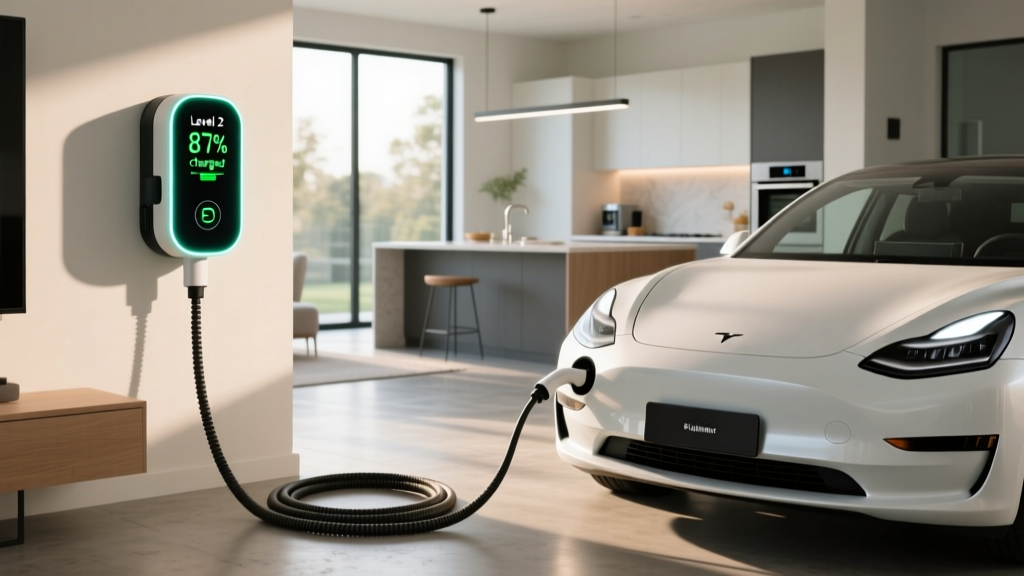
Level 2 is the home-charging standard. A 240V circuit delivering 48 amps (11.5 kW) can fully replenish a Tesla Model 3 Long Range overnight. Tesla's Wall Connector at 48A adds roughly 44 miles of range per hour to a Model Y. A 10–80% charge on a 75 kWh battery takes approximately 5–6 hours at this rate.
DC Fast Charging at Tesla Superchargers delivers direct current at up to 250 kW (V3 stalls) or 350 kW (V4 stalls). A Model 3 Long Range can accept a peak of ~250 kW, adding up to 200 miles in roughly 15 minutes under ideal conditions. However, the charge curve tapers significantly above 80% State of Charge (SoC) — expect the final 80–100% to take nearly as long as the initial 10–80%.
How Much Does Charging a Tesla Cost at Home? Per-kWh and Per-Mile Math
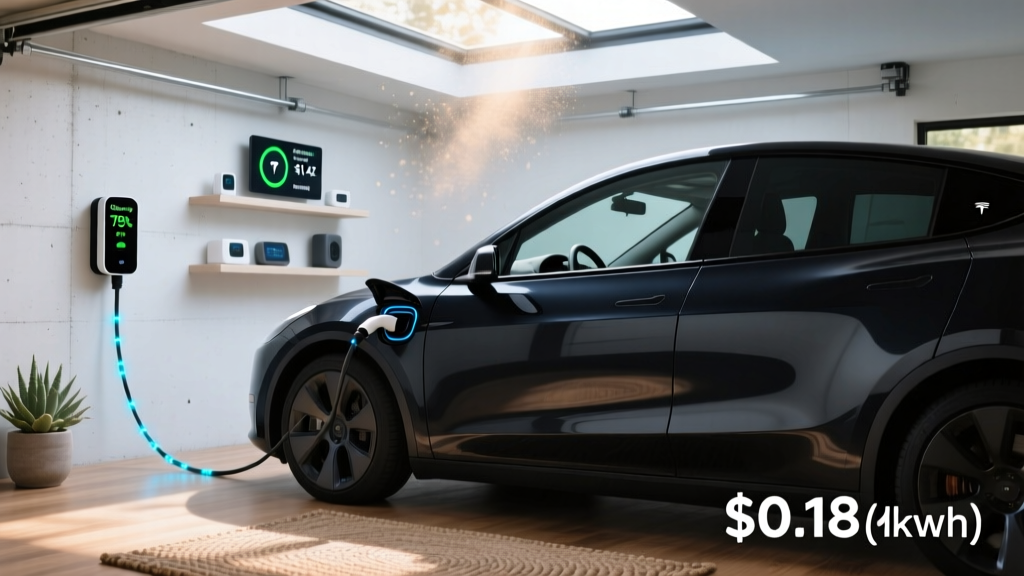
Your actual cost depends on your utility's rate structure. The US average residential electricity rate in early 2026 sits around $0.16/kWh according to EIA data, but rates vary enormously — from under $0.10/kWh in parts of the Pacific Northwest and Southeast to over $0.30/kWh in California and Hawaii.
| Scenario | Rate ($/kWh) | Vehicle Efficiency (kWh/mi) | Cost per Mile | Cost for 1,000 mi |
|---|---|---|---|---|
| Home off-peak (TOU plan) | $0.10 | 0.27 (Model 3 LR) | $0.027 | $27.00 |
| Home standard rate | $0.16 | 0.27 (Model 3 LR) | $0.043 | $43.20 |
| Home high-cost state | $0.28 | 0.27 (Model 3 LR) | $0.076 | $75.60 |
| Public Level 2 (network) | $0.35 | 0.27 (Model 3 LR) | $0.095 | $94.50 |
| Supercharger V3 (avg) | $0.35–$0.45 | 0.27 (Model 3 LR) | $0.095–$0.122 | $95–$122 |
| Gasoline (25 MPG, $3.40/gal) | — | — | $0.136 | $136.00 |
Bottom line: At the US average residential rate, home-charging a Tesla Model 3 Long Range costs roughly $0.04/mile. Even in high-cost states, home charging typically undercuts gasoline by 30–50%. Supercharging on road trips approaches gasoline parity per mile, but most daily driving happens at home.
How Much Does It Cost to Install a Home EV Charger?
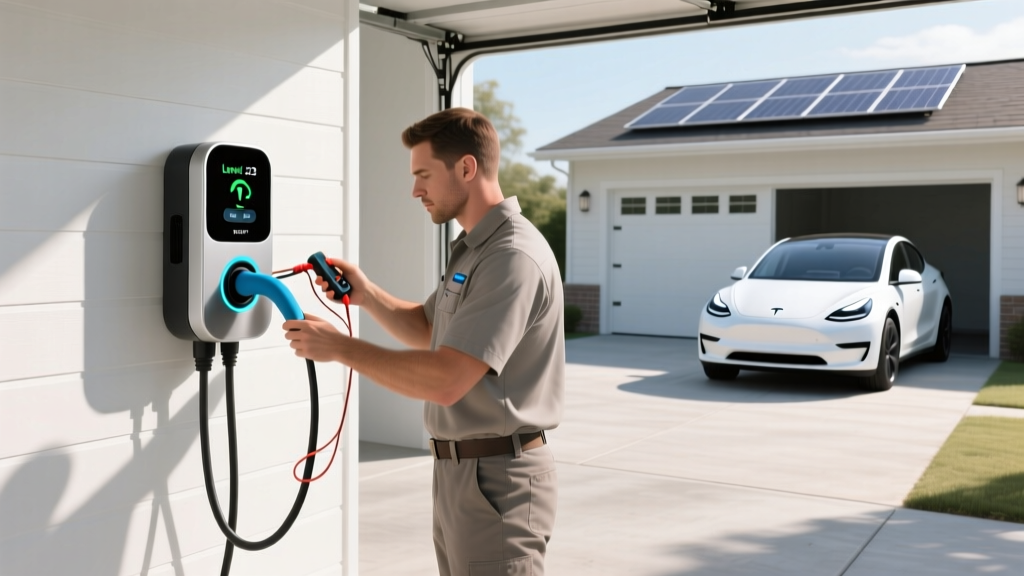
The installation cost for a Level 2 home charger spans a wide range depending on your home's electrical panel capacity, the distance from the panel to the charger location, and local permit requirements. Here's a realistic breakdown:
| Cost Component | Simple Install (panel nearby, 200A service) | Complex Install (long run, panel upgrade needed) |
|---|---|---|
| Level 2 charger equipment | $400–$650 | $400–$650 |
| Electrician labor (240V/50A circuit) | $600–$1,200 | $1,500–$3,000 |
| Electrical permit | $50–$200 | $50–$200 |
| Panel upgrade (100A → 200A, if needed) | $0 | $2,000–$5,000 |
| Conduit, wiring, misc. materials | $100–$300 | $300–$800 |
| Total estimated cost | $1,150–$2,350 | $4,250–$9,650 |
Panel upgrade reality check: Many homes built before 2000 have 100-amp or 150-amp electrical panels. Adding a 50-amp dedicated circuit for a Level 2 charger may exceed available capacity, especially if you also run electric HVAC, a dryer, and an electric range. A licensed electrician will perform a load calculation (NEC Article 220) to determine if an upgrade is required. Budget for this possibility — it's the single largest variable in installation cost.
Electrical Requirements for a Tesla Wall Connector
The Tesla Wall Connector (Gen 3) supports up to 48 amps continuous draw, which per NEC code requires a 60-amp breaker on a 240V circuit using 6 AWG copper wire (or 4 AWG aluminum). If your panel lacks capacity for a 60A breaker, you can configure the Wall Connector via DIP switches to operate at lower amperage (e.g., 40A on a 50A breaker, 32A on a 40A breaker). You'll sacrifice some charging speed, but the math may work if a panel upgrade isn't in the budget.
For safety and code compliance, your installation should include:
- Dedicated circuit: The charger must be on its own breaker — never shared with other appliances.
- GFCI protection: NEC 2023 (and likely 2026 adoptions) requires GFCI protection for outdoor EV receptacles. Hardwired installations may have different requirements depending on your jurisdiction.
- Outdoor rating: If mounting outside, ensure the unit carries a NEMA 4 or NEMA 4X rating for weather resistance. The Tesla Wall Connector is rated for indoor and outdoor use.
- Permit and inspection: Most jurisdictions require an electrical permit and a post-installation inspection. Skipping this can void homeowner's insurance coverage for electrical fires.
Which Connector and Charger Is Compatible with My Tesla?
All Tesla vehicles sold in North America use the North American Charging Standard (NACS) connector — a compact, proprietary design that Tesla opened to other automakers beginning in 2022. By 2026, NACS has become the dominant light-duty EV connector in the US, adopted by Ford, GM, Rivian, Volvo, Hyundai, and others.
| Connector | Used By | Tesla Compatibility |
|---|---|---|
| NACS (Tesla) | Tesla (all models), Ford, GM, Rivian, Hyundai, Kia, Volvo, others | Native — no adapter needed |
| CCS1 (Combined Charging System) | Legacy VW, BMW, Mercedes, Stellantis EVs | Requires Tesla CCS Adapter (~$175) for Supercharger access at non-NACS stalls |
| CHAdeMO | Nissan Leaf, Mitsubishi (discontinued for new vehicles) | Not compatible — no Tesla adapter exists |
| J1772 (Level 2 AC) | All non-Tesla EVs for AC charging | Tesla Mobile Connector includes J1772 adapter; Wall Connector is NACS-native |
For home charging, the simplest path is the Tesla Wall Connector with its native NACS plug — plug in directly, no adapter required. If you choose a third-party Level 2 charger with a J1772 connector (like the ChargePoint Home Flex or Emporia Vue), you'll use the J1772-to-NACS adapter that Tesla includes in the glovebox of every new vehicle.
Best Home Chargers for Tesla in 2026: Equipment Picks
Here are three proven Level 2 chargers that pair well with Tesla vehicles, with specs that matter:
Tesla Wall Connector (Gen 3)
- Max power: 11.5 kW (48A / 240V)
- Connector: NACS native
- Cable length: 24 feet
- Smart features: Wi-Fi, OTA firmware updates, Power Sharing (link up to 6 units on one circuit), Tesla app integration
- Price: ~$475
- Best for: Tesla-only households wanting seamless integration and max speed on a 60A circuit
ChargePoint Home Flex
- Max power: 12.0 kW (50A / 240V)
- Connector: J1772 (use Tesla's included adapter) or NACS version available
- Cable length: 23 feet
- Smart features: Wi-Fi, ChargePoint app scheduling, Alexa integration, detailed energy tracking
- Price: ~$550–$650
- Best for: Multi-EV households (Tesla + non-Tesla) needing flexible amperage settings from 16A to 50A
Emporia Vue Smart EV Charger
- Max power: 11.5 kW (48A / 240V)
- Connector: J1772 (Tesla adapter needed) or NACS version
- Cable length: 24 feet
- Smart features: Wi-Fi, solar integration with Emporia Vue energy monitor, TOU scheduling, load management
- Price: ~$400–$500
- Best for: Solar-equipped homes wanting to charge exclusively from excess solar production
All three units are hardwired or NEMA 14-50 plug-in compatible. Hardwired installations are preferred for 48A+ chargers because the NEMA 14-50 receptacle is rated for 50A, limiting plug-in units to 40A continuous draw (80% NEC derating rule). If you want the full 48A output, hardwire the unit.
Home Charging vs. Supercharging vs. Gasoline: Total Fuel Cost Comparison
Let's put the numbers in perspective with an annual cost scenario based on 12,000 miles of driving per year — the US average.
| Fueling Method | Cost per Mile | Annual Cost (12,000 mi) | 5-Year Cost |
|---|---|---|---|
| Home Level 2 (US avg $0.16/kWh) | $0.043 | $516 | $2,580 |
| Home Level 2 (off-peak TOU $0.10/kWh) | $0.027 | $324 | $1,620 |
| Tesla Supercharger (avg $0.40/kWh) | $0.108 | $1,296 | $6,480 |
| Gasoline sedan (28 MPG, $3.40/gal) | $0.121 | $1,457 | $7,286 |
| Gasoline SUV (22 MPG, $3.40/gal) | $0.155 | $1,855 | $9,273 |
Over five years, exclusive home charging at average rates saves roughly $4,700 compared to fueling a comparable gasoline sedan and $6,700 compared to a gasoline SUV. Even if you rely entirely on Superchargers, you still save modestly against gasoline. The real financial advantage of EV ownership comes from cheap, predictable home electricity.
Charging Time Examples for Current Tesla Models
Charge times depend on battery size, charger power, and where you start and stop on the State of Charge curve. Here are realistic estimates for 10–80% charges, which is the practical daily range most owners use:
| Model (2026) | Battery (usable kWh) | EPA Range | Level 2 at 11.5 kW (10–80%) | Supercharger V3 250 kW (10–80%) |
|---|---|---|---|---|
| Model 3 Long Range | ~75 kWh | 341 mi | ~5 hours | ~25–30 min |
| Model Y Long Range | ~75 kWh | 310 mi | ~5 hours | ~25–30 min |
| Model S Plaid | ~95 kWh | 396 mi | ~6.5 hours | ~30–35 min |
| Model X Long Range | ~95 kWh | 326 mi | ~6.5 hours | ~30–35 min |
Charging curve reality: Peak kW ratings are not sustained rates. A Model 3 Long Range may accept 250 kW at 10% SoC but will taper to ~100 kW by 50% SoC and ~40 kW by 80%. The "10–80% in 25 minutes" figure reflects the integrated average, not the peak. Above 80%, charging slows dramatically to protect battery longevity — plan your road-trip stops around the 10–80% window for the fastest experience.
Frequently Asked Questions
How much does it cost to install a home EV charger?
A straightforward Level 2 installation with an adequate 200A panel and short wire run typically costs $1,150–$2,350 including equipment, electrician labor, and permits. If your home needs a panel upgrade from 100A to 200A, total costs can reach $4,250–$9,650. Always get quotes from at least two licensed electricians and verify they pull the required permits.
How fast will each charging level add range to my Tesla?
Level 1 (120V) adds 3–5 miles per hour. Level 2 at 48A/11.5 kW adds roughly 44 miles per hour to a Model Y. DC Fast Charging at a 250 kW Supercharger can add up to 200 miles in about 15 minutes under optimal conditions, though the rate tapers as the battery fills.
Which connector is compatible with my Tesla for home charging?
All Tesla vehicles use the NACS connector natively. The Tesla Wall Connector has a built-in NACS plug. Third-party chargers with J1772 connectors work with the J1772-to-NACS adapter included in your Tesla's glovebox. No adapter is needed for the Tesla Wall Connector.
How much does charging a Tesla cost per mile compared to gas?
At the US average residential electricity rate of $0.16/kWh, a Tesla Model 3 Long Range costs approximately $0.043 per mile to charge at home. A comparable gasoline sedan at 28 MPG and $3.40/gallon costs $0.121 per mile. Home charging is roughly 65% cheaper per mile. Even at high electricity rates ($0.28/kWh), the Tesla costs $0.076/mile — still 37% less than gasoline.
What electrical upgrades might I need for a home charger?
The most common upgrade is a panel capacity increase from 100A or 150A to 200A, which costs $2,000–$5,000 depending on your utility's requirements and local labor rates. You'll also need a dedicated 240V circuit (typically 50A or 60A breaker) run with appropriately gauged wire. Your electrician will perform an NEC Article 220 load calculation to determine if your existing panel can support the new circuit without an upgrade.
Can I charge my Tesla with solar panels?
Yes. If you have a home solar array, you can configure chargers like the Emporia Vue or use the Tesla Wall Connector with a Tesla Powerwall to prioritize solar-generated electricity. This effectively reduces your per-mile cost to near zero (after the solar system payback period). Schedule charging during peak solar production hours (10 AM – 3 PM) rather than overnight to maximize solar utilization.
Does the federal tax credit apply to home charger installation?
The IRS §30C Alternative Fuel Vehicle Refueling Property Credit covers up to 30% of home charger equipment and installation costs, capped at $1,000. However, eligibility depends on your property being located in a qualifying census tract (typically lower-income or non-urban areas). Check the IRS website or consult a tax professional to confirm whether your address qualifies before purchasing. This credit is separate from the §30D vehicle purchase credit.
Home charging remains the cheapest, most convenient way to fuel a Tesla. With a Level 2 installation, most owners wake up to a full battery every morning, spend roughly $40–$55 per month on electricity for 1,000 miles of driving, and visit gas stations only for windshield washer fluid. The upfront installation investment — typically $1,200–$2,500 for a straightforward setup — pays for itself within 12–24 months through fuel savings alone.