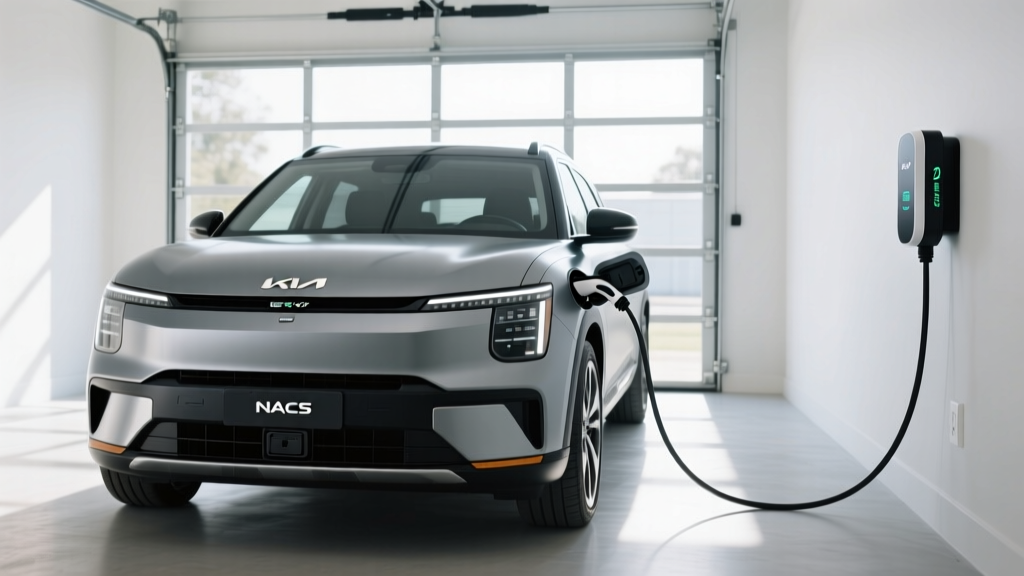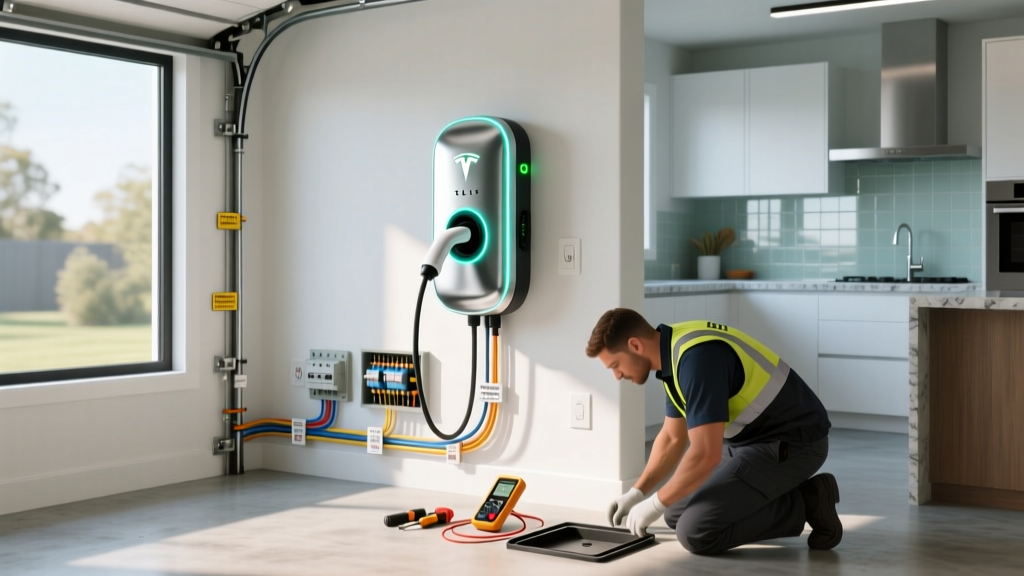
If you've ordered a Tesla Wall Connector or are planning to set up Level 2 home charging for your Model Y, Model 3, Cybertruck, or any NACS-equipped EV, the sticker price of the charger itself is only part of the equation. The real variable — and the one that catches most new EV owners off guard — is the electrical work required to support a dedicated 240V circuit. This guide breaks down the total Tesla home charger installation cost in 2026, including equipment, electrician labor, permits, and the panel upgrades that can double or triple your budget on older homes.
Understanding EV Charging Levels and Speeds
Before pricing an installation, you need to know what each charging level delivers. The distinction between kW (kilowatts, the rate of power delivery) and kWh (kilowatt-hours, the total energy stored in your battery) is the single most important concept in EV charging. Think of kW as the width of the pipe and kWh as the size of the tank.
| Charging Level | Voltage | Max Power (kW) | Miles of Range Added Per Hour | Typical Use Case |
|---|---|---|---|---|
| Level 1 (120V) | 120V AC | 1.2–1.9 kW | 3–5 miles | Overnight trickle; PHEVs; emergency backup |
| Level 2 (240V) | 240V AC | 3.3–19.2 kW | 14–75 miles | Primary home charging; destination charging |
| DC Fast Charging | 400–800V DC | 50–350+ kW | 150–1,000+ miles (equivalent) | Road trips; public stations; 10–80% in 15–30 min |
For Tesla owners, the Wall Connector is a Level 2 unit capable of up to 11.5 kW (48 amps) on a 60-amp dedicated circuit. At that rate, a Model Y Long Range with its ~75 kWh usable battery adds roughly 44 miles of range per hour — enough to fully replenish overnight from near-empty. However, if your home's electrical panel can only support a 40-amp circuit (yielding 9.6 kW / 37 amps to the car), you'll see about 37 miles of range per hour instead.
Tesla Home Charger Installation Cost: The Full Breakdown
The total cost to install a Tesla Wall Connector at home depends on three main variables: the charger unit itself, the complexity of the electrical run, and whether your panel needs an upgrade. Here is what most homeowners encounter in 2026.
| Cost Component | Simple Install (Panel Nearby) | Moderate Install (Long Run) | Complex Install (Panel Upgrade) |
|---|---|---|---|
| Tesla Wall Connector (unit) | $420–$475 | $420–$475 | $420–$475 |
| Electrician labor | $300–$600 | $600–$1,500 | $1,000–$2,000 |
| Electrical materials (conduit, wire, breaker) | $100–$300 | $300–$800 | $400–$1,000 |
| Permit & inspection | $50–$200 | $50–$250 | $100–$350 |
| Electrical panel upgrade (if needed) | — | — | $1,500–$4,000 |
| Total Estimated Cost | $870–$1,575 | $1,370–$3,025 | $3,420–$7,825 |
What drives the cost range?
Distance from panel to charger location: A Wall Connector mounted on the garage wall directly next to a 200-amp panel with available slots is a 1–2 hour job. Running 60 feet of 6 AWG copper through finished walls, attic crawls, or underground conduit to a detached garage is an entirely different project.
Panel capacity: Most modern homes built after 2000 have 200-amp service panels with spare capacity. Older homes — particularly those with 100-amp or 150-amp panels already loaded with electric ranges, dryers, HVAC, and water heaters — may need a panel upgrade or a load-management device that throttles the charger when other high-draw appliances are running.
Local permit requirements: Nearly all jurisdictions require an electrical permit for a new 240V circuit. Permit fees range from $50 in smaller municipalities to $350+ in cities with stricter inspection regimes. Skipping the permit is not recommended — it can void your homeowner's insurance coverage for electrical fires and complicate a future home sale.
Electrical Requirements for the Tesla Wall Connector
The Tesla Wall Connector (Gen 3, current as of 2026) supports the following configurations:
- Maximum output: 11.5 kW (48 amps continuous) on a 60-amp breaker
- Adjustable amperage: Configurable from 16A to 48A via internal DIP switches, allowing installation on smaller circuits (20A, 30A, 40A, 50A, or 60A breakers)
- Voltage: 240V (split-phase residential) or 208V (some commercial/multi-unit)
- Wire gauge: 6 AWG copper for 60A; 8 AWG for 40A; 10 AWG for 30A
- Cable length: 24 feet (standard), providing reach across a two-car garage
- Connector: NACS (North American Charging Standard) — native for Tesla vehicles
Per the National Electrical Code (NEC), EV chargers are considered continuous loads, meaning the circuit must be rated for 125% of the charger's maximum draw. A 48-amp charger therefore requires a 60-amp breaker. A 40-amp charger needs a 50-amp breaker. This is non-negotiable for code compliance and safety.
- Dedicated circuit: The Wall Connector must be on its own dedicated breaker — not shared with a dryer, oven, or HVAC system.
- GFCI protection: NEC 2020 and later require GFCI protection for all 240V EV charging outlets (though hardwired units like the Wall Connector may have different requirements depending on jurisdiction — confirm locally).
- Outdoor rating: The Gen 3 Wall Connector is NEMA 4-rated for outdoor installation, but the junction box and conduit connections must also be rated for wet locations.
- Disconnect: Some jurisdictions require a visible disconnect switch within sight of the charger for emergency shutoff.
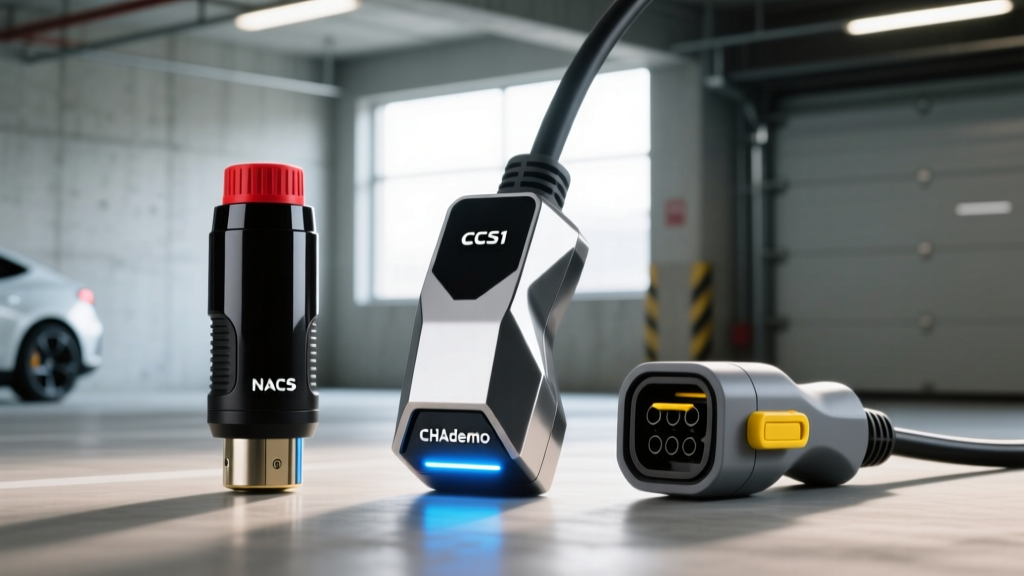
Connector Compatibility: NACS, CCS, and CHAdeMO
The connector landscape has shifted dramatically since 2023, when Ford, GM, Rivian, Volvo, and dozens of other automakers committed to adopting the NACS plug. As of the 2026 model year, NACS is the dominant light-duty EV connector in North America. Here is where each brand stands:
| Connector Type | Native Vehicles (2026) | Home Charger Availability | Adapter Required? |
|---|---|---|---|
| NACS (Tesla) | Tesla (all), Ford (F-150 Lightning, Mustang Mach-E 2025+), GM (Equinox EV, Blazer EV, Silverado EV), Rivian, Hyundai Ioniq 5/9 (NACS trims) | Tesla Wall Connector, Emporia Level 2 (NACS), Autel MaxiCharger | No — native plug |
| CCS1 | VW ID.4, BMW i4/i5, Hyundai Ioniq 5 (CCS trims), Kia EV6 (CCS trims), legacy 2021–2024 EVs | ChargePoint Home Flex, Enel X JuiceBox (legacy) | CCS-to-NACS adapter for Tesla Superchargers; NACS-to-CCS adapter for home NACS chargers |
| CHAdeMO | Nissan Leaf (legacy, discontinued in US after 2025) | Limited; mostly public DC stations | Not practical for home Level 2 — CHAdeMO home chargers effectively discontinued |
Practical advice: If you own a Tesla or any 2025+ NACS-equipped vehicle, the Tesla Wall Connector is the most cost-effective native solution. If you own a CCS1 vehicle but anticipate switching to a NACS vehicle in the future, consider a dual-connector charger like the Emporia Level 2 (which offers both NACS and J1772/CCS pigtails) or plan to use a NACS-to-CCS adapter. Adapters from Tesla and Lectron typically cost $150–$250 and are rated for the full 48-amp Level 2 throughput.
Charging Time Examples: How Long to Fill Common EV Batteries
Charging time depends on your battery's usable capacity (in kWh), the charger's output (in kW), and the charge curve — the reality that batteries accept power quickly at low states of charge and taper significantly above 80%. Here are real-world Level 2 times for popular 2026 EVs using a Tesla Wall Connector at 11.5 kW:
| Vehicle (2026 MY) | Usable Battery (kWh) | Onboard Charger Acceptance | 0–80% Time at 11.5 kW | Overnight Full Charge (0–100%) |
|---|---|---|---|---|
| Tesla Model Y Long Range | ~75 kWh | 11.5 kW max | ~5 hours 15 min | ~7 hours |
| Tesla Model 3 Long Range | ~75 kWh | 11.5 kW max | ~5 hours 15 min | ~7 hours |
| Ford F-150 Lightning (Extended Range) | ~131 kWh | 19.2 kW (with 80A charger) / 11.5 kW on Wall Connector | ~9 hours at 11.5 kW | ~12 hours |
| Hyundai Ioniq 5 (Long Range AWD) | ~77.4 kWh | 10.9 kW max | ~5 hours 30 min | ~7.5 hours |
| Chevrolet Equinox EV | ~85 kWh | 11.5 kW max | ~5 hours 55 min | ~8 hours |
The 80% taper matters. On DC fast chargers, you'll see peak speeds (e.g., 250 kW on a Tesla V3 Supercharger) only between roughly 10–40% SoC. By 80%, the rate often drops below 50 kW. This is why manufacturers quote "10–80% time" rather than 0–100%. For home Level 2 charging, the taper is less dramatic because the charge rate is well within the battery's thermal comfort zone, but the final 80–100% still takes proportionally longer.
Cost to Charge: Home Electricity vs. Gas Per Mile
One of the strongest economic arguments for home charging is the cost-per-mile advantage over gasoline. The exact figure depends on your local electricity rate and driving efficiency. Here is a realistic comparison using national averages from the U.S. Energy Information Administration (EIA):
| Scenario | Energy Cost | Vehicle Efficiency | Cost Per Mile |
|---|---|---|---|
| Home charging (national avg. rate) | $0.165/kWh | 3.5 mi/kWh (typical EV) | $0.047 |
| Home charging (off-peak TOU rate) | $0.08–$0.12/kWh | 3.5 mi/kWh | $0.023–$0.034 |
| Public Level 2 (ChargePoint, EVgo L2) | $0.25–$0.49/kWh | 3.5 mi/kWh | $0.071–$0.140 |
| DC Fast Charging (Tesla Supercharger, EA) | $0.28–$0.48/kWh | 3.5 mi/kWh | $0.080–$0.137 |
| Gasoline vehicle (30 MPG combined) | $3.35/gallon (2026 avg.) | 30 MPG | $0.112 |
| Gasoline vehicle (22 MPG, truck/SUV) | $3.35/gallon | 22 MPG | $0.152 |
At home on an off-peak time-of-use (TOU) plan, charging an EV costs roughly 70–85% less per mile than fueling a comparable gas vehicle. Even at public DC fast charger rates, EV charging is typically cheaper or cost-competitive with gasoline. The critical caveat: if you rely exclusively on public DC fast charging at premium rates ($0.45+/kWh), your per-mile cost can exceed that of an efficient hybrid. Home charging is where the economics decisively favor EVs.
Time-of-use tip: Most utilities offer TOU plans that drop rates to $0.08–$0.12/kWh between 11 PM and 6 AM. The Tesla app and Wall Connector support scheduled charging — set your car to begin charging at midnight and you'll automatically capture the lowest rates without any manual intervention.
Equipment Recommendations: Home Chargers Compared
The Tesla Wall Connector is the default choice for NACS-equipped vehicles, but it's not the only option. Here are the top Level 2 home chargers for 2026, with specs that matter:
Tesla Wall Connector (Gen 3) — Best for Tesla & NACS Owners
- Max output: 11.5 kW (48A) on a 60A circuit
- Connector: NACS (native Tesla plug)
- Cable length: 24 ft
- Smart features: Wi-Fi connectivity, over-the-air updates, power-sharing between two units on one circuit, Tesla app integration, scheduled charging
- Price: $420–$475
- Best for: Tesla owners, Ford/GM NACS adopters, anyone wanting a clean native solution without adapters
Emporia Level 2 EV Charger — Best Smart Value with Dual Connector
- Max output: 11.5 kW (48A) on a 60A circuit
- Connector: Available in NACS or J1772 (CCS adapter included with J1772 version)
- Cable length: 24 ft
- Smart features: Real-time energy monitoring via Emporia app, solar integration (pair with Emporia Vue to charge on excess solar), load management, TOU scheduling
- Price: $399–$449
- Best for: Solar-equipped homes, households with mixed NACS and CCS vehicles, budget-conscious buyers wanting premium smart features
ChargePoint Home Flex (2nd Gen) — Best for CCS/J1772 Vehicles
- Max output: 12 kW (50A) on a 60A circuit (NEMA 14-50 plug or hardwired)
- Connector: J1772 (CCS-compatible); NACS adapter available separately
- Cable length: 23 ft
- Smart features: ChargePoint app, Alexa integration, adjustable amperage (16A–50A), detailed session history
- Price: $549–$599
- Best for: Non-Tesla EVs (VW ID.4, older Hyundai/Kia CCS models), renters who want a plug-in NEMA 14-50 unit they can take when moving
Hardwired vs. plug-in: The Tesla Wall Connector is hardwired (no plug), which means a cleaner install with no exposed receptacle and no GFCI breaker requirement in most jurisdictions. Plug-in chargers using a NEMA 14-50 outlet offer portability but may require a GFCI breaker (adding $50–$120 to your electrical cost) and are limited to 40 amps continuous per NEC rules on a 50-amp receptacle.
Federal Tax Credits and Utility Rebates for Home Charging
The federal Alternative Fuel Vehicle Refueling Property Credit (IRS Form 8911) covers 30% of home EV charger equipment and installation costs, up to a maximum of $1,000. However, this credit is subject to specific eligibility requirements:
- The charger must be installed at your primary residence in the United States
- The property must be located in an eligible census tract (non-urban or low-income community as defined by the IRA) — many suburban and urban tracts do not qualify
- The credit is non-refundable (it reduces your tax liability but won't generate a refund beyond zero)
- Equipment and installation costs both count toward the $1,000 cap
Many utilities also offer direct rebates for Level 2 charger installations — typically $250–$500, with some California, New York, and Colorado utilities offering up to $1,000 or free charger units. Check your utility's EV program page before purchasing equipment, as some rebates require specific charger models or installation by a utility-approved electrician.
Frequently Asked Questions
How much does it cost to install a Tesla home charger?
Total Tesla Wall Connector installation cost typically ranges from $870 to $3,025 for most homes. The charger unit itself costs $420–$475. Electrician labor runs $300–$1,500 depending on the distance from your panel and wiring complexity. Permits add $50–$350. If your electrical panel needs an upgrade from 100A to 200A service, expect an additional $1,500–$4,000.
Can I install a Tesla Wall Connector on a 100-amp panel?
Possibly, but it depends on your existing load. A 100-amp panel can technically support a 40-amp breaker (yielding 32 amps / 7.7 kW to the car) if your other circuits don't exceed ~60 amps of calculated load. Your electrician will perform a NEC Article 220 load calculation to determine if you have sufficient headroom. If not, a panel upgrade to 200 amps or a load-management device like the Tesla Gateway or Emporia smart panel will be required.
Do I need a permit to install a home EV charger?
Yes, in nearly all US jurisdictions. A new 240V circuit requires an electrical permit and a post-installation inspection. Permit fees range from $50 to $350 depending on your municipality. The inspection verifies proper wire gauge, breaker sizing, grounding, and GFCI compliance. Skipping the permit can invalidate homeowner's insurance coverage and create liability during a home sale.
Is a NEMA 14-50 outlet better than hardwiring the Tesla Wall Connector?
Hardwiring is generally preferred for the Tesla Wall Connector. It allows the full 48-amp output (vs. 40 amps max on a NEMA 14-50 per NEC continuous-load rules), eliminates the need for a GFCI breaker in most jurisdictions, and provides a cleaner, safer installation with fewer connection points. A NEMA 14-50 outlet is better only if you plan to move the charger to a new home or want the flexibility to plug in a different charger or RV in the future.
How fast will a Tesla Wall Connector charge a Model Y?
At its maximum 11.5 kW output (48 amps on a 60-amp circuit), the Tesla Wall Connector adds approximately 44 miles of EPA range per hour to a Model Y Long Range. A full charge from 10% to 90% takes roughly 6.5 hours. Most owners who plug in at 10 PM wake up to a full battery by 6 AM, even after depleting to 20% the previous evening.
Can I use a Tesla Wall Connector with a non-Tesla EV?
Yes — any vehicle equipped with a NACS charge port can use the Tesla Wall Connector natively. As of 2026, this includes the Ford F-150 Lightning, Ford Mustang Mach-E (2025+), GM Equinox EV, GM Blazer EV, Rivian R1T/R1S, and select Hyundai models. If your EV has a CCS1 port, you'll need a NACS-to-CCS adapter (available from Tesla, Lectron, or A2Z for $150–$250) to use the Wall Connector.
Does installing a home EV charger qualify for a tax credit?
The federal Alternative Fuel Vehicle Refueling Property Credit covers 30% of equipment and installation costs, up to $1,000. However, eligibility is restricted to properties in qualifying census tracts (typically rural or low-income communities). Many suburban and urban homeowners do not qualify. Consult a tax professional and check the IRS guidelines before assuming eligibility.