If you've just ordered a Tesla—or any EV with the North American Charging Standard (NACS) port—you're probably asking: how much is a Tesla charger for your house? The short answer is that the Wall Connector hardware itself runs about $420 to $500 in 2026, but the total installed cost typically lands between $850 and $3,200 depending on your home's electrical panel, wiring distance, and local permit fees. In some older homes, a panel upgrade can push that figure well past $4,000.
This guide breaks down every line item—equipment, labor, permits, and potential panel upgrades—so you can budget accurately before calling an electrician. We'll also cover charging speeds, connector compatibility, and the real cost per mile compared to gas.
Tesla Wall Connector Hardware: What You're Actually Buying
Tesla sells two primary home charging products in 2026:
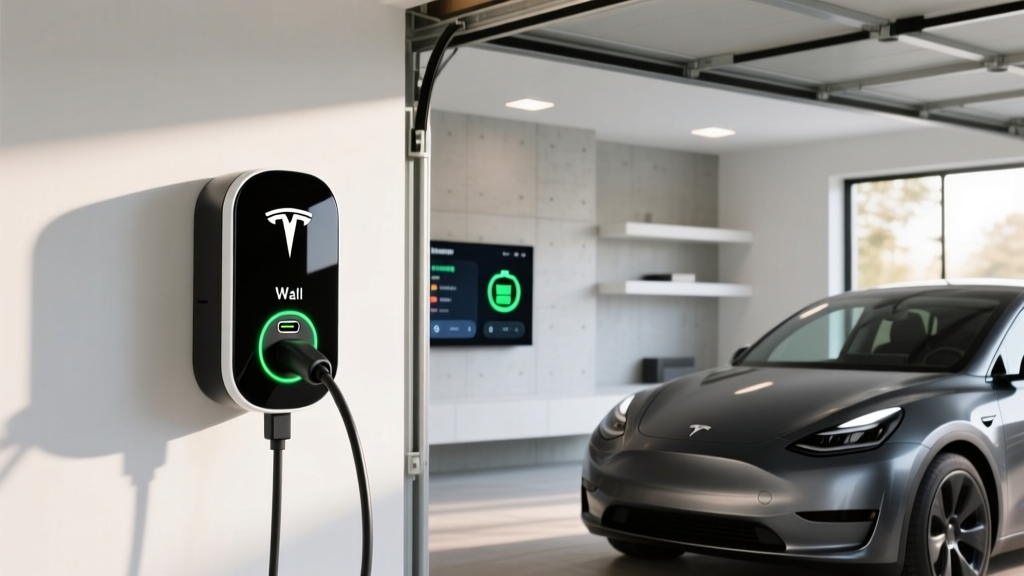
- Tesla Wall Connector (Gen 3/Gen 4): A hardwired Level 2 unit delivering up to 11.5 kW (48 amps on a 60-amp dedicated circuit). The 24-foot cable version retails for approximately $420, while the 18-foot version is around $400. It features a NACS plug native to Tesla vehicles, Wi-Fi connectivity for firmware updates and scheduling, and a NEMA 4 indoor/outdoor rating.
- Tesla Mobile Connector: A portable cord-set that ships with most new Teslas. With the included NEMA 5-15 adapter, it delivers roughly 1.4 kW (Level 1, about 3–5 miles of range per hour). With an optional NEMA 14-50 adapter (~$35) and a 240V outlet, it can deliver up to 7.2 kW (roughly 25–30 miles per hour). The Mobile Connector bundle is about $200.
The Wall Connector is the serious home-charging solution. It charges roughly 2–3x faster than the Mobile Connector on a 14-50 outlet and doesn't occupy your dryer or range receptacle. For daily use and road-trip preconditioning, the hardwired Wall Connector is the right choice for most owners.
kW (kilowatts) measures power—the rate at which electricity flows into your car, like water pressure from a hose. kWh (kilowatt-hours) measures energy—the total amount of electricity stored in your battery, like gallons in a tank. A 48-amp Wall Connector delivers up to 11.5 kW of power. A Tesla Model Y Long Range has roughly 75 kWh of usable battery energy. Charging at 11.5 kW, a near-empty battery would take about 6.5 hours to fill.
Charging Levels Explained: Speed, Power, and Real-World Range Added
Understanding the three charging levels is essential before you invest in equipment. Here's how they compare in practical terms:
| Level | Voltage / Amperage | Power (kW) | Miles of Range Added per Hour | Typical Use Case |
|---|---|---|---|---|
| Level 1 | 120V / 12A | ~1.4 kW | 3–5 mi/hr | Overnight trickle; PHEVs; emergency top-ups |
| Level 2 | 240V / 40–48A | 7.7–11.5 kW | 25–44 mi/hr | Primary home charging; daily use |
| DC Fast Charging | 400–800V DC | 50–350 kW | 150–1,000+ mi/hr (peak) | Road trips; Superchargers; public stations |
For context, a Tesla Model Y Long Range with an EPA-estimated 310 miles of range and approximately 75 kWh of usable battery would take about 7 hours from 10% to 80% on an 11.5 kW Wall Connector. On a Tesla Supercharger V4 (up to 250 kW), that same 10–80% session takes roughly 20–25 minutes—though charging speed tapers significantly above 80% State of Charge (SoC) to protect battery health.
Total Installed Cost: Equipment, Electrician, Permits, and Panel Upgrades
The hardware is the cheapest part of the equation. Labor and electrical infrastructure determine your actual out-of-pocket cost. Here's a realistic breakdown based on 2026 national averages:
| Line Item | Low Estimate | High Estimate | Notes |
|---|---|---|---|
| Tesla Wall Connector (hardware) | $400 | $500 | 24-ft cable, NACS connector, Wi-Fi enabled |
| Electrician labor (simple install) | $400 | $800 | Panel has spare capacity, short wire run (<30 ft) |
| Electrician labor (complex install) | $800 | $1,500 | Long wire run, conduit, attic/crawlspace routing |
| Permit fee | $50 | $250 | Varies by municipality; some waive for EV installs |
| Electrical panel upgrade (200A) | $1,500 | $3,500 | Required if panel is 100A or at capacity |
| TOTAL (no panel upgrade) | $850 | $2,550 | Most homes with modern 200A panels |
| TOTAL (with panel upgrade) | $2,350 | $5,550 | Older homes with 100A service or maxed-out panels |
When Will You Need a Panel Upgrade?
A Tesla Wall Connector at 48 amps requires a 60-amp dedicated circuit. That's a significant load. Your electrician will perform a load calculation per NEC Article 220 to determine whether your existing panel can handle the additional draw. You'll likely need a panel upgrade if:
- Your home has a 100-amp main panel (common in homes built before 1990)
- Your 200-amp panel is already near capacity with electric HVAC, an electric range, electric dryer, and a hot tub or pool heater
- You plan to add a second EV charger in the future (consider a subpanel or smart load-management system like the Tesla Gateway or Span smart panel)
Some utilities offer make-ready programs that cover the cost of wiring from the utility to your panel, reducing your upgrade cost by $500–$2,000. Check with your local utility before starting work.
Electrical Requirements for the Tesla Wall Connector
The Wall Connector must be installed on a dedicated circuit with the following specifications:
- Voltage: 240V (split-phase, standard US residential)
- Breaker size: 60 amps (for 48A continuous charging); can be configured down to 40A breaker / 32A charging if panel capacity is limited
- Wire gauge: 6 AWG copper THHN in conduit, or 4 AWG if the run exceeds 100 feet (to minimize voltage drop)
- Connection type: Hardwired (no plug); requires a junction box or direct conduit entry
- GFCI protection: The 2023 NEC (and most 2026-adopted local codes) requires GFCI protection for EV charging circuits—this is built into the Wall Connector's internal electronics, so an external GFCI breaker is typically not required, but confirm with your local inspector
Connector Compatibility: NACS, CCS, and What Fits Your EV
The Tesla Wall Connector ships with a NACS (North American Charging Standard) connector—the same plug used on all Tesla vehicles since the original Roadster. As of 2025–2026, most major automakers have adopted NACS for their North American EVs, including Ford, GM, Rivian, Hyundai, Kia, and Volvo. However, many EVs on the road today still use the CCS1 (Combined Charging System) connector.
| Connector | Brands Using It (2026) | Compatible with Tesla Wall Connector? |
|---|---|---|
| NACS | Tesla, Ford (F-150 Lightning, Mustang Mach-E 2025+), GM (Cadillac Lyriq, Equinox EV, Blazer EV 2025+), Rivian, Hyundai (Ioniq 5 2026+), Kia (EV6 2025+), Volvo, Polestar | Yes — native plug |
| CCS1 | Volkswagen (ID.4), BMW (i4, iX), older Ford/GM/Hyundai/Kia models pre-NACS switch, Stellantis, Subaru (Solterra), Toyota (bZ4X) | Requires a NACS-to-CCS adapter (~$200–$250) or use a CCS-native charger |
| CHAdeMO | Nissan Leaf (legacy); effectively discontinued for new vehicles | Not compatible; no adapter available |
If you own a non-Tesla EV with a CCS1 port and want to use the Tesla Wall Connector, you'll need a NACS-to-CCS1 adapter. Tesla sells one for approximately $250, and third-party options from Lectron and A2Z are available for around $200. Note that these adapters are rated for Level 2 AC charging only—they will not work at DC fast chargers.
If you drive a CCS vehicle and don't want to buy an adapter, consider a universal Level 2 charger with a CCS1 or J1772 plug (with J1772-to-NACS adapter for Teslas). We cover alternatives below.
Alternative Home Chargers: Comparing Tesla and Third-Party Options
The Tesla Wall Connector isn't your only option. Here's how it stacks up against popular alternatives in 2026:
Tesla Wall Connector
- Power: Up to 11.5 kW (48A)
- Connector: NACS (native)
- Cable: 18 ft or 24 ft
- Smart features: Wi-Fi, OTA updates, scheduled charging, Power-Share (load balancing between two units)
- Price: ~$420
- Best for: Tesla owners; NACS-equipped non-Tesla EVs
ChargePoint Home Flex
- Power: Up to 12 kW (50A), configurable 16–50A
- Connector: J1772 (NACS adapter included in 2026 bundle)
- Cable: 23 ft
- Smart features: Wi-Fi, app scheduling, Alexa integration, energy tracking
- Price: ~$550
- Best for: Multi-EV households (CCS and NACS)
Emporia Level 2 EV Charger
- Power: Up to 11.5 kW (48A)
- Connector: J1772 or NACS (select at purchase)
- Cable: 24 ft
- Smart features: Wi-Fi, solar integration, energy monitoring, time-of-use scheduling
- Price: ~$400
- Best for: Solar-panel owners; budget-conscious buyers
Grizzl-E Smart
- Power: Up to 10 kW (40A)
- Connector: J1772 or NACS
- Cable: 24 ft
- Smart features: Wi-Fi, OCPP-compatible, extreme cold-rated (-40°F)
- Price: ~$500
- Best for: Cold-climate owners; outdoor installs
For Tesla-only households, the Wall Connector is hard to beat on price and integration. If you have a mixed fleet (one Tesla, one CCS vehicle), the ChargePoint Home Flex with its included NACS adapter offers the most flexibility.
Cost Per Mile: Home Charging vs. Public Charging vs. Gas
One of the strongest arguments for home charging is the cost advantage. Let's run the numbers for a Tesla Model Y Long Range (approximately 3.5 miles per kWh, or about 28 kWh per 100 miles):
| Scenario | Cost per kWh | Cost per 100 Miles | Cost per Mile |
|---|---|---|---|
| Home charging (national avg. $0.16/kWh) | $0.16 | $4.48 | $0.045 |
| Home off-peak / time-of-use ($0.08/kWh) | $0.08 | $2.24 | $0.022 |
| Public Level 2 (avg. $0.25/kWh) | $0.25 | $7.00 | $0.07 |
| Tesla Supercharger (avg. $0.35/kWh) | $0.35 | $9.80 | $0.098 |
| Gas equivalent (28 MPG at $3.40/gal) | $3.40/gal | $12.14 | $0.121 |
Home charging on an off-peak rate saves roughly 80% per mile compared to a comparable gas vehicle. Even at peak residential rates, you're paying less than half what a 28-MPG gas car costs per mile. The savings compound: a driver covering 12,000 miles per year would spend approximately $538/year on home electricity vs. $1,457/year on gas—a difference of nearly $920 annually.
Check whether your utility offers an EV-specific time-of-use (TOU) rate. Many utilities offer rates as low as $0.06–$0.09/kWh between 11 PM and 6 AM. The Wall Connector's built-in scheduling feature can automatically start charging during these windows.
Safety, Code, and Installation Best Practices
EV charging draws sustained high current for hours—unlike most household appliances. Proper installation is critical for safety and insurance compliance:
- Dedicated circuit: The Wall Connector must be on its own dedicated breaker—never shared with other outlets or appliances. A 60A breaker for 48A continuous charging is standard.
- Permit required: Nearly all US jurisdictions require an electrical permit for EV charger installation. Skipping the permit can void your homeowner's insurance in the event of a fire and may cause issues at resale.
- Outdoor rating: The Wall Connector carries a NEMA 4 rating, meaning it's suitable for outdoor installation and resistant to rain and splashing water. It is not rated for pressure washing or submersion.
- Wire sizing: Undersized wire causes voltage drop and heat buildup. Your electrician should size wire per NEC Table 310.16, accounting for ambient temperature and conduit fill. For runs over 100 feet, upsizing to 4 AWG is standard practice.
- Load management: If your panel is near capacity but you don't want to pay for a full upgrade, consider a smart load-management device like the Sense EV charger integration or the Span Drive panel, which dynamically adjusts charging amperage based on real-time household load.
Always hire a licensed electrician who has experience with EV charger installs. Ask for a detailed quote that separates equipment, labor, permit, and any panel work. Get at least three quotes—prices vary significantly by market and contractor.
Frequently Asked Questions
How much does it cost to install a Tesla home charger?
The Tesla Wall Connector hardware costs about $420. Total installed cost ranges from $850 to $2,550 for homes with adequate panel capacity, or $2,350 to $5,550 if a panel upgrade is required. The national average for a straightforward install is approximately $1,200–$1,800 all-in.
How fast will a Tesla Wall Connector charge my car?
At full 48-amp / 11.5 kW output, the Wall Connector adds approximately 44 miles of range per hour to a Model Y. A 10–80% charge on a Model Y Long Range (75 kWh usable) takes about 5–6 hours. Charging on a 40A circuit (32A continuous / 7.7 kW) adds roughly 30 miles per hour and takes about 7–8 hours for the same session.
Can I use the Tesla Wall Connector with a non-Tesla EV?
Yes, if your non-Tesla EV has a NACS port (increasingly common on 2025–2026 models from Ford, GM, Hyundai, Kia, and Rivian). If your EV has a CCS1 port, you'll need a NACS-to-CCS adapter (~$200–$250). CHAdeMO vehicles (Nissan Leaf) are not compatible.
Does the Tesla Wall Connector qualify for a tax credit?
The federal Residential Clean Energy Credit (IRC §25D) expired for EV charging equipment at the end of 2025. However, some state and utility incentive programs still offer rebates of $250–$1,000 for home charger installation. Check your utility's website and the Alternative Fuels Data Center for current programs in your state.
Do I need a 200-amp electrical panel for a Tesla charger?
Not necessarily. A 200A panel is standard in most homes built after 2000 and usually has enough headroom for a 60A EV circuit. Homes with 100A panels or panels already near capacity will likely need an upgrade. Your electrician will perform a NEC Article 220 load calculation to determine your exact situation. In some cases, configuring the Wall Connector to 32A (40A breaker) or using a smart load-management system can avoid a panel upgrade entirely.
Is it cheaper to charge at home or at a Supercharger?
Home charging is significantly cheaper. At the national average residential rate of $0.16/kWh, you'll pay about $4.48 per 100 miles. A Tesla Supercharger at $0.35/kWh costs about $9.80 per 100 miles—more than double. For daily driving, home charging saves $600–$1,000 per year compared to exclusive Supercharger use.