If you've searched for a Tesla free Supercharger promotion, you've probably noticed the landscape has changed dramatically since the early Model S days of unlimited complimentary charging. In 2026, Tesla's free Supercharger offers are mostly limited to referral bonuses, loyalty transfers, and occasional end-of-quarter sales incentives — not permanent perks. That makes understanding your full charging ecosystem — home Level 2, public DC fast, and the real cost per mile — more important than ever.
This guide breaks down every charging tier with exact speeds in kW, installation costs with electrician and permit line items, connector compatibility across the expanding NACS ecosystem, and a realistic cost-per-mile comparison versus gasoline. Whether you're picking up a new Model Y, a Ford F-150 Lightning that now uses NACS, or any other EV, these numbers will anchor your expectations.
Where Tesla Free Supercharger Credits Stand in 2026
Unlimited free Supercharging was retired for new purchases years ago. Today, you'll encounter the perk in three narrow scenarios:
- Referral program credits: Tesla periodically reactivates referral bonuses that grant a set number of free Supercharger kWh (often 1,000–3,000 kWh) usable within 12 months. Availability fluctuates by quarter.
- End-of-quarter or end-of-year delivery incentives: In push periods (typically late March, June, September, December), Tesla has offered 10,000–20,000 free Supercharger miles for buyers who take delivery before a deadline. These are promotional, not guaranteed.
- Loyalty transfers: In some cases, remaining Supercharger credit on a traded-in Tesla can be moved to a new purchase — handled case-by-case by sales advisors.
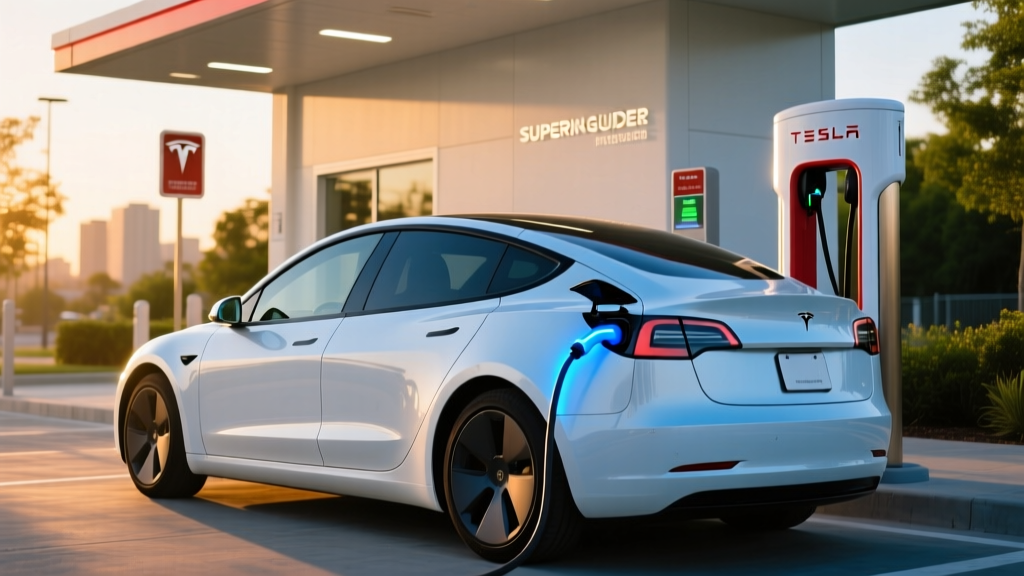
Outside these offers, expect to pay Tesla's posted per-kWh rate at Superchargers, which in 2026 ranges roughly from $0.28 to $0.48/kWh depending on location, time of day, and whether the station uses peak pricing. For a 75 kWh usable battery (Model Y Long Range), a 10–80% fill costs approximately $15–$27 at a Supercharger before any credits.
Charging Levels Explained: Speeds in kW and Miles per Hour
The single most important distinction in EV charging: kW (kilowatts) measures power — how fast energy flows. kWh (kilowatt-hours) measures energy — how much the battery holds. A 240 kW DC fast charger (power) filling a 75 kWh battery (energy) is analogous to a 2-inch hose filling a 50-gallon tank.
| Level | Voltage | Power (kW) | Miles of Range per Hour | Typical Use Case |
|---|---|---|---|---|
| Level 1 | 120V AC | 1.0–1.4 kW | 3–5 mi/hr | Overnight trickle, PHEVs, emergency |
| Level 2 | 240V AC | 7.2–19.2 kW | 25–65 mi/hr | Home daily charging, workplace |
| DC Fast (CCS/NACS) | 400–800V DC | 50–350 kW | 150–1,000+ mi/hr (peak) | Road trips, corridor travel |
Real-world nuance: DC fast charging follows a charge curve. A Tesla Model Y may peak at 250 kW at 10% SoC but taper to under 60 kW above 70%. That's why manufacturers quote 10–80% times rather than 0–100%. Expect a Model Y Long Range (75 kWh usable, NMC) to do 10–80% at a V3 Supercharger in roughly 25–28 minutes, and a Hyundai Ioniq 5 (84 kWh, 800V architecture) at a 350 kW Electrify America station in about 18–20 minutes.
Home Level 2 Installation: Electrical Requirements and Real Costs
Most EV owners do 80%+ of their charging at home on a Level 2 circuit. A proper install requires a dedicated 240V circuit, typically 40A, 50A, or 60A depending on the charger's max draw. Continuous-load electrical code (NEC Article 625) requires the circuit to be rated at 125% of the charger's continuous draw — so a 48A charger needs a 60A breaker.
What an electrician evaluates
- Panel capacity: Does your main service (100A, 150A, 200A) have room for a new 50–60A double-pole breaker while staying under the 80% continuous load rule?
- Wire gauge and run length: 6 AWG copper for 50A, 4 AWG for 60A, with longer runs possibly requiring upsizing to limit voltage drop.
- GFCI protection: NEC 2020+ requires GFCI for EV receptacles in garages; many hardwired chargers sidestep this requirement.
- Permitting: Most jurisdictions require an electrical permit ($50–$250) and inspection.
Installation cost breakdown
| Line Item | Low End | High End | Notes |
|---|---|---|---|
| Level 2 charger hardware | $400 | $750 | 40A–48A Wi-Fi-enabled unit |
| Electrician labor (simple install, panel adjacent) | $350 | $800 | Short conduit run, same wall as panel |
| Electrician labor (long run or garage subpanel) | $800 | $2,000 | 50+ ft wire, conduit, drywall work |
| Permit and inspection | $50 | $250 | Varies by municipality |
| Panel upgrade (100A → 200A) | $1,800 | $4,500 | Older homes; not always required |
| Total (no panel upgrade) | $800 | $3,000 | Most common range: $1,200–$2,000 |
| Total (with panel upgrade) | $2,600 | $7,500 | Homes built pre-1990 most at risk |
The §30D tax credit no longer covers home charger equipment directly (the former 30C credit for residential charging hardware expired for most homeowners), though some states and utilities still rebate $200–$700 of the install. Check your local utility — programs from PG&E, ConEd, Xcel, and others remain active in 2026.
Connector Compatibility: NACS, CCS1, and CHAdeMO in 2026
Since Tesla opened the Supercharger network, the North American Charging Standard (NACS) has won the connector war. Ford, Rivian, GM, Volvo, Polestar, and most other OEMs now ship with native NACS ports or include CCS-to-NACS adapters. CHAdeMO remains legacy — supported only at older stations and on the Nissan Leaf, which is now discontinued in the US.
| Brand | Native Port | Adapter Needed for Superchargers | Adapter Needed for Electrify America (CCS) |
|---|---|---|---|
| Tesla (all models) | NACS | None | Tesla CCS adapter (~$175) |
| Ford (F-150 Lightning, Mustang Mach-E 2025+) | NACS | None | None |
| GM (Silverado EV, Blazer EV, Equinox EV) | NACS | None | None |
| Rivian (R1S, R1T 2025+) | NACS | None | None |
| Hyundai / Kia (Ioniq 5, EV6, EV9) | CCS1 | CCS-to-NACS adapter | None |
| BMW, Mercedes, VW ID.4 | CCS1 | CCS-to-NACS adapter | None |
| Nissan Leaf (legacy) | CHAdeMO | CHAdeMO-to-NACS (limited) | CHAdeMO-to-CCS (rare) |
If you own a CCS-native vehicle and want Supercharger access, Tesla and third-party brands (Lectron, A2Z) sell CCS-to-NACS adapters rated for up to 250 kW DC. Confirm your vehicle's firmware supports NACS handshaking — most 2024+ CCS vehicles do after an OTA update.
Cost to Charge: Per-Mile Math vs. Gasoline
Charging cost depends heavily on where and when you plug in. Home off-peak rates are dramatically cheaper than DC fast networks, which is why home charging dominates economically.
| Scenario | Rate | Vehicle Efficiency | Cost per Mile |
|---|---|---|---|
| Home, off-peak utility rate | $0.13/kWh | 3.5 mi/kWh (Tesla Model Y) | $0.037 |
| Home, peak rate | $0.28/kWh | 3.5 mi/kWh | $0.080 |
| Tesla Supercharger (avg) | $0.35/kWh | 3.5 mi/kWh | $0.100 |
| Electrify America / EVgo DC | $0.43/kWh | 3.2 mi/kWh | $0.134 |
| Gasoline car, 28 MPG combined | $3.45/gal | 28 mi/gal | $0.123 |
| Gasoline truck, 19 MPG combined | $3.45/gal | 19 mi/gal | $0.182 |
Takeaway: Home-charged EVs cost 3–5 cents per mile, roughly one-quarter the cost of an efficient gas sedan. Even DC fast charging at public networks is competitive with gasoline on a per-mile basis — but it's slower and less convenient than refueling. The economics overwhelmingly favor home Level 2.
Recommended Home Level 2 Chargers for 2026
These are the units we'd spec for a typical 2026 EV buyer, balancing power output, cable length, smart features, and price.
Tesla Wall Connector (Gen 3)
- Power output: 11.5 kW (48A) on a 60A circuit
- Connector: NACS native; J1772 adapter included
- Cable length: 24 ft
- Smart features: Wi-Fi, OTA updates, load sharing (pair two on one circuit), Powerwall integration
- Price: ~$475
- Best for: Tesla owners, and NACS-native Ford/GM/Rivian vehicles
ChargePoint Home Flex
- Power output: Up to 12 kW (50A) on a 60A circuit; configurable down to 16A
- Connector: J1772 standard (NACS adapter available separately)
- Cable length: 23 ft
- Smart features: Wi-Fi, app scheduling, utility demand-response, Alexa
- Price: ~$599
- Best for: CCS-native vehicles (Hyundai, Kia, BMW, VW) and renters who may move
Emporia Vue EV Charger
- Power output: 11.5 kW (48A) on a 60A circuit
- Connector: J1772 (NACS version launched late 2025)
- Cable length: 24 ft
- Smart features: Wi-Fi, integration with Emporia whole-home energy monitor, solar-aware scheduling
- Price: ~$399
- Best for: Budget-conscious buyers with solar panels or energy-monitoring setups
Safety, Code, and the Panel-Upgrade Gotcha
Level 2 EV charging is a continuous high-draw load — essentially running a large electric dryer for 6–10 hours straight. Code compliance isn't optional; it protects your home and ensures insurance coverage in a fault event.
- Dedicated circuit: EV chargers must be on their own breaker — no sharing with dryers, ovens, or HVAC.
- GFCI protection: Required for NEMA 14-50 receptacles in garages under NEC 2020+. Hardwired units are often exempt and avoid nuisance trips.
- Outdoor rating: If the charger is exterior-mounted, confirm NEMA 4 (weatherproof) rating and use an in-use cover for receptacle installations.
- Panel upgrade reality: Homes with 100A service, common in pre-1990 construction, often cannot support a 60A EV circuit alongside electric ranges, dryers, and central AC. A licensed electrician will perform a load calculation per NEC Article 220. Budget $1,800–$4,500 if an upgrade to 200A service is required.
Skipping the permit to save $150 is a false economy: unpermitted work can void homeowner's insurance and complicate future sales.
Frequently Asked Questions
How much does it cost to install a home EV charger?
Most homes with a modern 200A panel and a short wire run will spend $1,200–$2,000 all-in (charger + electrician + permit). Long conduit runs push costs to $2,500–$3,000. Homes needing a panel upgrade to 200A should budget $2,600–$7,500 total.
How fast will each charging level add range?
Level 1 (120V) adds roughly 3–5 miles per hour. Level 2 (240V, 48A) adds 30–45 miles per hour on a typical midsize SUV. DC fast charging at 150–250 kW can add 150–250 miles in 20 minutes, though the charge curve tapers significantly above 70–80% SoC.
Which connector/charger is compatible with my EV?
If your vehicle is a 2025+ Tesla, Ford, GM, Rivian, or Volvo, it likely has a native NACS port and plugs directly into Superchargers and Tesla Wall Connectors. If it's a Hyundai, Kia, BMW, VW, or Mercedes EV, it has CCS1 and needs a CCS-to-NACS adapter (~$150–$200) for Supercharger access. Check your owner's manual or the EPA's fueleconomy.gov listing for your specific model year.
How much does charging cost per mile vs gas?
Home off-peak charging averages 3–4 cents per mile for a typical EV. Gasoline at $3.45/gal in a 28 MPG sedan costs about 12 cents per mile. Even public DC fast charging at $0.43/kWh works out to roughly 13 cents per mile — comparable to gas but slower. The savings case for EVs hinges on consistent home charging.
What electrical upgrades might I need?
The most common upgrade is a panel capacity increase from 100A to 200A, needed when the home's calculated load (existing appliances + EV charger) exceeds 80% of the main breaker rating. Less common but possible: replacing a Federal Pacific or Zinsco panel (known fire hazards, $1,500–$3,000 to swap), or adding a 200A subpanel in a detached garage ($800–$2,000).
Is a Tesla free Supercharger promotion worth choosing Tesla over other brands?
Rarely as a standalone reason. A 10,000-mile free Supercharger credit is worth roughly $350–$450 at current rates — a one-time benefit that doesn't offset long-term home-charging economics. Choose your EV based on range, charging speed, price, and daily usability. The Supercharger network's reliability and coverage remain a genuine advantage, but you'll pay per kWh like everyone else after the credits expire.