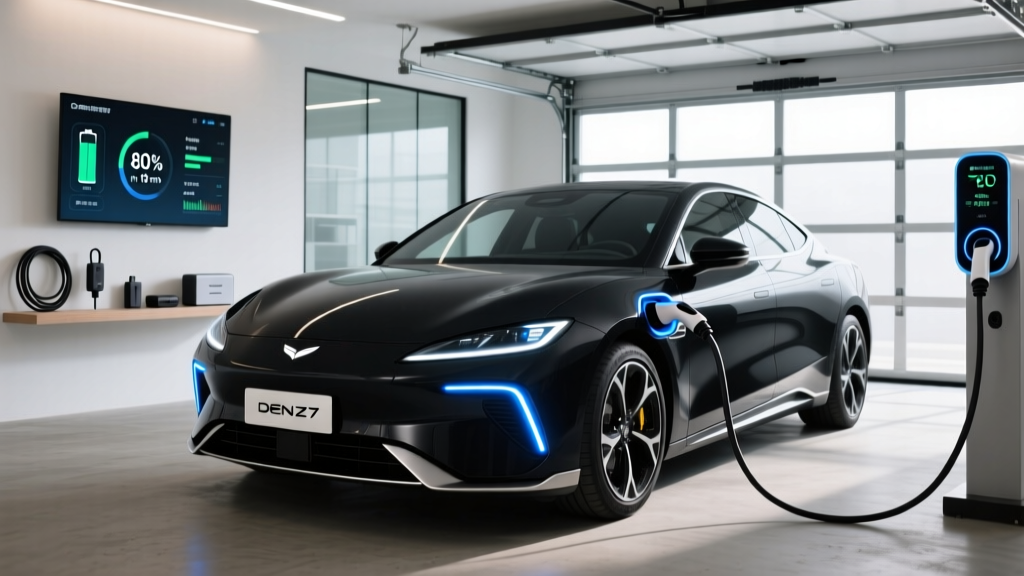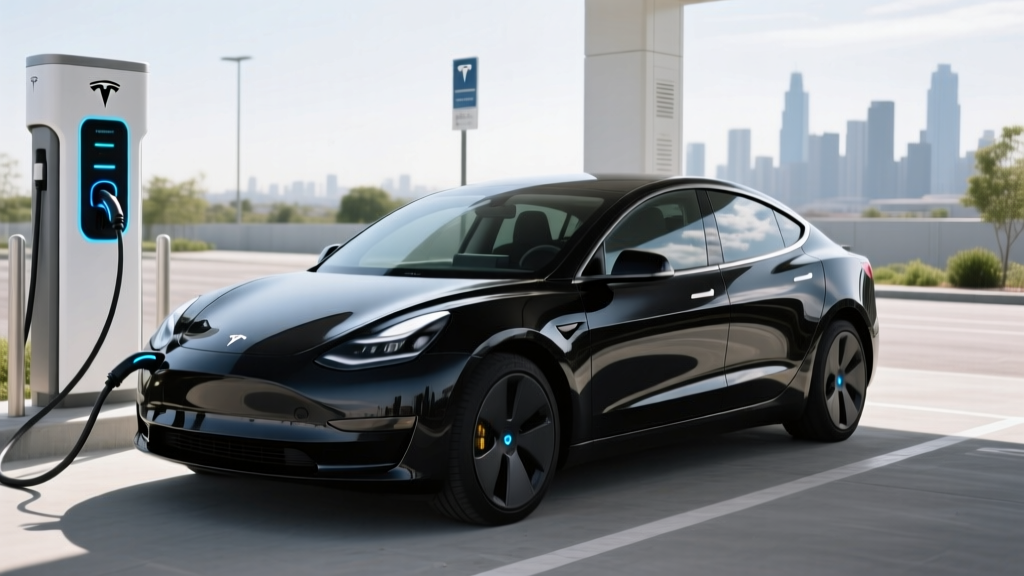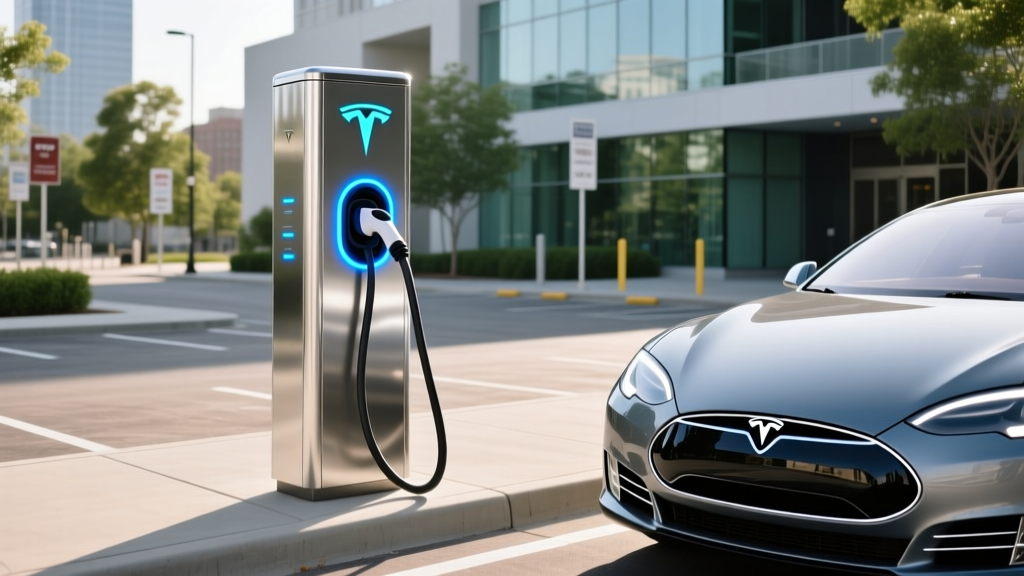
If you've pulled into a hotel, winery, or upscale restaurant and spotted a sleek wall-mounted charging unit with a Tesla logo, you've likely encountered a Tesla Destination Charger. But what exactly is it, how does it differ from a Supercharger, and does it matter if you drive a non-Tesla EV? This guide answers the question "what is a Tesla Destination Charger" in practical, spec-driven detail — and covers everything you need to know about home and public charging in 2026.
What Is a Tesla Destination Charger, Exactly?
A Tesla Destination Charger is a Level 2 AC charging station installed by businesses — hotels, restaurants, parking garages, resorts, shopping centers — as part of Tesla's Destination Charging program. Unlike Superchargers (which are DC fast chargers designed for 15-30 minute highway stops), Destination Chargers deliver slower, overnight-friendly power meant for extended parking sessions of 2 to 12+ hours.
Here's what defines them technically:
- Power output: Typically 11.5 kW to 19.2 kW (48A to 80A circuit), depending on the site's electrical infrastructure
- Connector: NACS (North American Charging Standard) — the same connector Tesla uses on all its vehicles and that most major automakers have adopted for 2025+ models
- Charging speed: Adds roughly 30-60 miles of range per hour, depending on vehicle acceptance rate
- Cost to user: Varies — many are free for patrons; some charge $0.20-$0.40/kWh or a flat session fee
- Network: Listed on Tesla's in-vehicle navigation and the Tesla app, but not part of the Supercharger network
Destination Chargers are essentially Tesla-branded Level 2 wall connectors deployed at commercial locations. Tesla provides the hardware to participating businesses at little or no cost; the business covers installation and electricity. For context, a Tesla Wall Connector purchased for home use retails around $475 and offers the same core functionality.
Charging Levels Explained: Speeds, kW, and Miles Per Hour
Before going further, let's clarify a critical distinction: kW (kilowatts) measures power — the rate at which energy flows into your battery. kWh (kilowatt-hours) measures energy — the total capacity of your battery. Think of kW as the width of a hose and kWh as the size of the bucket. A wider hose (higher kW) fills the bucket (kWh) faster.
| Level | Voltage | Max Power (kW) | Miles of Range Added/Hour | Typical Use Case |
|---|---|---|---|---|
| Level 1 | 120V AC | 1.4-1.9 kW | 3-5 mi/hr | Emergency/trickle; standard outlet |
| Level 2 | 240V AC | 7.2-19.2 kW | 20-60 mi/hr | Home, workplace, Destination Chargers |
| DC Fast (Level 3) | 400-800V DC | 50-350 kW | 150-1,000+ mi/hr | Highway travel; 10-80% in 15-40 min |
A Tesla Destination Charger operates at Level 2. If you park at a hotel with a 19.2 kW Destination Charger for 8 hours, you could add up to 240-300 miles of range — enough to fully replenish most EV batteries overnight. That's the design intent: slow, convenient topping while you sleep, dine, or shop.
For comparison, a Tesla V4 Supercharger delivers up to 250-350 kW of DC power, adding up to 200 miles in roughly 15 minutes. But Superchargers are located along highways, not at hotels.
Home Charging Installation: Electrical Requirements, Costs, and Gotchas
If you're considering installing a Level 2 charger at home — whether a Tesla Wall Connector or a third-party unit — here's what's involved electrically and financially.
Electrical Requirements
A Level 2 home charger requires a dedicated 240V circuit, similar to what powers an electric dryer or oven. Common configurations:
- 40A circuit / 32A continuous: Delivers ~7.7 kW — sufficient for most EVs with onboard chargers capped at 7.7-11.5 kW
- 60A circuit / 48A continuous: Delivers ~11.5 kW — the sweet spot for Tesla vehicles and many 2025+ EVs with 11.5 kW onboard chargers
- 80A circuit / 64A continuous: Delivers ~15.3 kW — requires robust panel capacity; beneficial for large batteries like the Ford F-150 Lightning Extended Range (131 kWh usable)
National Electrical Code (NEC) requires EV chargers to be on a dedicated circuit with a breaker rated 125% of the continuous load. A 48A charger needs a 60A breaker. A GFCI breaker is required for outdoor installations in most jurisdictions.
Installation Cost Breakdown
| Component | Cost Range | Notes |
|---|---|---|
| Level 2 Charger (hardware) | $350-$750 | Tesla Wall Connector ~$475; ChargePoint Home Flex ~$599 |
| Electrician labor (standard install) | $500-$1,500 | Short run from panel to garage; conduit, wiring, breaker |
| Permit fees | $50-$250 | Varies by municipality; some jurisdictions waive for EV |
| Panel upgrade (if needed) | $1,500-$3,500 | 100A → 200A service; common in pre-2000 homes |
| Trenching / long wire runs | $500-$2,000+ | Detached garage or charger far from panel |
| Total (no panel upgrade) | $900-$2,500 | Typical attached-garage scenario |
| Total (with panel upgrade) | $2,400-$6,000 | Older homes needing 200A service |
The panel upgrade is the wildcard. If your home has a 100A electrical panel (common in homes built before 2000), adding a 60A EV circuit may push you over capacity, especially if you also run electric HVAC, a dryer, and an electric range. A licensed electrician can perform a load calculation to determine if an upgrade is necessary. Don't skip this step — an overloaded panel is a fire risk.
The federal residential clean energy credit (IRS §25D) does not cover EV charger hardware in 2026, though the Alternative Fuel Vehicle Refueling Property Credit (§30C) may offer up to $1,000 for home charging equipment if you live in a qualifying census tract. Check irs.gov for current eligibility maps.
Connector Compatibility: Will It Fit My EV?
The EV charging connector landscape has consolidated dramatically since 2023. Here's the 2026 reality:
| Connector | Vehicles Using It (2026) | Notes |
|---|---|---|
| NACS (Tesla) | All Tesla models; Ford F-150 Lightning, Mustang Mach-E (2025+); GM Ultium vehicles (2025+); Rivian R1T/R1S (2025+); Volvo, Polestar, Nissan (2025+) | Now the dominant standard in North America |
| CCS1 | Legacy Hyundai/Kia (pre-2025), BMW i4/iX (pre-2026), VW ID.4 (pre-2025), older non-Tesla EVs | Being phased out by most automakers |
| CHAdeMO | Nissan Leaf (legacy only); Mitsubishi Outlander PHEV | Effectively discontinued for new models |
Since Tesla Destination Chargers use the NACS connector, they natively fit all Tesla vehicles and the growing roster of NACS-equipped 2025-2026 models from Ford, GM, Rivian, Volvo, and others. If you drive an older CCS1-equipped EV, you'll need a CCS-to-NACS adapter (several are available for $150-$250 from brands like Lectron and A2Z). However, not all Destination Chargers welcome non-Tesla vehicles — some remain Tesla-only per the business's agreement with Tesla. Always check the Tesla app or in-vehicle navigation for access details before relying on one.
Cost to Charge: Home vs. Public vs. Gas
One of the strongest arguments for EV ownership is per-mile fuel cost. Here's how charging scenarios compare in 2026:
| Scenario | Cost per kWh | Cost per Mile* | Annual Fuel Cost (12,000 mi) |
|---|---|---|---|
| Home (off-peak utility rate) | $0.08-$0.14 | $0.024-$0.042 | $288-$504 |
| Home (average blended rate) | $0.14-$0.18 | $0.042-$0.054 | $504-$648 |
| Destination Charger (paid) | $0.20-$0.40 | $0.06-$0.12 | $720-$1,440 |
| Public DC Fast (Electrify America, EVgo) | $0.35-$0.55 | $0.105-$0.165 | $1,260-$1,980 |
| Gas car (28 MPG combined, $3.40/gal) | — | $0.121 | $1,457 |
*Based on an EV averaging 3.0-3.5 miles per kWh (typical for a midsize crossover like the Tesla Model Y or Hyundai Ioniq 5). Efficiency varies by vehicle, temperature, and driving style.
Home charging at off-peak rates remains the cheapest option by a wide margin — often 70-80% less per mile than gasoline. Even paid Destination Chargers at $0.30/kWh undercut gas on a per-mile basis for efficient EVs. The worst-case scenario — exclusive reliance on DC fast charging at $0.50/kWh — approaches or exceeds gas costs, which is why home or workplace Level 2 charging is the economic backbone of EV ownership.
Charging Time Examples: What to Expect
Charging time depends on three variables: the charger's power output (kW), your vehicle's onboard charger capacity (for Level 2), and your battery size (kWh). Here are real-world examples:
- Tesla Model Y Long Range (75 kWh usable) on a 19.2 kW Destination Charger: 10-80% in approximately 3.5-4 hours
- Ford F-150 Lightning Extended Range (131 kWh usable) on an 11.5 kW Destination Charger: 10-80% in approximately 10-11 hours
- Hyundai Ioniq 5 (77.4 kWh usable) on a 350 kW DC fast charger: 10-80% in approximately 18-20 minutes (peak rate tapers above 80%)
- Chevrolet Equinox EV (85 kWh usable) on a 7.7 kW Level 2 circuit: 10-80% in approximately 8-9 hours
Note that DC fast charging speeds are not linear. A vehicle may peak at 250 kW from 10-30% SoC, then taper to 150 kW by 50%, and drop below 50 kW past 80%. This charge-curve taper is why manufacturers quote 10-80% times rather than 0-100%. For Level 2 Destination Charging, the rate is essentially constant until the battery nears full, making it ideal for predictable overnight fills.
Equipment Recommendations for Home Level 2 Charging
If you're buying a Level 2 charger for home use, these are the top-performing, code-compliant options in 2026:
Tesla Wall Connector (Gen 4)
- Power output: Up to 11.5 kW (48A on 60A circuit)
- Connector: NACS native
- Cable length: 24 feet
- Smart features: Wi-Fi, OTA updates, power-sharing (link up to 6 units on one circuit), Tesla app integration
- Price: ~$475
- Best for: Tesla owners; NACS-equipped Ford/GM/Rivian owners
ChargePoint Home Flex
- Power output: Up to 12 kW (50A on 60A circuit); configurable down to 16A
- Connector: NACS (2025+ models); CCS adapter included for older units
- Cable length: 23 feet
- Smart features: Wi-Fi, ChargePoint app, Amazon Alexa, scheduling, energy tracking
- Price: ~$599
- Best for: Multi-EV households; users wanting detailed energy data
Emporia Vue Level 2 Charger
- Power output: Up to 11.5 kW (48A on 60A circuit)
- Connector: NACS or J1772 versions available
- Cable length: 24 feet
- Smart features: Wi-Fi, solar integration, energy monitoring via Emporia app, load management
- Price: ~$399
- Best for: Budget-conscious buyers; solar-panel owners
All three units are UL-listed, rated for indoor and outdoor use (NEMA 4), and compatible with hardwired or NEMA 14-50 plug installation. Hardwired is preferred for 48A+ units — a NEMA 14-50 outlet is rated for 50A, which limits continuous draw to 40A (9.6 kW). If you want the full 48A (11.5 kW), hardwire directly to the breaker.
Safety, Code, and Installation Best Practices
EV chargers draw significant continuous current — often for 8-12 hours straight. Proper installation isn't optional:
- Dedicated circuit: Your charger must have its own breaker — no sharing with other appliances
- GFCI protection: Required for outdoor installations per NEC 2023/2026; many jurisdictions now require it indoors as well
- Wire gauge: 6 AWG copper for 60A circuits; 4 AWG for 80A. Aluminum wire requires one size larger
- Outdoor rating: NEMA 4 (weather-resistant) enclosure required for exterior mounting
- Permit and inspection: Most municipalities require an electrical permit and post-installation inspection. Skipping this can void home insurance coverage in the event of a fire
- Load calculation: Your electrician should perform a NEC Article 220 load calculation to confirm your panel can handle the added circuit
Never use an extension cord with a Level 2 charger. Never plug a charger into an outlet shared with high-draw appliances. And if your installation involves running conduit through finished walls or across an attic, factor in the additional labor cost — it can double the electrician's estimate.
Frequently Asked Questions
How much does it cost to install a home EV charger?
A typical Level 2 home charger installation costs $900-$2,500 when no panel upgrade is needed (equipment + electrician + permit). If your home requires a 100A-to-200A panel upgrade, expect $2,400-$6,000 total. Get at least two quotes from licensed electricians and confirm they include permit fees in the estimate.
How fast will each charging level add range?
Level 1 (120V): 3-5 miles per hour. Level 2 (240V): 20-60 miles per hour depending on kW output. DC fast charging: 150-1,000+ miles per hour equivalent, though sessions are measured in minutes (10-80% in 15-40 min for most 2026 EVs).
Which connector is compatible with my EV?
For 2025-2026 model-year vehicles, NACS is the dominant standard — Tesla, Ford, GM, Rivian, Volvo, Polestar, and Nissan have adopted it. Older non-Tesla EVs (pre-2025 Hyundai, Kia, BMW, VW) use CCS1. CHAdeMO is limited to legacy Nissan Leaf models. Check your vehicle's charge port or owner's manual to confirm.
How much does charging cost per mile vs. gas?
Home charging at average utility rates costs $0.03-$0.05 per mile — roughly 60-75% less than a 28 MPG gas car at $3.40/gallon ($0.12/mile). Even paid public DC fast charging at $0.45/kWh costs ~$0.13-$0.15/mile, roughly equal to gas. The savings are maximized with home Level 2 charging at off-peak rates.
What electrical upgrades might I need?
Homes built before 2000 with 100A panels often need a panel upgrade to 200A to safely support a 60A EV circuit alongside existing loads. Homes with 200A panels usually have sufficient headroom. A load calculation by a licensed electrician (per NEC Article 220) is the definitive answer. Some utilities offer rebates for panel upgrades tied to EV adoption.
Can non-Tesla vehicles use Tesla Destination Chargers?
Physically, any NACS-equipped vehicle (2025+ Ford, GM, Rivian, etc.) can plug in. However, access policies vary by location — some Destination Chargers are restricted to Tesla vehicles per the host business's agreement. Always verify in the Tesla app or on-site signage before relying on one. CCS-equipped vehicles need a CCS-to-NACS adapter and should confirm compatibility.
What's the difference between a Destination Charger and a Supercharger?
Destination Chargers are Level 2 AC chargers (11.5-19.2 kW) at hotels, restaurants, and similar locations, designed for multi-hour parking. Superchargers are DC fast chargers (150-350 kW) along highways, designed for 15-30 minute stops. Think of Destination Chargers as the "overnight" option and Superchargers as the "road trip" option.