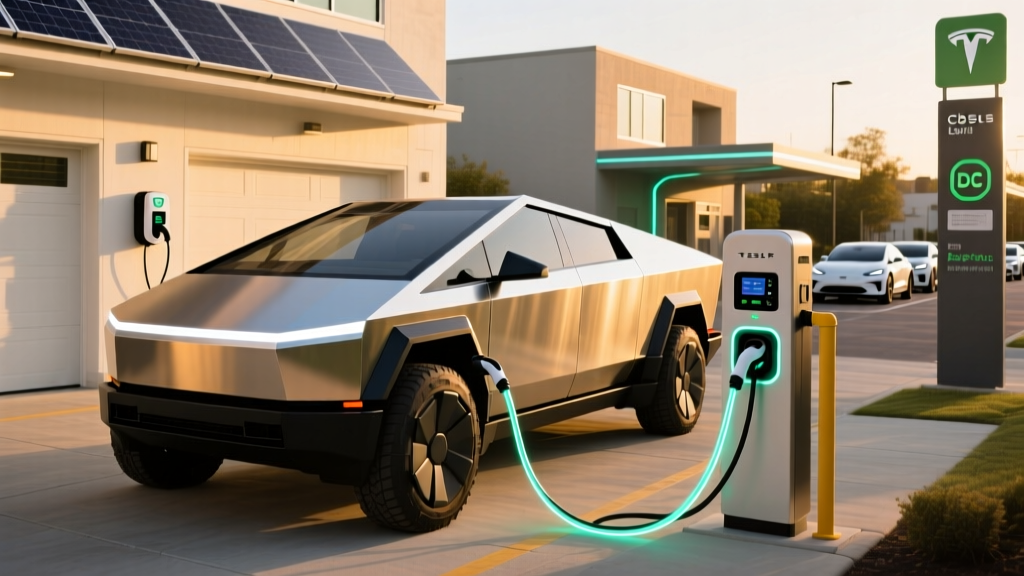
The Tesla Cybertruck's massive 123 kWh battery pack (usable) and 845-horsepower tri-motor powertrain make it one of the most capable electric vehicles on the road — but that same battery size demands a serious charging strategy. Whether you're looking to preserve your Tesla Cybertruck range (EPA-estimated 340 miles for the AWD trim, 320 miles for the Cyberbeast) or minimize downtime on road trips, understanding your charging options is non-negotiable for ownership.
This guide breaks down every charging scenario a Cybertruck owner will face: home Level 2 installation, public DC fast charging, connector compatibility, and the real cost per mile. We'll also cover the electrical upgrades your home might need before plugging in a 15,000-pound electric truck.
Cybertruck Range and Battery: What You're Charging
Before selecting chargers or scheduling an electrician, you need to understand what you're filling. The Cybertruck uses a structural battery pack with 4680-type cells in a nickel-manganese-cobalt (NMC) chemistry, chosen for its high energy density to offset the truck's 6,600–6,800 lb curb weight.
- Cybertruck AWD: EPA 340 miles — expect ~280–310 miles mixed highway driving, ~230–260 miles in freezing temperatures
- Cybertruck Cyberbeast: EPA 320 miles — expect ~260–290 miles mixed highway, ~220–250 miles in freezing temperatures
- Towing (5,000 lb trailer): Range drops 40–50%, yielding roughly 160–190 miles depending on terrain and speed
Source: EPA Fuel Economy
The 123 kWh usable capacity means a full 10–80% charge requires pushing roughly 86 kWh into the pack. That's a lot of energy — and it dictates why a standard 120V outlet won't cut it for daily ownership.
Charging Levels Explained: Speeds, kW, and Miles Per Hour
EV charging is measured in kW (kilowatts), which is the rate of power delivery — think of it as the width of the hose. The battery capacity is measured in kWh (kilowatt-hours), the total volume of energy stored. Confusing these two is the single most common mistake new EV owners make.
| Level | Voltage | Max Power (kW) | Miles Added/Hour | 10–80% Time (Cybertruck) | Best For |
|---|---|---|---|---|---|
| Level 1 (120V) | 120V AC | 1.2–1.4 kW | ~3–4 mi/hr | ~72+ hours | Emergency/trickle only |
| Level 2 (240V) | 240V AC | 7.2–19.2 kW | ~22–58 mi/hr | ~5–12 hours | Daily home charging |
| DC Fast Charge | 400–800V DC | Up to 250 kW (Cybertruck) | ~180–500+ mi/hr | ~28–35 minutes | Road trips, quick top-ups |
The Cybertruck supports up to 19.2 kW AC Level 2 charging via its onboard charger and up to 250 kW peak DC fast charging. In real-world DC fast charging, expect the Cybertruck to peak around 250 kW in ideal conditions (warm battery, low state of charge) and taper significantly above 60% SoC. A typical 10–80% session at a Tesla V4 Supercharger takes approximately 28–35 minutes.
Home Level 2 Charger Installation: Electrical Requirements and Costs
A proper Level 2 home charger is the backbone of Cybertruck ownership. Here's what your electrical system needs to support:
Electrical Requirements
- Circuit: Dedicated 60-amp breaker (for a 48-amp continuous charger) or 50-amp breaker (for 40-amp continuous)
- Voltage: 240V single-phase (standard US residential split-phase)
- Wire gauge: 6 AWG copper for 60A circuits; 8 AWG for 50A
- Connector: NEMA 14-60 receptacle or hardwired connection (hardwired preferred for higher amperage and code compliance in many jurisdictions)
Panel Upgrade: The Hidden Cost
Most homes built before 2010 have 100-amp or 150-amp main service panels. Adding a 60-amp EV circuit to an already-loaded 100A panel often requires a panel upgrade to 200 amps, which is the single largest variable in your installation cost. A licensed electrician will perform a load calculation (NEC Article 220) to determine if your panel can handle the additional draw.
| Component | Cost Range | Notes |
|---|---|---|
| Level 2 Charger (Equipment) | $400 – $750 | 48A Wi-Fi-enabled units |
| Electrician Labor (standard install) | $500 – $1,500 | Run from panel to garage, 20–50 ft |
| Electrical Permit | $50 – $300 | Varies by municipality |
| Panel Upgrade (if needed) | $1,500 – $4,000 | 100A → 200A service upgrade |
| Total (no panel upgrade) | $950 – $2,550 | Typical for newer homes |
| Total (with panel upgrade) | $2,450 – $6,550 | Common for older homes |
Always hire a licensed electrician and pull a permit. Unpermitted electrical work can void your homeowner's insurance and create fire risk. Many utilities offer rebates of $250–$1,000 for Level 2 installations — check your local provider.
Connector Compatibility: NACS, CCS, and Adapters
The Cybertruck ships with the NACS (North American Charging Standard) connector — Tesla's proprietary plug that has now been adopted by Ford, GM, Rivian, Hyundai, and most major automakers. Here's how that affects your charging options:
| Connector Type | Network / Use | Cybertruck Compatible? | Adapter Needed? |
|---|---|---|---|
| NACS (Tesla) | Tesla Supercharger, Tesla Wall Connector, home chargers | ✅ Native | No |
| CCS1 | Electrify America, EVgo, ChargePoint DC stations | ⚠️ With adapter | Yes — NACS-to-CCS adapter (~$200–$300) |
| CHAdeMO | Legacy Nissan/Mitsubishi stations (declining) | ❌ Not practical | No reliable adapter exists |
| J1772 (Level 2) | Public Level 2 stations, non-Tesla home chargers | ⚠️ With adapter | Yes — J1772-to-NACS adapter (included with Cybertruck) |
Tesla includes a J1772-to-NACS adapter with every Cybertruck. For DC fast charging on non-Tesla networks (Electrify America, EVgo), you'll need a third-party NACS-to-CCS adapter from brands like Lectron or A2Z. However, Tesla's Supercharger network now has over 25,000 stalls in North America, making adapters largely unnecessary for most Cybertruck owners.
Cost to Charge: Home vs. Public vs. Gas Comparison
The Cybertruck's efficiency is rated at approximately 56 MPGe combined (AWD) — roughly 2.0 kWh per mile driven. That's thirsty by EV standards, owing to the truck's 6,700-lb weight and angular stainless-steel exoskeleton creating significant aerodynamic drag. Here's what that means for your wallet:
| Scenario | Rate | Cost for 300 Miles | Cost Per Mile |
|---|---|---|---|
| Home (off-peak utility rate) | $0.10/kWh | $60.00 | $0.20 |
| Home (national avg residential) | $0.17/kWh | $102.00 | $0.34 |
| Tesla Supercharger (avg) | $0.32/kWh | $192.00 | $0.64 |
| Electrify America (avg) | $0.48/kWh | $288.00 | $0.96 |
| Gas Truck (Ford F-150 4x4, 20 MPG) | $3.40/gal | $51.00 | $0.17 |
| Gas Truck (Chevy Silverado, 17 MPG) | $3.40/gal | $60.00 | $0.20 |
The honest math: at national average electricity rates, the Cybertruck's per-mile cost is comparable to a fuel-efficient gas truck — not dramatically cheaper. The savings become significant with time-of-use (TOU) utility plans that offer off-peak rates of $0.08–$0.12/kWh, where home charging drops to $0.16–$0.24 per mile. Public DC fast charging, by contrast, is often more expensive than gasoline per mile. This is a truck you buy for performance, utility, and technology — not for rock-bottom fuel costs.
Recommended Home Chargers for the Cybertruck
With a 123 kWh battery, you want the highest-amperage Level 2 charger your electrical panel supports. A 48-amp charger delivering 11.5 kW will add roughly 34 miles of range per hour — enough to fully replenish a day's driving overnight. Here are our top picks for 2026:
Tesla Wall Connector (Gen 4)
- Power Output: Up to 48A / 11.5 kW (240V)
- Connector: NACS native — no adapter needed
- Cable Length: 24 feet
- Smart Features: Wi-Fi, OTA updates, Power Sharing (link two units on one circuit), access control
- Price: ~$475
- Why it works: Seamless integration with the Tesla app, scheduled charging, and native NACS plug make this the default choice for Cybertruck owners.
ChargePoint Home Flex
- Power Output: Configurable 16A–50A / up to 12 kW (240V)
- Connector: J1772 (NACS adapter required — included with Cybertruck)
- Cable Length: 23 feet
- Smart Features: Wi-Fi, Alexa integration, amperage dial adjustment, detailed energy tracking
- Price: ~$550–$700
- Why it works: Adjustable amperage lets you match your circuit exactly — ideal if your panel can only support a 40A or 50A breaker.
Emporia Level 2 EV Charger
- Power Output: Up to 48A / 11.5 kW (240V)
- Connector: J1772 (NACS adapter required)
- Cable Length: 24 feet
- Smart Features: Wi-Fi, solar integration (pairs with Emporia Vue energy monitor), load management
- Price: ~$400–$500
- Why it works: Best value for smart features; excellent if you have rooftop solar and want to charge only on excess production.
Safety and Electrical Code Considerations
EV charging draws sustained high current for hours — more like a continuous industrial load than a typical household appliance. Safety isn't optional:
- Dedicated circuit: Your Level 2 charger must have its own dedicated breaker — never share a circuit with other appliances. NEC 625.40 requires this for all EV supply equipment.
- GFCI protection: NEC 2020 and later require GFCI (Ground Fault Circuit Interrupter) protection for outdoor receptacles used for EV charging. Hardwired installations may be exempt depending on local code — ask your electrician.
- Outdoor rating: If mounting outside, ensure the charger is rated NEMA 4 (weatherproof). The Tesla Wall Connector and ChargePoint Home Flex both carry NEMA 4 ratings.
- Cable management: Use a wall-mounted holster or retractable cable reel to prevent tripping hazards and cord damage. Never run charging cables across driveways or walkways.
- Thermal monitoring: Quality chargers include built-in thermal sensors that reduce power if the plug or cable overheats. Avoid cheap, no-name chargers lacking this protection.
Cybertruck DC Fast Charging: Real-World Expectations
On road trips, the Cybertruck's 250 kW peak DC fast charging capability means quick stops at Tesla Superchargers — but understanding the charge curve is essential for realistic trip planning.
Like all lithium-ion batteries, the Cybertruck charges fastest at low states of charge and progressively slows as the battery fills. Here's a typical session at a V3 or V4 Supercharger:
- 10–30% SoC: Peak ~250 kW — adds roughly 120 miles in 10 minutes
- 30–60% SoC: Sustains ~150–200 kW — adds roughly 100 miles in 12 minutes
- 60–80% SoC: Tapers to ~80–120 kW — adds roughly 60 miles in 12 minutes
- 80–100% SoC: Drops to ~20–40 kW — not recommended for road trips; charge to 80% and go
Total 10–80% time: approximately 28–35 minutes under good conditions. Cold weather (below 32°F) can add 5–10 minutes to this unless the battery is preconditioned — the Cybertruck automatically warms the pack when you navigate to a Supercharger, so always use the built-in navigation for charging stops.
Frequently Asked Questions
How much does it cost to install a home EV charger for the Cybertruck?
A standard Level 2 installation with a 60-amp circuit typically costs $950–$2,550 including equipment, electrician labor, and permit — assuming your electrical panel has sufficient capacity. If your home needs a panel upgrade from 100A to 200A service, add $1,500–$4,000, bringing the total to $2,450–$6,550. Always get a load calculation from a licensed electrician before committing.
How fast will each charging level add range to the Cybertruck?
Level 1 (120V) adds roughly 3–4 miles per hour — essentially useless for a 123 kWh battery. Level 2 at 48A (11.5 kW) adds about 34 miles per hour, replenishing a full day's driving in 4–6 hours. DC fast charging at 250 kW peak can add up to 200 miles in roughly 15 minutes at the start of a session, tapering as the battery fills.
Which connector and charger is compatible with the Cybertruck?
The Cybertruck uses the NACS connector natively. This works directly with all Tesla Superchargers and the Tesla Wall Connector. For non-Tesla Level 2 stations (J1772 plug), Tesla includes a J1772-to-NACS adapter. For Electrify America or EVgo DC fast chargers (CCS1 plug), you'll need an aftermarket NACS-to-CCS adapter. CHAdeMO is effectively unsupported.
How much does charging the Cybertruck cost per mile vs. a gas truck?
At home with the national average electricity rate ($0.17/kWh), the Cybertruck costs approximately $0.34 per mile. A comparable gas truck (Ford F-150 4x4 at 20 MPG) costs about $0.17/mile at $3.40/gallon. With off-peak utility rates ($0.10/kWh), the Cybertruck drops to $0.20/mile. Public DC fast charging ($0.32–$0.48/kWh) costs $0.64–$0.96 per mile — more expensive than gas. Home charging on a TOU plan is where EV savings materialize.
What electrical upgrades might I need for a Cybertruck home charger?
The most common upgrade is a panel service increase from 100A to 200A, needed when your existing panel lacks capacity for a 60-amp dedicated EV circuit. Older homes may also need updated wiring from the utility meter to the panel, or a sub-panel installation in the garage. Your electrician will perform a NEC Article 220 load calculation to determine your exact needs.
Does the Cybertruck qualify for the federal EV tax credit?
The Cybertruck's eligibility for the IRS §30D tax credit depends on current-year battery sourcing, critical mineral requirements, MSRP caps ($80,000 for trucks), and buyer income limits ($300K joint / $150K single). Rules change frequently — consult a tax professional and check the IRS qualified vehicle list before purchasing. The credit may be transferred to the dealer at point of sale if eligible.
Source references: EPA Fuel Economy — Tesla Cybertruck, Tesla Home Charging Installation Guide, IRS New Clean Vehicle Credit