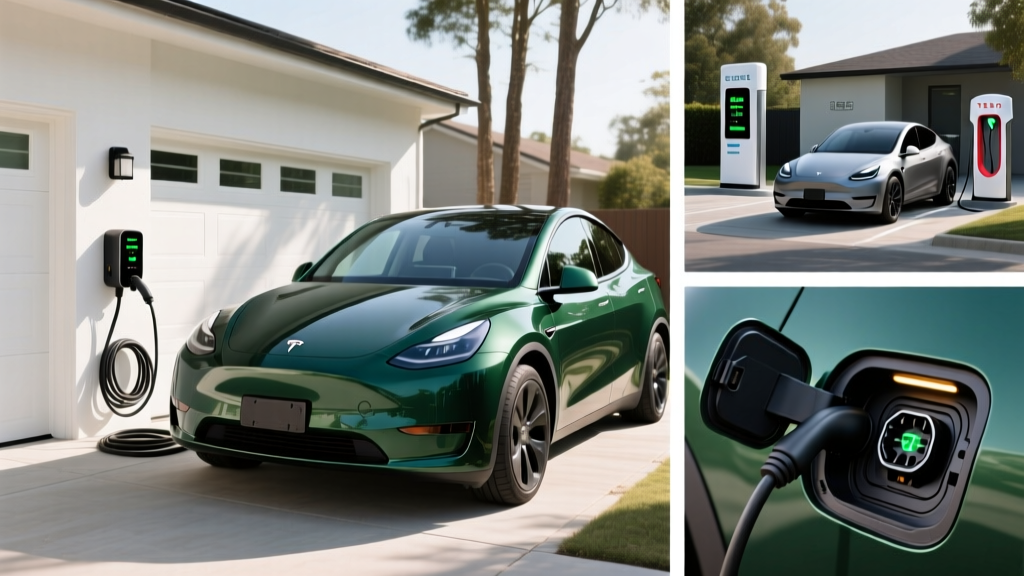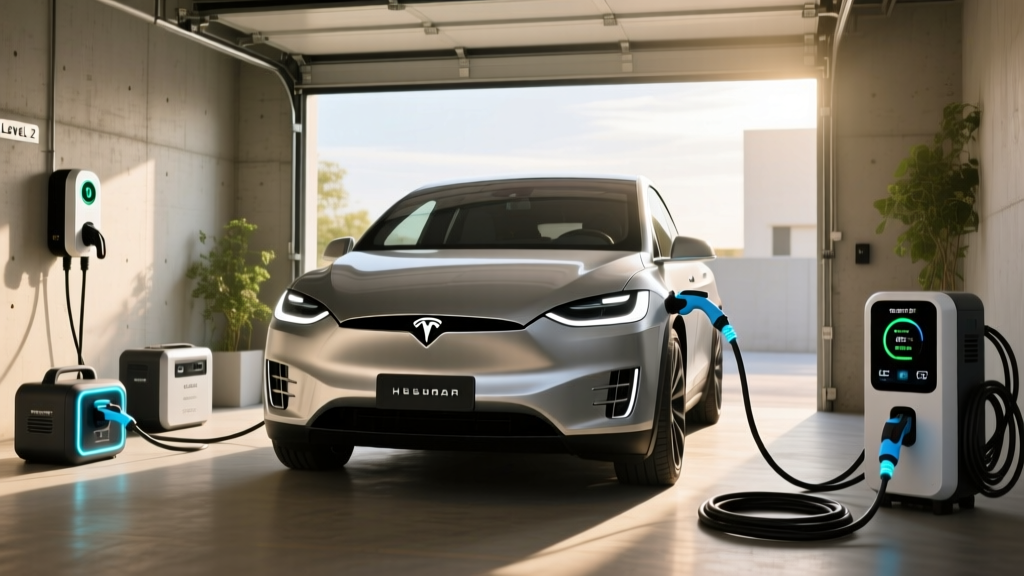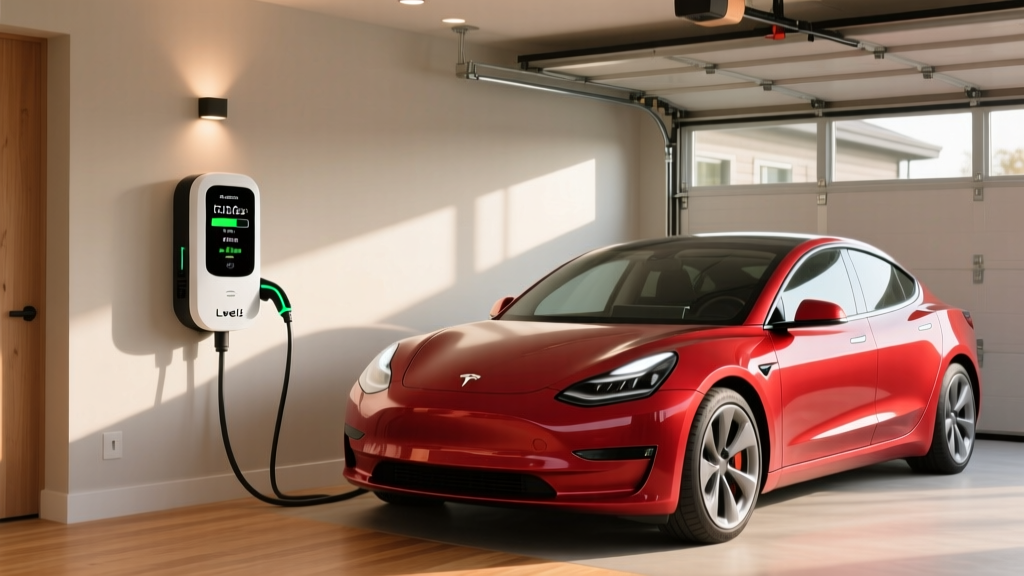
Over 80% of Tesla charging happens at home, and for good reason: waking up to a full battery every morning eliminates range anxiety and costs a fraction of public fast charging. But "Tesla charging from home" means different things depending on your electrical setup, budget, and daily mileage needs. This guide breaks down exactly what it takes to charge a Tesla at home in 2026 — from a standard 120V outlet to a hardwired 48-amp Wall Connector — with real numbers for speed, cost, and installation.
Understanding Charging Levels: What Speed Can You Expect?
Before choosing equipment, you need to understand the three charging levels available to Tesla owners. The critical distinction: kW (kilowatts) measures power — how fast energy flows into your car. kWh (kilowatt-hours) measures energy — how much your battery holds. A Tesla Model Y Long Range has an ~75 kWh usable battery; charging it at 11.5 kW adds roughly 11.5 kWh per hour.
| Level | Voltage | Max Power (kW) | Miles of Range Added/Hour | Typical Use Case |
|---|---|---|---|---|
| Level 1 | 120V AC | 1.0–1.4 kW | 3–5 miles | Overnight top-up, low daily mileage |
| Level 2 | 240V AC | 3.3–11.5 kW | 14–44 miles | Daily home charging, full overnight recharge |
| DC Fast Charging | 400V+ DC | 50–250+ kW | 150–1,000+ miles (equivalent) | Road trips, Superchargers |
Home Electrical Requirements: What Your Panel Needs to Handle
Level 2 Tesla charging from home requires a 240-volt circuit, similar to what powers an electric dryer or oven. The most common setup for Tesla owners is a NEMA 14-50 outlet or a hardwired Tesla Wall Connector. Here's what each configuration demands:
- NEMA 14-50 outlet (40A circuit): Delivers up to 9.6 kW (32A continuous draw). Requires a 50-amp breaker. This is the most flexible option — you can unplug and take the Mobile Connector with you.
- Hardwired Wall Connector (60A circuit): Delivers up to 11.5 kW (48A continuous draw). Requires a 60-amp breaker. Faster charging, no outlet wear, and eligible for some utility rebates.
- Hardwired Wall Connector (40A circuit): Delivers up to 7.7 kW (32A continuous). Adequate for most daily needs and works in homes where a 60A circuit isn't feasible.
Do You Need a Panel Upgrade?
This is the question that can double or triple your installation cost. Most homes built after 2000 have a 200-amp electrical panel, which typically supports a 40A–60A EV circuit without issue. However, older homes with 100-amp service, or homes already running multiple high-draw appliances (electric range, dryer, HVAC, hot tub), may need a panel upgrade to 200A or even 400A.
A licensed electrician will perform a load calculation (per NEC Article 220) to determine if your panel has headroom. Signs you might need an upgrade: your panel is 100A, you have fewer than 4 open breaker slots, or your electrician flags existing circuits near capacity.
How Much Does It Cost to Install a Home Tesla Charger?
Installation costs vary enormously based on your home's electrical infrastructure, the distance from panel to charging location, and local permitting. Here's a realistic breakdown for 2026:
| Component | Basic Install (NEMA 14-50, short run) | Standard Install (Hardwired, moderate run) | Complex Install (panel upgrade + long run) |
|---|---|---|---|
| Tesla Wall Connector (hardware) | $0 (using Mobile Connector) | $475 | $475 |
| Electrical materials (wire, conduit, breaker) | $150–$300 | $300–$600 | $500–$900 |
| Electrician labor (licensed) | $400–$800 | $800–$1,500 | $1,500–$3,000 |
| Permit & inspection | $50–$150 | $100–$300 | $150–$400 |
| Panel upgrade (if needed) | $0 | $0 | $1,500–$4,000 |
| Total Estimated Cost | $600–$1,250 | $1,675–$2,875 | $4,125–$8,775 |
Which Connector Does Your Tesla Need? (NACS Compatibility Guide)
Tesla pioneered the North American Charging Standard (NACS) connector, which is now being adopted across the industry. If you own a Tesla, you have the simplest home charging situation: every Tesla vehicle sold in North America uses the native NACS plug, and the Tesla Wall Connector ships with a NACS cable.
For non-Tesla EV owners considering a Tesla Wall Connector (now open to other brands), or Tesla owners who also drive a CCS-equipped vehicle, here's the connector landscape:
| Connector | Brands Using It (2026) | Tesla Wall Connector Compatible? | Adapter Needed? |
|---|---|---|---|
| NACS (Tesla) | Tesla (all), Ford, GM, Rivian, Volvo, Polestar, others transitioning | Yes — native | None for Tesla vehicles |
| CCS1 | Hyundai, Kia, BMW, VW, legacy non-Tesla EVs | Yes (with CCS adapter) | Tesla CCS Adapter (~$175) or third-party |
| CHAdeMO | Nissan Leaf (legacy), Mitsubishi | No | Not available |
If you're a Tesla owner who occasionally needs to charge a CCS-equipped guest vehicle at home, the Tesla Wall Connector with its Magic Dock adapter (available at select Superchargers) or a separate CCS-compatible Level 2 unit may be worth considering.
Cost to Charge a Tesla at Home vs. Gas: The Per-Mile Breakdown
One of the strongest arguments for Tesla charging from home is the fuel-cost advantage. Here's how it breaks down using 2026 average electricity and gasoline prices:
| Scenario | Rate | Cost to Add 200 Miles | Cost Per Mile |
|---|---|---|---|
| Home charging (national avg. electricity) | $0.16/kWh | $8.80 | $0.044 |
| Home charging (off-peak TOU rate) | $0.09/kWh | $4.95 | $0.025 |
| Home charging (California avg.) | $0.28/kWh | $15.40 | $0.077 |
| Tesla Supercharger (avg.) | $0.32/kWh | $17.60 | $0.088 |
| Public DC fast charger (Electrify America, EVgo) | $0.40/kWh | $22.00 | $0.110 |
| Gas vehicle (30 MPG, $3.40/gal) | $3.40/gallon | $22.67 | $0.113 |
| Gas vehicle (25 MPG, $3.40/gal) | $3.40/gallon | $27.20 | $0.136 |
How these numbers are calculated: A Tesla Model Y consumes approximately 28 kWh per 100 miles (per fueleconomy.gov). Adding 200 miles requires roughly 56 kWh. At $0.16/kWh, that's $8.96 — less than half the cost of fueling an equivalent gas crossover.
For a driver covering 12,000 miles annually with off-peak home charging at $0.09/kWh, the yearly "fuel" cost is approximately $297. A comparable gas vehicle at 28 MPG and $3.40/gallon spends $1,457 — a savings of over $1,100 per year with home Tesla charging.
Best Home Charging Equipment for Tesla Owners in 2026
Here are the top Level 2 chargers we recommend for Tesla home charging, based on power output, reliability, smart features, and value:
Tesla Wall Connector (Gen 3)
- Power Output: Up to 11.5 kW (48A) on a 60A circuit
- Connector: Native NACS (24-foot cable)
- Smart Features: Wi-Fi, OTA updates, Power Sharing (link multiple units), access control
- Price: $475
- Best For: Tesla-only households wanting maximum speed and seamless integration
ChargePoint Home Flex
- Power Output: Up to 12 kW (50A) on a 60A circuit, configurable down to 16A
- Connector: NACS or J1772 (23-foot cable)
- Smart Features: Wi-Fi, app scheduling, Alexa integration, detailed energy tracking
- Price: $649 (NACS version)
- Best For: Multi-EV households or those wanting granular app control
Tesla Mobile Connector (Bundle)
- Power Output: Up to 7.7 kW (32A) on a 40A circuit via NEMA 14-50 adapter
- Connector: Native NACS
- Smart Features: None (plug and charge)
- Price: $200 (includes 120V and 240V adapters)
- Best For: Budget-conscious installs, renters, or backup/travel use
Grizzl-E Smart
- Power Output: Up to 10 kW (40A) on a 50A circuit
- Connector: NACS available (24-foot cable)
- Smart Features: Wi-Fi, OCPP support, adjustable amperage, built-in load management
- Price: $499
- Best For: Cold-climate garages (rated to -40°F), outdoor installs
Charging Time Examples: How Long to Charge Common Tesla Batteries
Charge times depend on battery size, starting state of charge, and circuit amperage. Here are realistic 10–80% charge times for popular Tesla models on common home setups:
| Vehicle | Usable Battery (kWh) | Level 1 (1.4 kW / 120V) | Mobile Connector (7.7 kW / 14-50) | Wall Connector (11.5 kW / 60A) |
|---|---|---|---|---|
| Model 3 RWD | 57.5 kWh | ~34 hours | ~5.2 hours | ~3.5 hours |
| Model 3 Long Range | 75 kWh | ~45 hours | ~6.8 hours | ~4.6 hours |
| Model Y Long Range | 75 kWh | ~45 hours | ~6.8 hours | ~4.6 hours |
| Model S / X | 95 kWh | ~57 hours | ~8.6 hours | ~5.8 hours |
Safety, Permits, and Code Requirements
Home EV charger installation isn't a DIY project — the National Electrical Code (NEC) and most local jurisdictions require a licensed electrician and a permit. Here's what you need to know:
- Dedicated circuit: Your EV charger must have its own dedicated breaker — it cannot share a circuit with other appliances. A NEMA 14-50 requires a 50A breaker; a hardwired 48A Wall Connector requires a 60A breaker.
- GFCI protection: NEC 2020 and later requires GFCI protection for outdoor outlets. Hardwired units typically don't need a separate GFCI breaker (the Wall Connector has built-in ground fault protection).
- Outdoor rating: If your charger is installed outside, the Tesla Wall Connector is rated NEMA 3R (weather-resistant). For NEMA 14-50 outlets installed outdoors, a weatherproof in-use cover is required by code.
- Wire gauge: A 60A circuit requires 6 AWG copper wire (or 4 AWG aluminum) for runs up to ~100 feet. Longer runs may require thicker wire to minimize voltage drop.
- Permit and inspection: Most jurisdictions require an electrical permit ($50–$300) and a final inspection. Skipping this can void your homeowner's insurance in the event of a fire.
Frequently Asked Questions
How much does it cost to install a home EV charger for a Tesla?
A basic NEMA 14-50 outlet installation runs $600–$1,250 (electrician + materials + permit). A hardwired Tesla Wall Connector on a 60A circuit costs $1,675–$2,875. If your home needs a panel upgrade (100A to 200A), add $1,500–$4,000, bringing the total to $4,000–$8,000+.
Can I charge my Tesla from a regular 120V outlet?
Yes, using the Tesla Mobile Connector with the included 120V adapter. However, Level 1 charging adds only 3–5 miles of range per hour (1–1.4 kW). A full charge from 10–80% takes 35–60 hours depending on the model. Level 1 is practical only for drivers covering fewer than 30 miles daily or as emergency backup.
How fast will a Level 2 home charger add range to my Tesla?
On a 48A/11.5 kW Tesla Wall Connector, expect approximately 44 miles of range per hour for a Model 3 and 40 miles per hour for a Model Y. On a 32A/7.7 kW Mobile Connector setup, expect about 30 miles per hour. Most Tesla owners recover a full day's driving (30–50 miles) in under 2 hours on Level 2.
Do I need a Tesla Wall Connector or can I use a third-party charger?
The Tesla Wall Connector offers the best integration (native NACS plug, Power Sharing, OTA updates), but third-party chargers like the ChargePoint Home Flex or Grizzl-E Smart work perfectly with Teslas and offer features like OCPP support and adjustable amperage. Any NACS-equipped Level 2 charger will work.
How much does charging a Tesla at home cost per mile compared to gas?
At the national average electricity rate of $0.16/kWh, home Tesla charging costs approximately $0.044 per mile. With off-peak TOU rates ($0.09/kWh), it drops to $0.025/mile. A comparable gas vehicle at 28 MPG and $3.40/gallon costs $0.12/mile — making home EV charging 3–5x cheaper per mile.
What electrical upgrades might I need for Tesla home charging?
The most common upgrade is adding a 50A or 60A breaker (if you have open panel slots). Older homes with 100-amp service may need a full panel upgrade to 200A ($1,500–$4,000). Homes with long wire runs (garage far from the panel) may need heavier-gauge wire. A licensed electrician's load calculation will determine exactly what's required.
Does Tesla home charging degrade the battery faster than Supercharging?
No — the opposite. Level 2 home charging at moderate power generates far less heat than DC fast charging, which is the primary driver of battery degradation. Tesla batteries charged primarily at home typically show 5–8% degradation over 100,000 miles, versus slightly higher rates for vehicles that rely heavily on Supercharging.