Do Teslas Catch Fire While Charging? The Data Behind the Headlines
Search for "how often do Teslas catch fire while charging" and you will find viral photos but almost no hard numbers. That gap between social-media panic and actual statistics is where bad purchase decisions happen. Let's close it.
According to data compiled by the National Fire Protection Association (NFPA) and incident reports tracked by NHTSA, EV charging-related fires are exceptionally rare. A 2023 AutoInsuranceEZ analysis using NTSB and BTS data found that battery-electric vehicles experienced approximately 25.1 fires per 100,000 vehicles sold, compared to 1,529.9 fires per 100,000 for internal-combustion vehicles. Hybrids sat in between at 3,474.5 per 100,000 (inflated by the sheer volume of older hybrid models with aging fuel systems).
Fires specifically occurring during charging represent a tiny subset of those already-low EV fire numbers. Tesla's own 2024 Impact Report noted one vehicle fire for roughly every 130 million miles driven across all causes — and the majority of those were collision-related, not charging-related. Independent analysis by the Swedish Civil Contingencies Agency (MSB) in 2023 found that out of approximately 614,000 EVs registered in Sweden, only 23 caught fire in a full year — roughly 0.004% — and most were not linked to charging.
That said, the fires that do happen tend to share common causes: aftermarket or damaged charging cables, improper electrical installations (undersized wiring, missing GFCI protection), battery damage from prior collisions, or manufacturing defects in early-production cells. Understanding these risks is the first step toward eliminating them — and that starts with a correct home charging setup.
Understanding EV Charging Levels: Speed, Power, and What Each Means
Before we talk about safety hardware, you need the vocabulary. The single most common EV confusion is mixing up kW (kilowatts — the rate of power delivery, like water pressure) with kWh (kilowatt-hours — the total energy stored, like gallons in a tank). A 75 kWh battery charged at 11.5 kW takes roughly 6.5 hours from empty. That's energy divided by power equals time.
| Level | Voltage | Power (kW) | Miles of Range Added per Hour | Typical Use Case |
|---|---|---|---|---|
| Level 1 | 120V AC | 1.0–1.4 kW | 3–5 mi/hr | Overnight trickle; PHEVs or emergency top-ups |
| Level 2 (Home/Public) | 240V AC | 3.3–19.2 kW | 12–75 mi/hr | Daily home charging; workplace; shopping centers |
| DC Fast Charging | 200–800V DC | 50–350 kW | 150–1,000+ mi/hr (peak) | Road trips; 10–80% in 15–40 min depending on vehicle |
For a Tesla Model Y Long Range (75 kWh usable battery, ~310 miles EPA), Level 2 at 11.5 kW (48A) adds roughly 44 miles of range per hour — enough to go from 20% to full overnight. On a V3 Supercharger peaking at 250 kW, that same vehicle hits 10–80% in about 27 minutes, though charging slows significantly above 80% due to the battery management system tapering current to protect cell longevity.
How Much Does It Cost to Install a Home EV Charger?
This is where the real variability lives. The charger unit itself is a known cost; the electrical work behind your panel is not. Here's the honest breakdown based on 2025–2026 electrician quotes across US markets:
| Cost Component | Low End | High End | Notes |
|---|---|---|---|
| Level 2 Charger (hardwired, 48A) | $350 | $700 | ChargePoint Home Flex, Wall Connector, Emporia |
| Electrician labor (run 240V circuit) | $500 | $2,000 | Depends on distance from panel to garage |
| Electrical permit | $50 | $200 | Required in most jurisdictions; varies by city |
| Panel upgrade (if needed) | $1,500 | $4,000+ | Older 100A panels often need 200A service |
| Total (no panel upgrade) | $900 | $2,900 | Typical for homes with 200A service |
| Total (with panel upgrade) | $2,400 | $6,900+ | Common in pre-1990 homes |
The single biggest cost surprise is the panel upgrade. If your home has a 100-amp main panel and you're already running central AC, an electric dryer, and an electric range, there may not be spare capacity for a 60A breaker (which feeds a 48A continuous charger). A licensed electrician will perform a load calculation per NEC Article 220 to determine whether you need a service upgrade, a sub-panel, or a smart load-management device like the Emporia Smart Panel that can dynamically throttle charger amperage to stay within your panel's capacity.
Safety, Electrical Code, and Fire Prevention for Home Charging
Given that this article started with fire-risk data, let's be specific about what prevents the rare incidents that do occur:
Dedicated Circuit and Proper Wire Gauge
A 48A continuous-load charger requires a 60A breaker and 6 AWG copper wire (or 4 AWG aluminum). Undersizing wire is the number-one cause of residential electrical fires, EV or not. Never plug a high-draw charger into a shared circuit with other appliances.
GFCI Protection
The 2020 and 2023 National Electrical Code (NEC 625.54) requires GFCI (Ground-Fault Circuit Interrupter) protection for all EV receptacles. Hardwired chargers bypass the receptacle requirement but should still have ground-fault monitoring built into the unit — Tesla's Wall Connector and the ChargePoint Home Flex both include this.
Outdoor and Wet-Location Ratings
If your charger is mounted outside or in an unsealed garage, it must carry a NEMA 4 (weather-resistant) rating. All major chargers listed below meet this standard, but third-party or imported units from online marketplaces sometimes do not.
Cable Management and Inspection
Most charging-cable-related fires involve physical damage — a cable run over by a car, pinched in a garage door, or frayed from UV exposure. Inspect your cable quarterly. Replace any unit with exposed conductors or a cracked connector housing immediately. Tesla and most OEMs sell replacement cables.
Which Connector and Charger Is Compatible with My EV?
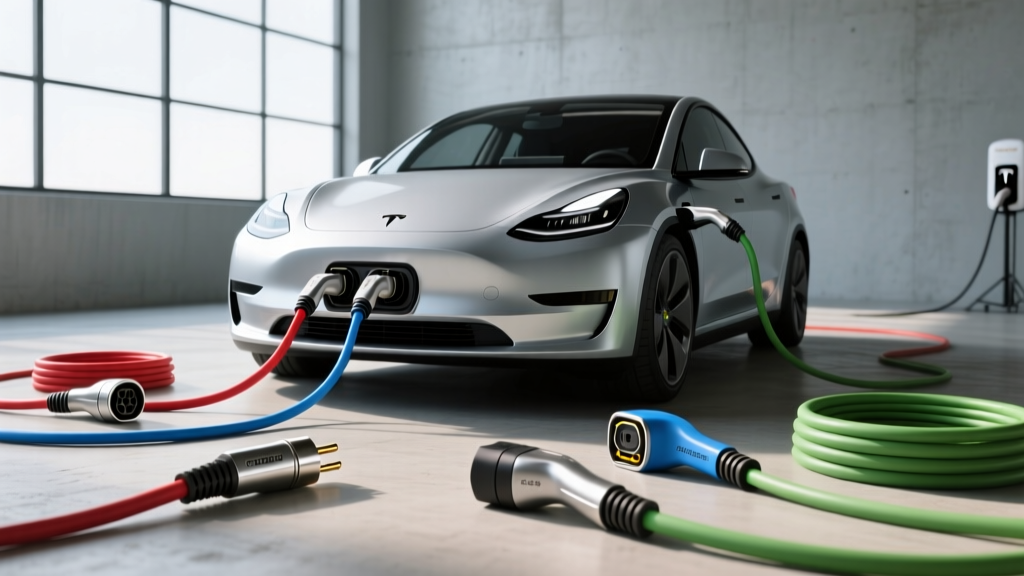
The connector landscape shifted dramatically between 2023 and 2026. Tesla's North American Charging Standard (NACS) is now the dominant plug in North America, with Ford, GM, Rivian, Volvo, Hyundai/Kia, and most major automakers adopting it for new vehicles. CCS1 remains on many 2020–2025 models, and CHAdeMO is effectively legacy (Nissan Leaf being the last holdout).
| Connector | Brands Using It (2026 Models) | Adapter Needed? |
|---|---|---|
| NACS (Tesla) | Tesla (all), Ford, GM, Rivian, Hyundai/Kia (2025+), Volvo, BMW (2025+) | None for NACS-native vehicles |
| CCS1 | VW ID.4 (through 2024), older Ford/GM/Hyundai EVs, Lucid, BMW (pre-2025) | CCS-to-NACS adapter ($200–$300) for Supercharger access |
| CHAdeMO | Nissan Leaf (discontinued after 2025), Mitsubishi Outlander PHEV (older) | Limited adapter options; network shrinking |
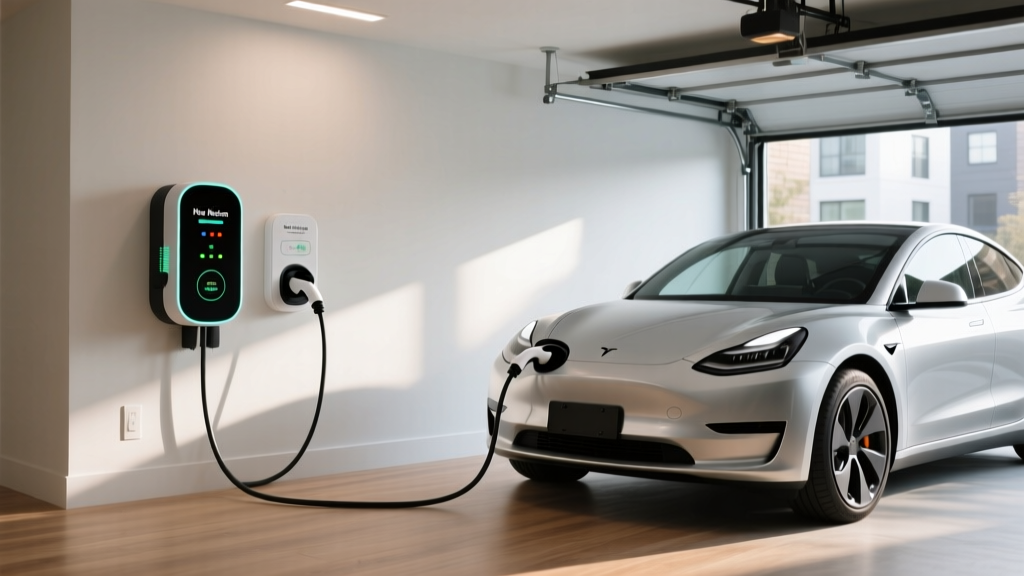
For home Level 2 charging, the connector matters less because J1772 (the standard AC plug) works with every EV via adapter, and NACS vehicles come with a J1772-to-NACS adapter in the glovebox. Tesla's Wall Connector now ships with a NACS plug and includes a J1772 adapter in the box, making it compatible with virtually every EV on the road.
Equipment Recommendations: Best Home Chargers for 2026
These are the units we recommend based on power output, build quality, safety certifications (UL-listed), smart features, and real-world reliability:
Tesla Wall Connector (Gen 4)
- Power: 11.5 kW (48A) on 60A circuit
- Connector: NACS native; J1772 adapter included
- Cable length: 24 ft
- Smart features: Wi-Fi OTA updates, Power Sharing (link up to 6 units on one circuit), access control
- Price: ~$475
- Best for: Tesla owners, multi-Tesla households
ChargePoint Home Flex
- Power: Up to 12 kW (50A) on 60A circuit; configurable down to 16A
- Connector: J1772 (NACS version available 2025)
- Cable length: 23 ft
- Smart features: App scheduling, Alexa/Google integration, flexible amperage dial
- Price: ~$550–$650
- Best for: Multi-EV households, panel-limited homes
Emporia Level 2 Charger
- Power: 11.5 kW (48A) on 60A circuit
- Connector: J1772 (NACS adapter available)
- Cable length: 24 ft
- Smart features: Energy monitoring via Emporia Vue, solar integration, load management
- Price: ~$399
- Best for: Solar-equipped homes, budget-conscious buyers
Grizzl-E Smart
- Power: 10 kW (40A) on 50A circuit
- Connector: J1772 (NACS version available)
- Cable length: 24 ft
- Smart features: OCPP-compatible, extreme cold rated (-40°F), rugged aluminum case
- Price: ~$499
- Best for: Cold-climate and outdoor installations
How Much Does Charging Cost Per Mile vs. Gas?
The economics depend heavily on where and when you charge. Here's a realistic comparison using a Tesla Model Y Long Range (28 kWh/100mi efficiency) versus a comparable gas SUV averaging 26 MPG:
| Charging/Fueling Scenario | Rate | Cost per Mile (Model Y) | Cost per Mile (26 MPG Gas SUV @ $3.40/gal) |
|---|---|---|---|
| Home — Off-peak utility rate | $0.09/kWh | $0.025 | $0.131 |
| Home — Average US rate | $0.16/kWh | $0.045 | $0.131 |
| Public Level 2 (ChargePoint, etc.) | $0.25–$0.35/kWh | $0.070–$0.098 | $0.131 |
| DC Fast Charging (Tesla Supercharger) | $0.28–$0.40/kWh | $0.078–$0.112 | $0.131 |
| DC Fast Charging (Electrify America) | $0.48–$0.56/kWh | $0.134–$0.157 | $0.131 |
The pattern is clear: home charging is dramatically cheaper than gas, often by a factor of 3–5x. Public DC fast charging approaches or occasionally exceeds gas cost per mile, which is why it's designed for road trips, not daily use. A Model Y driven 12,000 miles/year at home off-peak rates costs about $300/year in electricity versus $1,569/year in gasoline for the equivalent SUV.
Charging Time Examples: What to Expect by Battery Size
Charge time depends on battery capacity (kWh), the charger's power output (kW), and the vehicle's onboard charger limit. Here are common scenarios:
- Tesla Model 3 RWD (57.5 kWh, 11 kW onboard): 0–100% at home Level 2 in ~5.5 hours. 10–80% at a 250 kW Supercharger in ~22 minutes.
- Tesla Model Y Long Range (75 kWh, 11.5 kW onboard): 0–100% at home in ~6.5 hours. 10–80% at a 250 kW Supercharger in ~27 minutes.
- Ford F-150 Lightning Extended Range (131 kWh, 19.2 kW onboard): 0–100% at home (80A Pro Power) in ~7 hours. 10–80% at a 150 kW DC charger in ~45 minutes (limited by charge-curve taper above 80%).
- Hyundai Ioniq 5 (77.4 kWh, 10.9 kW onboard): 0–100% at home in ~7.5 hours. 10–80% at a 350 kW charger in ~18 minutes (800V architecture sustains high power longer).
A note on charge-curve taper: peak kW ratings are not sustained. A vehicle rated for 250 kW peak may only hold that rate from 10–30% State of Charge, then step down to 150 kW, then 90 kW, then 40 kW as it approaches full. This is why 10–80% time is the industry-standard metric — the final 20% can take as long as the first 70%.
Frequently Asked Questions
Are Teslas more prone to fires than gas cars?
No. By every available dataset — NHTSA, NFPA, and international studies from Sweden's MSB and Australia's EV FireSafe — battery-electric vehicles including Teslas catch fire at a rate roughly 1/60th that of internal-combustion vehicles. The perception gap exists because EV fires receive disproportionate media coverage due to novelty.
What causes the rare EV fires during charging?
Investigations typically point to: (1) damaged or non-UL-listed charging cables, (2) improper home electrical installations with undersized wiring or missing GFCI, (3) battery damage from a prior collision that was not inspected, or (4) extremely rare manufacturing defects in individual cells. Following manufacturer charging guidance and having a licensed electrician install your circuit eliminates the vast majority of these risks.
Should I unplug my Tesla when it's fully charged?
No, and Tesla explicitly recommends leaving the vehicle plugged in. The battery management system stops accepting current once the target State of Charge is reached and uses shore power for thermal management (battery heating in winter, cooling in summer). Leaving it unplugged in extreme temperatures can actually accelerate degradation.
Can a Supercharger or DC fast charger cause a fire?
DC fast chargers communicate constantly with the vehicle's BMS (Battery Management System), which controls charge rate and will halt charging if cell temperatures exceed safe thresholds. The handshake protocol (ISO 15118 / DIN SPEC 70121) includes multiple safety interlocks. Public DC fast-charging fires are exceedingly rare and more often involve the vehicle's charge port hardware than the charger itself.
Do I need a permit to install a home EV charger?
In most US jurisdictions, yes. An electrical permit ensures a city or county inspector verifies the installation meets NEC code — which protects you from fire risk and is required for insurance coverage if an electrical fire does occur. Permit costs typically run $50–$200. Skipping the permit to save money is a false economy that can void your homeowner's insurance claim.
What's the safest home charger to buy?
Look for UL-listed (Underwriters Laboratories) or ETL-listed certification. All four chargers recommended above (Tesla Wall Connector, ChargePoint Home Flex, Emporia, Grizzl-E) carry UL/ETL certification. Avoid unbranded chargers from overseas sellers on Amazon or eBay that lack independent safety testing — these have been implicated in the few residential charging fires that have occurred.
For the latest on federal EV charging tax credits (up to $1,000 under IRS §30C for home charger installation, subject to income and census-tract eligibility), consult a tax professional. Rules and eligible areas are updated annually.