The Real Cost to Charge a Tesla: Home vs Supercharger vs Gas
If you're shopping for a Tesla — or already own one — the question "how much does Tesla charging cost" is probably top of mind. The answer depends entirely on where and how you charge. A full charge at home on off-peak utility rates might cost under $10, while the same charge at a DC fast charger on a highway corridor could run $25–$40. And compared to gasoline? The savings are substantial, but not universal.
This guide breaks down every charging scenario with exact dollar figures, per-mile costs, installation expenses, and equipment recommendations — all based on current 2026 utility rates, Supercharger pricing, and Tesla's lineup (Model 3, Model Y, Model S, Model X, and the refreshed Cybertruck).
Understanding Charging Levels: Speeds, Power, and Range Added
Before calculating cost, you need to understand the three charging levels available to Tesla owners. The critical distinction: kW (kilowatts) measures power — how fast energy flows into your battery. kWh (kilowatt-hours) measures energy — the total capacity of your battery. Think of kW as the width of a hose and kWh as the size of the bucket.
| Level | Voltage | Power (kW) | Miles of Range per Hour | Typical Use Case |
|---|---|---|---|---|
| Level 1 | 120V AC | 1.0–1.4 kW | 3–5 mi/hr | Emergency / overnight trickle |
| Level 2 | 240V AC | 7.2–19.2 kW | 25–60 mi/hr | Home daily charging, workplace |
| DC Fast (Supercharger) | 400V+ DC | 150–325 kW (peak) | 200–1,000+ mi/hr (at peak) | Road trips, rapid top-ups |
A few real-world caveats: DC fast charging speeds are peak rates, not sustained. Tesla's charge curve tapers significantly above ~80% state of charge (SoC) to protect battery health. A Model Y Long Range (75 kWh usable, NMC chemistry) might peak at 250 kW at a V3 Supercharger, but a 10–80% session averages closer to 130–150 kW and takes approximately 25–28 minutes. Pushing from 80–100% can add another 20+ minutes — which is why most EV owners limit fast charges to 80%.
How Much Does Tesla Charging Cost Per kWh? Three Scenarios
Tesla owners charge in three primary environments, each with different pricing structures.
Scenario 1: Home Charging (Level 2, 240V)
Home charging is where most Tesla owners do 80–90% of their charging — and it's the cheapest option by far. The cost depends on your local utility rate.
- National average residential rate (2026): ~$0.16/kWh (per U.S. EIA data)
- Off-peak EV plans (TOU): $0.08–$0.12/kWh in many markets (California, Texas, Pacific Northwest)
- Peak rates (summer afternoon): $0.25–$0.45/kWh in high-cost areas
For a Model Y Long Range with a 75 kWh usable battery, charging from 10% to 90% requires about 60 kWh:
- At $0.16/kWh (national avg): $9.60
- At $0.10/kWh (off-peak TOU): $6.00
- At $0.35/kWh (peak): $21.00
Scenario 2: Tesla Supercharger Network (DC Fast)
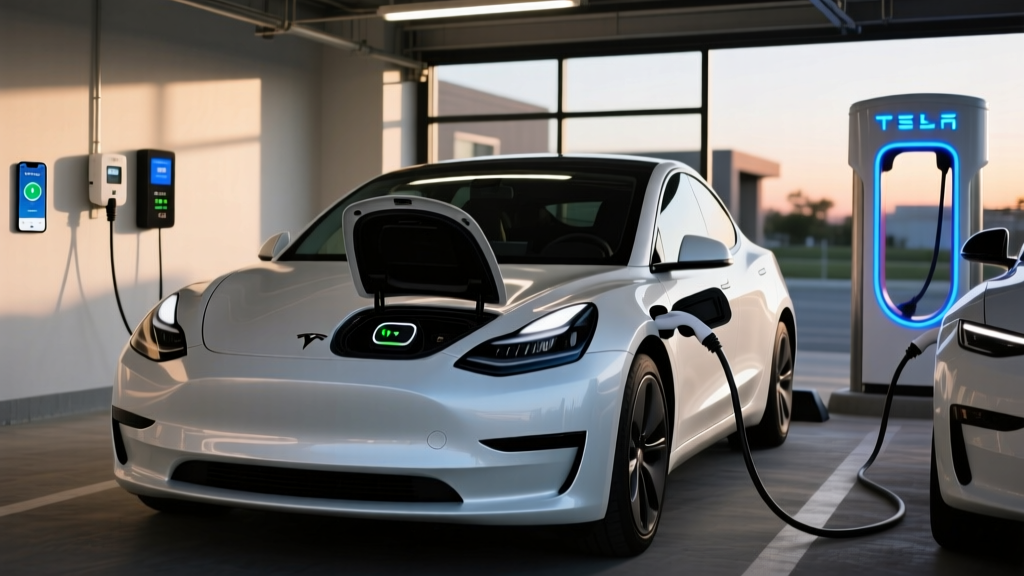
Tesla's Supercharger network now serves both Tesla and non-Tesla EVs (via the NACS connector standard). Pricing varies by location, time of day, and whether you're a Tesla owner.
- Tesla owner Supercharger rate: $0.28–$0.42/kWh (varies by station and time)
- Non-Tesla EV at Supercharger: $0.38–$0.52/kWh (higher tier)
- Idle fees: $0.50–$1.00/minute if you remain plugged in after reaching your charge limit
That same 60 kWh session for a Model Y at $0.35/kWh (a common Supercharger rate): $21.00.
Scenario 3: Third-Party DC Fast Chargers (Electrify America, EVgo, ChargePoint)
With Tesla vehicles now shipping with NACS ports natively, and CCS adapters available, you can access third-party networks. Pricing tends to be higher:
- Electrify America: $0.38–$0.55/kWh (guest); $0.31–$0.43/kWh (Pass+ subscription at $4/month)
- EVgo: $0.35–$0.50/kWh
- ChargePoint DC fast: $0.35–$0.55/kWh (varies by site host)
Cost Per Mile: Tesla Charging vs Gasoline
The most useful comparison for buyers is cost per mile. Here's how a Tesla Model Y Long Range (EPA 310 miles, real-world highway ~270 miles) stacks up against a comparable gas crossover averaging 28 MPG combined.
| Charging/Fueling Scenario | Cost Per Unit | Cost Per Mile | Annual Cost (12,000 mi) |
|---|---|---|---|
| Home charging (off-peak, $0.10/kWh) | $0.10/kWh | $0.027 | $324 |
| Home charging (national avg, $0.16/kWh) | $0.16/kWh | $0.043 | $516 |
| Tesla Supercharger ($0.35/kWh) | $0.35/kWh | $0.095 | $1,140 |
| Gasoline ($3.40/gal, 28 MPG) | $3.40/gal | $0.121 | $1,452 |
The Model Y consumes approximately 27 kWh per 100 miles (EPA combined, per fueleconomy.gov). Even at Supercharger rates, you'll spend less per mile than a gas vehicle at current fuel prices. Home charging delivers savings of 65–78% compared to gasoline.
Real-world caveat: Cold weather (below 32°F) increases energy consumption by 15–30% due to battery heating and cabin climate demands. In winter, expect your cost per mile to rise accordingly — though still below gasoline in most cases.
Home Charger Installation: Electrical Requirements, Costs, and Gotchas
Installing a Level 2 home charger is the single most impactful upgrade for Tesla ownership. Here's what's involved electrically and financially.
Electrical Requirements
Tesla's Wall Connector supports up to 48A continuous draw on a 60A dedicated circuit (240V). However, most homes install on a 40A or 50A circuit, delivering 32A or 40A continuous — which yields 7.7 kW or 9.6 kW respectively. That's 25–35 miles of range per hour of charging, enough to fully replenish a Model Y overnight.
- Minimum recommended: 240V / 40A circuit (NEMA 14-50 outlet or hardwired)
- Ideal for Tesla Wall Connector: 240V / 60A circuit (hardwired for full 48A/11.5 kW)
- Wire gauge: 6 AWG copper for 50A; 4 AWG for 60A
- Dedicated circuit required: The EV charger must have its own breaker — no sharing with other appliances
Do You Need a Panel Upgrade?
This is the question that can double or triple your installation cost. Most modern homes have a 200A main electrical panel. If your panel is already near capacity (running electric range, dryer, HVAC, water heater), adding a 40–60A EV circuit may require a panel upgrade to 200A or even 400A, or the addition of a sub-panel.
Signs you may need an upgrade:
- Your panel is 100A or 150A (common in homes built before 1990)
- Your panel has no open breaker slots
- An electrician's load calculation shows you're above 80% of panel capacity
Installation Cost Breakdown
| Component | Simple Install (panel nearby, no upgrade) | Complex Install (long wire run, sub-panel) | Panel Upgrade Required |
|---|---|---|---|
| EV charger equipment | $400–$600 | $400–$600 | $400–$600 |
| Electrician labor | $400–$800 | $800–$2,000 | $1,500–$3,000 |
| Permit and inspection | $50–$200 | $100–$300 | $150–$400 |
| Panel upgrade | $0 | $0 | $1,500–$4,000 |
| Total estimated cost | $850–$1,600 | $1,300–$2,900 | $3,550–$8,000 |
The national average for a straightforward Level 2 installation (charger within 20–30 feet of the panel, no upgrade) is approximately $1,200–$1,800 all-in. Always get at least three quotes from licensed electricians and confirm they pull a permit — unpermitted work can void home insurance and create fire risk.
Federal Tax Credit for Home Charging Equipment
Under IRS §30C Alternative Fuel Vehicle Refueling Property Credit, you may claim up to 30% of the cost of home charging equipment and installation, capped at $1,000. This applies to the charger hardware and electrical work. Eligibility depends on census tract requirements — the property must be in a qualifying area. Consult a tax professional for your specific situation.
Connector Compatibility: NACS, CCS, and Adapter Requirements
As of 2026, the North American Charging Standard (NACS) — originally Tesla's proprietary connector — has become the dominant standard. All new Tesla vehicles ship with a NACS port. Most other manufacturers (Ford, GM, Rivian, Hyundai, Volvo, and others) have transitioned to NACS as well.
| Connector | Vehicles Using It | Tesla Compatibility |
|---|---|---|
| NACS (Tesla) | All Tesla models; Ford, GM, Rivian, Hyundai, Kia, Volvo (2025+ models) | Native on all Tesla vehicles |
| CCS1 | Older VW ID.4, BMW iX, pre-2025 Hyundai/Kia, legacy non-Tesla EVs | Tesla CCS Adapter (~$175) required for non-Tesla DC fast chargers |
| CHAdeMO | Nissan Leaf (legacy); effectively discontinued for new vehicles | No adapter available; not compatible |
If you own a Tesla and travel to areas where CCS-only chargers remain (some Electrify America and older ChargePoint stations), Tesla sells a CCS Adapter for approximately $175. For non-Tesla EVs charging at Superchargers, no adapter is needed on 2025+ NACS-equipped models; older CCS vehicles require a NACS-to-CCS adapter from the manufacturer or a third party.
Equipment Recommendations: Best Home Chargers for Tesla Owners
Here are the top Level 2 home chargers for Tesla owners in 2026, based on power output, build quality, smart features, and value.
Tesla Wall Connector (Gen 4)
- Power output: Up to 11.5 kW (48A on 60A circuit)
- Connector: NACS (native Tesla)
- Cable length: 24 feet
- Smart features: Wi-Fi, OTA updates, load sharing between multiple units, access control
- Price: ~$475
- Best for: Tesla-only households wanting maximum charge speed
ChargePoint Home Flex
- Power output: Up to 12 kW (50A on 60A circuit); configurable down to 16A
- Connector: NACS or J1772 (select at purchase)
- Cable length: 23 feet
- Smart features: Wi-Fi, Alexa integration, scheduling, detailed energy tracking via app
- Price: ~$550–$650
- Best for: Mixed-EV households (Tesla + non-Tesla) wanting app flexibility
Emporia Level 2 EV Charger
- Power output: Up to 11.5 kW (48A on 60A circuit)
- Connector: J1772 (NACS adapter included or available)
- Cable length: 24 feet
- Smart features: Wi-Fi, integration with Emporia Vue energy monitor, solar-aware scheduling
- Price: ~$350–$400
- Best for: Budget-conscious buyers, solar-panel owners
Grizzl-E Smart
- Power output: Up to 10 kW (40A on 50A circuit)
- Connector: J1772 or NACS
- Cable length: 24 feet
- Smart features: OCPP-compatible, adjustable amperage, extreme cold rating (-40°F)
- Price: ~$450–$550
- Best for: Cold-climate owners, outdoor installations
Safety, Electrical Code, and Installation Best Practices
EV charging places a sustained high-amperage load on your home's electrical system — unlike an oven or dryer that cycles on and off, an EV charger can draw maximum current for 6–10 hours straight. Safety is non-negotiable.
- Dedicated circuit: Your EV charger must have its own breaker. Never share a circuit with other high-draw appliances.
- GFCI protection: The 2023 NEC (National Electrical Code) requires GFCI protection for all EV charging outlets (NEMA 14-50). Hardwired installations (like the Tesla Wall Connector) are exempt from this GFCI requirement and are generally preferred by electricians for reliability.
- Outdoor rating: If your charger is installed outside, ensure the unit carries a NEMA 4 or IP65 rating for weather resistance. All chargers listed above meet outdoor installation standards.
- Permit and inspection: Most jurisdictions require a permit for EV charger installation. An inspector will verify wire gauge, breaker sizing, grounding, and GFCI compliance. Skip the permit at your own risk — unpermitted work can complicate home sales and insurance claims.
- Wire run considerations: Longer runs from the panel to the charger require thicker wire to prevent voltage drop. Runs over 50 feet typically need an upsized wire gauge, adding $200–$500 to the project.
Frequently Asked Questions
How much does it cost to install a home EV charger for a Tesla?
A straightforward Level 2 installation (no panel upgrade, short wire run) typically costs $1,200–$1,800 including the Tesla Wall Connector ($475), electrician labor, and permit. Complex installs with long wire runs or sub-panels can reach $2,500–$3,000. If your home needs a panel upgrade from 100A to 200A, expect total costs of $3,500–$8,000.
How fast will each charging level add range to my Tesla?
Level 1 (120V standard outlet) adds approximately 3–5 miles per hour — useful only for overnight trickle or emergencies. Level 2 (240V) at 40A adds about 30–35 miles per hour, fully charging a Model Y overnight. DC fast charging at a V3/V4 Supercharger can add up to 200 miles in 15 minutes at peak rates, though the charge curve tapers significantly above 80% SoC.
Can I charge a non-Tesla EV with a Tesla Wall Connector?
Yes. Tesla's Gen 4 Wall Connector with a NACS connector can charge any NACS-equipped vehicle. For vehicles with CCS or J1772 ports, you would need a NACS-to-J1772 adapter (available from third-party manufacturers for ~$100–$200).
Is Tesla Supercharging cheaper than gas?
Yes, in nearly all scenarios. At a typical Supercharger rate of $0.35/kWh, a Model Y costs about $0.095 per mile to charge. A comparable gas crossover at 28 MPG with $3.40/gallon fuel costs $0.121 per mile — roughly 27% more expensive. Home charging delivers even greater savings, at $0.027–$0.043 per mile.
What electrical upgrades might I need for a Tesla home charger?
The most common upgrade is adding a dedicated 240V circuit (40A–60A) to your existing panel. If your panel is at or near capacity — common in older homes with 100A or 150A service — you may need a panel upgrade to 200A or the addition of a sub-panel. Some utilities offer a separate meter for EV charging to avoid peak-rate tier pricing, which can also influence the installation scope. Always have a licensed electrician perform a load calculation before committing to a circuit size.
Does Tesla offer free Supercharging?
Free unlimited Supercharging is no longer included with new Tesla purchases as of 2026. Tesla occasionally offers limited-time promotions (e.g., 10,000 free Supercharger miles as a referral incentive or during end-of-quarter sales events). Check Tesla's current offers at the time of purchase. Most owners pay per kWh at Supercharger stations.
How does cold weather affect Tesla charging cost?
In temperatures below 32°F, your Tesla's battery requires energy for thermal management (warming the battery pack), and cabin heating increases consumption. Expect 15–30% higher energy use in winter, which directly increases your cost per mile. A Model Y that achieves 3.7 miles/kWh in mild weather may drop to 2.8–3.1 miles/kWh in freezing conditions. Preconditioning your battery while plugged in (using grid power rather than battery power) mitigates some of this loss and also enables faster DC charging speeds when you hit a Supercharger.