Most Tesla owners do the majority of their charging at home. But the phrase "home charging" covers a wide spread of speeds, costs, and electrical requirements — from a standard 120V wall outlet adding 3 miles of range per hour to a hardwired 48-amp Wall Connector replenishing up to 44 miles per hour. Choosing the right setup depends on your daily mileage, electrical panel capacity, and budget.
This guide breaks down every Tesla charging at home option available in 2026, with exact kW figures, installation costs, equipment recommendations, and the electrical upgrades you might need before plugging in.
Understanding kW vs kWh: The EV Charging Basics
Before comparing chargers, lock in this distinction — it's the single most common source of confusion for new EV owners:
- kW (kilowatts) = power, or the rate at which electricity flows into your battery. Think of it as the width of the pipe. A 11.5 kW charger delivers energy faster than a 1.4 kW outlet.
- kWh (kilowatt-hours) = energy, or the total amount of electricity stored in your battery. A Tesla Model Y Long Range has a ~75 kWh usable battery; a Model S has ~95 kWh usable.
Charging time is a function of both: dividing your battery's kWh by the charger's kW gives you a rough hours-to-full estimate (real-world times are longer due to charging-curve taper above 80% State of Charge).
Charging Levels Explained: Speeds and Range Added Per Hour
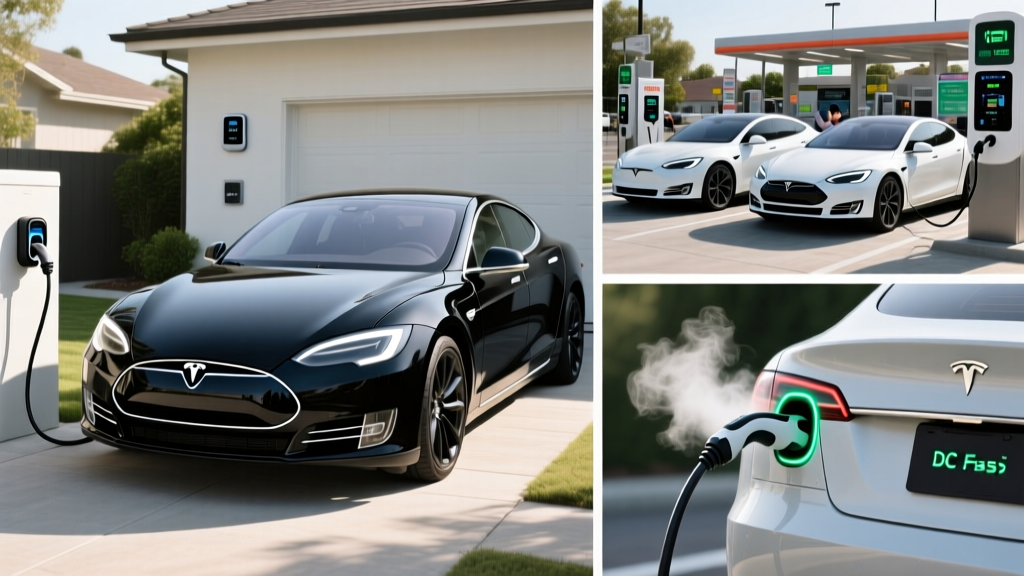
Home charging falls into two categories — Level 1 and Level 2. DC Fast Charging (Level 3) is a public-only option you'll use on road trips. Here's how they compare for Tesla vehicles:
| Level | Voltage | Max Power (kW) | Miles of Range Added/Hour | Typical Use Case |
|---|---|---|---|---|
| Level 1 (120V) | 120V / 12A | ~1.4 kW | 3–5 mi/hr | Overnight top-ups, low daily mileage |
| Level 2 (240V) | 240V / 32–48A | 7.7–11.5 kW | 25–44 mi/hr | Primary home charging |
| DC Fast (Supercharger) | 400V+ / 150–250 kW | 150–250 kW | ~200+ mi in 15 min | Road trips, public stations |
Real-world note: Those miles-per-hour figures assume a Model Y or Model 3 at roughly 250 Wh/mile efficiency. A heavier Model X or Cybertruck will add fewer miles per hour at the same kW rate because they consume more energy per mile.
Level 1: The Included Mobile Connector Option
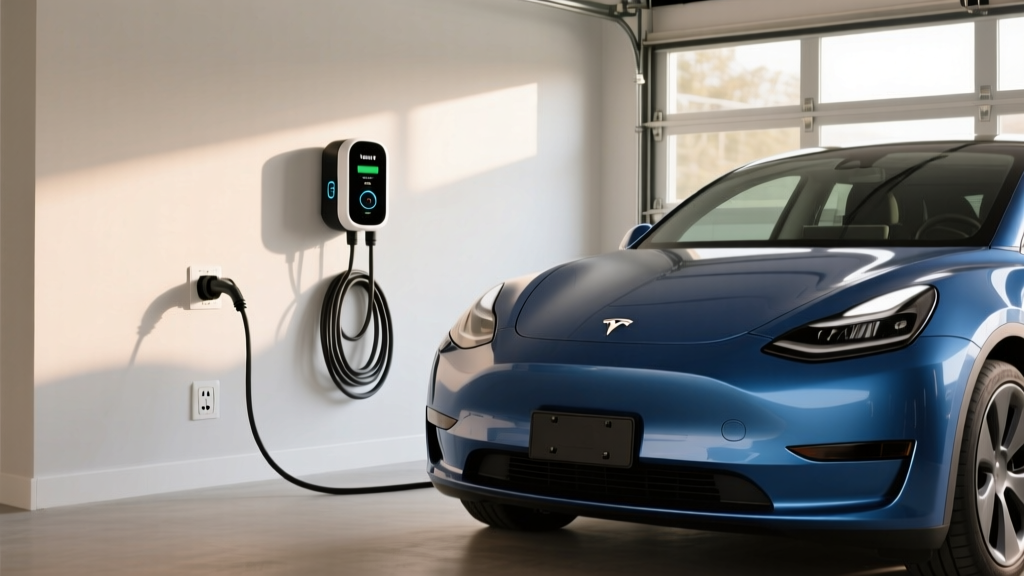
Every new Tesla ships with a Mobile Connector bundle that includes a NACS plug and adapters for standard 120V (NEMA 5-15) and 240V (NEMA 14-50) outlets. Plugging into a standard household 120V outlet delivers roughly 1.4 kW — enough for about 3–5 miles of range per hour.
Who Level 1 works for: Drivers with short commutes (under 30 miles round-trip), access to workplace charging, or those who can leave the car plugged in for 12+ hours overnight. An 8-hour overnight session adds roughly 25–40 miles — sufficient for many daily routines.
Where Level 1 falls short: If you drive 60+ miles daily, arrive home near-empty, or need quick turnaround for errands, Level 1 won't keep up. Fully recharging a 75 kWh Model Y battery from 10% on Level 1 takes roughly 50+ hours — impractical for most owners.
Level 2: The Home Charging Standard for Tesla Owners
Level 2 charging at 240V is the practical home standard. Tesla offers two primary Level 2 paths:
Tesla Wall Connector
The Tesla Wall Connector is Tesla's flagship home charger. Key specs for the current generation:
- Max output: 11.5 kW (48 amps) on a 60-amp dedicated circuit
- Cable length: 24 feet
- Connector: Native NACS (Tesla plug) — no adapter needed
- Wi-Fi enabled: Supports over-the-air updates, scheduled charging, and power sharing between multiple Wall Connectors on one circuit
- Price: ~$475 (equipment only)
At 11.5 kW, the Wall Connector adds up to 44 miles of range per hour to a Model 3 or Model Y. A 10–80% charge on a 75 kWh battery takes roughly 5–6 hours — meaning you can plug in after an evening drive and wake up fully topped off.
Mobile Connector on a 240V Outlet
If you already have or install a NEMA 14-50 (240V, 50-amp) outlet, the included Mobile Connector delivers up to 7.7 kW (32 amps) — adding roughly 30 miles of range per hour. This is a lower-cost alternative to the Wall Connector if you're on a budget or want portability for travel.
Electrical Requirements and Installation Costs
Here's where real-world planning matters. A Level 2 charger isn't just plug-and-play — it requires a dedicated circuit, proper wire gauge, and often a permit. Costs vary significantly based on your home's electrical infrastructure.
Circuit and Amperage Requirements
- Tesla Wall Connector (48A): Requires a 60-amp dedicated breaker, 6 AWG copper wire, and 240V service. This is the most common high-power residential setup.
- NEMA 14-50 outlet (32A Mobile Connector): Requires a 50-amp breaker, 6 AWG copper wire, and 240V service.
- Lower-amperage option: If your panel can't support a 60-amp circuit, the Wall Connector can be configured during installation to draw less power (e.g., 32A on a 40-amp breaker), still delivering ~7.7 kW.
Panel Upgrade Considerations
Most modern homes have a 200-amp electrical panel, which can typically accommodate a 60-amp EV circuit alongside existing loads. However, older homes with 100-amp panels — or homes already running high-draw appliances (electric oven, dryer, HVAC, hot tub) — may need a panel upgrade to 200 amps before adding a Level 2 charger.
A panel upgrade adds $1,500–$3,500 to your project and may require utility coordination. This is the single biggest variable in home charger installation cost.
| Cost Component | Simple Install (Panel Nearby) | Complex Install (Long Run / Panel Upgrade) |
|---|---|---|
| Equipment (Wall Connector or Mobile Connector) | $0–$475 | $475 |
| Electrician labor (240V circuit, wiring, outlet/hardwire) | $500–$1,200 | $1,500–$3,000 |
| Permit and inspection | $50–$200 | $100–$300 |
| Panel upgrade (if needed) | $0 | $1,500–$3,500 |
| Total estimated range | $550–$1,875 | $3,575–$7,275 |
Always hire a licensed electrician for 240V work. Your local jurisdiction will likely require a permit and inspection for a new dedicated circuit — this isn't optional and protects your home insurance coverage. The National Electrical Code (NEC) governs these requirements.
Third-Party Level 2 Chargers Compatible with Tesla (NACS)
You aren't limited to Tesla-branded equipment. Since Tesla adopted the North American Charging Standard (NACS) and opened its connector to other manufacturers, a growing ecosystem of NACS-native chargers exists. If you drive a non-Tesla EV with a CCS1 port, you can also use a Tesla Wall Connector with a CCS adapter — or choose a universal charger.
| Connector Type | Native Vehicles | Home Charger Compatibility | Adapter Needed? |
|---|---|---|---|
| NACS (Tesla) | Tesla Model 3/Y/S/X, Cybertruck; 2025+ Ford, GM, Rivian, Volvo, etc. | Tesla Wall Connector, ChargePoint Home Flex (NACS), Emporia Vue (NACS) | No — for NACS vehicles |
| CCS1 | Hyundai Ioniq 5/6, Kia EV6/EV9, Ford Mustang Mach-E (pre-2025), VW ID.4, BMW iX | ChargePoint Home Flex, Emporia Vue, Grizzl-E | Tesla CCS adapter (~$175) for Superchargers; no adapter for non-Tesla home chargers |
| CHAdeMO | Nissan Leaf (legacy) | Limited home options; mostly public DC | No direct home adapter to NACS |
Recommended Level 2 Chargers for Tesla Owners
Tesla Wall Connector
- Power output: 11.5 kW (48A)
- Connector: NACS native
- Cable length: 24 ft
- Smart features: Wi-Fi, OTA updates, power sharing, scheduled charging via Tesla app
- Price: ~$475
- Best for: Tesla-only households wanting seamless app integration
ChargePoint Home Flex (NACS version)
- Power output: Up to 12 kW (50A) — adjustable down to 16A
- Connector: NACS (2025+ models) or J1772 with adapter
- Cable length: 23 ft
- Smart features: Wi-Fi, ChargePoint app scheduling, Alexa integration, amperage configurable in-app
- Price: ~$599
- Best for: Multi-EV households or those wanting adjustable amperage for older panels
Emporia Vue Smart Charger (NACS)
- Power output: Up to 11.5 kW (48A)
- Connector: NACS
- Cable length: 24 ft
- Smart features: Wi-Fi, real-time energy monitoring, solar integration, load management
- Price: ~$399
- Best for: Solar-equipped homes or budget-conscious buyers
Charging Cost: Home Electricity vs Gas Per Mile
One of the strongest economic arguments for home charging is cost per mile. Let's compare real scenarios using 2026 average rates:
| Scenario | Rate | Cost for 75 kWh Fill (Model Y) | Cost Per Mile (at 3.5 mi/kWh) |
|---|---|---|---|
| Home — national avg residential electricity | $0.17/kWh | $12.75 | $0.049 |
| Home — off-peak TOU rate (night) | $0.09/kWh | $6.75 | $0.026 |
| Home — high-cost state (CA avg) | $0.30/kWh | $22.50 | $0.086 |
| Tesla Supercharger (public DC) | $0.30–$0.40/kWh | $22.50–$30.00 | $0.086–$0.114 |
| Gas car (30 MPG combined, $3.50/gal) | $3.50/gal | — | $0.117 |
Key takeaway: Home charging on an off-peak time-of-use (TOU) plan cuts your per-mile fuel cost to roughly one-quarter of a comparable gas vehicle. Even at California's higher residential rates, home charging undercuts gas. Public DC fast charging narrows the gap significantly — which is why home charging is the economic sweet spot.
To maximize savings, contact your utility about EV-specific TOU plans. Most utilities offer rates 40–60% below peak pricing for overnight charging (typically 9 PM – 6 AM). Schedule your Tesla to charge during these windows via the vehicle's touchscreen or the Tesla app.
Charging Time Examples: 10–80% for Common Tesla Batteries
Here's how long a 10–80% session takes across Tesla's lineup on Level 2. Note that charging slows significantly above 80% State of Charge to protect battery health — the charge curve tapers, and the final 20% can take as long as the first 70%.
| Vehicle | Battery (usable kWh) | Level 1 (1.4 kW) | Level 2 Mobile (7.7 kW) | Level 2 Wall Connector (11.5 kW) | DC Fast (250 kW) |
|---|---|---|---|---|---|
| Model 3 Long Range | ~75 kWh | ~37 hrs | ~6.8 hrs | ~4.6 hrs | ~25 min (10–80%) |
| Model Y Long Range | ~75 kWh | ~37 hrs | ~6.8 hrs | ~4.6 hrs | ~25 min (10–80%) |
| Model S | ~95 kWh | ~47 hrs | ~8.6 hrs | ~5.8 hrs | ~30 min (10–80%) |
| Cybertruck AWD | ~123 kWh | ~61 hrs | ~11.2 hrs | ~7.5 hrs | ~35–40 min (10–80%) |
Cold-weather caveat: In sub-freezing temperatures, expect Level 2 charging times to increase 10–25% because the battery management system diverts energy to warming the pack before accepting a full charge rate. Always enable Scheduled Departure in your Tesla's settings — this preconditioning warms the battery ahead of your departure, improving both range and charging speed.
Safety, Code, and Best Practices
Home EV charging is safe when installed to code. Key requirements and recommendations:
- Dedicated circuit: Your Level 2 charger must be on its own dedicated breaker — not shared with other appliances. This prevents overloading and tripped breakers.
- GFCI protection: The NEC requires GFCI (Ground Fault Circuit Interrupter) protection for outdoor receptacles. Hardwired Wall Connectors have built-in ground fault protection. If using a NEMA 14-50 outlet outdoors, ensure your electrician installs a GFCI breaker.
- Outdoor rating: The Tesla Wall Connector is rated NEMA 3R (suitable for outdoor installation). If mounting outdoors, ensure the installation location is protected from direct sprinkler spray and physical damage.
- Wire gauge: 6 AWG copper for 48A/60A circuits; 8 AWG for 32A/40A circuits. Aluminum wire requires a larger gauge — confirm with your electrician.
- Cable management: Keep the charging cable off the ground to prevent tripping hazards and wear. Tesla sells a cable organizer, or use a simple hook system.
Tax Credits and Incentives for Home Charging
The federal Residential Clean Energy Credit (IRC §25D) previously covered 30% of home EV charger equipment and installation costs up to $1,000. However, this specific charger credit expired for installations after December 31, 2021, and was replaced with different provisions under the Inflation Reduction Act.
As of 2026, the §30D Clean Vehicle Credit applies to the vehicle purchase itself (up to $7,500 for qualifying new EVs, subject to MSRP caps, buyer income limits, and battery sourcing requirements), but does not cover home charging equipment separately.
Check your state and utility incentives — many states and local utilities offer rebates of $250–$1,500 for Level 2 charger installation. The Alternative Fuels Data Center maintains a searchable database of state and local incentives. Consult a tax professional for eligibility specifics.
How much does it cost to install a Tesla home charger?
A straightforward Tesla Wall Connector installation with an existing 200-amp panel and short wire run typically costs $550–$1,875 total (equipment + electrician + permit). Complex installations requiring long wire runs, conduit, or a panel upgrade can range from $3,575–$7,275. Get at least two quotes from licensed electricians.
How fast will each charging level add range to my Tesla?
Level 1 (120V) adds 3–5 miles per hour. Level 2 via Mobile Connector (240V, 32A) adds ~30 miles per hour. Level 2 via Wall Connector (240V, 48A) adds up to 44 miles per hour. These figures assume Model 3/Y efficiency; heavier vehicles add fewer miles per hour at the same power.
Which connector and charger is compatible with my EV?
All Tesla vehicles use the NACS connector natively. The Tesla Wall Connector, ChargePoint Home Flex (NACS), and Emporia Vue (NACS) all plug directly into any Tesla without an adapter. If you own a non-Tesla EV with CCS1, you'll need a CCS-compatible charger or a Tesla-to-CCS adapter for Supercharger access.
How much does charging a Tesla cost per mile compared to gas?
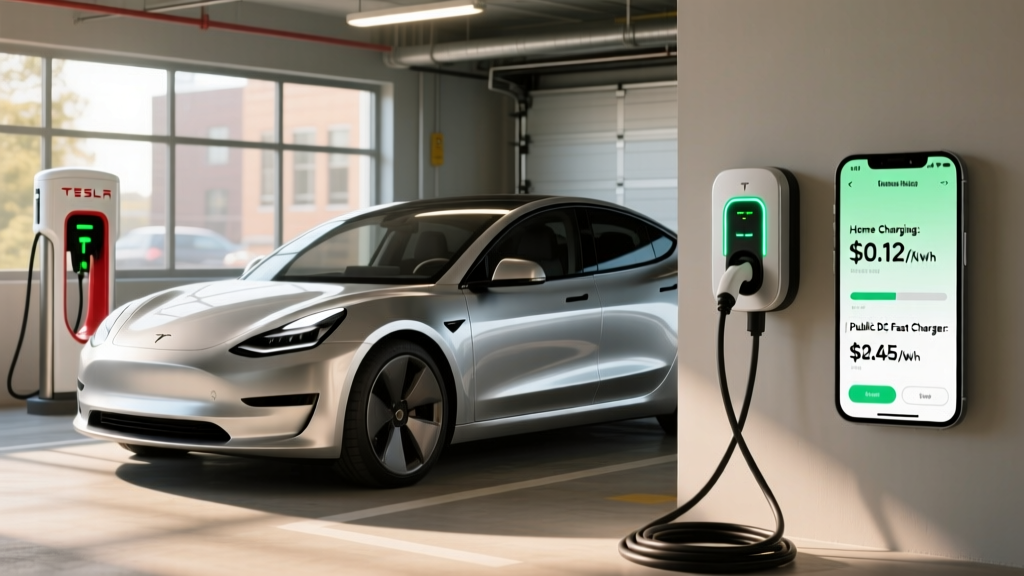
At the national average residential electricity rate of $0.17/kWh, charging a Model Y costs roughly $0.049/mile — about 58% less than a 30 MPG gas car at $3.50/gallon ($0.117/mile). On an off-peak TOU plan at $0.09/kWh, the cost drops to $0.026/mile, roughly 78% less than gas.
What electrical upgrades might I need for a Level 2 charger?
If your home has a 200-amp panel with available capacity, you likely only need a new 60-amp (or 50-amp) dedicated breaker and wiring run. Homes with 100-amp panels or panels near capacity may need a full panel upgrade to 200 amps ($1,500–$3,500). Your electrician will perform a load calculation to determine your panel's available headroom before recommending a circuit size.
Can I charge my Tesla on a regular 120V outlet?
Yes — using the included Mobile Connector with the NEMA 5-15 adapter, you can charge at ~1.4 kW (3–5 miles of range per hour). This works for low-mileage drivers who can leave the car plugged in overnight but is too slow for high-mileage daily use or quick turnaround.