If you've just taken delivery of a Tesla Model Y, Model 3, or Cybertruck—or any EV with a NACS port—the next logical step is setting up reliable home charging. The most common question we hear: how much is it to install a Tesla charger? The honest answer is that costs range from essentially free (if you already have a 240V outlet) to over $3,000 if your electrical panel needs an upgrade. Most homeowners land somewhere between $500 and $2,200 for a complete, code-compliant Level 2 installation.
This guide walks through every cost layer—equipment, labor, permits, and potential panel upgrades—so you can budget accurately before calling an electrician.
Understanding EV Charging Levels: Speed, Power, and What You Need
Before pricing anything, you need to understand the three charging levels and what they deliver. Power is measured in kW (kilowatts)—the rate at which energy flows into your battery. Energy capacity is measured in kWh (kilowatt-hours)—the total amount your battery holds. A Tesla Model Y Long Range has roughly 75 kWh of usable battery capacity; charging it at 11.5 kW means you're adding 11.5 kWh per hour (in ideal conditions).
| Level | Voltage / Amps | Power (kW) | Miles of Range per Hour | Best For |
|---|---|---|---|---|
| Level 1 | 120V / 12A | ~1.4 kW | 3–5 mi/hr | Overnight top-ups, PHEVs, emergencies |
| Level 2 | 240V / 32–48A | 7.7–11.5 kW | 25–44 mi/hr | Daily home charging, full BEVs |
| DC Fast | 400–800V DC | 50–350 kW | 150–1,000+ mi/hr | Road trips, rapid top-ups |
For most Tesla owners, a Level 2 home charger is the practical target. Level 1 from a standard wall outlet is too slow for a 75+ kWh battery—it would take 50+ hours for a full charge. DC fast charging is reserved for Tesla Superchargers and public networks, not home installation.
- Tesla Model 3 RWD (57.5 kWh battery) at 7.7 kW (32A): ~6.5 hours | at 11.5 kW (48A): ~4.3 hours
- Tesla Model Y Long Range (~75 kWh battery) at 7.7 kW: ~8.5 hours | at 11.5 kW: ~5.7 hours
- Tesla Cybertruck (~123 kWh battery) at 11.5 kW: ~13.5 hours (Level 2 alone won't fill this overnight—plan accordingly)
Tesla Charger Equipment Options and Pricing
Tesla offers two primary home charging solutions, and third-party options have expanded significantly now that the NACS (North American Charging Standard) connector is the industry standard adopted by Ford, GM, Rivian, Hyundai, and others.
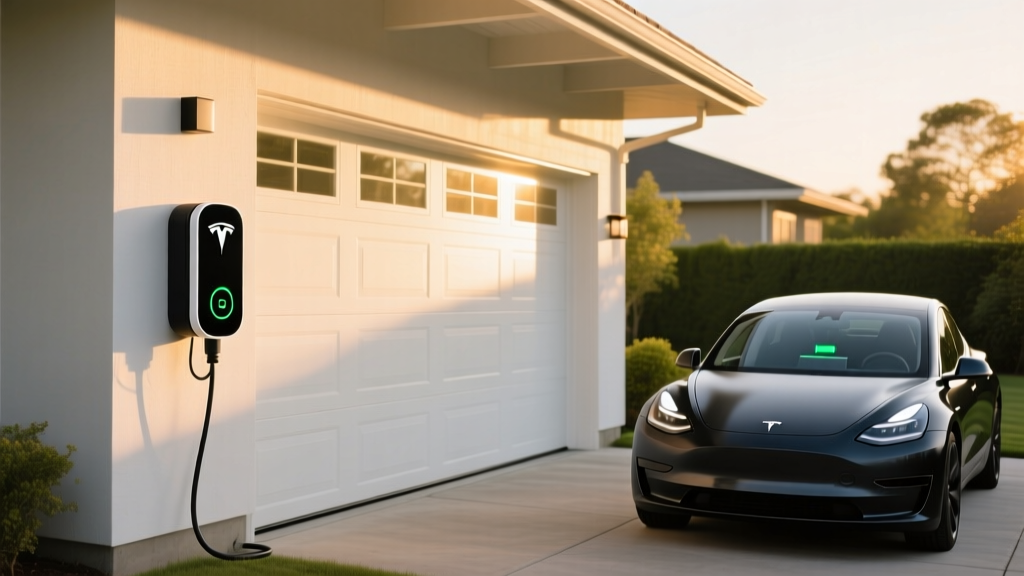
Tesla Wall Connector
- Price: ~$420 (direct from Tesla)
- Power Output: Up to 11.5 kW (48A on a 60A circuit)
- Connector: NACS (native Tesla)
- Cable Length: 24 feet
- Smart Features: Wi-Fi updates, Power Sharing (link up to 6 units on one circuit), access control, Tesla app integration
- Best For: Tesla-only households wanting maximum charge speed
Tesla Mobile Connector (Bundle)
- Price: ~$200 (included with some new vehicles)
- Power Output: Up to 7.7 kW (32A on NEMA 14-50) or 1.4 kW on 120V
- Connector: NACS with interchangeable adapters
- Cable Length: 20 feet
- Smart Features: None—basic EVSE, no Wi-Fi or scheduling
- Best For: Budget install, renters, or backup/travel charging
Notable Third-Party NACS Chargers: The Emporia Vue Level 2 (~$400, 48A, 24ft cable, smart scheduling via app, load management) and the Grizzl-E Smart (~$550, 40A, 24ft cable, OCPP-compatible, extreme cold rated to -40°F) both offer NACS connectors and work with any EV using the Tesla-standard plug.
How Much Does It Cost to Install a Home EV Charger? Full Breakdown
Installation cost is where most of the variability lives. Here's a detailed breakdown based on 2026 national averages from licensed electricians.
| Cost Component | Simple Install (Panel Nearby) | Standard Install | Complex Install (Panel Upgrade) |
|---|---|---|---|
| Charger Equipment (Tesla Wall Connector) | $420 | $420 | $420 |
| Electrician Labor (2–4 hrs @ $85–$150/hr) | $170–$300 | $340–$600 | $600–$1,200 |
| Electrical Materials (conduit, wire, breaker) | $50–$100 | $100–$250 | $200–$400 |
| Permit Fee | $50–$150 | $50–$150 | $50–$150 |
| Electrical Panel Upgrade (if needed) | $0 | $0 | $1,500–$3,500 |
| Total Estimated Cost | $690–$970 | $910–$1,420 | $2,770–$5,670 |
What Defines Each Scenario?
Simple Install: Your electrical panel has spare capacity (at least 60A for a 48A charger, per NEC 80% continuous-load rule), and the charger mounts within 10–15 feet of the panel. Minimal conduit, short wire run, straightforward breaker addition.
Standard Install: The charger is in a garage or driveway 30–60 feet from the panel. Requires longer wire runs, conduit routing through walls or along exterior surfaces, and possibly a sub-panel. This is the most common scenario.
Complex Install: Your home has an older 100A electrical panel that's already near capacity. Adding a 60A circuit for EV charging would exceed safe limits, requiring a panel upgrade to 200A—the single biggest cost driver. Homes built before 1990 frequently face this.
Electrical Requirements: Voltage, Amperage, and Code Compliance
A Tesla Wall Connector at full 11.5 kW output requires a dedicated 240V, 60-amp circuit (which delivers a continuous 48A under NEC rules). Here's what that means for your home's electrical system:
- Circuit breaker: 60A double-pole breaker in your main panel
- Wire gauge: 6 AWG copper (THHN in conduit) or 4 AWG aluminum for longer runs
- Dedicated circuit: The charger must have its own circuit—no sharing with dryers, ovens, or HVAC
- GFCI protection: NEC 2020 and later require GFCI protection for outdoor receptacles; hardwired Wall Connectors are exempt in most jurisdictions, but the Mobile Connector plugged into a NEMA 14-50 outlet requires a GFCI breaker (adding ~$50–$100)
- Permit: Nearly all municipalities require an electrical permit for EV charger installation—your electrician pulls this, and an inspector verifies the work
If you opt for a NEMA 14-50 outlet instead of hardwiring (which lets you use the Mobile Connector or unplug the charger if you move), expect the electrician to install a 50A breaker, which limits charging to 40A continuous (9.6 kW). This is still fast enough for overnight charging on all Tesla models except the Cybertruck at very high daily mileage.
Connector Compatibility: NACS, CCS, and Adapters
As of 2026, the charging connector landscape has consolidated significantly around NACS, but legacy connectors still exist on public infrastructure.
| Connector | Used By | Home Charging? | Adapter Needed? |
|---|---|---|---|
| NACS (Tesla) | Tesla, Ford, GM, Rivian, Hyundai, Kia, Volvo, Polestar (2025+) | Yes — native | None for Tesla vehicles |
| CCS1 | Legacy VW, BMW, older Ford/GM EVs | Yes with CCS charger | Tesla CCS Adapter (~$175) for Supercharger access |
| CHAdeMO | Nissan Leaf (legacy, phasing out) | Rarely | No Tesla adapter available |
If you own a Tesla, the Wall Connector and Mobile Connector use NACS natively—no adapters needed at home. If you own a non-Tesla EV that has switched to NACS (like a 2025+ Ford F-150 Lightning or Hyundai Ioniq 5), you can use a Tesla Wall Connector directly. Non-Tesla EVs still on CCS1 will need a CCS-compatible Level 2 charger or a NACS-to-CCS adapter (availability and pricing vary by manufacturer).
How Much Does Charging Cost per Mile vs Gas?
Home charging is where EVs deliver the most dramatic fuel savings. Here's a realistic comparison using 2026 energy and fuel prices.
| Scenario | Rate | Cost per Mile (Tesla Model Y, ~3.5 mi/kWh) |
|---|---|---|
| Home charging (national avg electricity) | $0.16/kWh | $0.046/mi |
| Home charging (off-peak / time-of-use) | $0.08–$0.10/kWh | $0.023–$0.029/mi |
| Home solar (amortized) | $0.04–$0.06/kWh | $0.011–$0.017/mi |
| Public Level 2 (networks) | $0.25–$0.40/kWh | $0.071–$0.114/mi |
| Tesla Supercharger (DC fast) | $0.28–$0.42/kWh | $0.080–$0.120/mi |
| Gas vehicle (28 MPG avg, $3.40/gal) | $3.40/gal | $0.121/mi |
At 12,000 miles per year, home charging on off-peak rates saves roughly $1,100–$1,200 annually compared to a 28 MPG gas vehicle. Even public DC fast charging at Supercharger prices is competitive with gasoline on a per-mile basis. The savings widen further if you have rooftop solar with net metering.
For the latest electricity rate data in your area, check the U.S. Energy Information Administration's state-by-state averages.
Safety, Permits, and Smart Features Worth Paying For
Beyond raw cost, several factors affect your installation decision:
- Hardwired vs. plug: Hardwired Tesla Wall Connectors avoid GFCI nuisance tripping common with NEMA 14-50 receptacles and allow full 48A charging. Plug-in setups offer portability but cap at 40A.
- Outdoor rating: The Wall Connector is NEMA 4 rated (weatherproof) for outdoor mounting. Ensure your electrician uses outdoor-rated conduit and fittings.
- Load management: If your panel is borderline, smart chargers like the Emporia Vue or Tesla Wall Connector with Power Sharing can dynamically reduce charge rate to avoid tripping your main breaker—potentially avoiding a costly panel upgrade.
- Federal tax credit: The IRS Residential Clean Energy Credit does not cover EV chargers for most taxpayers after 2022. However, the Alternative Fuel Vehicle Refueling Property Credit (§30C) may cover up to $1,000 of home charger equipment and installation if you live in an eligible census tract. Consult a tax professional to verify eligibility.
Step-by-Step: How to Plan Your Tesla Charger Installation
- Check your electrical panel: Locate your main breaker and note the amperage (100A, 150A, or 200A). Photograph the panel label and available breaker slots.
- Calculate spare capacity: A licensed electrician will perform a NEC Article 220 load calculation to determine if your panel can handle an additional 60A circuit. If your panel is 200A with gas appliances (not electric heat, oven, or dryer), you likely have room.
- Choose your mounting location: Ideally within 18–24 feet of where your Tesla's charge port sits (driver-side rear for Model 3/Y, front quarter-panel for Cybertruck). Consider cord management and driveway clearance.
- Get 2–3 electrician quotes: Ask for itemized quotes covering labor, materials, permit, and any panel work. Verify the electrician is licensed, insured, and has EV charger installation experience.
- Pull the permit: Your electrician should handle this. Typical turnaround is 1–3 weeks for inspection scheduling.
- Configure and test: After installation, set up the Tesla Wall Connector in the Tesla app, configure charge scheduling for off-peak rates, and run a full test charge to verify amperage and throughput.
Frequently Asked Questions
How much does it cost to install a home EV charger?
For a Tesla Wall Connector, expect $690–$1,420 for most homes with adequate panel capacity. If your panel needs upgrading from 100A to 200A, total costs can reach $2,800–$5,700. The single biggest variable is whether your existing electrical panel has spare capacity for a 60A circuit.
How fast will each charging level add range?
Level 1 (120V) adds 3–5 miles per hour—too slow for daily BEV use. Level 2 (240V, 48A) adds 35–44 miles per hour, easily replenishing a full day's driving overnight. DC fast charging at a Tesla Supercharger (250 kW) can add 200+ miles in 15 minutes, though charge speed tapers significantly above 80% State of Charge.
Which connector and charger is compatible with my EV?
All Tesla vehicles use NACS natively. If you drive a 2025+ model from Ford, GM, Rivian, Hyundai, or Kia, your vehicle also has a NACS port and works directly with the Tesla Wall Connector. Older non-Tesla EVs with CCS1 ports need a CCS-compatible charger. Check your vehicle's charge port or owner's manual to confirm.
How much does charging cost per mile vs gas?
Home charging averages $0.03–$0.05 per mile depending on your electricity rate—roughly 60–75% cheaper than gasoline at $3.40/gallon in a 28 MPG vehicle ($0.12/mi). Off-peak time-of-use rates and rooftop solar can push EV fuel costs below $0.02/mile.
What electrical upgrades might I need?
The most common upgrade is a panel capacity increase from 100A to 200A, costing $1,500–$3,500. You may also need a new meter base, utility service drop upgrade, or a sub-panel if the charger is far from the main panel. Homes with all-electric appliances (heat pump, electric range, electric dryer) are more likely to need a panel upgrade than homes with gas appliances.
Can I install a Tesla charger myself?
Tesla's Mobile Connector simply plugs into an existing outlet, so no electrician is needed for Level 1 (120V) or a pre-existing NEMA 14-50 (240V). However, hardwiring a Wall Connector or installing a new 240V circuit requires a licensed electrician in virtually all jurisdictions. DIY electrical work on 240V circuits carries serious shock and fire risk, and unpermitted work can void your homeowner's insurance.