Charging an electric vehicle is fundamentally different from filling a gas tank, and nowhere is that more apparent than in the pricing structure. If you own a Tesla or are shopping for one, understanding the Tesla charger cost per kWh across different charging scenarios is the single most important factor in calculating your real ownership costs. Unlike the relatively stable price of gasoline, electricity rates vary dramatically based on time of day, location, charging speed, and whether you are at home or on the road.
This guide breaks down exactly what you will pay per kilowatt-hour (kWh) — the unit of energy stored in your battery — across Level 1, Level 2, and DC fast charging. We will also cover the true cost of installing a home charger, which connector standards matter in 2026, and how EV charging stacks up against gasoline on a per-mile basis.
The Critical Distinction: kW vs kWh
Before examining costs, let's eliminate the most common EV confusion. Kilowatts (kW) measure power — the rate at which electricity flows into your car, like water pressure from a hose. Kilowatt-hours (kWh) measure energy — the total amount of electricity stored in your battery, like gallons in a tank. A Tesla Model Y Long Range has a ~75 kWh usable battery. If you charge at 11.5 kW (a typical Level 2 home charger), it takes roughly 6.5 hours to go from empty to full. When we discuss cost, we price per kWh — the energy unit — not kW.
Charging Levels Explained: Speed and Cost at Every Tier
EV charging falls into three tiers, each with distinct power delivery, charging times, and pricing. Understanding these is essential before evaluating cost per kWh.
| Charging Level | Power (kW) | Voltage / Amps | Miles of Range Added Per Hour | Typical 10–80% Time (75 kWh Battery) | Primary Use Case |
|---|---|---|---|---|---|
| Level 1 (Standard Outlet) | 1.0–1.4 kW | 120V / 12A | 3–5 miles | ~52 hours | Overnight trickle, emergency backup |
| Level 2 (Home / Workplace) | 3.3–19.2 kW | 240V / 16–80A | 12–75 miles | ~4–5 hours (at 11.5 kW) | Daily home charging, destination charging |
| DC Fast Charging (Supercharger / Public) | 50–350 kW | 400–800V DC | 150–1,000+ miles | ~15–30 minutes | Road trips, rapid top-ups |
Real-world note on charging speed: DC fast charging does not sustain peak kW throughout the session. A Tesla Model 3 Long Range may peak at 250 kW at a V3 Supercharger, but the charge curve tapers significantly above 50–60% state of charge (SoC). That 10–80% time of ~25 minutes assumes battery preconditioning is active — navigate to a Supercharger using the car's built-in navigation, and the system will warm the battery to optimize charge acceptance. Without preconditioning, expect slower initial charge rates, especially in cold weather.
Tesla Charger Cost Per kWh: Scenario-by-Scenario Pricing
The actual cost to charge your Tesla depends heavily on where and when you plug in. Here is how the pricing breaks down across the most common scenarios in 2026.
Home Charging: The Cheapest Option by Far
Residential electricity rates in the United States average approximately $0.16–$0.17 per kWh nationally, according to U.S. Energy Information Administration (EIA) data. However, this varies enormously by state and utility:
- Off-peak / Time-of-Use (TOU) rates: Many utilities offer reduced overnight rates of $0.08–$0.12/kWh for EV owners who enroll in TOU plans. If your utility offers this, charging a 75 kWh Model Y battery from 10% to 80% (~52.5 kWh) costs roughly $4.20–$6.30.
- Standard residential rates: At $0.16/kWh, that same 10–80% session costs approximately $8.40.
- High-cost states (CA, HI, Northeast): Rates can reach $0.25–$0.35/kWh, pushing a 10–80% charge to $13.13–$18.38. Solar panel owners in these states often achieve effective rates well below $0.10/kWh.
Tesla Supercharger Network: Mid-Range Pricing
Tesla's Supercharger network remains the gold standard for DC fast charging reliability. As of 2026, Supercharger pricing in the U.S. typically ranges from $0.25 to $0.50 per kWh, with most stations clustering around $0.30–$0.38/kWh. Pricing is dynamic and varies by:
- Location: Urban stations in high-cost-electricity states (California, New York) trend toward $0.40–$0.50/kWh.
- Time of day: Some Superchargers now offer off-peak discounts, with rates dropping $0.05–$0.10/kWh during overnight hours.
- Membership: Tesla's membership program (available to non-Tesla EVs using the NACS connector) offers reduced per-kWh pricing for a monthly fee.
At a typical $0.35/kWh Supercharger rate, charging a Model Y Long Range from 10–80% costs approximately $18.38.
Third-Party DC Fast Chargers: The Premium Tier
Public DC fast chargers operated by Electrify America, EVgo, and ChargePoint often carry the highest per-kWh costs. Expect to pay $0.35–$0.60/kWh at these stations, with some urban locations exceeding $0.60/kWh during peak demand. Idle fees, session fees, and subscription tiers can add to the effective cost. On a road trip through a charging desert where only one network is available, you may have little pricing leverage.
| Charging Scenario | Rate ($/kWh) | Session Cost | Cost Per Mile (325 mi range) |
|---|---|---|---|
| Home (off-peak TOU) | $0.10 | $5.25 | $0.016 |
| Home (standard rate) | $0.16 | $8.40 | $0.026 |
| Tesla Supercharger (typical) | $0.35 | $18.38 | $0.057 |
| Third-party DCFC (average) | $0.48 | $25.20 | $0.078 |
| Gasoline equivalent (25 MPG, $3.50/gal) | — | $45.50 | $0.14 |
EV Charging Cost Per Mile vs Gasoline
The most meaningful comparison for buyers is cost per mile driven. Let's compare a Tesla Model Y Long Range (EPA-estimated 320 miles range, ~3.5 miles/kWh efficiency) against a comparable gasoline SUV averaging 25 MPG combined.
| Scenario | Energy/Fuel Cost | Cost Per Mile | Annual Cost (12,000 mi) |
|---|---|---|---|
| Home charging (off-peak, $0.10/kWh) | $0.10/kWh | $0.029 | $343 |
| Home charging (standard, $0.16/kWh) | $0.16/kWh | $0.046 | $549 |
| Tesla Supercharger ($0.35/kWh) | $0.35/kWh | $0.100 | $1,200 |
| Gasoline SUV (25 MPG, $3.50/gal) | $3.50/gal | $0.140 | $1,680 |
| Gasoline SUV (25 MPG, $4.00/gal) | $4.00/gal | $0.160 | $1,920 |
Even at Supercharger rates, the Tesla Model Y costs less per mile than a 25 MPG gasoline SUV. But the dramatic savings come from home charging — particularly on a TOU plan. An EV owner who charges primarily at home and uses Superchargers only for road trips might spend $500–$700 annually on electricity for 12,000 miles, versus $1,680+ on gasoline. That is a savings of $1,000+ per year, or $5,000+ over five years of ownership.
Real-world caveat: The EPA-estimated 320-mile range for a Model Y Long Range assumes ideal conditions. Expect approximately 270–290 miles of real-world highway range in moderate temperatures, dropping to 220–250 miles in sustained cold weather (below 30°F) due to battery resistance and cabin heating demands. This increases your effective cost per mile slightly, but the EV still maintains a significant advantage over gasoline.
Home Charger Installation: True Costs and Electrical Requirements
Installing a Level 2 home charger is the single best investment an EV owner can make for convenience and cost savings. But the total cost varies widely depending on your home's electrical infrastructure.
Electrical Requirements for Level 2 Charging
A Level 2 charger requires a 240-volt dedicated circuit, similar to what powers an electric dryer or oven. The most common residential setups are:
- NEMA 14-50 outlet (50A circuit, 40A continuous): Delivers up to 9.6 kW. This is the most popular home charging configuration and supports most Tesla Wall Connectors and third-party chargers.
- Hardwired 60A circuit (48A continuous): Delivers up to 11.5 kW. Required for the Tesla Wall Connector at maximum output. Hardwired installations eliminate the outlet, reducing one potential failure point.
- Hardwired 80A circuit (64A continuous): Delivers up to 15.4 kW. Only useful for EVs with large onboard chargers (the Model S/X accept up to 11.5 kW; the Ford F-150 Lightning Extended Range can accept up to 19.2 kW with the optional dual onboard charger).
Panel upgrade reality check: If your home has a 100-amp electrical panel (common in homes built before the 1990s), adding a 50A or 60A EV circuit may require a panel upgrade to 200A. This is the most expensive variable in home charger installation and can add $1,500–$4,000 to the project. A licensed electrician must perform a load calculation to determine whether your existing panel has sufficient capacity.
| Component | Simple Install (Panel Nearby) | Complex Install (Panel Upgrade) |
|---|---|---|
| Level 2 Charger Equipment | $350–$650 | $350–$650 |
| Electrical Permit | $50–$200 | $50–$200 |
| Electrician Labor (2–4 hours) | $400–$1,200 | $800–$2,000 |
| Wiring / Conduit (long runs) | $0–$300 | $200–$800 |
| Panel Upgrade (if needed) | $0 | $1,500–$4,000 |
| Total Estimated Cost | $800–$2,350 | $2,900–$7,650 |
Always hire a licensed electrician and pull the required local permit. Unpermitted electrical work can void your homeowner's insurance and create fire hazards. The National Electrical Contractors Association and your local building department can help you find qualified professionals.
Federal Tax Credit for Home Charging Equipment
The IRS §30C Alternative Fuel Vehicle Refueling Property Credit covers 30% of home charger equipment and installation costs, up to $1,000. Eligibility depends on whether your home is located in a qualifying census tract (typically rural or low-income communities). Check the latest IRS guidance on §30C for current-year eligibility maps and rules, as these change periodically.
Connector Compatibility: NACS, CCS, and Adapters in 2026
The connector landscape has shifted dramatically. Tesla's North American Charging Standard (NACS) has been adopted by nearly every major automaker, making it the dominant connector for new EVs sold in North America as of the 2025–2026 model years.
| Connector Type | Brands Using Natively | Max DC Fast Charge Rate | Adapter Needed For |
|---|---|---|---|
| NACS (Tesla Standard) | Tesla, Ford, GM, Rivian, Volvo, Polestar, Mercedes, Nissan (2025+), Honda, BMW, Hyundai/Kia (2025+) | Up to 350 kW | CCS stations require NACS-to-CCS adapter (sold by Tesla, ~$250) |
| CCS1 (Combined Charging System) | Legacy: older VW ID.4, older Hyundai Ioniq 5, older Kia EV6, Stellantis models | Up to 350 kW | Tesla Superchargers require CCS-to-NACS adapter (Magic Dock at some stations) |
| CHAdeMO | Nissan Leaf (legacy), Mitsubishi Outlander PHEV | Up to 100 kW | Phasing out; limited adapter options; declining station availability |
What this means for Tesla owners: If you drive a Tesla, your vehicle uses NACS natively and has access to the Supercharger network — the most extensive and reliable DC fast charging network in North America, with over 6,000 stations and 60,000+ connectors. To use Electrify America or other CCS-based networks, you will need a NACS-to-CCS adapter.
What this means for non-Tesla EV owners: If your 2025+ Ford, GM, or Rivian vehicle uses NACS, you can now access Tesla Superchargers directly. If you own an older CCS-equipped EV, Tesla has opened select Supercharger locations to CCS vehicles via the built-in Magic Dock adapter at the stall. Check the Tesla app for station compatibility before arriving.
Best Home EV Chargers for Tesla and NACS Vehicles (2026)
Here are our top equipment recommendations based on power output, build quality, smart features, and value. All units below support the NACS connector natively or via included adapter.
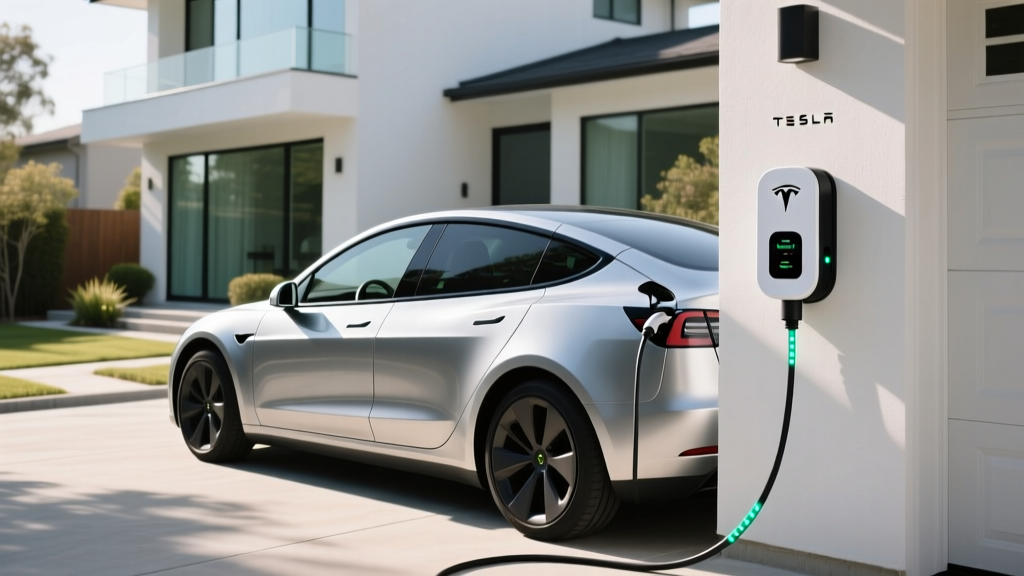
Tesla Wall Connector
Power Output: Up to 11.5 kW (48A) on a 60A hardwired circuit
Connector: NACS (native)
Cable Length: 24 feet
Smart Features: Wi-Fi, OTA updates, Power Sharing (link multiple units on one circuit), access control
Price: ~$475
Best For: Tesla owners who want seamless integration, clean aesthetics, and the fastest Level 2 charge their vehicle can accept.
ChargePoint Home Flex
Power Output: Up to 12 kW (50A) on a NEMA 14-50 or hardwired 60A circuit
Connector: NACS or J1772 (configurable)
Cable Length: 23 feet
Smart Features: Wi-Fi, app scheduling, Alexa integration, Energy Star certified, flexible amperage settings
Price: ~$600–$650
Best For: Multi-EV households or buyers who want to set amperage to match their circuit capacity.
Emporia Vue Level 2 Charger
Power Output: Up to 11.5 kW (48A) hardwired, 9.6 kW (40A) on NEMA 14-50
Connector: NACS or J1772
Cable Length: 24 feet
Smart Features: Wi-Fi, app-based scheduling, energy monitoring (pairs with Emporia Vue home energy monitor), solar integration
Price: ~$350–$400
Best For: Budget-conscious buyers and solar panel owners who want detailed energy tracking.
Grizzl-E Smart
Power Output: Up to 10 kW (40A) on NEMA 14-50
Connector: NACS or J1772
Cable Length: 24 feet
Smart Features: OCPP compatibility, adjustable amperage, extreme cold-rated (-40°F), IP67 outdoor rating
Price: ~$450–$550
Best For: Cold-climate owners who need rugged, outdoor-rated equipment with proven low-temperature reliability.
Safety and Electrical Code Considerations
Home EV charging is safe when installed correctly, but cutting corners on electrical work is never acceptable. Key safety requirements include:
- Dedicated circuit: Your Level 2 charger must be on a dedicated circuit — not shared with other appliances. A 50A NEMA 14-50 or 60A hardwired circuit should serve only the EV charger.
- GFCI protection: The National Electrical Code (NEC) requires Ground Fault Circuit Interrupter (GFCI) protection for outdoor receptacles and, in many jurisdictions, for indoor EV charging circuits as well. Hardwired chargers with built-in GFCI protection satisfy this requirement.
- Outdoor rating: If your charger is installed outdoors (garage-less homes, driveways), ensure the unit carries an IP65 or higher ingress protection rating. All units recommended above meet this standard.
- Proper wire gauge: A 50A circuit requires minimum 6 AWG copper wire; a 60A circuit requires 4 AWG. Your electrician will size wire appropriately based on circuit length and local code.
- Surge protection: While not universally required by code, a whole-home surge protector ($200–$400 installed) safeguards your charger and vehicle's onboard electronics from voltage spikes — a worthwhile investment in areas with frequent lightning or grid instability.
Frequently Asked Questions
How much does it cost to install a home EV charger?
A straightforward Level 2 installation with an existing 200A panel and a short wire run typically costs $800–$2,350 total (equipment, labor, permit). If your home needs a panel upgrade from 100A to 200A, the total can reach $2,900–$7,650. Always get at least two quotes from licensed electricians and verify that the quote includes permit fees.
How fast will each charging level add range?
Level 1 (120V) adds 3–5 miles of range per hour — adequate only for plug-in hybrids with small batteries or as emergency backup. Level 2 (240V, 40–48A) adds 25–44 miles per hour, fully replenishing most EVs overnight. DC fast charging at 150–250 kW can add 150–200+ miles in 15–20 minutes, though the charge curve tapers above 60–80% SoC.
Which connector is compatible with my EV?
All current Tesla vehicles use NACS. Starting in 2025, Ford, GM, Rivian, and most other automakers transitioned to NACS as well. If you own an older CCS-equipped EV (2022–2024 model year VW ID.4, Hyundai Ioniq 5, etc.), you may need a CCS-to-NACS adapter to access Tesla Superchargers, or you can continue using Electrify America and other CCS networks. CHAdeMO is effectively discontinued for new vehicles.
How much does charging cost per mile vs gas?
At home on an off-peak TOU rate ($0.10/kWh), a Tesla Model Y costs approximately $0.029 per mile. On a Supercharger ($0.35/kWh), it costs about $0.10 per mile. A comparable 25 MPG gasoline SUV at $3.50/gallon costs $0.14 per mile. Home charging delivers 75–80% savings per mile versus gasoline; even Supercharger pricing undercuts gas by roughly 25–30%.
What electrical upgrades might I need?
The most common upgrade is a panel capacity increase from 100A to 200A, required when your existing panel lacks capacity for a new 50–60A dedicated circuit. Your electrician will perform a NEC Article 220 load calculation. Other potential upgrades include replacing aluminum wiring with copper, adding a sub-panel in a detached garage, or upgrading the service drop from the utility. Homes built after 2000 with 200A panels rarely need upgrades.
Is the Tesla Mobile Connector sufficient for daily use?
The Tesla Mobile Connector (included with the vehicle) delivers up to 3 kW on a 120V outlet and up to 7.2 kW on a 240V NEMA 14-50 outlet with the appropriate adapter. At 7.2 kW, it adds roughly 30 miles of range per hour — adequate for many drivers who cover less than 60 miles daily and can charge for 8+ hours overnight. However, for a permanent, faster, and safer daily solution, a hardwired Wall Connector at 11.5 kW is the recommended setup.