If you drive a pre-2025 Tesla with a proprietary charge port, the Tesla CCS adapter retrofit is one of the most practical upgrades you can make. It unlocks access to Electrify America, EVgo, and thousands of third-party DC fast chargers using the CCS1 standard — critical for road trips and for owners in areas where Supercharger coverage is thin. This guide covers which Teslas support the retrofit, what you need for home Level 2 charging, real installation costs, and exactly how fast each charging level adds range.
Why the Tesla CCS Adapter Retrofit Matters
Since late 2024, Tesla has opened its Supercharger network to non-Tesla EVs equipped with NACS (North American Charging Standard) connectors. But the reverse scenario — Tesla vehicles charging on CCS networks — requires an adapter. Tesla began shipping CCS adapters to owners in select markets and offers a CCS adapter retrofit kit (part number varies by model) for vehicles that received a firmware update enabling CCS communication protocols.
The retrofit isn't just a physical dongle. Tesla service centers must flash the vehicle's charge controller firmware to recognize CCS1 handshakes. Without this update, the adapter won't initiate a DC fast-charge session on third-party networks. As of early 2026, the adapter retrofit is available for:
- Model 3 (2018–2024 build, with firmware update)
- Model Y (2020–2024 build, with firmware update)
- Model S (2021+ refresh, with firmware update)
- Model X (2021+ refresh, with firmware update)
Vehicles built from mid-2025 onward ship with native NACS ports and broad CCS compatibility via adapter. If you're unsure whether your Tesla qualifies, check the Tesla app under Charging > Adapter Compatibility or contact a service center directly.
Charging Levels Explained: Speed, Power, and Range Added
Understanding charging requires separating kW (kilowatts) — the rate of power delivery — from kWh (kilowatt-hours) — the total energy stored in your battery. Think of kW as how wide the pipe is and kWh as the size of the tank. A 75 kWh battery charged at 11.5 kW (Level 2) will fill in roughly 7–8 hours; at 150 kW (DC fast), it reaches 80% in about 30 minutes.
| Level | Voltage / Amps | Max Power (kW) | Miles of Range per Hour | Typical Use |
|---|---|---|---|---|
| Level 1 | 120V / 12A | 1.4 kW | 3–5 mi/hr | Overnight trickle, PHEVs |
| Level 2 | 240V / 32–48A | 7.7–11.5 kW | 25–44 mi/hr | Home daily charging, workplace |
| DC Fast (CCS1) | 400–800V DC | 50–350 kW | 150–800+ mi/hr (peak) | Road trips, public stations |
| DC Fast (NACS/Supercharger) | 400V DC | 150–250 kW | 400–700 mi/hr (peak) | Tesla Superchargers, NACS stations |
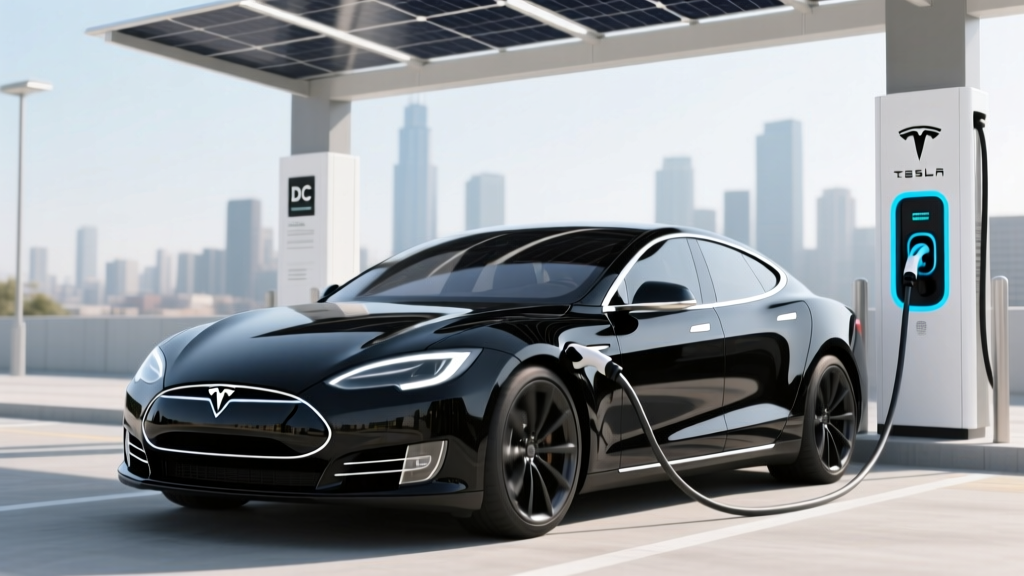
Real-world caveat: DC fast-charging speeds follow a curve, not a flat line. A Tesla Model Y Long Range (75 kWh usable, NMC chemistry) will peak at ~170 kW on a V3 Supercharger from 10–30% state of charge, then taper to ~60 kW above 60%. Expect a 10–80% session in roughly 28–32 minutes. On a 350 kW Electrify America stall via CCS adapter, the same vehicle will still peak at its onboard limit (~170 kW), so the extra station capacity doesn't speed things up.
Tesla CCS Adapter Retrofit: Cost and How to Get It
As of 2026, Tesla sells the CCS1 adapter through its online shop and service centers for approximately $175–$250, depending on the specific part number for your model. The firmware update required for compatibility is typically applied during a scheduled service visit or mobile ranger appointment. Some owners report receiving the update over-the-air after requesting it through the Tesla app.
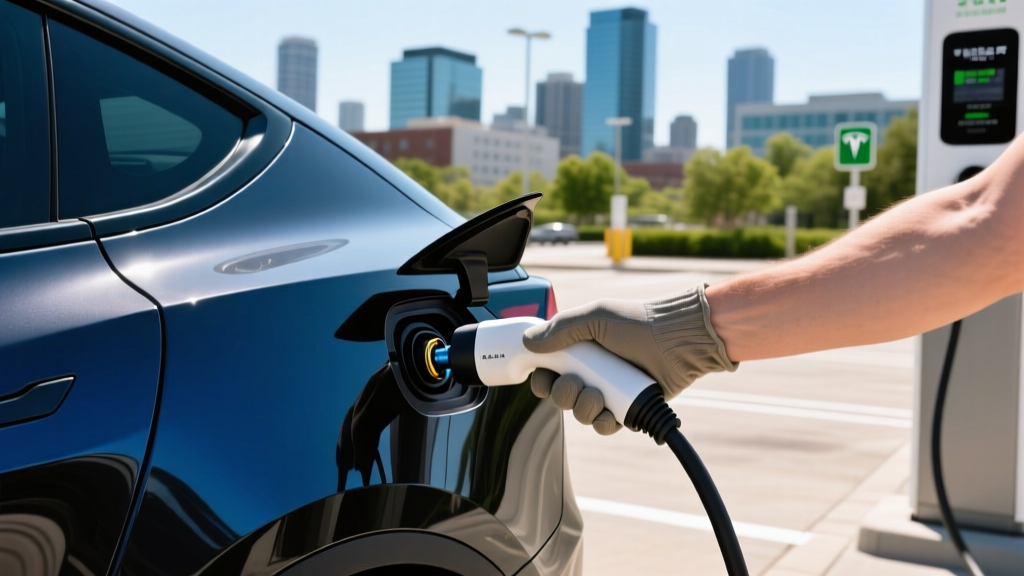
The adapter itself is compact — roughly 8 inches long — and adds a CCS1-compatible inlet that bridges to your Tesla's NACS charge port. Keep it in your frunk or glovebox for road trips. Note that the adapter supports DC fast charging only; for Level 2 AC charging on J1772 stations, Tesla includes a separate J1772 adapter with every vehicle.
Connector Compatibility: What Plugs Into What
The North American charging landscape in 2026 is consolidating around NACS, but CCS1 infrastructure remains widespread. Here's what fits your Tesla:
| Connector | Network Examples | Tesla Native? | Adapter Needed? |
|---|---|---|---|
| NACS (Tesla) | Tesla Supercharger, Rivian Adventure Network | Yes (all Teslas) | None |
| CCS1 | Electrify America, EVgo, ChargePoint (some) | No | Tesla CCS adapter retrofit |
| J1772 (AC Level 2) | Public Level 2, workplace, hotels | No | J1772 adapter (included with vehicle) |
| CHAdeMO | Largely deprecated (older Nissan Leaf stations) | No | Not available for Tesla |
Non-Tesla EVs built for 2025–2026 increasingly ship with NACS ports (Ford, GM, Rivian, Hyundai, and others have adopted the standard). For these vehicles, a NACS-to-CCS adapter may be needed at older Electrify America stations that haven't been retrofitted with NACS cables. Always check the station's connector listing in the AFDC station locator before relying on it.
Home Level 2 Charger Installation: Requirements and Costs
The most cost-effective and convenient way to charge a Tesla is a home Level 2 setup. Here's what's required electrically:
- Circuit: Dedicated 240V circuit, typically 40A or 60A breaker
- Wire gauge: 6 AWG copper for 60A; 8 AWG for 40A (varies by run length)
- Connector: NEMA 14-50 outlet (most common) or hardwired wall connector
- Panel capacity: Your electrical panel must have spare amperage; a 200A panel is standard in modern homes, but older 100A panels may require an upgrade
Installation Cost Breakdown
| Component | Low Estimate | High Estimate | Notes |
|---|---|---|---|
| Level 2 Charger Equipment | $350 | $700 | Tesla Wall Connector, ChargePoint, Emporia |
| Electrician Labor (standard install) | $400 | $1,200 | Varies by run length, conduit, drywall work |
| Electrical Permit | $50 | $200 | Required in most jurisdictions |
| Panel Upgrade (if needed) | $1,500 | $4,000 | 100A → 200A service upgrade; not always required |
| Total (no panel upgrade) | $800 | $2,100 | Most homes with 200A panel |
| Total (with panel upgrade) | $2,300 | $6,100 | Older homes with 100A service |
Before scheduling an electrician, check your panel's main breaker rating and count available slots. A licensed electrician can perform a load calculation per NEC Article 220 to determine whether your panel can handle an additional 40A–60A continuous load. Some utilities offer rebates of $200–$500 for Level 2 installation — check with your local provider. Federal tax incentives for home charging equipment expired for most taxpayers after 2022, though some state-level credits remain; consult IRS guidelines on the Alternative Fuel Vehicle Refueling Property Credit for current eligibility.
Charging Cost per Mile: Home vs. Public vs. Gas
One of the strongest economic arguments for EV ownership is lower per-mile energy cost. Here's how scenarios compare for a Tesla Model Y Long Range (330 EPA miles, ~3.5 miles/kWh efficiency):
| Scenario | Rate | Cost per kWh | Cost per Mile |
|---|---|---|---|
| Home (off-peak utility rate) | $0.12/kWh | $0.12 | $0.034 |
| Home (peak utility rate) | $0.22/kWh | $0.22 | $0.063 |
| Public Level 2 (ChargePoint, etc.) | $0.25–$0.35/kWh | $0.30 avg | $0.086 |
| DC Fast (Electrify America) | $0.40–$0.55/kWh | $0.48 avg | $0.137 |
| Tesla Supercharger (2026 avg) | $0.28–$0.36/kWh | $0.32 avg | $0.091 |
| Gas vehicle (25 MPG, $3.40/gal) | — | — | $0.136 |
Home charging at off-peak rates delivers the lowest cost — roughly $0.03–$0.04 per mile, or about 75% cheaper than a 25 MPG gas car. Public DC fast charging narrows the gap to near parity with gasoline, which is why home access is the single biggest factor in EV ownership satisfaction. For a driver covering 12,000 miles/year, home off-peak charging costs approximately $408 annually versus $1,632 for gasoline.
Recommended Home Chargers for Tesla Owners
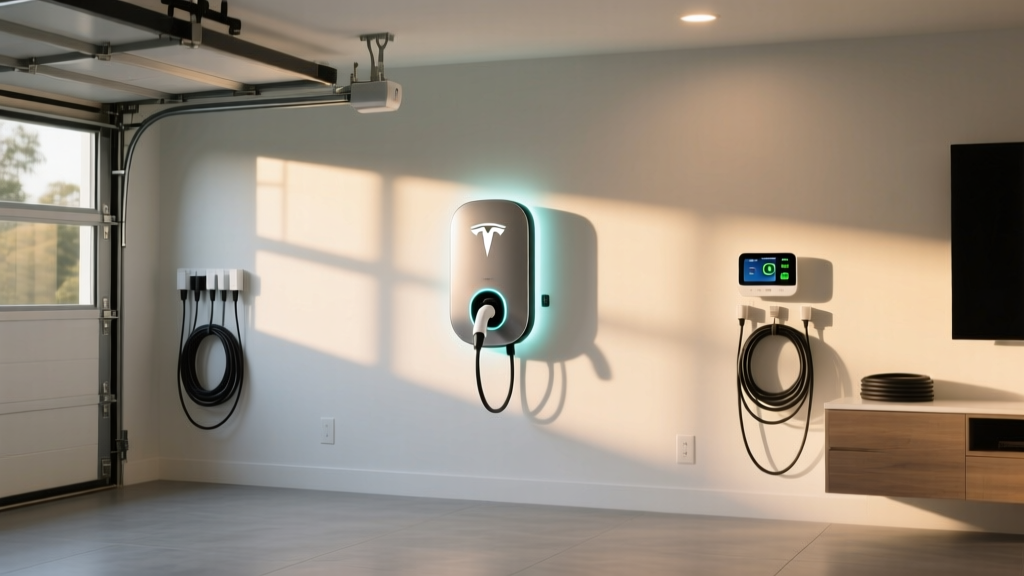
Tesla Wall Connector (Gen 4)
- Power Output: 11.5 kW (48A) on a 60A circuit
- Connector: NACS (native Tesla)
- Cable Length: 24 ft
- Smart Features: Wi-Fi, OTA updates, Power Sharing (link two units on one circuit), access control
- Price: ~$475
- Best For: Tesla-only households wanting seamless integration
Emporia Vue Level 2 Charger
- Power Output: 11.5 kW (48A) on a 60A circuit
- Connector: J1772 (use Tesla's included J1772 adapter)
- Cable Length: 24 ft
- Smart Features: Energy monitoring, solar integration, scheduling, load management
- Price: ~$399
- Best For: Multi-EV households (charges any J1772 or NACS vehicle with adapter)
ChargePoint Home Flex
- Power Output: Up to 12 kW (50A) on a 60A circuit; configurable down to 16A
- Connector: J1772 (use Tesla adapter)
- Cable Length: 23 ft
- Smart Features: App scheduling, Alexa integration, flexible amperage dip-switch
- Price: ~$649
- Best For: Homes with limited panel capacity (dial down amps to fit)
All three units require a dedicated 240V circuit and professional installation. The Tesla Wall Connector is the simplest choice for single-Tesla homes — no adapter needed, and Power Sharing lets you install two connectors on a single 60A circuit (useful for two-car garages). The ChargePoint Home Flex's adjustable amperage is valuable if your panel is near capacity; an electrician can set it to 32A (7.7 kW) to avoid a panel upgrade.
Safety, Permits, and Electrical Code Considerations
EV charging is a continuous load under the National Electrical Code (NEC Article 625), meaning the circuit must be rated for 125% of the charger's maximum draw. A 48A charger requires a 60A breaker — not a 50A. Key safety requirements include:
- Dedicated circuit: EV chargers must not share a circuit with other appliances
- GFCI protection: Required for outdoor installations (NEC 2023+); some jurisdictions require it indoors as well
- Outdoor rating: If mounting outside, ensure the charger carries a NEMA 4 or IP55 weather rating — all three units above qualify
- Permit: Most municipalities require an electrical permit for new 240V circuits; your electrician typically handles this
- Inspection: A city/county inspector will verify the install meets code before final approval
Skip the permit and you risk voiding your homeowner's insurance if a fire originates from an unpermitted circuit. It also creates a liability issue at resale. Budget $50–$200 for the permit and expect a 1–2 week turnaround for inspection in most areas.
Charging Time Examples: 10–80% by Battery Size
DC fast-charging times vary based on battery capacity, chemistry, state of charge, ambient temperature, and the station's maximum output. Below are realistic 10–80% estimates for common Tesla configurations at a 150 kW DC fast charger (via CCS adapter or Supercharger):
- Model 3 RWD (57.5 kWh, LFP): ~32 minutes (LFP batteries tolerate higher charge rates at elevated SoC, but peak at ~100 kW)
- Model Y Long Range (75 kWh, NMC): ~28 minutes (peaks at ~170 kW, tapers above 60%)
- Model S Plaid (95 kWh, NMC): ~35 minutes (larger battery, similar peak rate)
On a 350 kW Electrify America station, these times won't improve significantly because the vehicle's onboard charge controller limits peak draw. Preconditioning the battery (navigating to a charger in the Tesla nav system) warms the pack and can shave 3–5 minutes off a cold-weather session.
Frequently Asked Questions
How much does it cost to install a home EV charger?
A standard Level 2 installation with a 240V/60A circuit and no panel upgrade typically costs $800–$2,100 including equipment, electrician labor, and permit. If your home has an older 100A electrical panel that needs upgrading to 200A, add $1,500–$4,000. Always get 2–3 quotes from licensed electricians and verify they include permit costs.
How fast will each charging level add range?
Level 1 (120V) adds 3–5 miles per hour — suitable only for plug-in hybrids or overnight trickle charging. Level 2 (240V) adds 25–44 miles per hour depending on amperage, fully recharging most EVs overnight. DC fast charging adds 150–800+ miles per hour at peak rates, though real-world sessions taper significantly above 60% state of charge.
Which connector/charger is compatible with my EV?
All Tesla vehicles use the NACS connector natively and can access Superchargers without an adapter. For CCS1 stations (Electrify America, EVgo), pre-2025 Teslas require the Tesla CCS adapter retrofit plus a firmware update. For Level 2 public stations with J1772 connectors, Tesla includes a J1772 adapter with every vehicle. Non-Tesla EVs built in 2025–2026 increasingly use NACS; older EVs use CCS1 or (rarely) CHAdeMO.
How much does charging cost per mile vs gas?
Home off-peak charging averages $0.03–$0.04 per mile — roughly 75% cheaper than a 25 MPG gas car at $3.40/gallon ($0.14/mile). Public DC fast charging at $0.48/kWh costs about $0.14/mile, near gas parity. The economic advantage of EVs depends heavily on home charging access; relying exclusively on public DC fast chargers erodes most of the fuel savings.
What electrical upgrades might I need?
The most common upgrade is a panel service increase from 100A to 200A, required in older homes that lack spare amperage for a 60A EV circuit. Your electrician will perform a NEC Article 220 load calculation. Alternatives to a panel upgrade include installing a lower-amperage charger (32A/7.7 kW), using a smart panel load-management device like the Emporia Smart Panel, or installing a utility-meter-connected circuit that monitors total home load and throttles the charger dynamically.
Does the Tesla CCS adapter work at all Electrify America stations?
Yes, provided your Tesla has received the required firmware update. The adapter supports the CCS1 handshake protocol used by Electrify America, EVgo, and most non-Tesla DC fast networks in North America. Some older Electrify America stations with CHAdeMO-only connectors won't work, but these are increasingly rare. Always verify station connector availability via the EA app or the AFDC locator before routing a trip.
Can I use the CCS adapter for Level 2 AC charging?
No. The Tesla CCS adapter is designed for DC fast charging only. For AC Level 2 stations with J1772 connectors, use the J1772 adapter that came with your vehicle (or purchase a replacement from Tesla for ~$95).