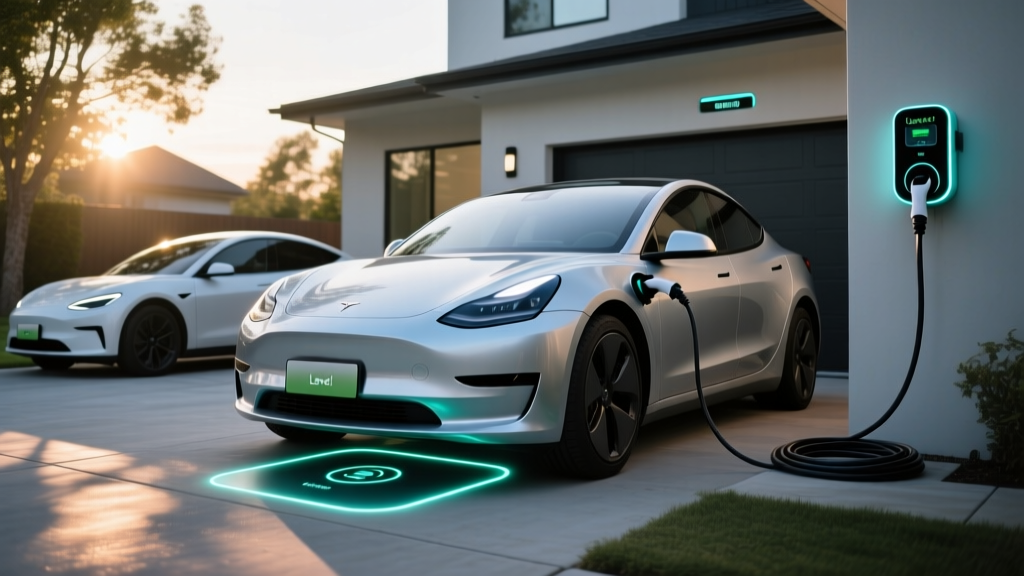
Tesla finally rolled out bi-directional charging capability in late 2025, and the feature is now filtering into the 2026 Model Y refresh, Cybertruck, and the updated Model S/X platform. If you've been searching for a practical breakdown of Tesla bi-directional charging — what it actually does, what hardware you need, and how much it costs to set up at home — this guide covers the full picture with real numbers.
Bi-directional charging isn't a single feature. It's an umbrella term for two distinct capabilities: Vehicle-to-Home (V2H), which powers your house during an outage, and Vehicle-to-Load (V2L), which powers individual devices or tools via an outlet. Tesla's implementation focuses primarily on V2H through the updated Powerwall 3 integration, with limited V2L via a bed-outlet accessory on the Cybertruck.
Charging Levels and How Fast Each Adds Range
Before tackling bi-directional flow, let's establish the baseline charging speeds for getting energy into your Tesla. These rates also define the upper limits of what your home electrical system can handle when energy flows back out.
| Level | Voltage / Amperage | Power (kW) | Miles of Range Added Per Hour | 10–80% Time (75 kWh Battery) |
|---|---|---|---|---|
| Level 1 (120V) | 120V / 12A | ~1.4 kW | 3–5 mi/hr | ~38+ hours |
| Level 2 (240V) | 240V / 48A | ~11.5 kW | 30–44 mi/hr | ~5–6 hours |
| DC Fast Charging | 400–800V DC | Up to 250 kW (V3 Supercharger) | ~1,000 mi/hr (peak) | ~25–30 minutes |
Bi-directional output from a Tesla in V2H mode currently maxes at 11.5 kW — the same rate as a 48-amp Level 2 circuit in reverse. That's enough to run essential home circuits (refrigerator, lights, HVAC blower, well pump) but not an entire 200-amp panel at full draw.
Tesla Bi-Directional Charging: What Hardware You Actually Need
Tesla's V2H system requires three components working together:
- A compatible Tesla vehicle — As of early 2026, bi-directional capability is confirmed on the refreshed Model Y (Juniper), Cybertruck, and the latest Model S/X. Older vehicles built before mid-2025 do not support the feature and cannot be retrofitted via software alone; the onboard charger hardware must support inverter-mode power flow.
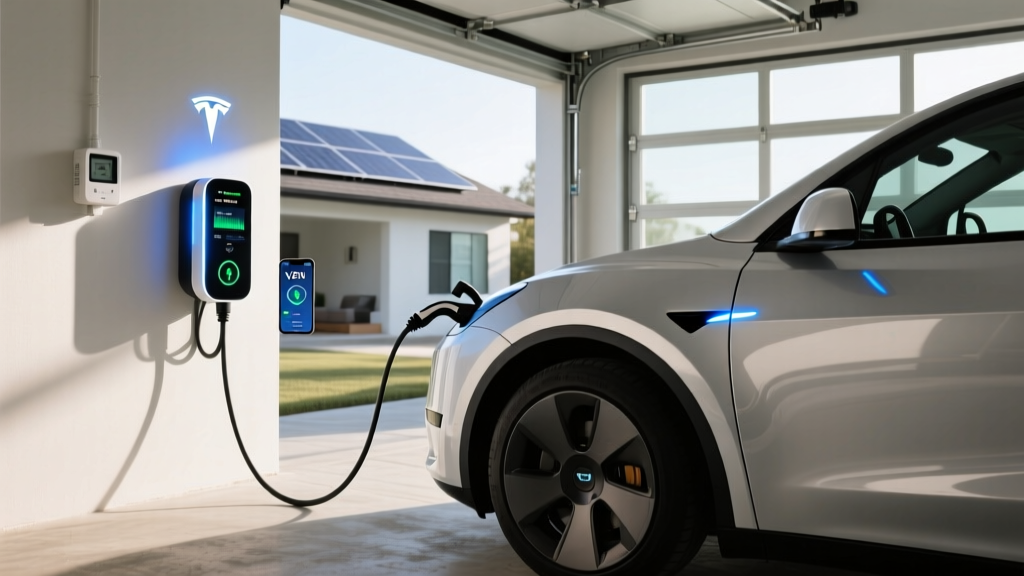
- Tesla Powerwall 3 — Acts as the gateway and inverter between your car and your home's electrical panel. The Powerwall 3 integrates a bi-directional gateway that manages the transfer switch automatically during an outage.
- Tesla Wall Connector (Gen 4) — The updated wall connector communicates with the Powerwall gateway to enable the reverse flow. Older Gen 3 Wall Connectors do not support bi-directional operation.
The Cybertruck's V2L capability is simpler: it offers up to 9.6 kW through bed-mounted 120V and 240V outlets (NEMA 14-50), letting you power tools, camping gear, or a portable heater directly without a Powerwall. This is limited to the Cybertruck and does not extend to other Tesla models.
Connector Compatibility: NACS, CCS, and Adapter Requirements
Tesla's North American Charging Standard (NACS) connector is now the dominant plug in the U.S. market, adopted by Ford, GM, Rivian, Hyundai, and most major automakers for 2025–2026 models. But bi-directional communication protocols matter as much as the physical plug.
| Connector | Bi-Directional Support | Vehicles Using It | Adapter Needed? |
|---|---|---|---|
| NACS (Tesla) | Yes (V2H via Powerwall 3) | All Tesla models (2025.5+), Ford F-150 Lightning, GM Ultium vehicles | No for Tesla; CCS-to-NACS adapter for non-Tesla |
| CCS1 | Yes (Ford/GM V2H systems) | Pre-2025 Ford, GM, Hyundai, BMW, VW | NACS-to-CCS adapter at Tesla Superchargers |
| CHAdeMO | Yes (Nissan Leaf V2H) | Nissan Leaf, Mitsubishi Outlander PHEV (legacy) | CHAdeMO-to-NACS adapter (limited availability) |
For Tesla owners, the ecosystem is self-contained: NACS plug, Tesla Wall Connector Gen 4, and Powerwall 3. If you drive a non-Tesla with CCS and want bi-directional capability, Ford's Pro Power Onboard and GM's Energy platform offer competing V2H systems through their own gateway hardware — but those won't work with Tesla's Powerwall.
Home Installation: Electrical Requirements and Costs
Installing a bi-directional Tesla charging system is significantly more involved than mounting a standard Level 2 charger. You're essentially adding a secondary power source to your home's electrical infrastructure.
Electrical Requirements
- Circuit: Dedicated 60-amp breaker (for 48-amp continuous draw/output) on a 240V circuit
- Wire gauge: 6 AWG copper (or 4 AWG aluminum) for runs up to 100 feet; thicker for longer runs
- Panel capacity: Minimum 200-amp main service panel recommended; older 100-amp or 150-amp panels may require an upgrade
- Gateway installation: Powerwall 3 gateway mounts between your meter and main panel, requiring a transfer-switch-style connection
- Permit: Required in virtually all U.S. jurisdictions — your electrician will pull this
- GFCI protection: NEC 2023/2026 requires GFCI protection for outdoor EV charging circuits; the Tesla Wall Connector Gen 4 has this built in
| Component | Low End | High End | Notes |
|---|---|---|---|
| Tesla Wall Connector Gen 4 | $475 | $475 | Fixed price from Tesla |
| Tesla Powerwall 3 (installed) | $9,200 | $15,000 | Includes gateway; varies by install complexity |
| Electrician labor (Wall Connector + circuit) | $800 | $2,500 | Depends on run length, conduit, drywall work |
| Electrical panel upgrade (if needed) | $2,000 | $5,000 | 100A → 200A service upgrade; not always required |
| Permit and inspection | $100 | $400 | Varies by municipality |
| Total system cost | $12,575 | $23,375 | Full V2H-capable setup |
The Powerwall 3 is the cost driver. If you only want standard Level 2 charging (no bi-directional capability), a Wall Connector Gen 4 installation alone typically runs $1,275–$2,975 total. The bi-directional premium is substantial — you're paying for outage resilience, not faster charging.
When a Panel Upgrade Becomes Necessary
Homes built before 1990 frequently have 100-amp or 150-amp service. Adding a 60-amp EV circuit plus a Powerwall gateway can exceed your panel's spare capacity. Signs you'll need an upgrade:
- Less than 4 unused breaker slots in your panel
- A main breaker rated below 200 amps
- An electrician's load calculation showing your existing circuits already draw over 80% of panel capacity
- Federal Pacific or Zinsco panels (these are flagged as fire hazards and must be replaced regardless)
Charging Cost Per Mile: Home vs. Public vs. Gas
Bi-directional capability doesn't change what you pay to charge — it changes what you can do with stored energy. Here's the cost picture for putting electrons into a Tesla in 2026:
| Scenario | Rate ($/kWh) | Cost for 75 kWh (10–80%) | Cost Per Mile* |
|---|---|---|---|
| Home (off-peak utility rate) | $0.08–$0.14 | $4.20–$7.35 | $0.02–$0.03 |
| Home (standard residential rate) | $0.16 | $8.40 | $0.03–$0.04 |
| Tesla Supercharger (V3/V4) | $0.28–$0.36 | $14.70–$18.90 | $0.06–$0.08 |
| Third-party DC fast (Electrify America, EVgo) | $0.32–$0.48 | $16.80–$25.20 | $0.07–$0.10 |
| Gas equivalent (30 MPG, $3.40/gal) | — | — | $0.11 |
*Based on a Tesla Model Y efficiency of ~250 Wh/mile (EPA combined). Real-world highway efficiency may be 280–310 Wh/mile, increasing cost per mile by 10–20%.
The bi-directional value proposition isn't about cheaper charging — it's about outage resilience and potential time-of-use arbitrage. If your utility offers a vehicle-to-grid (V2G) program or demand-response credits, you could theoretically sell power back during peak hours. As of early 2026, Tesla's V2G participation programs are limited to select utility pilots in California, Texas, and Vermont. Check with your utility before counting on revenue.
Equipment Recommendations for Bi-Directional and Standard Setups
Tesla Wall Connector Gen 4
- Power output: 11.5 kW (48A) on a 60A circuit
- Connector: NACS (native Tesla)
- Cable length: 24 ft
- Smart features: Wi-Fi, OTA updates, bi-directional communication with Powerwall 3 gateway, load sharing with second unit
- Outdoor rating: NEMA 4 (indoor/outdoor)
- Price: $475
Required for Tesla V2H. Best-in-class integration if you're in the Tesla ecosystem.
ChargePoint Home Flex
- Power output: Up to 12 kW (50A) on a 60A circuit; configurable down to 16A
- Connector: NACS or J1772 (select at purchase)
- Cable length: 23 ft
- Smart features: Wi-Fi, app scheduling, Alexa integration, circuit-sharing
- Outdoor rating: NEMA 4
- Price: $599–$649
Best standard Level 2 option if you don't need bi-directional. Flexible amperage for older panels.
Emporia Vue + EV Charger
- Power output: Up to 11.5 kW (48A)
- Connector: NACS or J1772
- Cable length: 24 ft
- Smart features: Real-time energy monitoring, solar integration, automatic load management, V2H-ready (with compatible gateway, announced 2026)
- Outdoor rating: NEMA 4
- Price: $399 (charger) + $299 (Vue panel monitor)
Budget-friendly with excellent energy monitoring. V2H support expected via firmware update for 2025+ units.
Safety, Code, and What Your Electrician Will Check
Bi-directional systems carry additional code requirements beyond a standard EV charger because your vehicle becomes a power source connected to your home's grid:
- Anti-islanding protection: The Powerwall 3 gateway includes automatic disconnect during grid outages to prevent backfeeding power lines — a critical safety feature for utility workers. This is mandated by NEC Article 702 for optional standby systems.
- Transfer switch: The Powerwall gateway acts as an automatic transfer switch, physically isolating your home from the grid before the vehicle begins discharging. Manual interlocks are not sufficient for bi-directional EV systems.
- Dedicated circuit: The Wall Connector must be on its own dedicated 60-amp breaker — no shared circuits with other appliances.
- Grounding: A proper equipment grounding conductor is required; the installer will verify your home's grounding electrode system meets code.
- Outdoor installation: If the Wall Connector is mounted outdoors, it must be on a GFCI-protected circuit (built into Gen 4) and rated for wet locations (NEMA 4, which it is).
- Utility notification: Most utilities require notification before installing any grid-interactive system, including V2H. Your installer typically handles this.
Is Tesla Bi-Directional Charging Worth the Investment?
The honest answer depends entirely on your outage risk and energy-cost structure:
Choose Tesla V2H if:
- You live in an area with frequent multi-hour outages (Texas grid, California PSPS events, hurricane/ice-storm zones)
- You already plan to install a Powerwall for solar self-consumption
- Your utility offers time-of-use rates with expensive peak periods (V2H can offset peak draw)
- You want a single integrated ecosystem (car + battery + charger + app)
Stick with standard Level 2 if:
- Your grid is reliable and outages are rare or brief
- You already have a gas generator for backup
- Your primary goal is simply fast, convenient home charging
- The $12,000+ premium for bi-directional hardware doesn't fit your budget
Frequently Asked Questions
How much does it cost to install a Tesla bi-directional home charging system?
A full Tesla V2H setup — Wall Connector Gen 4, Powerwall 3, electrical work, and permits — ranges from $12,575 to $23,375 depending on whether your panel needs upgrading and how complex the wiring run is. The Powerwall 3 alone accounts for $9,200–$15,000 of that total. A standard Level 2 install without bi-directional capability costs $1,275–$2,975.
How fast will each charging level add range to my Tesla?
Level 1 (120V) adds 3–5 miles per hour. Level 2 (240V, 48A) adds 30–44 miles per hour. DC fast charging at a V3 Supercharger (250 kW peak) can add up to 200 miles in 15 minutes, though the charge curve tapers significantly above 60% State of Charge. See the charging-levels table above for detailed figures.
Which Tesla models support bi-directional charging in 2026?
As of early 2026, bi-directional V2H is confirmed on the refreshed Model Y (Juniper platform), Cybertruck, and updated Model S/X. The standard-range Model 3 (RWD) does not currently support V2H. The Long Range and Performance Model 3 variants built after mid-2025 are expected to gain support via OTA update — check your vehicle's software release notes or Tesla's app for confirmation.
Can I use my Tesla to power my entire house during an outage?
Not at full capacity. A Tesla vehicle in V2H mode delivers up to 11.5 kW. The average U.S. home peaks at 15–25 kW when all major appliances run simultaneously. With the Powerwall 3 managing load priorities, essential circuits (lights, refrigerator, HVAC fan, Wi-Fi, well pump) will run for 11–15 hours from a 75 kWh battery. You'll need to manage heavy loads like electric ovens, dryers, and central AC compressors carefully.
Does the federal tax credit apply to bi-directional charging equipment?
The Residential Clean Energy Credit (IRC §25D) covers 30% of the cost of battery storage technology (including Powerwall 3) with no upper dollar limit, through 2032. This is separate from the §30D vehicle credit. The Wall Connector and installation labor may qualify under the Alternative Fuel Vehicle Refueling Property Credit (§30C), which covers up to $1,000 for home charging equipment. Consult a tax professional — eligibility depends on your specific installation and tax situation.
What's the difference between V2H, V2L, and V2G?
V2H (Vehicle-to-Home) powers your house during an outage through a gateway like the Powerwall 3. V2L (Vehicle-to-Load) powers individual devices through outlets built into the vehicle (Cybertruck's bed outlets, for example). V2G (Vehicle-to-Grid) sells power back to the utility grid for demand-response programs — Tesla's V2G support is currently limited to select utility pilot programs and is not broadly available as of 2026.