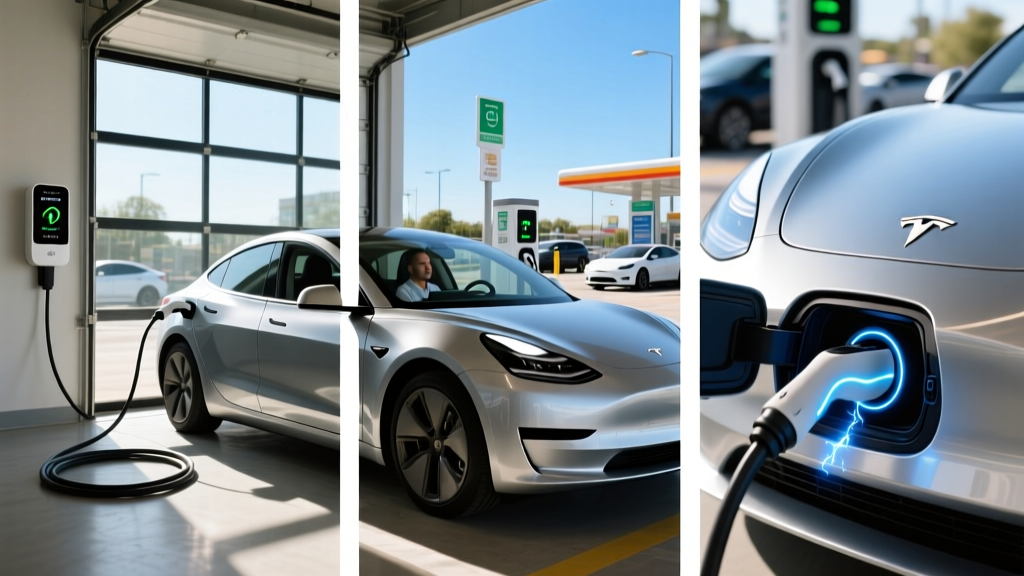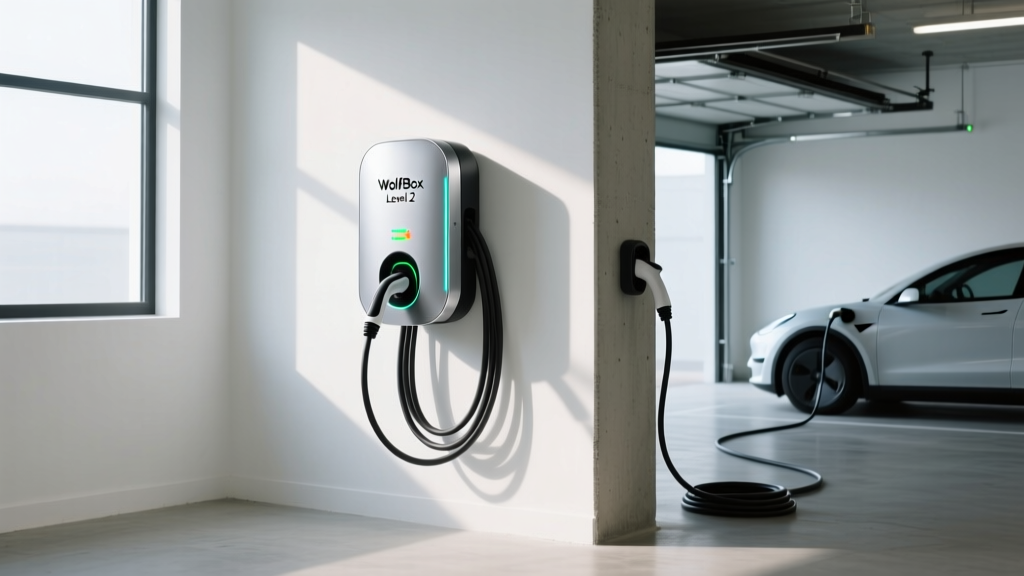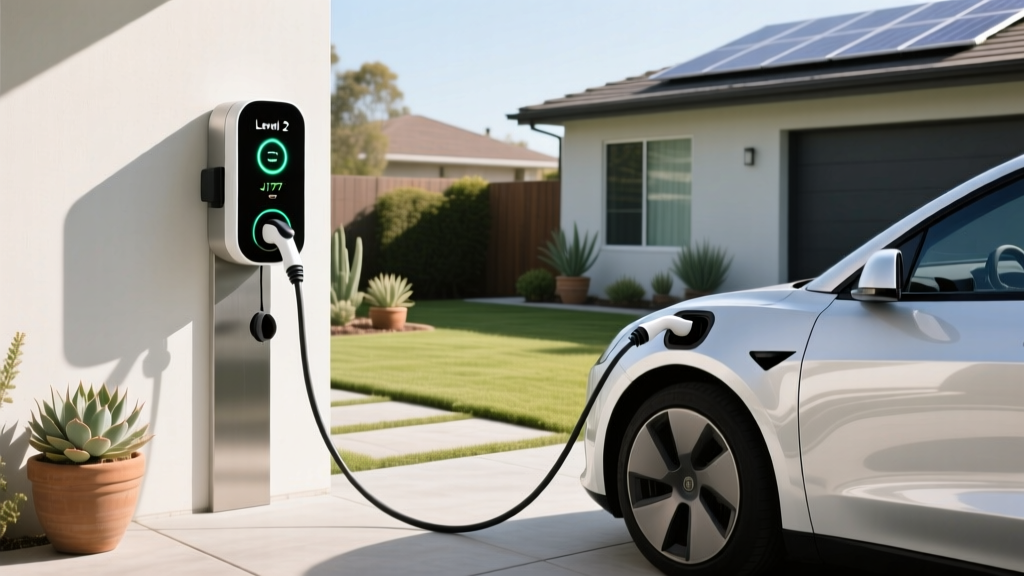
Installing a home EV charger is the single highest-impact upgrade an electric-vehicle owner can make. It transforms daily fueling from a public-charging chore into a plug-in-overnight routine that costs a fraction of gasoline. But between electrical panel capacity, permit requirements, connector standards in flux, and a federal tax credit with strict eligibility rules, the process demands real numbers before you call an electrician.
This guide breaks down the actual costs, the tax credit for charging station hardware under IRS §30C (Alternative Fuel Vehicle Refueling Property Credit), charging speeds at every level, and the equipment that earns a spot on your garage wall in 2026.
Charging Levels Explained: kW, Miles Per Hour, and Real Charge Times
The most common mistake new EV buyers make is confusing kW (kilowatts) with kWh (kilowatt-hours). kW measures power — how fast energy flows into your battery, like water pressure from a hose. kWh measures energy — the total capacity of your battery, like the size of the tank. A 10 kW charger delivers 10 kWh of energy in one hour. A 75 kWh battery charged at 10 kW from empty to full takes roughly 7.5 hours.
| Level | Voltage | Power (kW) | Miles Added/Hour | Typical Use Case |
|---|---|---|---|---|
| Level 1 | 120V AC | 1.2–1.9 kW | 3–5 mi/hr | Overnight top-up, PHEVs, low-mileage drivers |
| Level 2 | 240V AC | 3.3–19.2 kW | 12–75 mi/hr | Home daily charging, workplace, public destinations |
| DC Fast Charge | 400–800V DC | 50–350+ kW | 150–1,200+ mi/hr | Road trips, highway corridors, fleet depots |
For context, most modern BEVs average 3–4 miles per kWh. A 10 kW Level 2 charger adds roughly 30–40 miles of range per hour. A 350 kW DC fast charger can theoretically add 1,000+ miles per hour — but no battery can sustain that rate for long. Charge curves taper significantly above 80% state of charge (SoC), which is why manufacturers quote 10–80% times rather than 0–100%.
Real-World 10–80% Charge Times by Battery Size
| Battery Size | At 11.5 kW (Level 2, 48A) | At 150 kW (DC Fast) | At 250 kW (DC Fast) |
|---|---|---|---|
| 60 kWh (e.g., base Tesla Model Y) | ~3.7 hours | ~22 minutes | ~16 minutes |
| 77 kWh (e.g., Ford Mustang Mach-E ER) | ~4.7 hours | ~28 minutes | ~20 minutes |
| 84 kWh (e.g., Hyundai Ioniq 5 Long Range) | ~5.1 hours | ~30 minutes | ~18 minutes* |
| 100 kWh (e.g., Rivian R1S Dual Large) | ~6.1 hours | ~36 minutes | ~27 minutes |
*The Ioniq 5's 800V architecture sustains higher DC fast-charge rates longer than 400V competitors, hitting 10–80% in approximately 18 minutes on a 350 kW charger per Hyundai specs.
The Tax Credit for Charging Station Installs: IRS §30C Rules for 2026
The federal incentive for home charging equipment falls under IRS §30C — the Alternative Fuel Vehicle Refueling Property Credit, not the §30D new-vehicle credit. Here's what the credit actually covers and who qualifies.
- Credit amount: 30% of the cost of qualifying home charging equipment and installation, up to a maximum of $1,000 per tax year for residential property.
- Eligible costs: The charger hardware itself plus electrical installation labor. Does not cover panel upgrades, trenching, or general electrical work unrelated to the charger circuit.
- Location requirement: The equipment must be installed at your primary residence or a qualifying property in the United States.
- Placed-in-service date: Equipment must be placed in service during the tax year you claim. A charger bought in December 2026 but installed in January 2027 applies to your 2027 return.
- Income caps: None — unlike the §30D vehicle credit, §30C has no adjusted gross income limits as of current IRS guidance.
- MSRP caps: None for charging equipment.
- Nonrefundable: The credit reduces your tax liability dollar-for-dollar but cannot create a refund if you owe zero tax.
In practice, a $600 Level 2 charger with $800 in installation labor totals $1,400 — the 30% credit yields $420 back. If your total exceeds $3,334 (the point where 30% hits the $1,000 cap), you max out at $1,000. For the latest rules, consult IRS Publication on §30C directly.
Important caveat: Some states and utilities stack additional rebates on top of the federal credit — California's SGIP, New York's Charge Ready NY, and various utility make-ready programs can cover hundreds more. Check your local utility's EV program page before purchasing.
How Much Does It Cost to Install a Home EV Charger?
The honest answer: anywhere from $400 to $4,500+, depending entirely on your home's existing electrical infrastructure. Here's the breakdown based on typical 2026 electrician rates and equipment pricing.
| Component | Simple Install (Panel Adjacent) | Moderate Install (50–80 ft Run) | Complex Install (Panel Upgrade + Long Run) |
|---|---|---|---|
| Level 2 Charger (40–48A) | $400–$700 | $400–$700 | $400–$700 |
| 240V Circuit (50–60A breaker, 6/3 or 4/3 wire) | $200–$400 | $500–$1,200 | $800–$1,800 |
| Permit & Inspection | $50–$150 | $50–$200 | $100–$300 |
| Electrical Panel Upgrade (100A → 200A) | N/A | N/A | $1,500–$3,500 |
| Total Estimated Cost | $650–$1,250 | $950–$2,100 | $2,800–$6,300 |
What Electrical Upgrades Might I Need?
A Level 2 charger drawing 48 amps requires a dedicated 60-amp, 240-volt circuit (National Electrical Code requires breakers rated at 125% of continuous load — so 48A × 1.25 = 60A breaker). Most homes built after 1990 have 200-amp service panels with available capacity. Older homes with 100-amp panels often need an upgrade.
Your electrician will perform a load calculation per NEC Article 220 to determine if your panel can handle the additional draw. Key variables:
- Existing panel amperage (100A, 150A, or 200A)
- Available breaker slots (you need 2 adjacent slots for a 240V breaker)
- Current household load (electric range, dryer, HVAC, water heater all compete for capacity)
- Distance from panel to charger location (longer wire runs cost more and may require larger gauge wire to prevent voltage drop)
Pro tip: Some smart chargers (like the Emporia Vue-linked charger or Enel X Way) offer load-management features that dynamically reduce charging amperage when household demand spikes, potentially avoiding a panel upgrade entirely. Ask your electrician about this option if your panel is tight on capacity.
Connector Compatibility: NACS, CCS1, and CHAdeMO in 2026
The North American charging connector landscape has consolidated dramatically since Tesla opened its Supercharger network. Here's where things stand for 2026 model-year vehicles.
| Connector | Brands Using It (2026 Models) | Home Charger Availability | Notes |
|---|---|---|---|
| NACS (J3400) | Tesla, Ford, GM, Rivian, Volvo, Polestar, Mercedes, Nissan, Honda, Fisker, Lucid (adapter), Hyundai/Kia (select 2026+ models) | Tesla Wall Connector, ChargePoint Home Flex (NACS), Emporia Level 2 | Becoming the dominant North American standard. Smaller, lighter connector. |
| CCS1 | Most legacy non-Tesla BEVs (2020–2025 models), VW ID.4 (2025 and earlier), BMW iX/i4, some Hyundai/Kia | ChargePoint Home Flex, Enel X Way, Grizzl-E, Emporia | Being phased out on new models but remains widely deployed at public DCFC stations. |
| CHAdeMO | Nissan Leaf (all years), Mitsubishi Outlander PHEV (older models) | Limited — most home chargers are NACS/CCS | Effectively discontinued for new vehicles. Nissan adopted NACS for 2026+ models. |
Adapter reality: If you own a CCS1-equipped EV but want to access Tesla Superchargers (now open to non-Tesla vehicles), you'll need a CCS-to-NACS adapter — Tesla sells one for approximately $250. Conversely, if you buy a NACS-equipped vehicle and need to use legacy CCS public chargers, a NACS-to-CCS adapter is available from third-party manufacturers. For home charging, most Level 2 chargers now ship with NACS connectors or offer swappable connector options.
Cost to Charge: Home vs. Public vs. Gas per Mile
The economics of EV charging depend on your electricity rate, which varies dramatically by region, time of day, and whether you're on a time-of-use (TOU) plan. Here's a realistic comparison.
| Scenario | Rate ($/kWh) | Efficiency (mi/kWh) | Cost Per Mile | Annual Cost (12,000 mi) |
|---|---|---|---|---|
| Home Off-Peak (TOU plan, overnight) | $0.08–$0.12 | 3.5 | $0.023–$0.034 | $275–$410 |
| Home Standard Rate (no TOU) | $0.14–$0.18 | 3.5 | $0.040–$0.051 | $480–$615 |
| Public Level 2 (ChargePoint, EVgo L2) | $0.25–$0.49 | 3.5 | $0.071–$0.140 | $855–$1,680 |
| DC Fast Charge (Electrify America, Tesla SC) | $0.32–$0.56 | 3.5 | $0.091–$0.160 | $1,095–$1,920 |
| Gasoline Car (30 MPG, $3.40/gal) | — | — | $0.113 | $1,360 |
The takeaway is unambiguous: home charging on off-peak rates is 3–5× cheaper per mile than gasoline, and even DC fast charging is roughly comparable to or cheaper than gas on a per-mile basis. But relying exclusively on public DC fast charging erodes the cost advantage significantly — and accelerates battery degradation due to sustained high-C-rate charging. Home Level 2 is the economic sweet spot.
Best Home EV Chargers for 2026: Equipment Picks
We evaluated chargers on power output, connector options, cable length, smart features, build quality, and price. All recommendations below are UL-listed (or equivalent) and support NACS or CCS connectors.
ChargePoint Home Flex
- Power Output: Up to 12 kW (50A) on a 60A circuit; configurable down to 16A for lower-capacity panels
- Connector: Available in NACS or CCS1 (J1772 with adapter)
- Cable Length: 23 feet
- Smart Features: Wi-Fi connected, ChargePoint app scheduling, Alexa/Google Home integration, load sharing between two units on one circuit
- Price: ~$549 (NACS version)
- Best for: Most homeowners wanting a reliable, flexible smart charger with broad vehicle compatibility
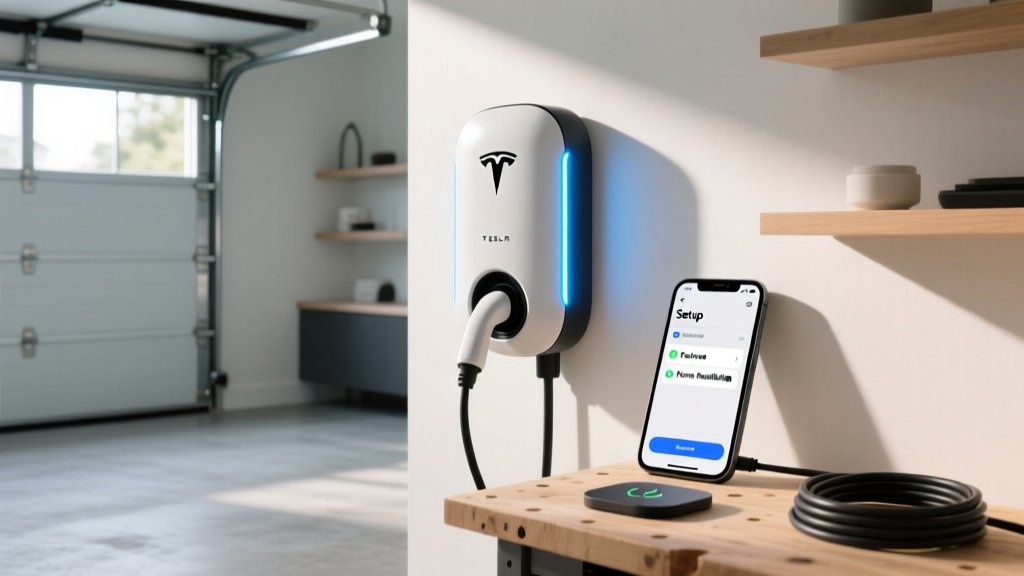
Tesla Wall Connector (Gen 3)
- Power Output: Up to 11.5 kW (48A) on a 60A circuit
- Connector: NACS native
- Cable Length: 24 feet
- Smart Features: Wi-Fi, over-the-air updates, power sharing between multiple Wall Connectors, integrated cable management
- Price: ~$420
- Best for: Tesla owners or households with NACS-equipped vehicles who want the cleanest installation aesthetic
Emporia Level 2 EV Charger
- Power Output: Up to 11.5 kW (48A) on a 60A circuit
- Connector: J1772 (NACS adapter included with newer shipments)
- Cable Length: 24 feet
- Smart Features: Integrates with Emporia Vue home energy monitor for real-time solar-aware charging, load management, and utility TOU scheduling
- Price: ~$399
- Best for: Homes with solar panels or Emporia Vue energy monitoring; budget-conscious buyers wanting smart features
Grizzl-E Smart
- Power Output: Up to 10 kW (40A) on a 50A circuit
- Connector: J1772 (NACS adapter available separately)
- Cable Length: 24 feet
- Smart Features: Wi-Fi, EVduty app, adjustable amperage via DIP switches (useful for panel-constrained homes)
- Price: ~$449
- Best for: Cold-climate garages (rated to -40°F), outdoor installations (NEMA 4 rated), Canadian-built durability
Safety, Code, and Installation Best Practices
A Level 2 charger is a continuous high-amperage load — it runs at full draw for hours unattended. Electrical safety isn't optional. Here's what your installation must include per the National Electrical Code (NEC) and best practice:
- Dedicated circuit: Your EV charger must have its own dedicated breaker — it cannot share a circuit with any other outlet or appliance.
- GFCI protection: NEC 2020 and later require GFCI protection for all 240V EV charging outlets (NEMA 14-50 or hardwired). Hardwired chargers with internal GFCI may satisfy this; confirm with your inspector.
- Outdoor rating: If your charger is installed outdoors or in an unenclosed carport, it must carry a NEMA 4 or NEMA 4X weather resistance rating. All chargers recommended above meet this standard.
- Proper wire gauge: A 60A circuit requires 6 AWG copper wire (THHN in conduit) or 4 AWG aluminum. Longer runs may need upsized wire to prevent voltage drop exceeding 3%.
- Permit and inspection: Virtually every jurisdiction requires an electrical permit for a new 240V circuit. Your electrician pulls the permit; a city/county inspector verifies the work. Do not skip this — it protects your home and is required for insurance coverage of electrical fires.
- NEMA 14-50 vs. hardwired: A NEMA 14-50 outlet offers portability (take the charger when you move), but hardwired installations avoid the GFCI breaker requirement in some jurisdictions and eliminate one failure point. Hardwired is preferred for permanent installations.
Frequently Asked Questions
How much does it cost to install a home EV charger?
A straightforward installation (panel nearby, no upgrade needed) runs $650–$1,250 including the charger, wiring, breaker, and permit. A moderate run of 50–80 feet costs $950–$2,100. If your home needs a 200A panel upgrade, expect $2,800–$6,300 total. The federal §30C tax credit returns up to $1,000 (30% of equipment + installation costs).
How fast will each charging level add range?
Level 1 (120V) adds 3–5 miles per hour — adequate for plug-in hybrids with small batteries. Level 2 (240V, 48A) adds 30–40 miles per hour for most EVs, fully replenishing a 75 kWh battery overnight. DC fast charging (150–350 kW) adds 150–1,200+ miles per hour at peak rate, but tapers significantly above 80% SoC — expect 10–80% in 18–36 minutes depending on vehicle architecture and charger power.
Which connector/charger is compatible with my EV?
Check your vehicle's charge port. 2026 models from Tesla, Ford, GM, Rivian, Volvo, and others use NACS. Most 2020–2025 non-Tesla EVs use CCS1. The Nissan Leaf uses CHAdeMO. For home charging, buy a charger with the matching connector — or use a certified adapter. Nearly all new chargers now offer NACS as a primary or optional connector.
How much does charging cost per mile vs gas?
Home charging on off-peak electricity costs roughly $0.02–$0.03 per mile — about 3–4× cheaper than a 30 MPG gas car at $3.40/gallon ($0.11/mile). Even standard-rate home electricity ($0.14–$0.18/kWh) delivers $0.04–$0.05 per mile. Public DC fast charging at $0.35–$0.50/kWh costs $0.09–$0.14 per mile — comparable to gas, which is why home charging is the economic foundation of EV ownership.
What electrical upgrades might I need?
Homes with 200A service and available breaker slots typically need no panel upgrade. Homes with 100A panels, electric heating, or heavy existing loads may need a panel upgrade to 200A ($1,500–$3,500). Smart chargers with load-management features can sometimes avoid an upgrade by dynamically reducing charging amperage when other appliances draw power. Always have a licensed electrician perform a load calculation before committing to equipment.
Can I claim the tax credit for a charging station I installed myself?
The §30C credit covers equipment and professional installation costs. DIY electrical work may not satisfy local code or permit requirements, and self-performed labor cannot be claimed. Use a licensed electrician — it protects your safety, satisfies inspection, and ensures your credit claim is clean.
Does frequent DC fast charging damage my battery?
Exclusively relying on DC fast charging accelerates lithium-ion degradation compared to Level 2 charging. Most battery management systems (BMS) limit charge rates at high and low SoC to protect cells, but sustained high-C-rate charging generates heat that stresses NMC chemistry in particular. For daily use, Level 2 at home is optimal; reserve DC fast charging for road trips. Per fueleconomy.gov, modern EV batteries are designed to retain 70–80% of original capacity after 8–10 years of mixed charging use.