The Federal Tax Credit for an Electric Car Charging Station Explained
Installing a Level 2 home charger is the single highest-impact upgrade an EV owner can make — and the IRS helps pay for it. Under Section 30C of the Internal Revenue Code, homeowners can claim a federal tax credit for electric car charging station equipment and installation costs. The credit covers 30% of qualified expenses, up to a maximum of $1,000 per tax year. Unlike the vehicle purchase credit (§30D), this incentive is specifically for the refueling property itself: the charger hardware, wiring, conduit, labor, and permits.
But the credit is not automatic, and it comes with location-based restrictions that trip up many buyers. The equipment must be installed in a census tract that is either classified as non-urban or designated as a low-income community. Before purchasing a charger, verify your address using the DOE's 30C eligibility mapping tool. If your home qualifies, here's everything you need to budget, select, and install a home charging system — and claim the credit on your return.
§30C Credit Eligibility Checklist
- Credit amount: 30% of equipment + installation costs, capped at $1,000
- Qualified property: EVSE (charger), wiring, conduit, labor, permits
- Location requirement: Installed in a qualifying non-urban or low-income census tract
- Property type: Your principal residence (rentals and second homes excluded)
- Filing: IRS Form 8911, submitted with your annual tax return
- Nonrefundable: Credit reduces tax liability to zero but does not generate a refund
Charging Levels: Speed, Power, and Range Added Per Hour
Before selecting equipment, you need to understand the three charging tiers. The critical distinction: kW (kilowatts) measures power — the rate at which energy flows into your battery. kWh (kilowatt-hours) measures energy — the total capacity stored. Think of kW as the width of a pipe and kWh as the size of the tank. A wider pipe (higher kW) fills the tank faster.
| Level | Voltage | Power (kW) | Miles of Range Added/Hour | Best Use Case |
|---|---|---|---|---|
| Level 1 | 120V AC | 1.2–1.9 kW | 3–5 miles | Overnight top-up for PHEVs or low-mileage BEV drivers |
| Level 2 | 240V AC | 7.2–19.2 kW | 20–60 miles | Daily home charging for all BEVs; full overnight recharge |
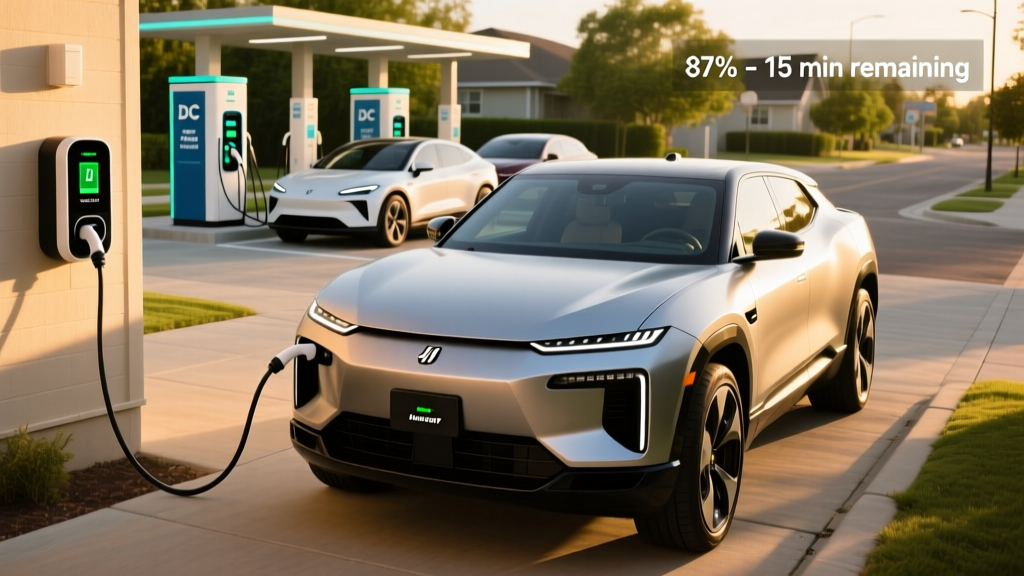
| DC Fast | 200–900V DC | 50–350 kW | 150–1,000+ miles (theoretical) | Road trips; 10–80% in 15–35 minutes |
Real-world charging time examples (Level 2, 11.5 kW / 48A):
- Tesla Model Y (75 kWh battery): ~6.5 hours from 10% to 80%
- Hyundai Ioniq 5 (77.4 kWh battery): ~6.7 hours from 10% to 80%
- Ford F-150 Lightning Extended Range (131 kWh battery): ~11.4 hours from 10% to 80%
- Chevrolet Equinox EV (85 kWh battery): ~7.4 hours from 10% to 80%
Most EV owners charge between 20% and 80% State of Charge (SoC) to preserve long-term battery health. A Level 2 charger at 11.5 kW will replenish a typical 75–85 kWh battery from 20% to 80% in roughly 4–5 hours — easily completed overnight while you sleep.
Home Charger Installation: Electrical Requirements and Costs
This is where most buyers underestimate the project. The charger itself is often $400–$700, but installation — wiring, conduit, circuit breaker, permits, and potential panel upgrades — frequently costs more than the hardware.
Electrical Requirements for a Level 2 Charger
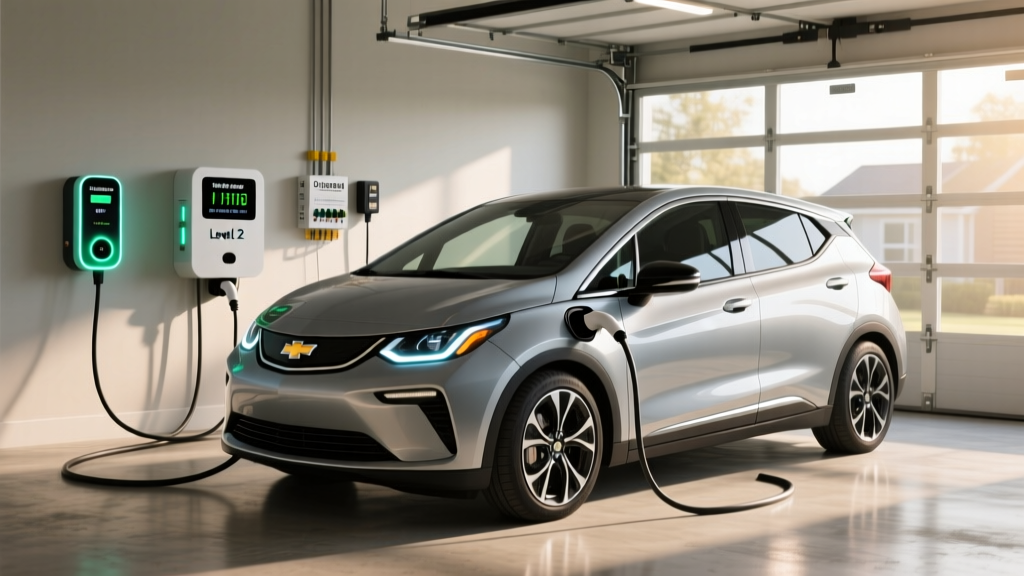
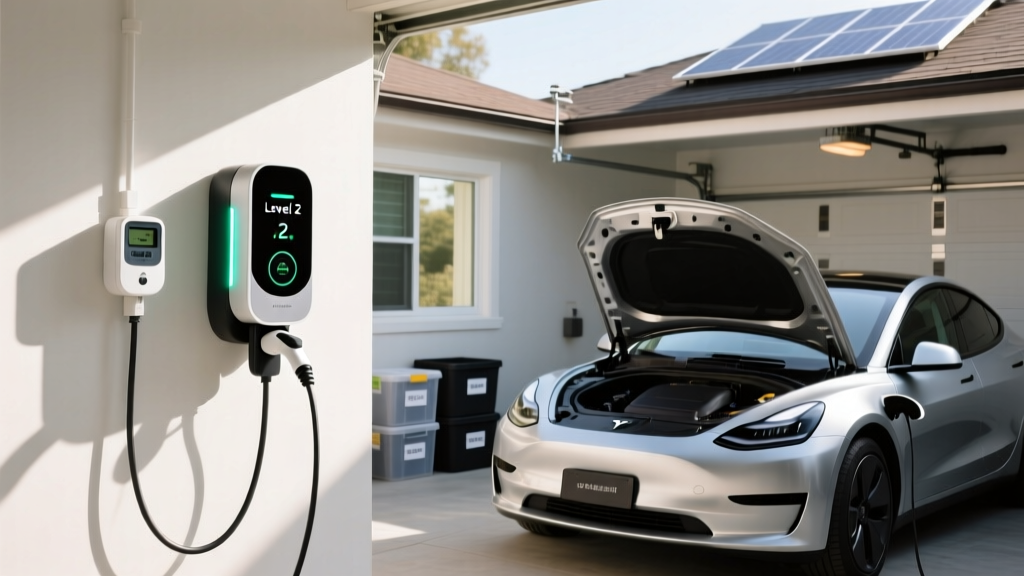
A standard Level 2 installation requires a dedicated 240V circuit. The most common configurations:
- 40A circuit / 32A continuous: Delivers 7.7 kW — sufficient for most sedans and crossovers
- 50A circuit / 40A continuous: Delivers 9.6 kW — the sweet spot for most homes
- 60A circuit / 48A continuous: Delivers 11.5 kW — maximizes charging speed for high-capacity batteries
The National Electrical Code (NEC) requires that continuous loads (anything running 3+ hours, which includes EV charging) use only 80% of the circuit's rated amperage. A 50A breaker therefore supports 40A of continuous draw.
Do You Need an Electrical Panel Upgrade?
If your home has a 100A main panel — common in houses built before 1990 — adding a 50A EV circuit may push total demand beyond safe capacity. An electrician will perform a load calculation (NEC Article 220). If the panel is maxed out, you'll need a service upgrade to 200A, which typically costs $1,500–$3,500 depending on your utility's requirements and local labor rates. Homes with existing 200A panels rarely need an upgrade.
| Cost Component | Typical Range | Notes |
|---|---|---|
| Level 2 Charger (hardware) | $350–$750 | Varies by power output, cable length, smart features |
| Electrician Labor (standard install) | $500–$1,500 | Short run from panel to garage: lower end. Long conduit runs: higher. |
| Permit & Inspection | $50–$250 | Required in most jurisdictions; varies by municipality |
| Electrical Panel Upgrade (if needed) | $1,500–$3,500 | 100A → 200A service upgrade; not always required |
| Total (no panel upgrade) | $900–$2,500 | Most common scenario for modern homes |
| Total (with panel upgrade) | $2,400–$6,000 | Older homes with 100A service |
After the §30C credit: A $2,000 total installation qualifies for a $600 credit (30% of $2,000), bringing your net cost to $1,400. A $3,000 project with a panel upgrade nets you the full $1,000 maximum credit, reducing your cost to $2,000. Note: the credit is nonrefundable — you must have sufficient federal tax liability to absorb it. Consult a tax professional for your specific situation.
Connector Compatibility: NACS, CCS, and CHAdeMO
The North American EV market has standardized on NACS (North American Charging Standard, originally Tesla's connector) for new vehicles starting with the 2025 model year. Here's what that means for your charger purchase:
| Connector | Vehicles That Use It | Home Charger Availability |
|---|---|---|
| NACS (J3400) | All Tesla vehicles; 2025+ Ford, GM, Rivian, Hyundai, Kia, BMW, Volvo, and others | Widely available — Tesla Wall Connector, ChargePoint Home Flex (NACS), Emporia Level 2 |
| CCS1 (J1772 + DC pins) | 2024 and older non-Tesla EVs (VW ID.4 pre-2025, older BMW i4, etc.) | Standard J1772 Level 2 chargers work for AC charging; CCS DC pins are only for public fast charging |
| CHAdeMO | Nissan Leaf (legacy); Mitsubishi Outlander PHEV | J1772 Level 2 chargers work for AC charging; CHAdeMO is DC-only and largely discontinued |
Key clarification for Level 2 home charging: All Level 2 AC charging in North America uses the J1772 standard (or its NACS equivalent for AC pins). The CCS1 DC pins and CHAdeMO connector are irrelevant for home charging — they only apply to DC fast charging at public stations. If you drive a pre-2025 non-Tesla EV with a J1772 port, any J1772 Level 2 charger will work. If you drive a newer NACS-equipped vehicle, you need a NACS-connector home charger or a J1772-to-NACS adapter.
Cost to Charge: Home vs. Public vs. Gas per Mile
The financial case for home charging is overwhelming. Here's what it actually costs to fuel an EV in 2026 across common scenarios:
| Scenario | Rate | Cost per kWh | Cost per Mile (3.5 mi/kWh EV) | Equivalent Gas Cost |
|---|---|---|---|---|
| Home (national avg. residential) | $0.16/kWh | $0.16 | $0.046 | $1.38/gal equivalent |
| Home (off-peak utility rate) | $0.08–$0.10/kWh | $0.09 | $0.026 | $0.77/gal equivalent |
| Public Level 2 (ChargePoint, EVgo) | $0.25–$0.49/kWh | $0.35 | $0.100 | $3.00/gal equivalent |
| DC Fast Charging (Electrify America, Tesla Supercharger) | $0.35–$0.65/kWh | $0.48 | $0.137 | $4.11/gal equivalent |
| Gas Vehicle (28 MPG avg, $3.50/gal) | $3.50/gal | — | $0.125 | $3.50/gal |
The takeaway: Home charging — especially on a time-of-use (TOU) plan with off-peak rates — costs roughly 60–80% less per mile than gasoline. Even public DC fast charging at peak rates is only marginally more expensive than gas. If you drive 12,000 miles per year and charge primarily at home on off-peak power, your annual fuel cost is approximately $310 versus $1,500 for a comparable gas vehicle — a savings of nearly $1,200 per year.
Many utilities offer dedicated EV rate plans with deeply discounted overnight charging (often midnight to 6 AM). Check with your local utility before installation — some even offer rebates on charger hardware or reduced-rate meter installations.
Recommended Home EV Chargers for 2026
These are the Level 2 chargers I've tested and tracked across multiple model years, chosen for reliability, power output, smart features, and value. All prices reflect current retail as of early 2026.
ChargePoint Home Flex (NACS or J1772)
- Power: Up to 12 kW (50A) — adjustable down to 16A for lower-capacity circuits
- Connector: Available in NACS and J1772 configurations
- Cable length: 23 feet
- Smart features: Wi-Fi, ChargePoint app scheduling, Alexa integration, energy tracking
- Price: ~$599 (J1772) / ~$649 (NACS)
- Best for: Drivers who want app-based scheduling and utility TOU integration
Tesla Wall Connector (Gen 3)
- Power: Up to 11.5 kW (48A)
- Connector: NACS native; J1772 adapter included in box
- Cable length: 24 feet
- Smart features: Wi-Fi, Tesla app, power sharing (link multiple units on one circuit), OTA firmware updates
- Price: ~$475
- Best for: Tesla owners and multi-EV households (power-sharing is a standout feature)
Emporia Vue Level 2 EV Charger
- Power: Up to 11.5 kW (48A)
- Connector: J1772 (NACS adapter available separately)
- Cable length: 24 feet
- Smart features: Wi-Fi, Emporia app, integrates with Emporia Vue home energy monitor for whole-home load tracking
- Price: ~$399
- Best for: Budget-conscious buyers who want high power output and energy monitoring
Grizzl-E Smart (United Chargers)
- Power: Up to 10 kW (40A)
- Connector: J1772 or NACS
- Cable length: 24 feet
- Smart features: Wi-Fi, OCPP-compatible (works with utility demand-response programs), adjustable amperage
- Price: ~$499
- Best for: Cold-climate installations (rated to -40°F) and utility-program participants
Safety, Code Compliance, and Installation Best Practices
EV charging draws sustained high current for hours at a time — far more demanding than typical household appliances. Cutting corners on installation is both dangerous and a code violation that can void your homeowner's insurance.
Non-Negotiable Safety Requirements
- Dedicated circuit: Your EV charger must be on its own dedicated breaker — not shared with other outlets or appliances.
- GFCI protection: NEC 2023 and later require Ground Fault Circuit Interrupter protection for all EV receptacles. Most hardwired chargers have built-in GFCI; if you're installing a NEMA 14-50 receptacle, the breaker must be GFCI-rated (adds ~$50–$100 to the breaker cost).
- Outdoor rating: If your charger is installed outside (driveway or exterior wall), the unit must carry a NEMA 4 or NEMA 4X rating for weather resistance. All four chargers recommended above meet this standard.
- Proper wire gauge: A 50A circuit requires 6 AWG copper wire (THHN in conduit or NM-B/Romex where permitted). A 60A circuit requires 4 AWG. Your electrician will size this correctly — but verify it's on the permit.
- Permit and inspection: Nearly all jurisdictions require a permit for EV charger installation. The inspection verifies correct wire gauge, breaker sizing, grounding, and GFCI compliance. Do not skip this step — it protects you and is required for the §30C tax credit documentation.
Hardwired vs. Plug-In (NEMA 14-50)
You have two installation options. A hardwired charger is directly connected to your electrical panel via conduit — no plug. This is the preferred method for 48A+ chargers, as NEMA 14-50 receptacles are rated for 50A and continuous 40A draw is at their upper limit. A plug-in charger on a NEMA 14-50 outlet offers portability (take it when you move) but limits you to 40A / 9.6 kW. For 48A / 11.5 kW chargers, hardwired is the correct choice.
Frequently Asked Questions
How much does it cost to install a home EV charger?
A typical Level 2 installation — charger, wiring, labor, and permit — costs $900–$2,500 in a home with an adequate 200A electrical panel. If your home has a 100A panel and requires a service upgrade to 200A, total project cost ranges from $2,400 to $6,000. The §30C federal tax credit covers 30% of these costs up to $1,000, provided your home is in a qualifying census tract.
How fast will each charging level add range?
Level 1 (120V) adds 3–5 miles per hour — adequate only for plug-in hybrids or very low daily mileage. Level 2 (240V) adds 20–60 miles per hour depending on the charger's amperage and your vehicle's onboard charger capacity — this is the standard for daily home charging. DC fast charging (50–350 kW) can add 150–300+ miles in 20–30 minutes, but is intended for road trips, not daily use, as frequent DC fast charging can accelerate battery degradation.
Which connector and charger is compatible with my EV?
For Level 2 home AC charging, all EVs use either J1772 (most pre-2025 non-Tesla vehicles) or NACS (all Teslas and most 2025+ models from Ford, GM, Hyundai, Kia, Rivian, BMW, and others). Check your vehicle's charge port: if it's a small round 5-pin connector, it's J1772. If it's a slim 5-pin connector (similar to Tesla's), it's NACS. Adapters are available in both directions. For DC fast charging, CCS1 and CHAdeMO connectors are being phased out in favor of NACS at new public stations.
How much does EV charging cost per mile compared to gas?
Home charging on a standard residential rate (~$0.16/kWh) costs approximately $0.046 per mile in a typical EV getting 3.5 miles per kWh. On an off-peak utility rate (~$0.09/kWh), that drops to $0.026 per mile. A comparable gas vehicle at 28 MPG and $3.50/gallon costs $0.125 per mile. Home-charged EVs save 63–79% on fuel costs. Public DC fast charging at ~$0.48/kWh costs roughly $0.137 per mile — slightly more than gas — which is why home charging is essential for long-term savings.
What electrical upgrades might I need for a home charger?
The most common upgrade is a panel service increase from 100A to 200A, required when your home's existing electrical load leaves insufficient headroom for a 40–50A EV circuit. Your electrician will perform an NEC Article 220 load calculation. Other potential upgrades include adding a sub-panel in the garage (if the main panel is far away, reducing wire run costs), installing a GFCI breaker for receptacle-based installations, and upgrading the meter socket if your utility requires a separate meter for an EV TOU rate plan.
Can I claim the tax credit for a rental property or second home?
No. The §30C Alternative Fuel Vehicle Refueling Property Credit applies only to equipment installed at your principal residence. Rental properties and vacation homes do not qualify. Additionally, the home must be located in a qualifying census tract (non-urban or low-income) as defined by the IRS and verified through the DOE mapping tool.
Is a smart charger worth the extra cost?
Yes, for most owners. Smart chargers with Wi-Fi and app control let you schedule charging during off-peak utility hours (maximizing savings), monitor energy usage, and participate in utility demand-response programs that may offer additional rebates. The price premium over a "dumb" charger is typically $50–$150, which is easily recovered through TOU scheduling savings within the first year.