The Ford SVT Cobra Fastback Supercharged — particularly the Terminator-era Mustang Cobra with its Eaton-supercharged 4.6L V8 — remains an icon of forced-induction muscle. But in 2026, enthusiasts cross-shopping a classic supercharged Cobra against a modern electric performance car face a fundamental question: what does daily fueling actually look like, and what does it cost? This guide breaks down the EV charging infrastructure you'd need to make the switch, with hard numbers on speed, cost, and installation — framed against the supercharged V8 baseline.
Why a Supercharged Cobra Owner Might Look at EVs in 2026
The 2003–2004 SVT Cobra produced 390 hp from its supercharged 4.6L, running roughly 15 MPG combined on premium fuel. At $4.50/gallon for premium in many markets, that's $0.30 per mile just in fuel. Modern electric performance cars — the Tesla Model 3 Performance, Hyundai Ioniq 5 N, Ford Mustang Mach-E GT — deliver comparable or greater acceleration while costing $0.04–$0.08 per mile on home electricity. The math is shifting even for enthusiasts who love the supercharger whine.
But the EV ownership experience hinges entirely on your charging setup. Let's break down exactly what that looks like.
Charging Levels Explained: kW Speed and Miles Per Hour
Understanding EV charging requires one critical distinction: kW (kilowatts) measures power — the rate of energy delivery, like the flow rate of a gas pump nozzle. kWh (kilowatt-hours) measures energy — the total amount stored in the battery, like gallons in a tank. Never confuse them.
| Level | Voltage | Max Power (kW) | Miles of Range Per Hour | Best Use Case |
|---|---|---|---|---|
| Level 1 (120V) | 120V / 12A | 1.4 kW | 3–5 mi/hr | Overnight top-off, PHEVs |
| Level 2 (240V) | 240V / 32–48A | 7.7–11.5 kW | 25–44 mi/hr | Daily home charging |
| DC Fast Charge | 400–800V DC | 50–350 kW | 150–300+ mi in 20 min | Road trips, rapid top-ups |
Real-world example: A Ford Mustang Mach-E GT with a 91 kWh usable battery charging on a 48A Level 2 circuit (11.5 kW) will go from 10% to 80% in roughly 6 hours — ideal for overnight. At a 150 kW DC fast charger, that same 10–80% session takes approximately 32 minutes, though peak rate only sustains up to ~50% SoC before tapering. This charge-curve taper is why manufacturers quote 10–80% times rather than 0–100%.
Home Charger Installation: Requirements, Costs, and Panel Upgrades
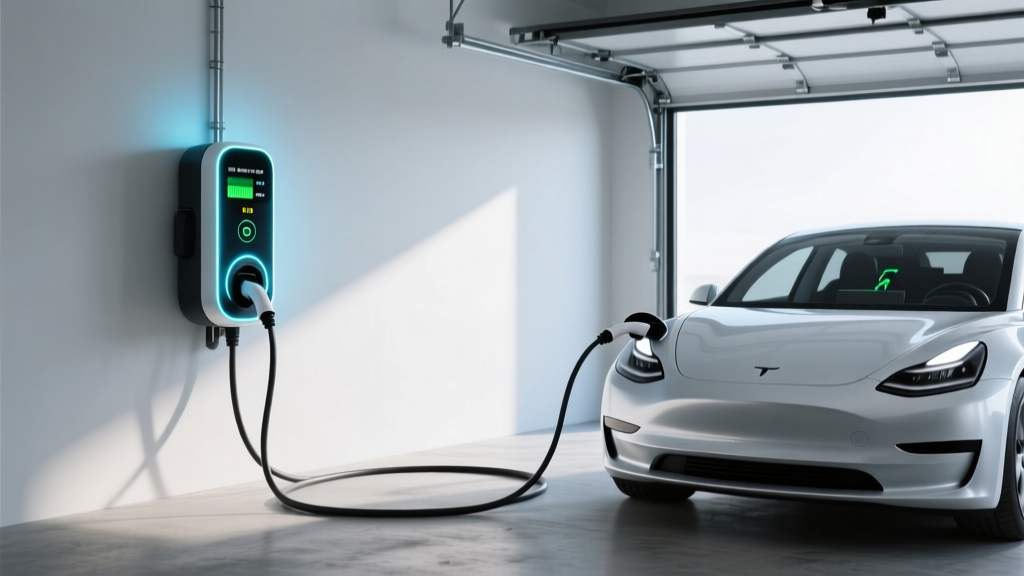
Installing a Level 2 home charger is the single most impactful upgrade for EV ownership. Here's what it actually requires electrically and financially.
Electrical Requirements
A typical Level 2 charger requires a dedicated 240V circuit at 40–60 amps. For a 48A continuous-draw charger, the National Electrical Code (NEC) requires the circuit be rated at 60A (continuous loads must be on circuits rated 125% of the draw). Your home's electrical panel must have sufficient spare capacity — typically 200A total service for modern homes with an EV charger.
Panel Upgrade Reality
Homes built before 2000 often have 100A or 150A panels. Adding a 60A EV circuit may exceed capacity, requiring a panel upgrade to 200A — or in some cases, a full service upgrade. This is the single biggest variable in installation cost and one that's frequently underestimated.
| Component | Low Estimate | High Estimate | Notes |
|---|---|---|---|
| Level 2 Charger Equipment | $400 | $750 | Hardwired or NEMA 14-50 plug |
| Electrician Labor | $500 | $2,000 | Depends on panel-to-garage distance |
| Electrical Permit | $50 | $250 | Varies by municipality |
| Panel Upgrade (if needed) | $1,500 | $4,000 | 100A→200A; not always required |
| Total (no panel upgrade) | $950 | $3,000 | Most homes with 200A service |
| Total (with panel upgrade) | $2,450 | $7,000 | Older homes with 100A/150A panels |
Federal incentive note: The IRS §30D alternative fuel vehicle refueling property credit can cover up to 30% of home charger installation costs (capped at $1,000) if you live in an eligible census tract. Check IRS guidelines for current eligibility, as census-tract qualifications and income limits apply. Consult a tax professional before claiming.
Connector Compatibility: NACS, CCS1, and CHAdeMO in 2026
The connector landscape has consolidated significantly since Ford, GM, Rivian, and most major automakers adopted the North American Charging Standard (NACS) — Tesla's connector — starting in 2025. Here's where things stand for 2026 model-year vehicles:
| Connector | Brands Using It (Factory) | DC Fast Network Access |
|---|---|---|
| NACS (Tesla plug) | Tesla, Ford, GM, Rivian, Volvo, Polestar, Mercedes, Fisker, Lucid (2025+) | Tesla Supercharger, Electrify America (NACS stalls), EVgo |
| CCS1 | Hyundai/Kia (some 2025 carryover), VW ID.4 (pre-2026), BMW iX | Electrify America, EVgo, ChargePoint |
| CHAdeMO | Nissan Leaf (discontinued), Mitsubishi Outlander PHEV | Limited — legacy network only |
Adapter needs: If you own a CCS1-equipped EV from a brand transitioning to NACS, a CCS-to-NACS adapter (~$200–$250) unlocks Tesla Supercharger access. For home Level 2 charging, all EVs use the J1772 standard (or NACS, which includes J1772 signaling) — universal compatibility is not an issue at home.
Cost Per Mile: Supercharged V8 vs. Electric Performance Cars
Here's where the SVT Cobra Fastback Supercharged comparison becomes concrete. Let's run the numbers against three 2026 electric performance benchmarks:
| Vehicle | Efficiency | Energy Cost | Cost Per Mile | Annual (12k mi) |
|---|---|---|---|---|
| SVT Cobra 4.6L SC (premium) | 15 MPG combined | $4.50/gal premium | $0.30 | $3,600 |
| Tesla Model 3 Performance | 26 kWh/100mi | $0.14/kWh home avg | $0.036 | $432 |
| Hyundai Ioniq 5 N | 34 kWh/100mi | $0.14/kWh home avg | $0.048 | $576 |
| Ford Mustang Mach-E GT | 32 kWh/100mi | $0.14/kWh home avg | $0.045 | $540 |
| Tesla Model 3 (DC fast only) | 26 kWh/100mi | $0.40/kWh DC avg | $0.104 | $1,248 |
Key takeaway: Home-charging an EV costs roughly 8–9x less per mile than fueling a supercharged Cobra on premium. Even relying exclusively on DC fast charging (the most expensive scenario), the EV still costs about one-third per mile. Over 5 years at 12,000 miles annually, the fuel savings alone reach $15,000–$16,000.
For context on EV efficiency ratings, the EPA's fueleconomy.gov database provides verified kWh/100mi and MPGe figures for every current model — always cross-reference manufacturer claims against EPA data.
Equipment Picks: 2026 Home Level 2 Chargers Worth Buying
Not all Level 2 chargers are equal. Here are three proven units with exact specs, covering different budgets and installation scenarios:
Tesla Wall Connector (Gen 4)
- Power output: 11.5 kW (48A) on 60A circuit
- Connector: NACS native; J1772 adapter included
- Cable length: 24 ft
- Smart features: Wi-Fi, OTA updates, load sharing (pair two units on one circuit), scheduled charging
- Price: ~$475
- Best for: NACS-equipped vehicles; cleanest installation with Tesla or Ford/GM/Rivian EVs
ChargePoint Home Flex
- Power output: Up to 12 kW (50A) configurable; adjustable from 16A–50A to match circuit
- Connector: J1772 (works with all EVs; NACS vehicles use included adapter)
- Cable length: 23 ft
- Smart features: Wi-Fi, app scheduling, Alexa integration, amperage dial for flexible circuit matching
- Price: ~$550
- Best for: Homes with limited panel capacity (dial down to 32A/40A easily); universal J1772 compatibility
Emporia Level 2 Smart Charger
- Power output: 11.5 kW (48A) on 60A circuit
- Connector: J1772
- Cable length: 24 ft
- Smart features: Wi-Fi, solar integration (pairs with Emporia Vue energy monitor), off-peak scheduling, energy tracking
- Price: ~$400
- Best for: Budget-conscious buyers; homes with solar panels seeking integrated energy management
Safety, Code, and Installation Non-Negotiables
EV charging involves sustained high-current draw — unlike a dryer that cycles on and off, a Level 2 charger may run at full load for 6–8 hours straight. This makes code compliance critical:
- Dedicated circuit: Your EV charger must be on its own dedicated breaker — never shared with other appliances.
- GFCI protection: NEC 2020 and later requires GFCI protection for outdoor receptacles used for EV charging. Hardwired installations may have different requirements depending on your AHJ (Authority Having Jurisdiction).
- Outdoor rating: If your charger mounts outside, it must carry a NEMA 3R or NEMA 4 enclosure rating for weather resistance.
- Permit and inspection: Always pull an electrical permit. The inspection ensures the installation meets NEC and local code — and protects your home insurance coverage if an electrical fire occurs.
- Wire gauge: A 60A circuit requires 6 AWG copper wire (THHN in conduit) or 4 AWG NM-B cable. Your electrician will size this correctly — but verify.
Charging Time Examples: What to Expect With Common Battery Sizes
Charging time depends on battery capacity (kWh) and available power (kW). Here are real-world estimates for popular 2026 EV battery sizes:
| EV (Battery Size) | Level 2 @ 11.5 kW (10–80%) | DC Fast (10–80%) | Peak DC Rate |
|---|---|---|---|
| Tesla Model 3 (75 kWh, LFP) | ~4.5 hours | ~25 min (250 kW) | 250 kW |
| Hyundai Ioniq 5 (77.4 kWh, NMC) | ~4.7 hours | ~18 min (800V, 240 kW) | 240 kW |
| Ford Mach-E GT (91 kWh, NMC) | ~5.5 hours | ~32 min (150 kW) | 150 kW |
| Chevy Silverado EV (200 kWh, NMC) | ~12 hours | ~40 min (350 kW) | 350 kW |
Cold-weather caveat: Lithium-ion batteries charge significantly slower when cold. If your EV doesn't precondition the battery (heat it to optimal temperature) before a DC fast session, expect 10–80% times to increase by 30–50% in sub-40°F conditions. Tesla, Hyundai/Kia, and Ford all include battery preconditioning when you navigate to a charger. Always use this feature.
Frequently Asked Questions
How much does it cost to install a home EV charger?
Expect $950–$3,000 for a standard Level 2 installation in a home with a 200A panel and a short run from panel to garage. If your home needs a panel upgrade from 100A or 150A to 200A, add $1,500–$4,000. The federal alternative fuel refueling credit may offset up to $1,000 of this cost if you're in an eligible census tract.
How fast will each charging level add range?
Level 1 (120V) adds 3–5 miles per hour — adequate only for PHEVs with small batteries or emergency overnight trickle charging. Level 2 (240V, 48A) adds 30–44 miles per hour, fully replenishing most EVs overnight. DC fast charging adds 150–300+ miles in 15–30 minutes depending on peak kW and battery architecture.
Which connector/charger is compatible with my EV?
For 2026 models, most new EVs from Ford, GM, Rivian, Tesla, Volvo, and others use NACS. Hyundai/Kia and some carryover models still use CCS1. For home Level 2, all EVs are compatible via J1772 or NACS (which supports J1772 signaling). Check your vehicle's charge port or the manufacturer's spec page before purchasing a charger.
How much does charging cost per mile vs gas?
Home charging at the US average residential rate of $0.14/kWh costs $0.03–$0.05 per mile for most EVs — compared to $0.25–$0.35 per mile for a supercharged V8 on premium gasoline. DC fast charging at $0.35–$0.48/kWh raises EV cost to $0.09–$0.14 per mile, still well below gasoline.
What electrical upgrades might I need?
The most common upgrade is a panel replacement from 100A or 150A to 200A service, required when your existing panel lacks capacity for a dedicated 60A EV circuit. Some homes may also need a new meter base or utility service drop. A licensed electrician can perform a load calculation per NEC Article 220 to determine if your panel supports the additional circuit — request this assessment before committing to equipment.
Should I get a hardwired charger or a NEMA 14-50 plug?
Hardwired installations avoid the NEC requirement for GFCI breakers on receptacles (which can nuisance-trip with some EV chargers) and allow higher amperage — up to 48A continuous on a 60A circuit. A NEMA 14-50 outlet limits you to 40A continuous (on a 50A circuit) but offers portability if you move. For maximum charging speed and reliability, hardwired is preferred.
The Enthusiast's Decision: Supercharged Soul vs. Electric Economics
The SVT Cobra Fastback Supercharged delivers something no EV replicates — the mechanical drama of an Eaton supercharger spooling, a solid rear axle planting 390 hp, and a 5-speed manual demanding engagement. That's real, and it has value beyond spreadsheets.
But the daily math is unambiguous. A modern EV performance car matches or exceeds the Cobra's acceleration (the Model 3 Performance hits 60 mph in 3.1 seconds vs. the Cobra's 4.7), costs $3,000+ less per year to fuel, and requires no oil changes, supercharger belt replacements, or premium gasoline. With a $950–$3,000 home charger installation, the EV infrastructure question resolves in a single afternoon of electrician work.
For enthusiasts keeping the Cobra as a weekend car while adding an EV daily driver, the home charging setup becomes even simpler — you already pay for the garage space; the charger is an incremental upgrade. The future of performance isn't either/or. It's both — the supercharged V8 for soul, and the electric daily for sense.