Why Sustainable EV Charging Starts at Home
The environmental promise of an electric vehicle only holds up if the electricity fueling it is as clean as possible — and if the charging process itself is efficient, affordable, and practical for daily life. Sustainable EV charging isn't just about solar panels on your roof; it's about choosing the right charging level, the right equipment, and the right time of day to plug in. A well-set-up home charging system running on off-peak or renewable-grid electricity delivers the lowest cost per mile, the least strain on your battery, and the smallest carbon footprint of any refueling method available today.
This guide covers everything you need to build a charging setup that's genuinely sustainable — from electrical requirements and connector compatibility to real cost-per-mile math and the specific Level 2 chargers worth buying in 2026.
Charging Levels Explained: Speeds, Power, and Range Added
The single most important distinction in EV charging is the difference between kW (kilowatts — the rate of power delivery, like water pressure) and kWh (kilowatt-hours — the total energy delivered, like gallons of water). Your battery capacity is measured in kWh; your charger's speed is measured in kW. Confusing them is the most common mistake new EV owners make.
| Level | Voltage | Max Power (kW) | Miles of Range Added Per Hour | Best For |
|---|---|---|---|---|
| Level 1 | 120V AC | 1.4–1.9 kW | 3–5 mi/hr | Overnight top-up, PHEVs, low-mileage drivers |
| Level 2 | 240V AC | 7.2–19.2 kW | 20–65 mi/hr | Daily home charging, workplace, destination |
| DC Fast Charge | 400–800V DC | 50–350 kW | 150–800+ mi/hr (peak) | Road trips, rapid top-up, commercial fleets |
For context: a 75 kWh battery charged from 10% to 80% (52.5 kWh delivered) takes roughly 36–40 hours on Level 1, about 6–8 hours on a 7.7 kW Level 2 circuit, and approximately 18–25 minutes on a 150+ kW DC fast charger — though charging curves taper significantly above 80% State of Charge (SoC), which is why 10–80% is the standard measurement.
Home EV Charger Installation: Requirements, Costs, and Panel Upgrades
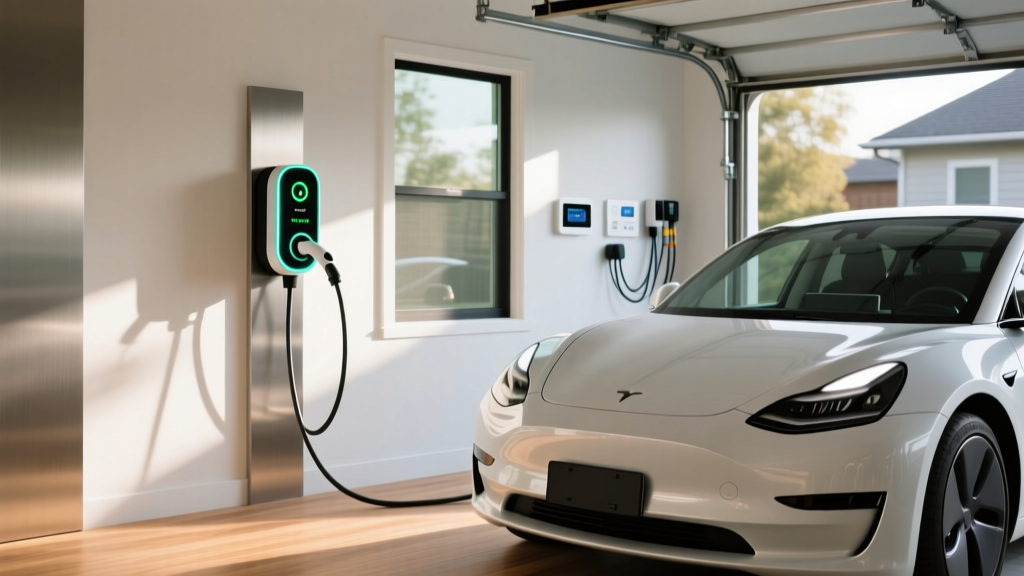
Installing a Level 2 home charger is the single biggest factor in making your EV ownership sustainable and cost-effective. Here's what's involved electrically and financially.
Electrical Requirements
A Level 2 charger requires a dedicated 240V circuit — the same voltage as your electric dryer or oven. The most common residential setup is a 240V / 40-amp circuit, which safely delivers up to 32 amps of continuous current (electrical code requires circuits be loaded to no more than 80% of their rated capacity for continuous loads). This yields approximately 7.7 kW of charging power, sufficient for most daily needs.
For faster home charging, a 240V / 60-amp circuit delivers up to 48 amps continuous, or about 11.5 kW. Some homes with 200-amp electrical panels can accommodate this; others cannot without an upgrade.
Installation Cost Breakdown
| Component | Low End | High End | Notes |
|---|---|---|---|
| Level 2 Charger Unit (hardwired or NEMA 14-50 plug) | $300 | $700 | Smart Wi-Fi chargers with load management cost more |
| Electrician Labor (run 240V circuit, mount charger) | $400 | $1,500 | Depends on distance from panel to garage/carport |
| Permit & Inspection | $50 | $300 | Varies by municipality; some jurisdictions waive EV permits |
| Electrical Panel Upgrade (if needed) | $1,500 | $4,000+ | Required if existing panel is 100A or has no spare breaker slots |
| Total (no panel upgrade) | $750 | $2,500 | Most homes with 200A panels fall in this range |
| Total (with panel upgrade) | $2,250 | $6,500+ | Common in older homes with 100A service |
The panel upgrade is the wildcard. Homes built before the 1990s often have 100-amp service, which may already be near capacity with existing appliances. Adding a 40-amp EV circuit to a maxed-out 100A panel is unsafe and code-violating. A licensed electrician will perform a load calculation before recommending circuit size. Don't skip this step — it determines whether you need a panel upgrade, a smaller circuit (e.g., 20A / 3.8 kW), or a smart charger with dynamic load management that throttles charging when household demand is high.
Safety and Code Considerations
Every installation should include:
- Dedicated circuit: Your EV charger must have its own breaker — never shared with other appliances.
- GFCI protection: NEC 2023 and later require GFCI (Ground Fault Circuit Interrupter) protection for all EV charging outlets. Hardwired chargers often have built-in GFCI, but plug-in NEMA 14-50 outlets require a GFCI breaker.
- Outdoor rating: If your charger is mounted outside, it must carry a NEMA 4 or NEMA 4X rating for weather resistance. All recommended chargers below meet this standard.
- Proper wire gauge: A 40A circuit typically requires 8 AWG copper wire; a 60A circuit requires 6 AWG. Your electrician will size this correctly — never undersize wire.
- Local permits: Most jurisdictions require an electrical permit and post-installation inspection. Skipping this can void homeowner's insurance coverage for electrical fires.
Connector Compatibility: NACS, CCS, and CHAdeMO in 2026
The connector landscape has consolidated significantly. Here's where things stand for the 2026 model year:
| Connector | Brands Using It | Notes |
|---|---|---|
| NACS (North American Charging Standard / Tesla) | Tesla, Ford, GM, Rivian, Volvo, Polestar, Mercedes-Benz, BMW, Hyundai, Kia (select 2026 models), Nissan (Ariya), Subaru | Now the dominant standard; smaller/lighter connector; access to Tesla Supercharger network |
| CCS1 (Combined Charging System) | Volkswagen ID.4 (remaining stock), Stellantis (Jeep, Dodge, Chrysler EVs), Lucid, legacy CCS vehicles | Still supported at most public DC stations; adapters available for Supercharger access |
| CHAdeMO | Nissan Leaf (legacy), Mitsubishi Outlander PHEV (legacy) | Being phased out; new DC stations rarely include CHAdeMO connectors |
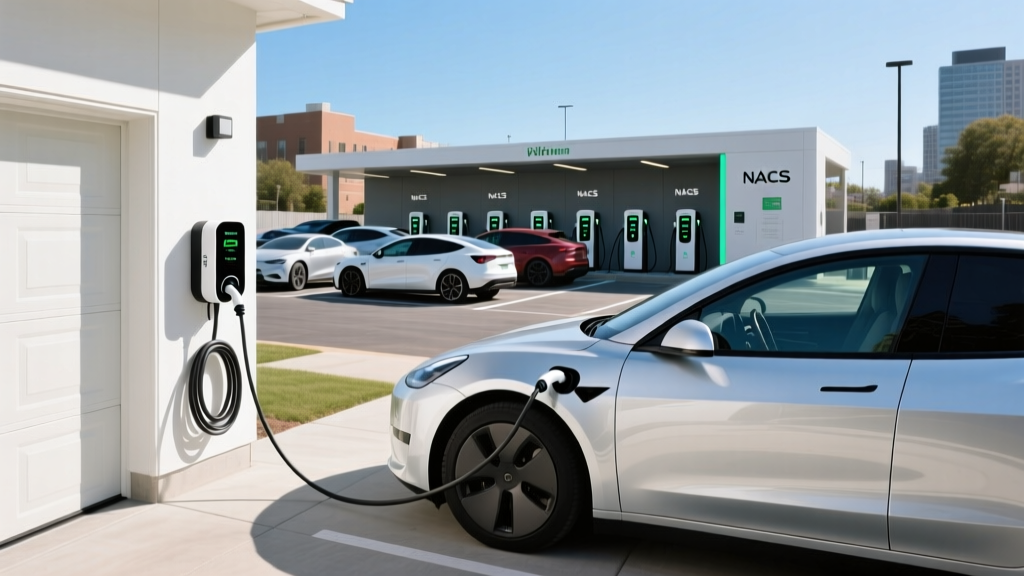
Adapter needs: If you own a CCS-equipped vehicle and want access to Tesla Superchargers, a CCS-to-NACS adapter (approximately $150–$250 from Tesla or third-party manufacturers) is required. Conversely, NACS-equipped vehicles from non-Tesla brands can access Electrify America, EVgo, and ChargePoint DC stations using a NACS-to-CCS adapter where needed — though most major networks have added native NACS cables by 2026. For home Level 2 charging, all vehicles use the J1772 connector (or Tesla's proprietary connector, which now includes a J1772 adapter in-box). The transition to NACS for Level 2 is underway but J1772 remains widely compatible.
Cost Per Mile: EV Charging vs. Gasoline — The Real Math
One of the strongest sustainability arguments for EVs is efficiency. Electric motors convert roughly 85–90% of electrical energy into motion; internal combustion engines manage only 20–30%. This physics advantage means even grid electricity from mixed sources typically produces fewer emissions per mile than gasoline — and costs dramatically less.
| Scenario | Rate | Cost for 75 kWh Battery (10–80%) | Cost Per Mile (250-mi range vehicle) |
|---|---|---|---|
| Home charging — off-peak utility rate | $0.08–$0.12/kWh | $3.15–$4.73 | $0.022–$0.033 |
| Home charging — standard residential rate | $0.14–$0.18/kWh | $5.51–$7.09 | $0.039–$0.050 |
| Home solar (amortized system cost) | $0.04–$0.07/kWh | $1.58–$2.76 | $0.011–$0.020 |
| Public Level 2 (workplace/destination) | $0.20–$0.35/kWh | $7.88–$12.34 | $0.056–$0.088 |
| DC Fast Charging (public, peak) | $0.35–$0.55/kWh | $13.78–$21.68 | $0.098–$0.155 |
| Gasoline (25 MPG vehicle, $3.40/gal) | $3.40/gal | — | $0.136 |
The takeaway: Home charging at off-peak rates delivers fuel costs roughly 75–85% lower than a 25 MPG gas car. Even DC fast charging on the road is often cheaper per mile than gasoline. The sustainability win compounds when your utility offers time-of-use (TOU) rates tied to renewable generation windows — charging at midday in solar-heavy grids (California, Texas, Arizona) or overnight in wind-heavy regions (Midwest, Plains) aligns your EV with the cleanest electrons on the grid.
Check fueleconomy.gov for your specific vehicle's MPGe and kWh/100mi ratings to calculate personalized costs.
Best Home Level 2 Chargers for 2026: Equipment Picks
These are the chargers we recommend based on real-world use, reliability data, and feature sets — not sponsored placements.
ChargePoint Home Flex (2nd Gen)
- Power Output: Up to 12 kW (50A circuit, 40A continuous) — adjustable down to 16A for smaller circuits
- Connector: J1772 (NACS adapter included for 2026 models)
- Cable Length: 23 feet
- Smart Features: Wi-Fi, app scheduling, TOU rate optimization, Alexa/Google Home integration, energy reporting, load sharing between two units on one circuit
- Price: ~$549 (unit only)
- Best For: Most homeowners — flexible amperage means it works on 20A through 50A circuits without replacing hardware
Emporia Vue EV Charger
- Power Output: Up to 11.5 kW (60A circuit, 48A continuous)
- Connector: J1772 (NACS-compatible models shipping 2026)
- Cable Length: 24 feet
- Smart Features: Wi-Fi, integration with Emporia Vue whole-home energy monitor, solar-aware charging (auto-charges when solar production exceeds household load), TOU scheduling, real-time cost tracking
- Price: ~$399 (unit only)
- Best For: Homes with solar panels — the solar-aware charging feature makes this the most sustainable option when paired with rooftop generation
Tesla Wall Connector
- Power Output: Up to 11.5 kW (60A circuit, 48A continuous)
- Connector: NACS native (includes J1772 adapter in-box for non-Tesla EVs)
- Cable Length: 24 feet
- Smart Features: Wi-Fi, over-the-air updates, power sharing between up to 6 Wall Connectors on one circuit, integrated cable management
- Price: ~$475 (unit only)
- Best For: Tesla owners or multi-EV households wanting power sharing — the most elegant NACS-native option
Grizzl-E Smart
- Power Output: Up to 10 kW (50A circuit, 40A continuous) — dip-switch adjustable
- Connector: J1772 (NACS adapter available separately)
- Cable Length: 24 feet
- Smart Features: Wi-Fi, OCPP (Open Charge Point Protocol) support for commercial/utility integration, extreme cold rated to -40°F, aluminum enclosure
- Price: ~$449 (unit only)
- Best For: Cold-climate and outdoor installations — built in Canada, tested to extreme temperatures; the most rugged option
Federal incentive note: The Residential Clean Energy Credit (IRS §25D) may cover 30% of home charger equipment and installation costs (up to $1,000) through 2032 for installations in eligible census tracts. Verify current eligibility at irs.gov and consult a tax professional — rules vary by location and income.
Sustainable Charging Strategies: Timing, Grid Impact, and Battery Health
True sustainability in EV charging goes beyond the vehicle itself. Three strategies maximize both environmental benefit and battery longevity:
1. Charge during renewable-heavy grid windows. In California's CAISO grid, solar peaks between 10 AM–3 PM; in ERCOT (Texas), wind peaks overnight. Setting your charger's schedule via its app to align with these windows means your EV runs on the cleanest available electricity. Most utilities now offer TOU rate plans that make this financially rewarding as well — off-peak rates can be 40–60% cheaper than peak.
2. Limit daily charging to 80% SoC for NMC batteries. Lithium-ion batteries with NMC (nickel-manganese-cobalt) chemistry degrade faster when held at 100% for extended periods. Setting a daily charge limit of 80% — and only charging to 100% before road trips — can extend battery life by 20–30% over a decade. Vehicles with LFP (lithium iron phosphate) batteries, like the Tesla Model 3 RWD and some BYD models, can be charged to 100% daily without accelerated degradation — LFP chemistry tolerates full SoC far better.
3. Minimize DC fast charging when possible. DC fast charging generates significant heat in the battery pack, which accelerates degradation over time. Using DC fast charging for road trips (1–2 times per month) has negligible impact; relying on it as your primary charging method (daily) can reduce battery capacity by an additional 3–5% over 100,000 miles compared to Level 2 charging. Sustainable charging means Level 2 at home as your baseline, DC fast as a supplement.
Frequently Asked Questions
How much does it cost to install a home EV charger?
Most homes with a 200-amp electrical panel and a short run from the panel to the garage will pay $750–$2,500 total (charger unit + electrician labor + permit). Homes requiring a panel upgrade from 100A to 200A should budget $2,250–$6,500+. Always get a load calculation from a licensed electrician before committing to a circuit size.
How fast will each charging level add range?
Level 1 (120V) adds 3–5 miles per hour. Level 2 (240V, 40A circuit) adds approximately 30–35 miles per hour — enough to fully replenish a typical 250-mile EV overnight in 7–8 hours. DC fast charging at 150+ kW can add 100–200 miles in 15–20 minutes, but the charge curve tapers significantly above 80% SoC, making 10–80% the practical window.
Which connector/charger is compatible with my EV?
For 2026 model-year vehicles, most new EVs from Ford, GM, Rivian, Tesla, Hyundai, Kia, Volvo, and BMW use the NACS connector. Volkswagen, Stellantis, and Lucid still use CCS1. The Nissan Leaf and older Mitsubishi PHEVs use CHAdeMO. For home Level 2 charging, all vehicles accept J1772 — and NACS vehicles include a J1772 adapter. Check your vehicle's charge port or owner's manual for confirmation.
How much does charging cost per mile vs. gas?
Home charging at off-peak rates ($0.08–$0.12/kWh) costs roughly $0.02–$0.03 per mile for a typical EV. A 25 MPG gas car at $3.40/gallon costs about $0.14 per mile. Even public DC fast charging at $0.45/kWh comes to roughly $0.10–$0.15 per mile — comparable to or cheaper than gasoline. Home solar charging can drop the cost below $0.02 per mile.
What electrical upgrades might I need?
The most common upgrade is a panel capacity increase from 100A to 200A ($1,500–$4,000), required when your existing panel has no spare breaker slots or is already near its load limit. Less commonly, you may need a service drop upgrade from the utility (the wire from the pole to your meter) if the utility's existing wire can't support 200A. Some utilities offer "make-ready" programs that cover the cost of wiring from the panel to the charger location — check with your local provider. Smart chargers with dynamic load management can sometimes avoid a panel upgrade by automatically reducing charge rate when other appliances are drawing power.