What Is Supercharger Voting and Why Does It Matter?
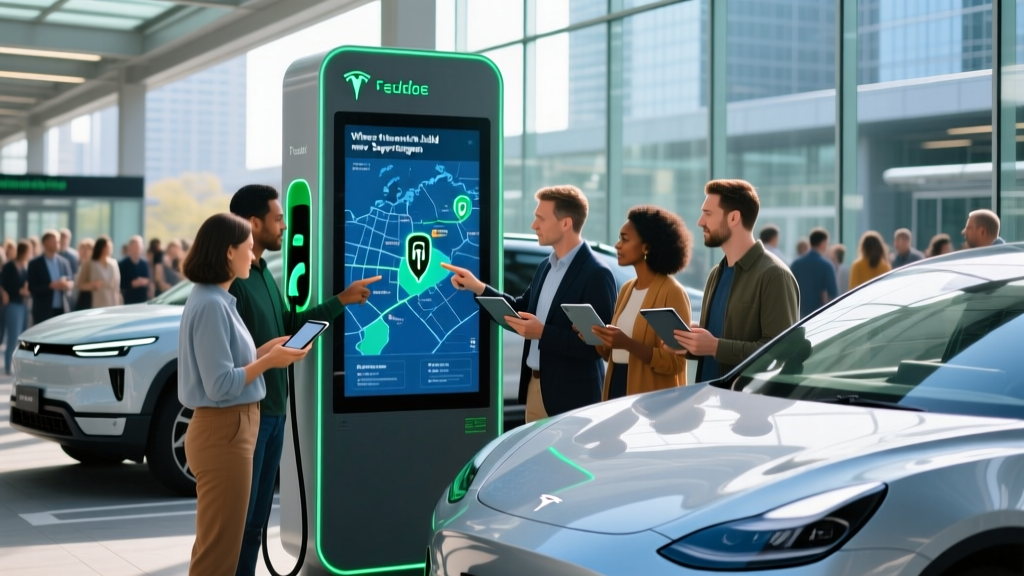
Tesla periodically runs a program it calls Supercharger voting, letting owners and drivers nominate locations and vote on where new Supercharger stations should be built. The idea is simple: the people who actually drive the cars know where the gaps are — a rural corridor with no DC fast charging, a highway interchange that forces a 40-mile detour, or a tourist destination where charging infrastructure hasn't kept pace with EV adoption.
Voting typically happens through the Tesla app or a dedicated web portal. Drivers submit or upvote proposed locations, Tesla evaluates feasibility (grid capacity, land availability, permitting timeline), and winning sites enter the construction pipeline. While Tesla doesn't publish exact vote tallies, the company has confirmed that community input has directly influenced station placement in underserved areas across the U.S. and Europe.
For non-Tesla EV drivers, this matters too. As Tesla opens its Supercharger network to CCS-equipped vehicles via the NACS connector, station locations decided by Tesla's voting process increasingly serve the broader EV market. Understanding where charging infrastructure is headed — and how to advocate for it — is now part of smart EV ownership.
But voting for public chargers is only half the equation. Most EV charging happens at home. This guide covers the full picture: how fast each charging level really is, what a home installation actually costs in 2026, which connector your car needs, and what you'll pay per mile compared to gas.
Charging Levels Explained: kW, Miles Per Hour, and Real-World Speeds
The single most important distinction in EV charging is kW vs. kWh. A kilowatt (kW) measures power — how fast energy flows into your battery. A kilowatt-hour (kWh) measures energy — the total capacity of your battery. Think of kW as the width of a hose and kWh as the size of the bucket. A wider hose (higher kW) fills the bucket (kWh) faster.
Here's how each charging level performs in practice:
| Level | Voltage / Amperage | Power (kW) | Miles of Range Added Per Hour | Best Use Case |
|---|---|---|---|---|
| Level 1 (120V) | 120V / 12A | ~1.4 kW | 3–5 miles | Overnight top-up for PHEVs or low-mileage commuters |
| Level 2 (240V) | 240V / 32–48A | 7.7–11.5 kW | 25–44 miles | Daily home charging for BEVs; full charge overnight |
| DC Fast Charging | 400V–800V DC | 50–350 kW | 150–1,000+ miles/hr (peak) | Road trips; 10–80% in 18–45 minutes depending on vehicle |
A few real-world caveats: Level 2 speeds depend on your car's onboard charger. A vehicle with an 11.5 kW onboard charger (like the Ford F-150 Lightning extended-range) will accept the full output of a 48A circuit, while a car limited to 7.7 kW (some base-model SUVs) won't charge any faster on a 48A circuit than on a 32A one.
DC fast charging speeds also vary dramatically. A Hyundai Ioniq 5 on a 350 kW Electrify America station can peak at ~240 kW and charge from 10–80% in roughly 18 minutes. A Chevrolet Equinox EV on the same station might peak at 150 kW and need 30+ minutes. Always check your vehicle's maximum DC charge rate — paying for a 350 kW stall doesn't help if your car caps at 150 kW.
Home Charger Installation: Electrical Requirements, Costs, and Panel Upgrades
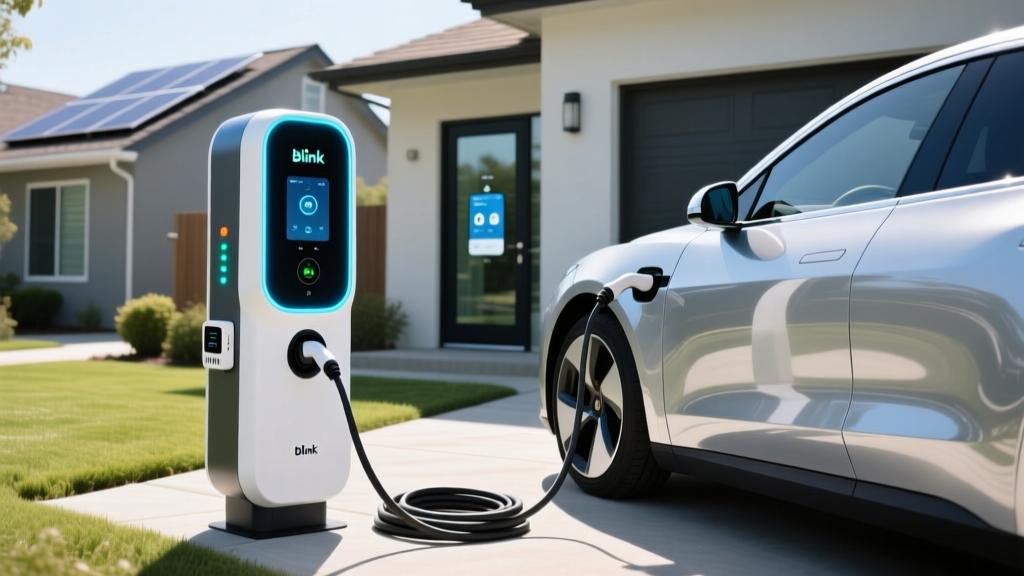
Installing a Level 2 home charger is the single highest-impact upgrade an EV owner can make. But costs vary enormously based on your home's electrical panel, the distance from panel to charger location, and local permitting requirements.
Electrical Requirements
A standard Level 2 home charger runs on a 240V dedicated circuit, identical to what an electric dryer or oven uses. The most common configurations:
- 32A circuit (40A breaker): Delivers up to 7.7 kW. Sufficient for most EVs with smaller batteries (under 75 kWh) or drivers covering under 40 miles daily.
- 40A circuit (50A breaker): Delivers up to 9.6 kW. The sweet spot for most homes — charges a 82 kWh battery (Tesla Model Y Long Range) from empty to full in roughly 8.5 hours.
- 48A circuit (60A breaker): Delivers up to 11.5 kW. Ideal for large-battery vehicles (F-150 Lightning, Rivian R1T) or homes with two EVs sharing a single charger via scheduled charging.
National Electrical Code (NEC) requires that continuous loads (including EV charging, which can run for hours) not exceed 80% of the circuit breaker rating. That's why a 40A breaker supports a 32A continuous charge, and a 50A breaker supports 40A continuous.
Installation Cost Breakdown
| Component | Simple Install (panel nearby, no upgrade) | Complex Install (long wire run, panel upgrade) |
|---|---|---|
| Level 2 Charger (Equipment) | $350–$700 | $350–$700 |
| Electrician Labor | $300–$800 | $1,200–$3,000 |
| Electrical Permit | $50–$200 | $50–$200 |
| Panel Upgrade (100A → 200A) | N/A | $1,500–$4,000 |
| Conduit, Wire, Misc. | $50–$200 | $300–$800 |
| Total Range | $750–$1,900 | $3,100–$8,700 |
The biggest cost variable is your electrical panel. Homes built before 1990 often have 100A service, which may already be near capacity with existing appliances. Adding a 40A EV circuit can push total demand past the panel's rating, requiring an upgrade to 200A service — a $1,500–$4,000 job on its own.
A licensed electrician will perform a load calculation during the estimate visit, adding up your home's existing circuits and major appliances to determine whether your panel can handle the new load. Some utilities and states offer rebates for panel upgrades tied to EV adoption — check with your local provider before assuming the worst-case price.
Always pull a permit. Unpermitted electrical work can void home insurance coverage and create a fire hazard. Most jurisdictions require a permit and inspection for any new 240V circuit.
Connector Compatibility: NACS, CCS1, CHAdeMO, and Adapter Reality
The connector landscape in North America has consolidated rapidly since Tesla opened its NACS (North American Charging Standard) design. As of 2026, here's where things stand:
| Connector | Brands Using It (2026 Models) | Network Access | Adapter Needed? |
|---|---|---|---|
| NACS (Tesla) | Tesla, Ford, GM, Rivian, Volvo, Polestar, Nissan (new models), Honda (new models), Fisker | Tesla Supercharger, Electrify America (select), third-party NACS stations | None for native NACS vehicles; CCS→NACS adapters available (~$200–$300) |
| CCS1 | Hyundai, Kia, Volkswagen, BMW, Mercedes-Benz, Stellantis, legacy Ford/GM models | Electrify America, EVgo, ChargePoint, Ionity (EU) | NACS→CCS adapter (~$200–$250) needed for Supercharger access |
| CHAdeMO | Nissan Leaf (legacy), Mitsubishi Outlander PHEV (legacy) | Declining; some Electrify America and EVgo stations retain connectors | Limited adapter availability; CHAdeMO infrastructure is being phased out |
If you're buying a new EV in 2026, NACS is the default for most brands. CCS1 remains on some holdover models and is fully supported by Electrify America's existing network. CHAdeMO is effectively legacy — functional for current Leaf owners but not a connector you should choose for a new purchase.
For Tesla Supercharger access with a CCS-equipped vehicle, you'll need a NACS-to-CCS adapter. Tesla sells one for ~$250, and third-party options from Lectron and A2Z exist at lower prices, though quality varies. Ford and GM provide adapters with many new vehicle purchases — check your purchase agreement.
Cost to Charge: Home vs. Public vs. Gas — The Per-Mile Math
Charging cost is where EVs typically win decisively over gasoline, but the margin depends on where and when you charge. Here's the real math for 2026:
| Scenario | Price per kWh | Vehicle Efficiency (kWh/100 mi) | Cost per Mile | Gas Equivalent (30 MPG @ $3.40/gal) |
|---|---|---|---|---|
| Home charging (off-peak utility rate) | $0.09–$0.13 | 28 kWh | $0.025–$0.036 | $0.113 |
| Home charging (standard residential rate) | $0.14–$0.18 | 28 kWh | $0.039–$0.050 | $0.113 |
| Public Level 2 (ChargePoint, workplace) | $0.20–$0.35 | 28 kWh | $0.056–$0.098 | $0.113 |
| DC Fast Charging (Electrify America, EVgo) | $0.35–$0.55 | 28 kWh | $0.098–$0.154 | $0.113 |
| Tesla Supercharger (varies by location/time) | $0.25–$0.40 | 28 kWh | $0.070–$0.112 | $0.113 |
Key takeaway: home charging is always cheaper than gas, typically by a factor of 3–4x. Public DC fast charging can approach or exceed gasoline costs per mile, which is why it should be used for road trips rather than as a daily charging strategy.
Time-of-use (TOU) utility rates can dramatically reduce home charging costs. Many utilities offer off-peak rates of $0.08–$0.10/kWh between 10 PM and 6 AM. If you charge a 75 kWh battery overnight at $0.09/kWh, that's $6.75 for roughly 250 miles of range — compared to $28+ for the same distance in a 30 MPG gas car.
According to fueleconomy.gov, the average EV driver who charges primarily at home saves $800–$1,200 annually on fuel compared to a 27 MPG gasoline vehicle.
Charging Time Examples: 10–80% for Popular Battery Sizes
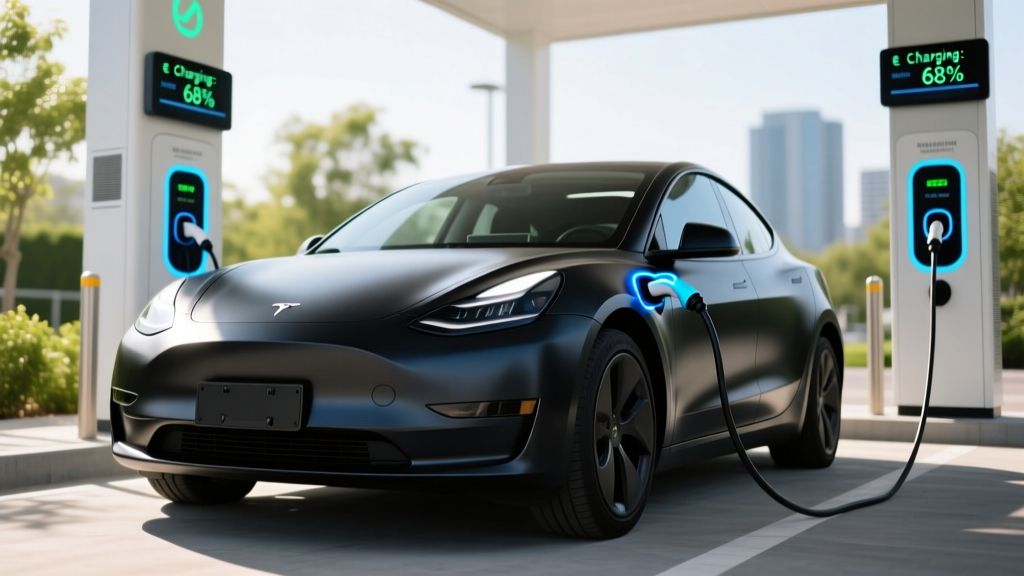
EV batteries charge fastest between 10% and roughly 50% State of Charge (SoC), then taper significantly above 80% to protect battery health. This charge curve means the 10–80% metric is the most useful real-world benchmark — most road-trip charging stops target this window.
Here's what to expect from common battery sizes on DC fast charging:
- 62 kWh battery (Nissan Ariya, base Hyundai Kona Electric): Peak ~100 kW. 10–80% in ~30–35 minutes on a 150 kW+ station.
- 77–82 kWh battery (Tesla Model Y, Ford Mustang Mach-E Extended Range): Peak 150–250 kW. 10–80% in ~22–28 minutes on a 250 kW Supercharger or equivalent.
- 84–100 kWh battery (Rivian R1S, BMW iX, Mercedes EQS): Peak 200–250 kW. 10–80% in ~25–35 minutes, with larger batteries taking longer despite high peak rates.
- 131 kWh battery (F-150 Lightning Extended Range): Peak ~170 kW. 10–80% in ~41 minutes — the trade-off for massive capacity.
On Level 2 at home (9.6 kW / 40A), expect to add roughly 30–35 miles of range per hour, or a full 10–80% charge in 6–10 hours depending on battery size. This is why overnight charging works so well: you plug in at 10 PM and wake up to a full battery at 6 AM.
One critical note on preconditioning: many EVs (Tesla, Hyundai/Kia, BMW) will warm the battery before a DC fast charging session if you navigate to a charger in the car's built-in navigation. A cold battery charges significantly slower — preconditioning can cut a 10–80% session by 5–10 minutes in cold weather.
2026 Equipment Picks: Home Chargers Worth Buying
Not all Level 2 chargers are equal. Here are four proven units across different budgets, with exact specs:
Tesla Wall Connector (Gen 4)
- Power output: Up to 11.5 kW (48A) on a 60A circuit
- Connector: Native NACS; CCS adapter included in box
- Cable length: 24 feet
- Smart features: Wi-Fi, OTA updates, power-sharing between two units on one circuit, access control
- Price: ~$475
- Best for: Tesla owners and NACS-equipped vehicles; best value at 48A
ChargePoint Home Flex
- Power output: Up to 12 kW (50A) on a 60A circuit; configurable down to 16A for smaller circuits
- Connector: NACS or CCS1 (choose at purchase); J1772 included
- Cable length: 23 feet
- Smart features: Wi-Fi, Alexa integration, scheduling, energy tracking via app
- Price: ~$650–$700
- Best for: Multi-EV households with mixed connector needs; flexible amperage settings
Emporia Vue Level 2 Charger
- Power output: Up to 11.5 kW (48A) on a 60A circuit
- Connector: J1772 (NACS and CCS adapters available separately)
- Cable length: 24 feet
- Smart features: Wi-Fi, integrates with Emporia Vue energy monitor for whole-home load tracking, solar-aware charging
- Price: ~$399
- Best for: Budget-conscious buyers; solar-panel owners who want to charge only on excess production
Grizzl-E Smart
- Power output: Up to 10 kW (40A) on a 50A circuit
- Connector: J1772 (NACS adapter available)
- Cable length: 24 feet
- Smart features: Wi-Fi, OCPP compatibility, adjustable amperage via DIP switches
- Price: ~$449
- Best for: Cold-climate durability (rated to -40°F); outdoor installations; Canadian-built
Safety, Code, and Installation Best Practices
EV charging involves sustained high-current draw over many hours — harder on your electrical system than intermittent loads like a microwave. Follow these non-negotiable safety rules:
- Dedicated circuit: Your EV charger must have its own circuit, not shared with other appliances. A 40A charger on a circuit also serving a dryer will trip the breaker.
- GFCI protection: NEC 2020 and later require GFCI (Ground Fault Circuit Interrupter) protection for all 240V EV charging outlets. Hardwired chargers may have GFCI built into the unit. If you're installing a NEMA 14-50 outlet, your breaker panel needs a GFCI breaker — these cost $50–$100 more than standard breakers.
- Outdoor rating: If your charger is mounted outside, verify it carries a NEMA 4 or IP65 weather rating. All the units listed above are outdoor-rated, but cable management matters — avoid letting the cable sit in pooled water or under snow drifts.
- NEMA 14-50 vs. hardwired: A NEMA 14-50 outlet lets you unplug and take the charger when you move. Hardwired installations avoid the GFCI breaker requirement (the charger's internal GFCI suffices) and are often slightly cheaper to install. Choose hardwired if you plan to stay; choose 14-50 if you might relocate.
- Wire gauge: Your electrician will size wire based on circuit amperage and run length. For a 60A circuit with a run over 50 feet, 4 AWG copper or 2 AWG aluminum is typical. Longer runs may need thicker wire to prevent voltage drop.
For detailed code requirements, the National Fire Protection Association's NEC resources provide the authoritative reference, but your licensed electrician should handle compliance.
Supercharger Voting Strategy: How to Get Chargers Where You Need Them
If you want to influence where Tesla builds its next Supercharger station — and increasingly, where NACS-compatible public charging appears — here's how to participate effectively:
- Monitor Tesla's voting portal: Tesla announces voting rounds via its app and social channels. Rounds typically last 2–4 weeks and focus on specific regions or corridor types.
- Nominate strategically: Don't just vote for your driveway. Think about corridors you drive regularly — the 120-mile stretch with no charging, the ski resort that lacks infrastructure, the rural town where you visit family.
- Mobilize local EV groups: Facebook groups, Reddit communities (r/electricvehicles, r/TeslaMotors), and local EV clubs often coordinate voting campaigns. A concentrated nomination effort from 200 local drivers carries more weight than scattered individual votes.
- Provide supporting data: Tesla considers grid capacity, traffic volume, and nearby amenities. If your nomination includes a specific site (a Walmart parking lot, a highway rest area with available electrical infrastructure), it's more actionable than a vague "somewhere on I-70."
- Engage local government: City councils and county transportation boards can accelerate permitting for charging stations. A letter from a local EV club supporting a Supercharger location can cut months off the approval timeline.
Remember: Supercharger voting influences Tesla's build pipeline, but non-Tesla networks (Electrify America, EVgo) use different site-selection processes, often driven by state NEVI formula funding and utility partnerships. For broader infrastructure advocacy, organizations like Plug In America and the EV Charging Association lobby for federal and state charging investment.
Frequently Asked Questions
How much does it cost to install a home EV charger?
A straightforward Level 2 installation (panel has capacity, short wire run) typically costs $750–$1,900 including equipment, electrician labor, and permit. If your home needs a panel upgrade from 100A to 200A service, total costs can reach $3,100–$8,700. Always get a load calculation from a licensed electrician before budgeting.
How fast will each charging level add range?
Level 1 (120V) adds 3–5 miles per hour. Level 2 (240V) adds 25–44 miles per hour depending on amperage and your car's onboard charger. DC fast charging adds 150–1,000+ miles per hour at peak, but sessions typically last 18–45 minutes for a 10–80% charge because the rate tapers as the battery fills.
Which connector/charger is compatible with my EV?
For 2026 models: Tesla, Ford, GM, Rivian, Volvo, Polestar, and new Honda/Nissan models use NACS. Hyundai, Kia, BMW, Mercedes, and Volkswagen use CCS1. CHAdeMO is limited to older Nissan Leaf and Mitsubishi models. Check your vehicle's charge port — it will physically accept only one connector type natively, though adapters are available.
How much does charging cost per mile vs gas?
Home charging at average residential rates ($0.14–$0.18/kWh) costs $0.04–$0.05 per mile for an EV averaging 28 kWh/100mi. A comparable 30 MPG gas car at $3.40/gallon costs $0.11 per mile. DC fast charging ($0.35–$0.55/kWh) costs $0.10–$0.15 per mile, approaching gas parity — which is why home charging is the economic sweet spot.
What electrical upgrades might I need?
The most common upgrade is a panel capacity increase from 100A to 200A service ($1,500–$4,000). You may also need: a GFCI breaker ($50–$100) if installing a NEMA 14-50 outlet, thicker-gauge wire for long runs over 50 feet, or a second sub-panel if your main panel has no available breaker slots. A load calculation from your electrician will identify all requirements before work begins.
How does Supercharger voting actually influence station placement?
Tesla uses community voting data as one input alongside grid feasibility, traffic patterns, and land availability. High-vote locations that also have strong infrastructure fundamentals (available utility capacity, commercial land zoned for charging) move to the top of the build queue. Voting doesn't guarantee a station, but sustained community demand demonstrably influences Tesla's expansion map.