Understanding Supercharger V3 in the Broader Charging Landscape
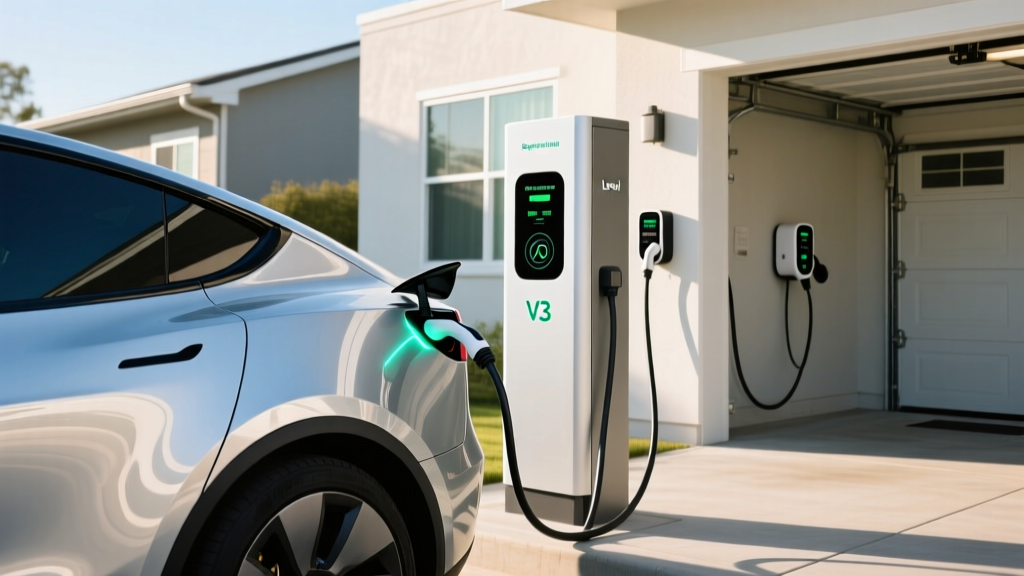
Tesla's Supercharger V3 remains one of the most widely deployed DC fast-charging architectures on North American roads, delivering a peak rate of 250 kW. But how does that translate to actual miles added, and how does it compare to the Level 2 charger you'd install at home? This guide breaks down every charging tier — from a standard 120V wall outlet to a 250 kW Supercharger V3 stall — with exact speeds, costs, and equipment requirements so you can plan both daily driving and road trips with precision.
Before we get into the numbers, one critical distinction: kW (kilowatts) measures power — the rate at which energy flows into your battery. kWh (kilowatt-hours) measures energy — the total capacity of your battery. Think of kW as the width of a pipe and kWh as the size of the tank you're filling. A 250 kW Supercharger V3 stall fills that tank very fast, but only if your vehicle's battery management system (BMS) can accept that rate.
Charging Levels Explained: Speeds, Power, and Miles Per Hour
Every EV owner uses a mix of three charging levels. Here's exactly what each delivers in real-world terms:
| Level | Voltage / Phase | Max Power (kW) | Miles of Range Added Per Hour | Typical Use Case |
|---|---|---|---|---|
| Level 1 | 120V AC / Single-phase | 1.4–1.9 kW | 3–5 miles/hr | Overnight top-up, PHEVs, emergencies |
| Level 2 | 240V AC / Single-phase | 3.3–19.2 kW | 12–75 miles/hr | Daily home & workplace charging |
| DC Fast (incl. Supercharger V3) | 400–800V DC | 50–350 kW | 150–1,000+ miles/hr (peak) | Road trips, rapid top-ups |
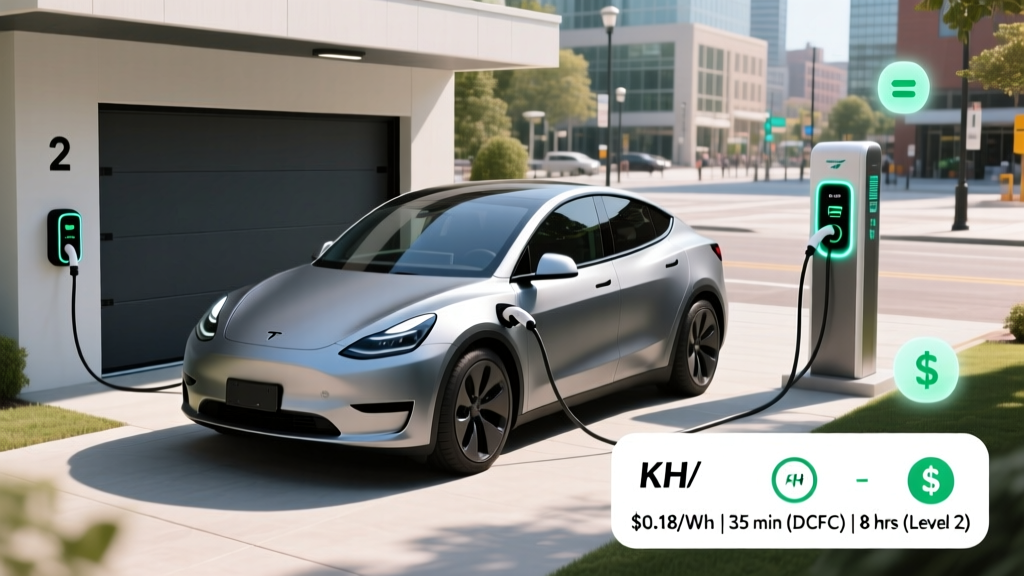
On a Supercharger V3 stall at 250 kW, a Tesla Model Y Long Range (75 kWh usable battery, ~310-mile EPA range) can add approximately 200 miles of range in 15 minutes under ideal conditions — meaning the battery is preconditioned and SoC is low (around 10–15%). In practice, a 10–80% session takes roughly 25–30 minutes for that vehicle, depending on battery temperature and pack chemistry.
For comparison, a 48-amp Level 2 home charger delivering 11.5 kW adds about 44 miles of range per hour to the same Model Y. An 8-hour overnight session replenishes roughly 350 miles — more than enough to refill the entire battery from near-empty.
Supercharger V3 Charging Times: Real 10–80% Data
The Supercharger V3 network uses the North American Charging Standard (NACS) connector natively for Tesla vehicles. Since 2024–2025, Ford, GM, Rivian, Volvo, and other automakers have adopted NACS, gaining access to the Supercharger network via built-in NACS ports or CCS-to-NACS adapters. Here's what 10–80% sessions look like across popular EVs on a V3 stall:
| Vehicle | Battery (kWh usable) | Peak Charge Rate (kW) | 10–80% Time | Notes |
|---|---|---|---|---|
| Tesla Model 3 Long Range (2025) | 75 kWh (NMC) | 250 kW | ~25 min | Sustains high rate 10–35% SoC |
| Tesla Model Y Long Range (2025) | 75 kWh (NMC) | 250 kW | ~27 min | Preconditioning critical in cold |
| Ford Mustang Mach-E GT (2025) | 88 kWh (NMC) | 150 kW (via adapter) | ~38 min | CCS-to-NACS adapter required |
| Rivian R1T Dual-Motor (2025) | 106 kWh (NMC) | ~200 kW (via adapter) | ~40 min | Larger pack extends session |
Non-Tesla vehicles accessing Supercharger V3 stalls via adapter may not achieve the full 250 kW rate because their onboard BMS and charge-port configurations limit peak acceptance. Always check your vehicle's maximum DC charge rate — it's the bottleneck, not the stall.
Home Level 2 Installation: Electrical Requirements and Costs
Most EV owners do 80% or more of their charging at home on Level 2. A proper installation requires a dedicated 240V circuit, and the specifics determine both your charge speed and your electrician's invoice.
Electrical Requirements
A typical Level 2 home charger runs on a 240V single-phase circuit. Common configurations:
- 32-amp charger on a 40-amp breaker — delivers 7.7 kW (about 30 miles/hr for a Model Y)
- 48-amp charger on a 60-amp breaker — delivers 11.5 kW (about 44 miles/hr)
- 80-amp charger on a 100-amp breaker — delivers 19.2 kW (about 73 miles/hr; requires a 200-amp panel minimum and heavy-gauge wiring)
The National Electrical Code (NEC) requires that continuous loads (like EV charging) not exceed 80% of the breaker rating. So a 48-amp charger requires a 60-amp breaker — never install a charger rated at the breaker's full capacity.
Panel Upgrade Considerations
Many older homes have 100-amp electrical panels that are already near capacity. Adding a 60-amp EV circuit may require a panel upgrade to 200 amps, which is one of the largest line items in a home charging installation. Signs you may need an upgrade:
- Your panel is 100 amps and has few open breaker slots
- You already run high-draw appliances (electric oven, dryer, HVAC) simultaneously
- Your electrician's load calculation shows insufficient headroom
Installation Cost Breakdown
| Component | Typical Cost Range | Notes |
|---|---|---|
| Level 2 Charger Equipment (hardwired, 48A) | $400 – $750 | Smart Wi-Fi models cost more; Tesla Wall Connector is ~$475 |
| Electrician Labor (standard install, <50 ft run) | $500 – $1,500 | Varies by region, conduit length, and wall type |
| Electrical Permit | $50 – $250 | Required in most jurisdictions; inspection included |
| Panel Upgrade (if needed, 100A → 200A) | $1,500 – $4,000 | Major variable; not needed in most newer homes |
| Total (no panel upgrade) | $950 – $2,500 | Most common scenario for 200-amp-panel homes |
| Total (with panel upgrade) | $2,450 – $6,500 | Older homes with 100A service |
Some utility companies offer rebates of $200–$500 for installing a smart Level 2 charger, and certain states provide additional incentives. Always check with your local utility and state energy office before scheduling work.
Connector Compatibility: NACS, CCS1, and CHAdeMO
The connector landscape has consolidated significantly since 2024. Here's where things stand for 2025–2026 model-year vehicles:
| Connector | Also Known As | Native Vehicles | DC Fast Charge Standard | Supercharger V3 Access |
|---|---|---|---|---|
| NACS | Tesla connector / J3400 | Tesla (all), Ford, GM, Rivian, Volvo, Polestar, Mercedes (2025+), others | Native on Tesla Supercharger V3/V4 | Direct plug-in |
| CCS1 | Combined Charging System | Hyundai, Kia, BMW, VW, legacy Ford/GM models (pre-NACS transition) | Electrify America, EVgo, ChargePoint DC | Via CCS-to-NACS adapter at open Superchargers |
| CHAdeMO | — | Nissan Leaf (legacy), Mitsubishi Outlander PHEV | Declining network; some Electrify America stalls | Not compatible |
If you drive a non-Tesla EV with a CCS1 port, you'll need a CCS-to-NACS adapter (typically $150–$250 from the automaker or third party) to access Supercharger V3 stalls that Tesla has opened to other brands. Ford, GM, and Rivian include or offer these adapters. Confirm that the specific Supercharger station you plan to visit is listed as open to non-Tesla vehicles in the Tesla app or your vehicle's navigation.
For home Level 2 charging, all vehicles use the J1772 connector (or NACS for Teslas). Tesla ships a J1772-to-NACS adapter with every vehicle, so a Tesla can use any public Level 2 station. Non-Tesla EVs with NACS ports starting in 2025 will need a NACS-to-J1772 adapter for older Level 2 stations — check with your automaker.
Cost Per Mile: Home Charging vs. Supercharger V3 vs. Gas
One of the strongest economic arguments for EVs is the cost-per-mile advantage of home charging. But public DC fast charging — including Supercharger V3 — narrows that gap. Here's a realistic breakdown using a Tesla Model Y Long Range (~3.5 miles/kWh efficiency) and a comparable gas SUV at 25 MPG combined:
| Charging / Fuel Scenario | Rate | Cost Per kWh (or Gallon) | Cost Per Mile |
|---|---|---|---|
| Home Level 2 (national avg. residential) | $0.16/kWh | $0.16 | $0.046 |
| Home Level 2 (off-peak TOU rate) | $0.09/kWh | $0.09 | $0.026 |
| Supercharger V3 (avg. 2025 rate) | $0.30–$0.40/kWh | $0.35 avg. | $0.10 |
| Public DC fast (Electrify America, EVgo) | $0.35–$0.55/kWh | $0.45 avg. | $0.13 |
| Gasoline SUV (25 MPG combined) | $3.40/gallon | $3.40/gal | $0.136 |
At national average electricity rates, home Level 2 charging costs roughly $0.04–$0.05 per mile — about one-third the cost of gasoline. Even on a Supercharger V3 at $0.35/kWh, you're paying roughly $0.10 per mile, which still undercuts a 25-MPG gas SUV at $3.40/gallon.
However, if you rely exclusively on public DC fast charging at $0.45–$0.55/kWh rates common in urban areas or on certain networks, your per-mile cost can match or exceed gasoline. This is why home charging access remains the single most important economic factor in EV ownership.
Time-of-use (TOU) utility plans can dramatically reduce home charging costs. Charging between 10 PM and 6 AM on a TOU plan can cut your electricity rate to $0.07–$0.10/kWh in many markets, making EV operation almost negligible in cost.
Recommended Home Level 2 Chargers (2025–2026)
Here are three well-regarded Level 2 chargers suited for different needs and budgets, all hardwired for maximum safety and performance:
Tesla Wall Connector (Gen 3)
- Power Output: Up to 11.5 kW (48 amps) on a 60-amp circuit
- Connector: NACS native; J1772 adapter included for non-Tesla EVs
- Cable Length: 24 feet
- Smart Features: Wi-Fi for OTA updates, load sharing between two units, access control via Tesla app
- Price: ~$475
- Best For: Tesla owners or households with NACS-equipped vehicles seeking a clean, reliable unit
ChargePoint Home Flex
- Power Output: Up to 12 kW (50 amps) on a 60-amp circuit; configurable down to 16A for smaller panels
- Connector: J1772 (NACS adapter required for Teslas)
- Cable Length: 23 feet
- Smart Features: Wi-Fi, ChargePoint app with scheduling and energy tracking, Alexa integration, amperage dip-switch adjustable
- Price: ~$550–$650
- Best For: Non-Tesla EV owners who want flexible amperage settings and robust app controls
Emporia Level 2 EV Charger
- Power Output: Up to 11.5 kW (48 amps) on a 60-amp circuit
- Connector: J1772 (NACS adapter available)
- Cable Length: 24 feet
- Smart Features: Wi-Fi, Emporia app with real-time energy monitoring, integrates with Emporia home energy monitors, solar-aware scheduling
- Price: ~$399
- Best For: Budget-conscious buyers who want smart energy tracking without a premium price
All three units support NEMA 4 (outdoor-rated) enclosures for garage or exterior installation. Hardwired installation is strongly preferred over plug-in (NEMA 14-50) for reliability — plug-in receptacles can loosen over time and are a known source of thermal issues in high-draw EV applications.
Safety, Code, and Installation Best Practices
EV charging is a continuous high-draw electrical load — comparable to running an electric oven for 8 hours straight. Safety and code compliance are non-negotiable:
- Dedicated circuit: Your EV charger must be on its own dedicated breaker — never share a circuit with other appliances.
- GFCI protection: The 2020 NEC requires GFCI (Ground Fault Circuit Interrupter) protection for outdoor receptacles. Hardwired installations may not require a GFCI breaker depending on local code, but many electricians include one for added safety. Note: some EV chargers have built-in ground-fault detection that can conflict with GFCI breakers, causing nuisance trips — discuss this with your electrician.
- Outdoor rating: If your charger is mounted outside, ensure both the unit and any conduit/junction boxes carry a NEMA 4 or NEMA 4X rating for weather resistance.
- Wire gauge: A 60-amp circuit typically requires 6 AWG copper wire for runs under 50 feet. Longer runs may need 4 AWG to prevent voltage drop. Your electrician will calculate this.
- Permit and inspection: Virtually all jurisdictions require an electrical permit for a new 240V circuit. The inspection ensures the work meets NEC standards — don't skip it. Unpermitted work can void homeowner's insurance claims.
- Load management: If your panel is near capacity but you don't want to pay for a full upgrade, consider an EV Energy Management System (EVEMS) — a device that monitors your home's total electrical load and dynamically throttles the charger to stay within panel limits. These cost $300–$600 and can avoid a $2,000+ panel upgrade.
Frequently Asked Questions
How much does it cost to install a home EV charger?
A standard Level 2 home charger installation with a 48-amp hardwired unit on a 60-amp circuit typically costs between $950 and $2,500, including equipment ($400–$750), electrician labor ($500–$1,500), and a permit ($50–$250). If your home needs an electrical panel upgrade from 100 amps to 200 amps, add $1,500–$4,000, bringing the total to $2,450–$6,500. Always get a load calculation from a licensed electrician before committing.
How fast will each charging level add range?
Level 1 (120V) adds 3–5 miles per hour — adequate for plug-in hybrids with small batteries but impractical for full EVs. Level 2 (240V, 48 amps) adds roughly 35–44 miles per hour for a mid-size SUV like the Model Y, fully replenishing the battery overnight. DC fast charging on a Supercharger V3 at 250 kW can add up to 200 miles in 15 minutes under ideal conditions, with a full 10–80% session taking 25–30 minutes for a 75-kWh battery.
Which connector and charger is compatible with my EV?
For 2025–2026 model-year vehicles: Tesla vehicles use NACS natively and access Supercharger V3 directly. Ford, GM, Rivian, Volvo, and several other brands have transitioned to NACS ports and can also use Superchargers natively. Hyundai, Kia, BMW, and Volkswagen still use CCS1 and require a CCS-to-NACS adapter for Supercharger access. For home Level 2 charging, Tesla vehicles use NACS while all other EVs use J1772 — adapters bridge the gap in both directions. Check your vehicle's charge port and consult your owner's manual for exact compatibility.
How much does charging cost per mile vs. gas?
Home Level 2 charging at the national average rate of $0.16/kWh costs roughly $0.046 per mile in a vehicle like the Model Y (3.5 mi/kWh). Off-peak TOU rates can drop this to $0.026/mile. Supercharger V3 at $0.35/kWh averages about $0.10/mile. A comparable gas SUV at 25 MPG and $3.40/gallon costs $0.136/mile. Home charging delivers a 65–70% cost advantage over gasoline; exclusive DC fast charging narrows the advantage to 25–30%.
What electrical upgrades might I need?
The most common upgrade is a panel replacement from 100 amps to 200 amps ($1,500–$4,000) if your existing panel lacks capacity for a new 60-amp circuit. You may also need conduit runs, a new breaker slot, or upgraded service wiring from the utility. In some cases, an EV Energy Management System (EVEMS) can avoid a panel upgrade entirely by dynamically limiting charger draw. A licensed electrician's load calculation — typically $100–$200 — will determine exactly what your home requires.
Sources: fueleconomy.gov (EPA range and efficiency data), Tesla Supercharger network information, NFPA National Electrical Code (NEC). Installation costs are estimates based on industry surveys; obtain quotes from licensed electricians in your area. Electricity rates vary by utility and region.