If you've shopped for an electric vehicle or browsed automotive forums, you've likely encountered the terms "supercharger" and "turbo" — and wondered what separates them. The confusion is understandable: both force more energy into a system to produce more power, but they belong to entirely different automotive worlds. One is a hallmark of internal-combustion performance; the other has become shorthand for the fastest way to recharge an EV battery.
Here at AutoEdgeView, we get this question constantly from readers transitioning from gas to electric. Below, we'll clarify the supercharger and turbo difference once and for all, then pivot to what actually matters for EV owners: a comprehensive, numbers-driven guide to charging at home and on the road in 2026.
Supercharger vs. Turbo: Two Completely Different Systems
Let's clear the air before touching a single charging cable.
Turbocharger (Turbo): A turbocharger is a forced-induction device bolted to a gasoline or diesel engine. It uses exhaust gases to spin a turbine, which compresses incoming air so the engine can burn more fuel per cycle. The result: more horsepower and torque from a smaller displacement engine. You'll find turbos on everything from the Ford EcoBoost F-150 to the Porsche 911 Turbo. Turbos have nothing to do with electric vehicles or battery charging.
Supercharger (Automotive): In the gas-car world, a supercharger is another form of forced induction, but it's mechanically driven by the engine's crankshaft via a belt rather than by exhaust gases. Think of the Hellcat Dodge Challenger or the supercharged 5.0L V8 in certain Jaguar models. Again, this is purely an internal-combustion technology.
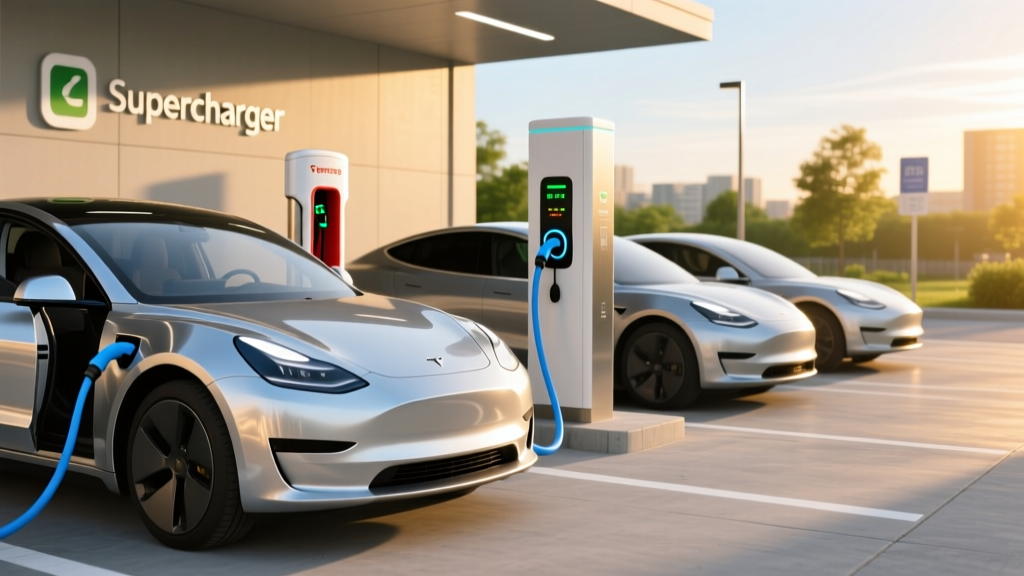
Supercharger (EV Context): When EV owners say "Supercharger," they're almost always referring to Tesla's Supercharger network — a global system of DC fast-charging stations capable of delivering up to 350 kW of power to a compatible battery. In 2026, Tesla has opened much of this network to non-Tesla EVs equipped with the North American Charging Standard (NACS) connector, making "Supercharger" synonymous with high-speed public EV charging.
Now that we've untangled the terminology, let's focus on what EV buyers and owners actually need to know: how charging works, how fast it is, what it costs, and how to set it up at home.
EV Charging Levels: Speed, Power, and Range Added Per Hour
Every EV charges at one of three defined levels. The critical metric here is kW (kilowatts), which measures the rate of power delivery — not to be confused with kWh (kilowatt-hours), which measures the battery's total energy capacity. Think of kW as the flow rate of a hose and kWh as the size of the bucket.
| Level | Voltage | Max Power (kW) | Miles of Range Added Per Hour | Typical Use Case |
|---|---|---|---|---|
| Level 1 | 120V AC | 1.0–1.4 kW | 3–5 miles | Overnight top-off, PHEVs, emergencies |
| Level 2 | 240V AC | 3.3–19.2 kW | 12–75 miles | Home daily charging, workplaces, hotels |
| DC Fast Charging | 400–800V DC | 50–350 kW | 150–1,200+ miles (equivalent/hr) | Road trips, highway corridors, rapid top-ups |
Real-world charging time examples (10–80% State of Charge):
- 60 kWh battery (e.g., base Nissan Leaf or Chevrolet Equinox EV): ~8 hours on a 7.2 kW Level 2 charger; ~22 minutes on a 150 kW DC fast charger.
- 82 kWh battery (e.g., Tesla Model 3 Long Range): ~10 hours on a 7.7 kW Level 2; ~18 minutes on a 250 kW Supercharger.
- 100 kWh battery (e.g., Ford F-150 Lightning Extended Range): ~12.5 hours on a 7.7 kW Level 2; ~25 minutes on a 350 kW DC fast charger (with preconditioning).
Note that DC fast charging follows a charge curve: the battery accepts peak kW only between roughly 10–50% State of Charge. Above 80%, charging speed tapers dramatically to protect battery health. This is why manufacturers quote "10–80%" times rather than 0–100%.
Home Charger Installation: Electrical Requirements, Permits, and Costs
Installing a Level 2 home charger is the single biggest quality-of-life upgrade an EV owner can make. But it requires proper electrical infrastructure, and costs vary enormously depending on your home's panel capacity and the distance between your panel and the charging location.
Electrical Requirements
Most Level 2 home chargers require a 240-volt dedicated circuit. The most common setups are:
- 40-amp circuit / 32-amp continuous — delivers up to 7.7 kW. Suitable for most EVs with onboard chargers rated at 7.7–11.5 kW.
- 50-amp circuit / 40-amp continuous — delivers up to 9.6 kW. Ideal for larger batteries (F-150 Lightning, Rivian R1S/R1T).
- 60-amp circuit / 48-amp continuous — delivers up to 11.5 kW. Requires a hardwired connection (no plug) and a panel with ample spare capacity.
Panel upgrade reality check: Many older homes have 100-amp main panels that simply cannot spare 40–60 amps for EV charging while also running central AC, an electric dryer, and an electric oven simultaneously. A panel upgrade to 200 amps typically costs $1,500–$3,000 before any charger work begins. Some homeowners opt for a smart load-management device (like the Emporia V2 with load shedding) instead, which dynamically reduces charger draw when other appliances kick on — saving thousands on a panel swap.
| Component | Low-End Cost | High-End Cost | Notes |
|---|---|---|---|
| Level 2 Charger Equipment | $300 | $750 | Varies by brand, power output, smart features |
| Electrician Labor (standard install) | $400 | $1,200 | Depends on run length, wall type, conduit needs |
| Electrical Permit | $50 | $250 | Required in most jurisdictions; varies by municipality |
| Panel Upgrade (if needed) | $1,500 | $3,000 | 100A to 200A upgrade; not always required |
| Total (no panel upgrade) | $750 | $2,200 | Most common scenario for newer homes |
| Total (with panel upgrade) | $2,250 | $5,200 | Older homes with 100A service |
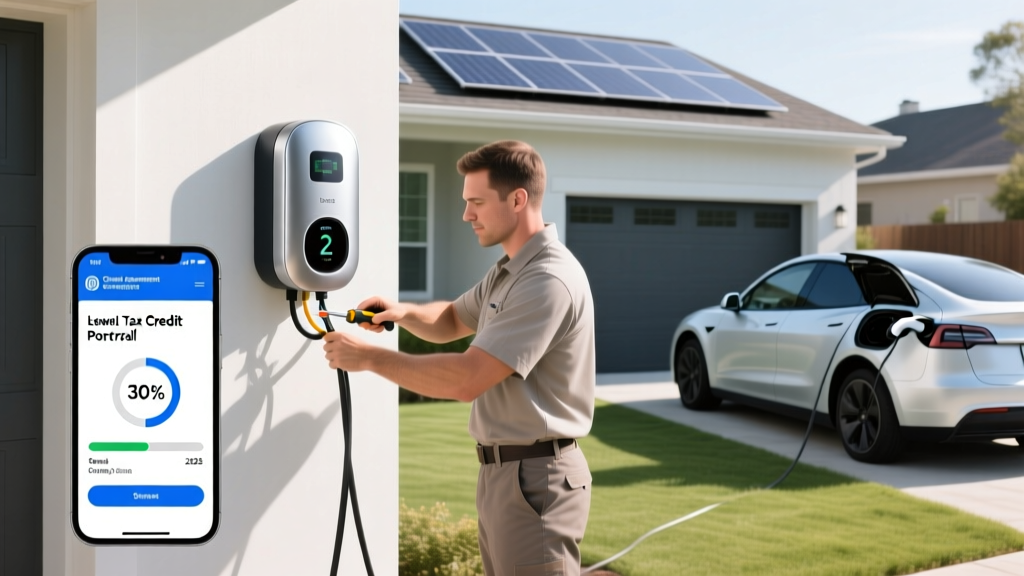
The IRS §30C alternative fuel vehicle refueling property credit may cover up to 30% of home charger equipment and installation costs (capped at $1,000), subject to census-tract eligibility and income requirements. Consult a tax professional for your specific situation.
Connector Compatibility: NACS, CCS1, CHAdeMO, and Adapters
Not all EV charging plugs are the same, and 2026 is a transitional year as the industry converges on the North American Charging Standard (NACS), originally developed by Tesla.
| Connector Type | Brands Using It (Native) | DC Fast-Charge Availability | Adapter Needed for Other Networks? |
|---|---|---|---|
| NACS (Tesla standard) | Tesla (all), Ford (2025+), GM (2025+), Rivian, Hyundai/Kia (2026+) | Widest network (Tesla Superchargers + others adopting NACS) | CCS→NACS adapter for non-Tesla CCS stations (~$200–$250) |
| CCS1 (Combined Charging System) | Volkswagen, BMW, Mercedes-Benz, Stellantis, legacy Ford/GM | Electrify America, EVgo, ChargePoint DC stations | NACS→CCS adapter for Tesla Superchargers (some OEMs provide free) |
| CHAdeMO | Nissan Leaf (legacy), Mitsubishi Outlander PHEV | Declining; few new stations being built | No widely available adapter; use CHAdeMO stations directly |
Practical advice: If you're buying a new EV in 2026, strongly favor NACS-equipped models. The Tesla Supercharger network has the best reliability record in the U.S., and former CCS-only automakers (Ford, GM, Rivian) now provide adapters — some included, some at extra cost. Always confirm adapter inclusion with your dealer before purchase.
Charging Cost Per Mile vs. Gasoline: The Real Numbers
One of the strongest economic arguments for EV ownership is the per-mile fuel cost. But the savings depend heavily on where and when you charge.
| Scenario | Cost per kWh | Efficiency (kWh/100 mi) | Cost per Mile | Equivalent Gas Price (at 28 MPG) |
|---|---|---|---|---|
| Home, off-peak utility rate | $0.09 | 30 | $0.027 | $0.76/gallon |
| Home, average U.S. residential | $0.17 | 30 | $0.051 | $1.43/gallon |
| Public Level 2 (workplace/mall) | $0.25 | 30 | $0.075 | $2.10/gallon |
| DC Fast Charging (Electrify America, EVgo) | $0.48 | 30 | $0.144 | $4.03/gallon |
| Tesla Supercharger (average 2026) | $0.35 | 28 (Tesla efficiency) | $0.098 | $2.74/gallon |
| Gasoline car (U.S. avg $3.40/gal, 28 MPG) | — | — | $0.121 | $3.40/gallon |
Source: Average electricity rates via U.S. EIA; vehicle efficiency data from fueleconomy.gov.
The bottom line: Home charging on an off-peak or average residential rate is dramatically cheaper than gasoline. However, exclusive reliance on DC fast charging can push your per-mile cost above that of an efficient gas car. This is why home charging access is the single most important factor in EV ownership economics.
Recommended Home EV Chargers for 2026
After testing and tracking reliability data across dozens of Level 2 units, here are our top picks organized by use case:
Best Overall: ChargePoint Home Flex
- Power Output: Up to 12 kW (50-amp circuit, adjustable down to 16A)
- Connector: NACS or J1772 (configurable)
- Cable Length: 23 feet
- Smart Features: Wi-Fi, app scheduling, utility demand-response integration, Alexa
- Price: ~$549 (NACS version)
Best Value: Emporia Level 2 EV Charger
- Power Output: Up to 11.5 kW (48-amp, hardwired)
- Connector: J1772 (NACS adapter available)
- Cable Length: 24 feet
- Smart Features: Wi-Fi, real-time energy monitoring, solar integration, load management with Emporia Vue panel monitor
- Price: ~$399
Best for Tesla/NACS Owners: Tesla Wall Connector
- Power Output: Up to 11.5 kW (48-amp, hardwired)
- Connector: NACS native
- Cable Length: 24 feet
- Smart Features: Wi-Fi, power sharing (daisy-chain up to 6 units), OTA updates, Powerwall integration
- Price: ~$475
Best for Outdoor Install: Grizzl-E Smart
- Power Output: Up to 10 kW (40-amp circuit)
- Connector: J1772 or NACS
- Cable Length: 24 feet
- Smart Features: OCPP-compatible, adjustable amperage, IP65 outdoor rating, extreme cold tested to -40°F
- Price: ~$499
Safety, Code, and Installation Best Practices
EV charging involves sustained high-current draw — often for 8+ hours straight. This is fundamentally different from the short bursts a dryer or oven demands. Cutting corners here creates fire risk.
- Dedicated circuit: Your Level 2 charger must be on its own dedicated breaker — never shared with other outlets or appliances.
- GFCI protection: The 2023 NEC (National Electrical Code) and subsequent 2026 adoptions require GFCI (Ground Fault Circuit Interrupter) protection for all EV charging outlets rated 150V to ground or less and 50 amps or less. Hardwired chargers may have GFCI built into the unit.
- Outdoor rating: If your charger is installed outdoors (garage-exterior wall, driveway pedestal), ensure the unit carries an IP65 or higher ingress-protection rating. NEMA 4 enclosure ratings are the equivalent standard.
- Hardwired vs. plug: Chargers rated above 40 amps (continuous) must be hardwired per NEC — no NEMA 14-50 receptacle. For 40-amp and below circuits, a NEMA 14-50 outlet provides flexibility to unplug and take the charger with you if you move.
- Permit and inspection: Most municipalities require a permit for EV charger installation. Skipping this can void homeowner's insurance claims related to electrical fires and may cause issues at home sale.
Frequently Asked Questions
How much does it cost to install a home EV charger?
For a straightforward installation (no panel upgrade, short cable run to a garage wall), expect $750–$2,200 total, including equipment ($300–$750), electrician labor ($400–$1,200), and a permit ($50–$250). If your home needs a panel upgrade from 100A to 200A, add $1,500–$3,000, bringing the total to $2,250–$5,200. Always get itemized quotes from at least two licensed electricians.
How fast will each charging level add range?
Level 1 (120V) adds roughly 3–5 miles per hour — adequate for plug-in hybrids with small batteries but painfully slow for full EVs. Level 2 (240V) at 7.7 kW adds roughly 25–35 miles per hour, easily replenishing a daily commute overnight. DC fast charging at 150–350 kW can add 150–300+ miles in 15–25 minutes, depending on battery size, chemistry, and preconditioning.
Which connector/charger is compatible with my EV?
Check your vehicle's charge port. If it's a 2025+ Tesla, Ford, GM, Rivian, or 2026+ Hyundai/Kia, it likely uses NACS. Most other recent EVs (VW ID.4, BMW i4/iX, Mercedes EQE/EQS) still use CCS1. The Nissan Leaf uses CHAdeMO. When in doubt, check the manufacturer's spec page or the EPA's fueleconomy.gov listing for your specific model year and trim.
How much does charging cost per mile vs gas?
At the U.S. average residential electricity rate of ~$0.17/kWh and a typical EV efficiency of 30 kWh/100 miles, home charging costs about $0.051 per mile. A gas car averaging 28 MPG at $3.40/gallon costs $0.121 per mile — more than double. However, DC fast charging at $0.48/kWh pushes the cost to $0.144/mile, exceeding gasoline. Home charging is where the savings live.
What electrical upgrades might I need?
The most common upgrade is a panel swap from 100 amps to 200 amps ($1,500–$3,000). Other potential needs include: running new conduit from the panel to the garage ($200–$800 depending on distance and wall material), upgrading the meter socket if your utility requires it, and installing a smart load-management device ($200–$400) as a lower-cost alternative to a full panel upgrade. A licensed electrician's load calculation is the definitive first step.
Is a supercharger the same as a turbo?
No. In automotive engineering, a turbocharger uses exhaust gas to compress intake air in a gas engine. A supercharger (in the gas-engine sense) does the same but is belt-driven by the crankshaft. In the EV world, "Supercharger" refers to Tesla's DC fast-charging network — a completely different technology that delivers high-power electricity (up to 350 kW) to recharge a battery. The shared name is a coincidence of branding, not engineering.