What Does a Supercharger Look Like?
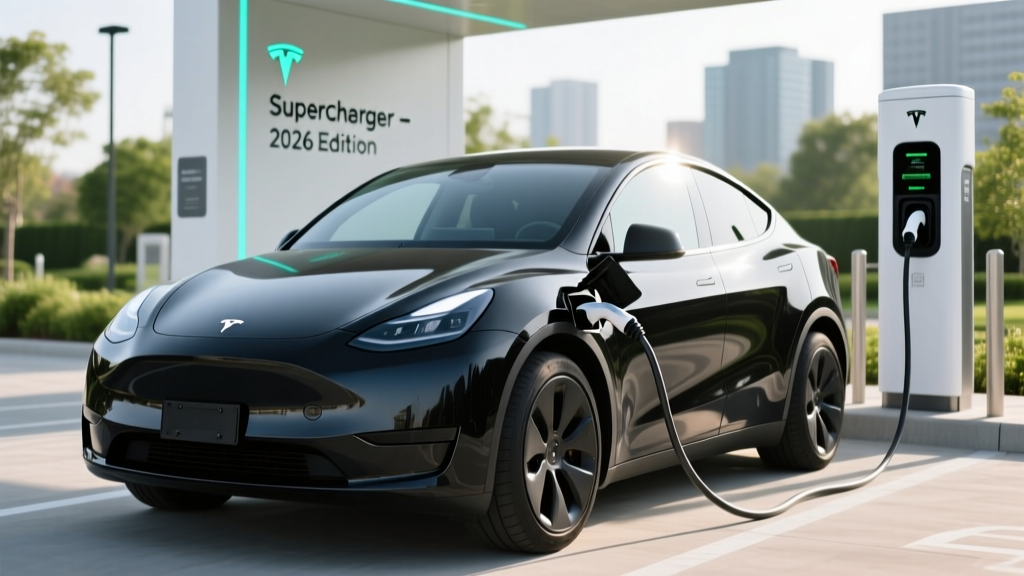
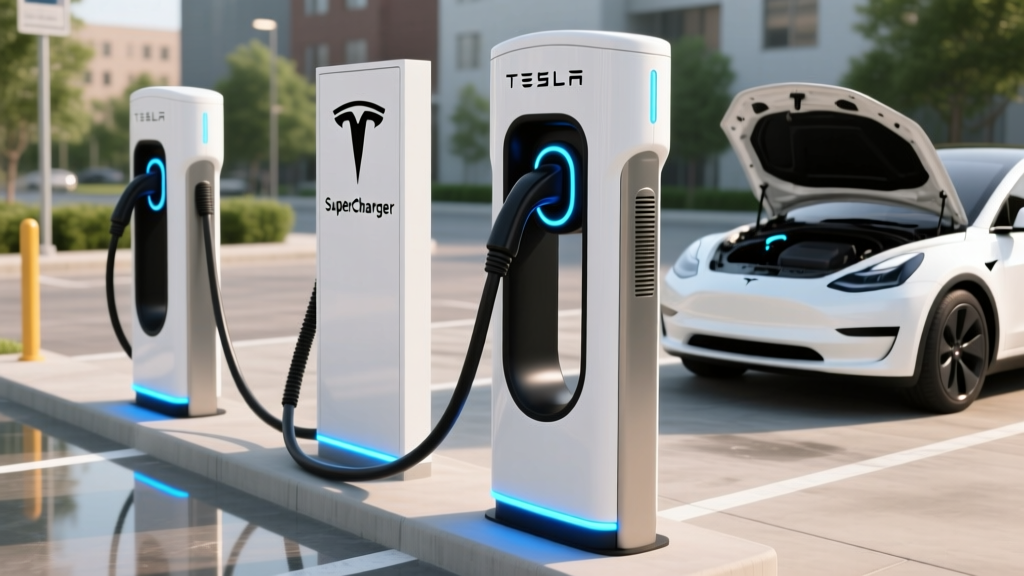
When you picture an electric vehicle fast-charging station, you're probably thinking of a Tesla Supercharger. The Tesla Supercharger cabinet (the large power-delivery unit) is a tall, white, rectangular structure roughly 6 feet tall, 5 feet wide, and 2 feet deep, typically mounted on a concrete pad. The charging posts — what you actually interact with — are sleek, white-and-red pillars about 4 feet tall with a distinctive curved top housing the Tesla logo. Each post holds a permanently attached cable with Tesla's proprietary NACS (North American Charging Standard) connector, a compact plug noticeably smaller than CCS1 or CHAdeMO connectors.
As of 2026, Tesla has opened much of its Supercharger network to non-Tesla EVs via the NACS standard, which is now the dominant connector for new EVs sold in North America. But Superchargers aren't the only DC fast chargers on the road. Networks like Electrify America, EVgo, and ChargePoint operate stations that look quite different — usually gray or black pedestals with bulkier CCS1 cables, larger screens, and sometimes dual connectors.
Understanding what each charger looks like, what connector it uses, and how fast it charges is essential before you buy an EV or plan a road trip. This guide breaks down every charging level, connector type, installation cost, and per-mile price you need to know.
Charging Levels Explained: Level 1, Level 2, and DC Fast Charging
EV charging falls into three categories, each defined by power delivery in kW (kilowatts), which measures the rate of energy flow — not to be confused with kWh (kilowatt-hours), which measures the total energy stored in your battery. Think of kW as how fast water flows from a hose, and kWh as the size of the bucket you're filling.
| Charging Level | Power (kW) | Voltage | Miles of Range Added Per Hour | Typical Use Case |
|---|---|---|---|---|
| Level 1 (120V) | 1.0–1.8 kW | 120V AC | 3–5 mi/hr | Overnight trickle charge; PHEVs |
| Level 2 (240V) | 3.3–19.2 kW | 240V AC | 12–60 mi/hr | Home daily charging; workplaces |
| DC Fast Charging | 50–350 kW | 200–800V DC | 150–1,000+ mi/hr | Road trips; rapid top-ups |
Level 1 uses a standard 120V household outlet and the portable cord that ships with most EVs. It adds roughly 3–5 miles of range per hour — adequate for plug-in hybrids with small batteries (e.g., a Toyota RAV4 Prime with 18.1 kWh) but painfully slow for a full BEV like the Chevrolet Equinox EV (85 kWh usable).
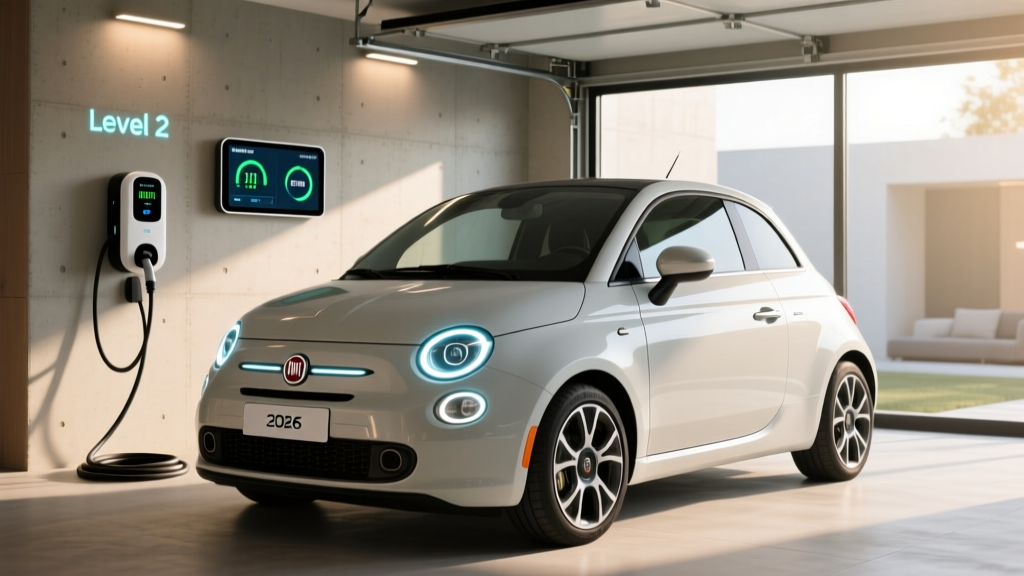
Level 2 requires a 240V circuit — the same type of outlet your electric dryer uses. Most home chargers deliver 7.7 kW to 11.5 kW, adding 25–45 miles of range per hour. A full overnight charge (8–10 hours) easily replenishes a 75–100 kWh battery.
DC Fast Charging bypasses the vehicle's onboard charger and feeds direct current straight to the battery. Tesla Superchargers range from 150 kW (V2) to 250 kW (V3) and up to 350 kW (V4, deployed at select locations). Electrify America stations peak at 350 kW. Real-world charging speed depends on your battery's charge curve: most EVs accept peak power only between roughly 10% and 50% state of charge, then taper significantly above 80% to protect battery health.
Connector Compatibility: NACS, CCS1, and CHAdeMO
The physical plug you connect to your EV varies by manufacturer, and the landscape has shifted dramatically. In 2026, NACS is the standard for Tesla and nearly all new EVs from Ford, GM, Rivian, Hyundai, Kia, and others. CCS1 remains on older models and some current vehicles, while CHAdeMO is essentially legacy — found only on older Nissan Leaf and Mitsubishi Outlander PHEV models.
| Connector | Brands Using It (2026) | DC Fast Charge Availability | Adapter Needed? |
|---|---|---|---|
| NACS (Tesla) | Tesla, Ford, GM, Rivian, Hyundai, Kia, Volvo, Polestar, BMW, Mercedes | Tesla Superchargers + growing NACS stations on EA, EVgo | CCS-to-NACS adapter for older CCS vehicles |
| CCS1 | Older VW ID.4, older BMW i4, some 2023–2024 models pre-NACS switch | Electrify America, EVgo, ChargePoint | NACS-to-CCS adapter to use Superchargers |
| CHAdeMO | Nissan Leaf (pre-2026), Mitsubishi Outlander PHEV (legacy) | Limited and shrinking network | No widely available adapter to NACS/CCS |
If you're buying a new EV in 2026, NACS compatibility is essentially a given. For owners of 2023–2024 CCS-equipped vehicles, manufacturers like Ford and Lectron sell CCS-to-NACS adapters (typically $150–$250) that enable Supercharger access. Tesla also provides a NACS-to-CCS adapter for legacy Tesla owners needing access to Electrify America stations.
Home Charger Installation: Electrical Requirements and Cost Breakdown
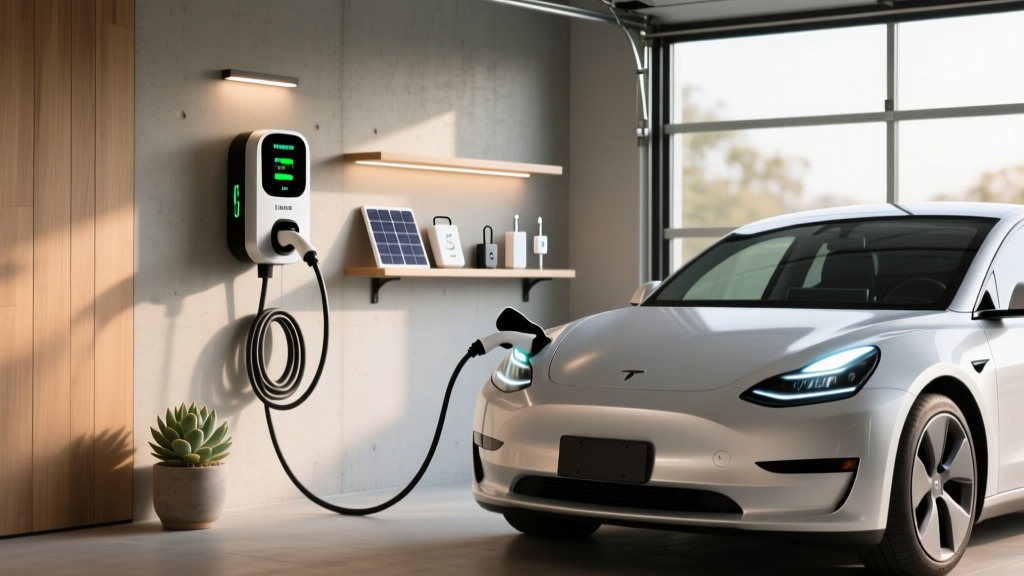
Installing a Level 2 home charger is the single most impactful upgrade for EV ownership. Most EV owners do 80% or more of their charging at home, waking up to a full battery every morning. Here's what's involved.
Electrical Requirements
A typical Level 2 home charger requires a 240V dedicated circuit on your electrical panel. The most common configurations:
- 40-amp circuit / 32-amp continuous: Delivers up to 7.7 kW. Suitable for most daily driving needs. Requires a NEMA 14-50 outlet or hardwired connection.
- 50-amp circuit / 40-amp continuous: Delivers up to 9.6 kW. Common for larger batteries (85–100 kWh).
- 60-amp circuit / 48-amp continuous: Delivers up to 11.5 kW. Maximizes Level 2 speed; requires adequate panel capacity.
Panel upgrade reality: Most homes built after 1990 have a 200-amp electrical panel, which can usually accommodate a 40–50A EV circuit. However, older homes with 100-amp or 150-amp service — or homes already running high-draw appliances (electric range, heat pump, hot tub) — may need a panel upgrade to 200A or even 400A. A panel upgrade adds $1,500–$4,000 to your project cost.
| Cost Component | Typical Range | Notes |
|---|---|---|
| Level 2 Charger Equipment | $300–$700 | Smart Wi-Fi chargers with NACS connector |
| Electrician Labor (240V circuit) | $400–$1,200 | Depends on run distance from panel to garage |
| Permit & Inspection | $50–$250 | Required in most jurisdictions; varies by city/county |
| Panel Upgrade (if needed) | $1,500–$4,000 | Only for older or maxed-out panels |
| Total (no panel upgrade) | $750–$2,150 | Most common scenario |
| Total (with panel upgrade) | $2,250–$6,150 | Older homes / high-load panels |
Always hire a licensed electrician familiar with EV charging installations. Per the National Electrical Code, your EV circuit must be dedicated (no shared loads), properly grounded, and protected by a GFCI breaker if the outlet is outdoors or in a garage. Many jurisdictions now require a permit and final inspection — skipping this can void your homeowner's insurance in the event of an electrical fire.
How Much Does Charging Cost Per Mile vs. Gasoline?
The economics of EV charging vary dramatically depending on where and when you charge. Home charging on a time-of-use (TOU) plan during off-peak hours is the cheapest option, while public DC fast charging can approach gasoline costs on a per-mile basis.
| Charging Scenario | Cost per kWh | Vehicle Efficiency (kWh/mi) | Cost per Mile | Gasoline Equivalent (at $3.40/gal, 28 MPG) |
|---|---|---|---|---|
| Home off-peak (TOU plan) | $0.08–$0.12 | 0.30 (e.g., Tesla Model Y) | $0.024–$0.036 | $0.121/mi |
| Home standard rate | $0.14–$0.18 | 0.30 | $0.042–$0.054 | $0.121/mi |
| Public Level 2 (workplace/mall) | $0.20–$0.35 | 0.30 | $0.060–$0.105 | $0.121/mi |
| DC Fast Charging (Electrify America) | $0.35–$0.55 | 0.30 | $0.105–$0.165 | $0.121/mi |
| Tesla Supercharger (avg 2026) | $0.28–$0.40 | 0.30 | $0.084–$0.120 | $0.121/mi |
For most EV owners charging primarily at home on off-peak rates, the per-mile cost is roughly one-quarter to one-third the cost of gasoline. Even on public DC fast chargers, a vehicle like the Tesla Model Y (averaging ~3.5 mi/kWh or 0.29 kWh/mi per fueleconomy.gov) still undercuts a 28 MPG gas car at current fuel prices.
However, if you rely exclusively on public DC fast charging — as apartment dwellers or frequent road-trippers might — your cost advantage narrows significantly. Plan your charging strategy around home access for maximum savings.
Charging Time Examples: 10-80% at Each Level
Real-world charging times depend on battery size (kWh), the charger's peak power (kW), and the vehicle's charge curve — the rate at which the battery accepts power across different states of charge. Peak kW is never sustained across the entire session; most EVs taper sharply above 80% SoC to protect cell longevity.
Here are representative 10–80% charge times for common battery sizes:
- 60 kWh battery (e.g., Chevrolet Equinox EV 2LT): Level 2 at 11.5 kW ≈ 5.5 hours; 150 kW DCFC ≈ 25 minutes; 250 kW DCFC ≈ 20 minutes.
- 82 kWh battery (e.g., Tesla Model Y Long Range): Level 2 at 11.5 kW ≈ 7 hours; 250 kW Supercharger ≈ 25 minutes (peak 250 kW, sustained ~170 kW average).
- 100 kWh battery (e.g., GMC Sierra EV Denali): Level 2 at 11.5 kW ≈ 9 hours; 350 kW DCFC ≈ 30 minutes (peak rate, tapering above 60% SoC).
- 18 kWh battery (e.g., Toyota RAV4 Prime PHEV): Level 1 at 1.4 kW ≈ 12 hours; Level 2 at 3.3 kW ≈ 5 hours; DCFC not available on most PHEVs.
The takeaway: Level 2 home charging handles daily needs effortlessly overnight. DC fast charging is designed for road trips, where a 20–30 minute stop adds 200+ miles of range — enough for most drivers to stretch their legs and grab food.
Equipment Recommendations: Best Home Level 2 Chargers for 2026
Choosing a home charger comes down to power output, connector type, cable length, smart features (Wi-Fi scheduling, load management), and price. Here are four top picks across categories:
Tesla Wall Connector (NACS)
- Power Output: Up to 11.5 kW (48A on 60A circuit)
- Connector: NACS (native Tesla); CCS adapter included in box
- Cable Length: 24 feet
- Smart Features: Wi-Fi, over-the-air updates, power sharing between two units, access control
- Price: ~$475
- Best For: Tesla owners and NACS-equipped EVs; excellent value for the power output
ChargePoint Home Flex (NACS/CCS)
- Power Output: Up to 12 kW (50A on 60A circuit); adjustable down to 16A for older panels
- Connector: NACS (2026 model); CCS1 available
- Cable Length: 23 feet
- Smart Features: Wi-Fi, Alexa integration, detailed energy tracking, flexible amperage settings
- Price: ~$599
- Best For: Homes needing adjustable amperage; strong app and energy monitoring
Emporia Vue Level 2 Charger
- Power Output: Up to 11.5 kW (48A)
- Connector: NACS
- Cable Length: 24 feet
- Smart Features: Wi-Fi, integrates with Emporia Vue energy monitor for whole-home load management, solar-aware scheduling
- Price: ~$399
- Best For: Budget-conscious buyers; solar-panel homes wanting integrated energy management
Grizzl-E Smart (NACS)
- Power Output: Up to 10 kW (40A)
- Connector: NACS
- Cable Length: 24 feet
- Smart Features: Wi-Fi, OCPP compatibility, extreme cold-rated (-40°F), rugged aluminum enclosure
- Price: ~$449
- Best For: Cold-climate installations and outdoor mounting; built in Canada for harsh winters
All of the above chargers are NEMA 4-rated for outdoor installation and carry at least a 3-year warranty. For homes with limited panel capacity, the ChargePoint Home Flex's adjustable amperage (down to 16A/3.8 kW) is a standout feature that avoids a costly panel upgrade.
Safety and Electrical Code Considerations
EV charging involves sustained high-current draw — often 6–10 hours at a time — which places different demands on your electrical system than intermittent loads like a microwave. Key safety requirements per the National Electrical Code (NEC Article 625):
- Dedicated circuit: Your EV charger must have its own breaker — no sharing with other outlets or appliances.
- Continuous load derating: NEC defines EV charging as a continuous load, meaning the circuit must be rated for 125% of the charger's maximum draw. A 40A charger requires a 50A breaker; a 48A charger requires a 60A breaker.
- GFCI protection: Required for all outdoor receptacles and for garage receptacles in most jurisdictions (2023 NEC and later). Hardwired chargers may be exempt in some areas — check local code.
- Outdoor rating: If mounting outside, the charger must carry at least a NEMA 4 (weather-resistant) rating. All chargers listed above meet this standard.
- Cable management: Avoid running charging cables across walkways or driveways where they create trip hazards or can be driven over. Wall-mounted cable organizers or retractable reels are inexpensive solutions.
Before purchasing any charger, consult a licensed electrician to assess your panel capacity and determine whether a panel upgrade is necessary. Many utilities offer free or low-cost home energy assessments that include EV charging readiness checks — check with your local provider.
Frequently Asked Questions
How much does it cost to install a home EV charger?
For most homes with a 200-amp electrical panel, expect to pay $750–$2,150 total including the charger ($300–$700), electrician labor ($400–$1,200), and permits ($50–$250). If your home needs a panel upgrade from 100A to 200A, add $1,500–$4,000. Always get 2–3 quotes from licensed electricians experienced with EV installations.
How fast will each charging level add range?
Level 1 (120V) adds 3–5 miles per hour. Level 2 (240V) adds 12–60 miles per hour depending on amperage. DC fast charging adds 150–1,000+ miles per hour at peak rates, though the charge curve tapers significantly above 80% SoC. For a 300-mile EPA-range vehicle, a 10–80% DC fast charge typically takes 20–35 minutes.
Which connector and charger is compatible with my EV?
If you're buying a new EV in 2026, it almost certainly uses the NACS connector and can charge at Tesla Superchargers natively. Older 2023–2024 models from VW, BMW, and others may still use CCS1 and require a CCS-to-NACS adapter ($150–$250) for Supercharger access. CHAdeMO is limited to legacy Nissan Leaf and Mitsubishi models with shrinking public infrastructure.
How much does charging cost per mile compared to gasoline?
Home charging on off-peak rates costs roughly $0.024–$0.036 per mile for an efficient EV like the Tesla Model Y — about one-quarter the cost of gasoline at $3.40/gallon in a 28 MPG vehicle ($0.121/mi). Even public DC fast charging at $0.35–$0.55/kWh typically costs $0.10–$0.17 per mile, still competitive with or cheaper than gas for most vehicles.
What electrical upgrades might I need for a home charger?
If your home has a 200-amp panel with available capacity, you likely need only a new 240V dedicated circuit — no panel work required. Homes with 100A or 150A service, or panels already near capacity with electric heating, A/C, range, and hot tub loads, may require a panel upgrade to 200A or 400A. A load calculation by a licensed electrician (often $100–$200) will determine your exact situation before any work begins.