If you've ever searched for a supercharger diagram, you've likely found a tangle of conflicting schematics: Tesla's proprietary DC architecture, CCS1 wiring standards, J1772 pinouts, and home panel one-line diagrams. What most diagrams omit is the practical context — what voltage you actually need at the panel, how many amps a 48A Level 2 charger pulls continuously, and whether your 100-amp service can handle it without an upgrade.
This guide decodes the supercharger diagram concept at every level: from the electrons leaving your utility transformer to the DC-DC converter inside your EV. We'll cover real 2026 installation costs, the NACS/CCS1/CHAdeMO connector landscape, and the exact $/mile math that separates home charging from public DC fast charging.
The Anatomy of EV Charging: Level 1, Level 2, and DC Fast
Before interpreting any wiring diagram, you need to understand the three charging tiers. The difference isn't just speed — it's whether AC or DC power crosses the charge port.
| Level | Voltage | Max Power (kW) | Miles of Range / Hour | Typical Use Case |
|---|---|---|---|---|
| Level 1 | 120V AC | 1.4 kW | 3–5 mi/hr | Overnight top-up, PHEVs |
| Level 2 | 240V AC | 7.2–19.2 kW | 20–60 mi/hr | Home, workplace, destination |
| DC Fast (Level 3) | 400–800V DC | 50–350 kW | 150–1,000+ mi/hr | Highway road trips |
Critical distinction: kW (kilowatts) measures power — the rate of energy flow, like water pressure. kWh (kilowatt-hours) measures energy — the total amount stored in your battery, like gallons in a tank. A 75 kWh battery charged at 7.2 kW takes roughly 10.4 hours from 0–100%. A 250 kW DC fast charger can deliver that same 75 kWh in under 30 minutes (subject to the charge curve taper).
Level 1 and Level 2 deliver AC power to the car. The vehicle's onboard charger converts AC to DC for the battery. DC Fast Charging bypasses the onboard charger entirely — the station does the AC-to-DC conversion at industrial scale and feeds DC straight into the battery management system. That's why DC fast chargers are massive, expensive, and require utility-grade infrastructure.
Decoding a Home Level 2 Supercharger Diagram: Panel to Plug
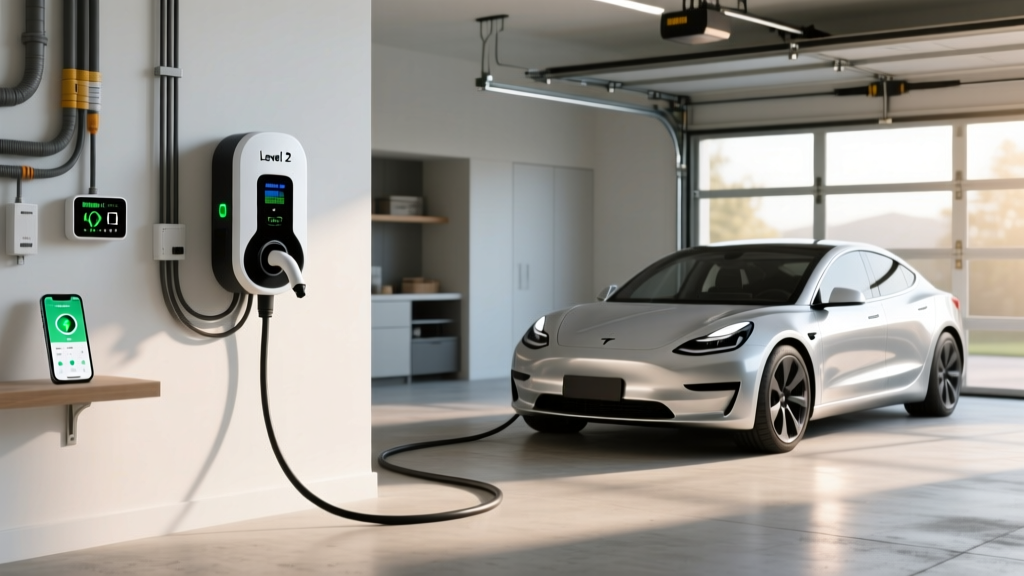
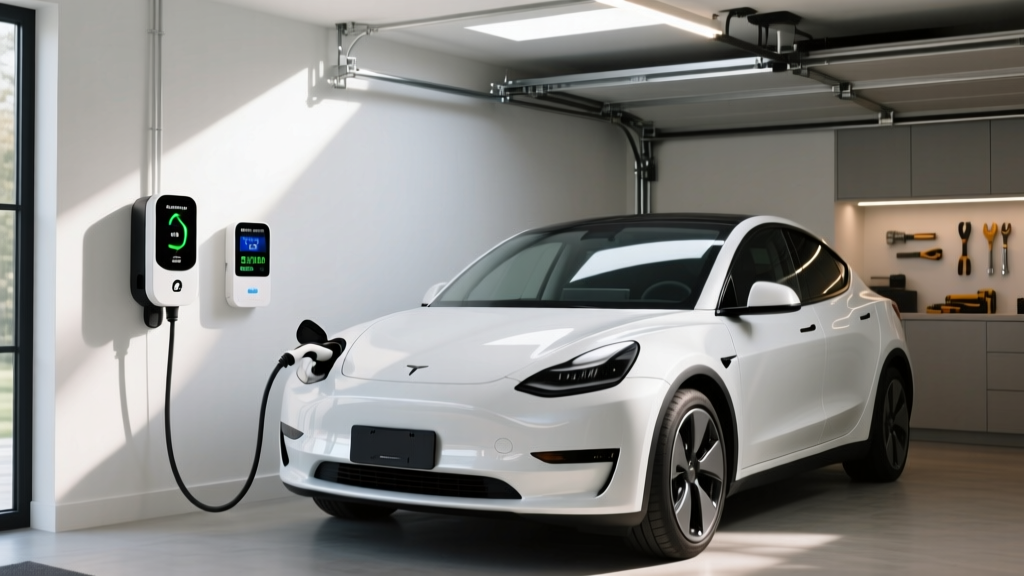
A proper home Level 2 installation diagram has four layers: utility service → main panel → dedicated circuit → EVSE (Electric Vehicle Supply Equipment). Here's what each requires.
Electrical Requirements
Most home Level 2 chargers run on 240V AC. The amperage depends on the charger's rated output:
- 32A charger (7.7 kW): requires a 40A breaker (NEC requires circuits rated 125% of continuous load)
- 40A charger (9.6 kW): requires a 50A breaker
- 48A charger (11.5 kW): requires a 60A breaker
- 80A charger (19.2 kW): requires a 100A breaker — rare in residential
Wire gauge matters too. A 60A circuit typically needs 6 AWG copper (or 4 AWG aluminum) in conduit. Longer runs may require upsizing to prevent voltage drop beyond 3%.
Panel Capacity Reality Check
Before pulling a permit, an electrician will perform a NEC Article 220 load calculation. This sums your existing loads (HVAC, range, dryer, water heater) against your panel's rated capacity. A 200-amp panel with gas appliances often has room for a 60A EV circuit. A 100-amp panel with electric heat? You'll likely need a panel upgrade or a smart load-management device like the Emporia Smart Load Center or Tesla Gateway.
Home Charger Installation Cost Breakdown
Installation costs vary wildly based on panel capacity, conduit run length, and local labor rates. Here's a realistic 2026 breakdown based on national electrician surveys and real owner reports.
| Component | Simple Install (panel adjacent) | Complex Install (long run / upgrade) |
|---|---|---|
| EVSE hardware (Level 2, 40–48A) | $400–$700 | $400–$700 |
| Electrician labor | $300–$600 | $800–$2,500 |
| Permit & inspection | $50–$150 | $50–$250 |
| Conduit & wire materials | $50–$150 | $200–$600 |
| Panel upgrade (if needed) | $0 | $1,500–$3,500 |
| Total | $800–$1,600 | $2,950–$7,550 |
Key gotcha: Many 1960s–1980s homes have 100-amp or 150-amp panels that are already near capacity. A $2,500 panel upgrade to 200 amps is common. Some utilities offer rebates of $200–$500 for panel upgrades tied to EV adoption — check with your local co-op or IOU before paying full price.
The IRS §30C credit covers up to 30% of home charging equipment and installation costs, capped at $1,000, but only if you live in an eligible census tract (non-attainment or low-income area). This is separate from the §30D vehicle credit.
Connector Compatibility: NACS, CCS1, and CHAdeMO in 2026
The connector landscape has consolidated significantly since 2024. Here's where things stand for 2026 model-year vehicles:
| Connector | Brands Using It | Max DC Fast Rate | Adapter Needed? |
|---|---|---|---|
| NACS (Tesla standard) | Tesla, Ford, GM, Rivian, Volvo, Polestar, Mercedes, Nissan (2026+) | Up to 350 kW | CCS→NACS adapters available (~$200) |
| CCS1 | Hyundai, Kia, BMW, VW, Audi, Porsche, Stellantis | Up to 350 kW | NACS→CCS adapters available (~$200) |
| CHAdeMO | Nissan Leaf (legacy), Mitsubishi Outlander PHEV | Up to 50–100 kW | Limited adapter options; network declining |
NACS won the North American connector war. Nearly every major automaker adopted it starting with 2025 model-year vehicles. If you buy a 2026 Ford, GM, or Rivian, you get a native NACS port and direct Tesla Supercharger access — no adapter required. Hyundai/Kia and BMW stuck with CCS1, but adapters to access Tesla Superchargers are widely available from Tesla, Lectron, and A2Z.
For home Level 2 charging, nearly all EVSEs ship with a J1772 connector (the AC standard). NACS-equipped vehicles come with a J1772-to-NACS adapter in the trunk. CCS1 vehicles use a combo connector that incorporates J1772 pins — so a standard J1772 home charger works universally for Level 2.
Cost to Charge: Home vs. Public vs. DC Fast (Per-Mile Math)
Charging economics depend on electricity rates, which vary by state, time of day, and network. Here's a real-world comparison using a mid-size EV averaging 3.5 miles per kWh (like a Tesla Model Y or Hyundai Ioniq 5).
| Scenario | $/kWh | Cost per Mile | Cost for 300-Mile Trip |
|---|---|---|---|
| Home off-peak (utility rate) | $0.08–$0.14 | $0.023–$0.040 | $6.90–$12.00 |
| Home standard rate (US avg.) | $0.17 | $0.049 | $14.57 |
| Public Level 2 (ChargePoint, EVgo) | $0.25–$0.49 | $0.071–$0.140 | $21.43–$42.00 |
| DC Fast (Electrify America, Tesla) | $0.35–$0.55 | $0.100–$0.157 | $30.00–$47.14 |
| Gas car (28 MPG avg, $3.40/gal) | — | $0.121 | $36.43 |
The takeaway: home charging at off-peak rates costs roughly 2–4 cents per mile — one-quarter the cost of gasoline. Public DC fast charging, however, often matches or exceeds gas on a per-mile basis. The financial case for EVs hinges on reliable home or workplace charging. If you can only charge publicly at DC fast rates, the savings shrink dramatically.
Pro tip: Many utilities offer time-of-use (TOU) plans with super off-peak rates between midnight and 5 AM. Programming your EV or EVSE to charge during these windows can cut your charging bill by 40–60% compared to standard rates.
Charging Time Examples: What to Expect by Battery Size
Charge times depend on battery capacity (kWh), the charger's power output (kW), and the vehicle's charge curve. No EV sustains peak charge rate from 10–80% — the rate tapers as the battery fills to protect cell health.
| Battery Size | Level 2 (11.5 kW / 48A) | DC Fast 150 kW (10–80%) | DC Fast 250+ kW (10–80%) |
|---|---|---|---|
| 60 kWh (e.g., Chevy Equinox EV) | ~5.2 hours | ~28 min | ~20 min |
| 77 kWh (e.g., Ford Mustang Mach-E ER) | ~6.7 hours | ~34 min | ~23 min |
| 84 kWh (e.g., Hyundai Ioniq 5) | ~7.3 hours | ~32 min | ~18 min |
| 100 kWh (e.g., Tesla Model S, Rivian R1S) | ~8.7 hours | ~40 min | ~25 min |
Charge curve reality: A Hyundai Ioniq 5 with 800V architecture peaks at 240 kW but only holds that rate from roughly 10–45% SoC. From 45–80%, it tapers to 100–150 kW. That's why "10–80% in 18 minutes" is the industry-standard metric — it captures the taper, not just the peak. Always be skeptical of marketing claims that cite only peak kW without a time range.
Equipment Recommendations: Best Home Level 2 Chargers for 2026
Based on reliability data, smart features, and build quality, here are the top home EVSEs we recommend for 2026:
ChargePoint Home Flex
- Power: Up to 12 kW (50A) — configurable via DIP switches to 16–50A
- Connector: J1772 (25-ft cable)
- Smart features: Wi-Fi, scheduling, energy tracking, Alexa integration
- Price: ~$549
- Best for: Flexibility — adjust amperage to match your circuit
Tesla Wall Connector
- Power: Up to 11.5 kW (48A)
- Connector: NACS native (24-ft cable) — includes J1772 adapter for non-Tesla EVs
- Smart features: Wi-Fi, OTA updates, power sharing (link up to 6 units on one circuit), Tesla app integration
- Price: ~$475
- Best for: Tesla owners and NACS-equipped EVs; multi-EV households
Emporia Vue EV Charger
- Power: Up to 11.5 kW (48A)
- Connector: J1772 (24-ft cable)
- Smart features: Whole-home energy monitoring integration, solar-aware charging, load management
- Price: ~$399
- Best for: Solar owners and budget-conscious buyers
Grizzl-E Smart
- Power: Up to 10 kW (40A)
- Connector: J1772 (24-ft cable)
- Smart features: OCPP-compatible, works with multiple apps, outdoor-rated (NEMA 4)
- Price: ~$449
- Best for: Cold-climate outdoor installs (rated to -40°F)
Safety, Code, and Permit Considerations
EV charging is a continuous load — the NEC defines this as a load expected to run for 3 hours or more. That triggers specific code requirements:
- Dedicated circuit: Your EVSE must have its own breaker — no sharing with outlets, lights, or appliances.
- 125% rule: A 40A continuous load requires a 50A breaker and wire rated for 50A. Never undersize.
- GFCI protection: NEC 2023 (adopted by most jurisdictions by 2026) requires GFCI protection for all EV receptacles. Hardwired EVSEs may be exempt depending on local interpretation — confirm with your inspector.
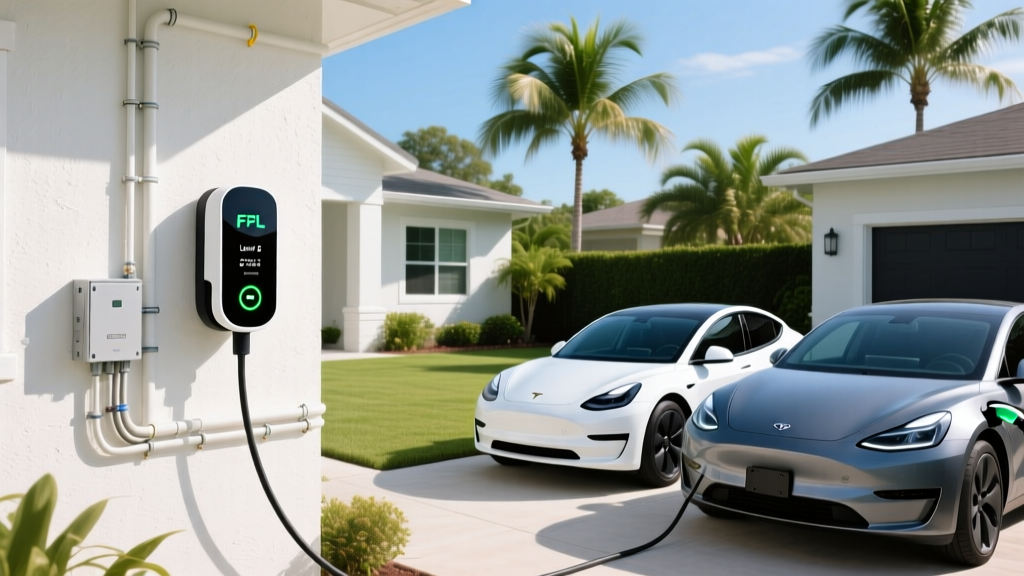
- Outdoor rating: If installing outside, the EVSE must be NEMA 4 (splash-resistant) or NEMA 4X (corrosion-resistant). The ChargePoint Home Flex and Grizzl-E are outdoor-rated; the Tesla Wall Connector is rated for covered outdoor use.
- Permit required: Virtually every jurisdiction requires an electrical permit for a new 240V circuit. Typical cost: $50–$250. The inspection ensures your wire gauge, breaker size, and grounding meet code. Skipping the permit risks insurance denial if a fire occurs.
Smart load management is worth considering if your panel is tight. Devices like the Emporia Smart Load Center or the Myenergi hub monitor your home's total draw in real time and throttle the EVSE if other loads spike — preventing breaker trips without requiring a panel upgrade.
Frequently Asked Questions
How much does it cost to install a home EV charger?
A straightforward install (panel nearby, short conduit run, no upgrade) costs $800–$1,600 including the charger, electrician labor, permit, and materials. Complex installs with long wire runs or a panel upgrade can reach $3,000–$7,500. The IRS §30C credit may cover 30% of costs (up to $1,000) if you're in an eligible census tract.
How fast will each charging level add range?
Level 1 (120V) adds 3–5 miles per hour — fine for PHEVs with small batteries, impractical for full BEVs. Level 2 (240V, 48A) adds 30–45 miles per hour, enough to fully recharge most EVs overnight. DC fast charging adds 150–1,000+ miles per hour at peak rates, but sustained rates taper above 50% SoC.
Which connector/charger is compatible with my EV?
For 2026 models: Tesla, Ford, GM, Rivian, Volvo, and Nissan use NACS. Hyundai, Kia, BMW, VW, and Stellantis use CCS1. For home Level 2 charging, a standard J1772 EVSE works with all EVs — NACS vehicles include a J1772 adapter. For public DC fast charging, check your vehicle's port and carry the appropriate adapter if you plan to use Tesla Superchargers with a CCS1 vehicle.
How much does charging cost per mile vs gas?
Home charging at the US average rate ($0.17/kWh) costs about 5 cents per mile for an efficient EV — roughly one-third the cost of gas at $3.40/gallon and 28 MPG. Off-peak home rates drop this to 2–3 cents. However, public DC fast charging at $0.40–$0.55/kWh can cost 10–16 cents per mile, matching or exceeding gas prices.
What electrical upgrades might I need?
If your home has a 100-amp or 150-amp panel that's already heavily loaded (electric range, dryer, HVAC), you may need a panel upgrade to 200 amps — typically $1,500–$3,500. Alternatively, smart load-management devices can share capacity between the EVSE and other appliances, avoiding an upgrade. An electrician's NEC load calculation will determine which path you need. See the National Electrical Code (NFPA 70) for the full standard.
Do I need a Tesla Supercharger at home?
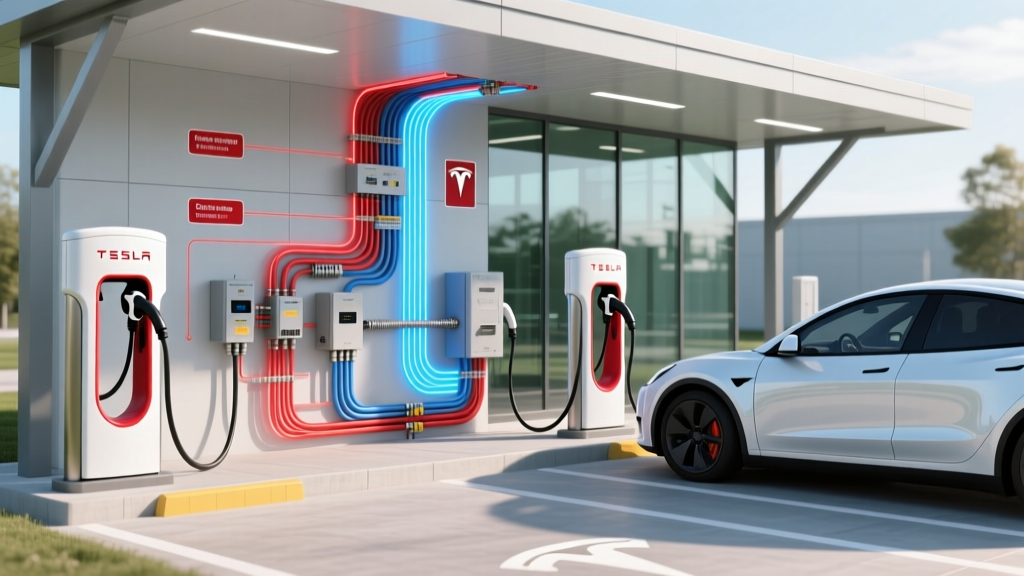
No. Tesla Superchargers are DC fast chargers rated at 150–350 kW — they require 480V three-phase utility service and cost $50,000–$150,000 to install. For home use, a Tesla Wall Connector (Level 2, 11.5 kW) provides the same connector and overnight charging capability for under $500 plus installation. The EPA's fueleconomy.gov site offers efficiency data to help you calculate your specific home charging needs based on your daily mileage.