The Real Cost of Using a Tesla Supercharger (and Every Other DC Fast Network)
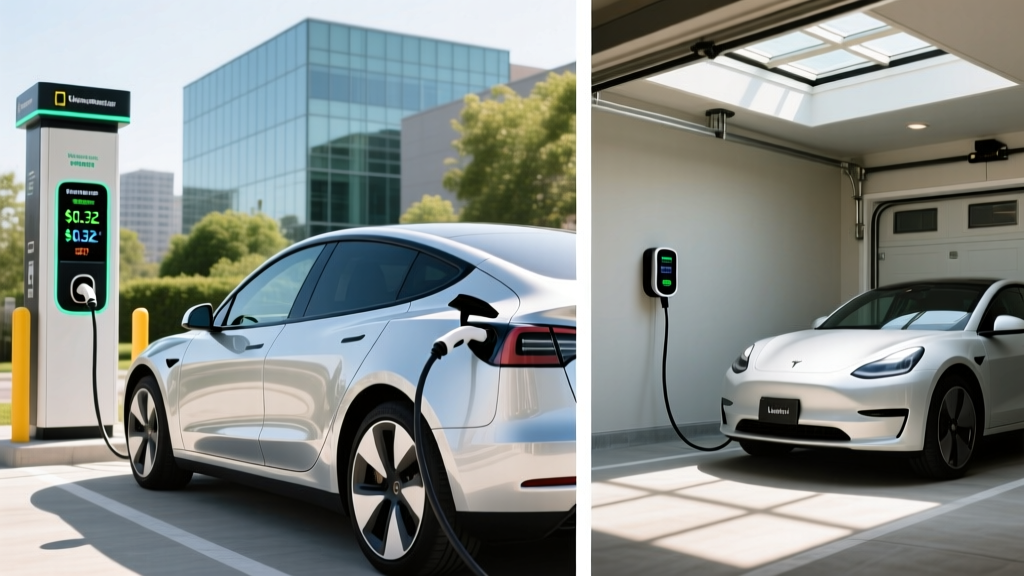
If you've typed "how much a supercharger cost" into a search bar, you're likely weighing whether an electric vehicle makes financial sense compared to a gas car — or you already own an EV and want to know what you'll actually pay at the plug. The answer depends heavily on where and how you charge. A Tesla Supercharger session in rural California might cost $0.48/kWh, while the same session at home on an off-peak utility rate could run $0.09/kWh. That's a 5x difference that dramatically changes your cost-per-mile.
This guide breaks down every charging scenario you'll encounter in 2026 — Tesla Superchargers, Electrify America, EVgo, home Level 2, and the equipment and electrical work required to make home charging affordable. We'll use exact $/kWh figures, real charging times, and installation cost ranges so you can budget accurately.
Charging Levels Explained: Speed, Power, and Miles Added Per Hour
Every EV owner interacts with three charging tiers. Understanding the kW output and real-world miles-per-hour of each is essential for trip planning and daily use.
| Level | Voltage | Power (kW) | Miles of Range Added/Hour | Typical Use |
|---|---|---|---|---|
| Level 1 | 120V AC | 1.0–1.4 kW | 3–5 mi/hr | Overnight trickle; PHEV-friendly |
| Level 2 | 240V AC | 3.3–19.2 kW | 12–75 mi/hr | Daily home & workplace charging |
| DC Fast (incl. Supercharger) | 400–800V DC | 50–350 kW | 150–1,200+ mi/hr (peak) | Road trips, rapid top-ups |
A few real-world caveats: DC fast charging speeds are peak rates, not sustained. A Tesla V4 Supercharger rated at 250 kW will only deliver that rate between roughly 10–30% state of charge (SoC) on a compatible vehicle with a preconditioned battery. Above 80% SoC, the charge curve tapers sharply — often dropping below 50 kW — to protect battery health. That's why manufacturers quote 10–80% charge times rather than 0–100%.
For a 75 kWh battery (typical midsize EV like the Tesla Model Y or Hyundai Ioniq 5), expect these approximate 10–80% times:
- Level 1 (1.4 kW): ~45+ hours (impractical for BEVs, fine for PHEVs with 15 kWh batteries)
- Level 2 (11.5 kW / 48A): ~5–6 hours
- Level 2 (7.7 kW / 32A): ~7–8 hours
- DC Fast (250 kW peak, e.g., Supercharger V3/V4): ~18–25 minutes
- DC Fast (350 kW peak, e.g., Electrify America): ~15–20 minutes on 800V architectures (Ioniq 5, Porsche Taycan)
Supercharger Pricing: What You'll Actually Pay Per kWh in 2026
Tesla Supercharger pricing varies by location, time of day, and whether you're in a Tesla vehicle. As of early 2026, here's the landscape:
- Tesla owners at Superchargers: $0.25–$0.48/kWh depending on region and time-of-use tiers. Average national rate: ~$0.32/kWh.
- Non-Tesla EVs at Superchargers (via Magic Dock or NACS): Typically $0.36–$0.56/kWh — Tesla charges a premium for non-Tesla vehicles unless you subscribe to a membership tier.
- Idle fees: $1.00/minute if your car remains plugged in after reaching its charge limit and the station is ≥50% occupied. This adds up fast.
Other DC fast networks price comparably:
- Electrify America: $0.31–$0.48/kWh (Pass+ membership reduces to ~$.25/kWh for 800 kWh/year)
- EVgo: $0.29–$0.43/kWh (subscription plans available)
- ChargePoint (DC stations): Set by site host — typically $0.25–$0.49/kWh
According to fueleconomy.gov, the average EV in 2026 consumes roughly 28–32 kWh per 100 miles. Let's translate that into cost-per-mile across scenarios.
| Scenario | $/kWh | Cost per 100 mi (30 kWh) | Cost per Mile |
|---|---|---|---|
| Home (off-peak utility rate) | $0.09 | $2.70 | $0.027 |
| Home (average US residential) | $0.17 | $5.10 | $0.051 |
| Tesla Supercharger (average) | $0.32 | $9.60 | $0.096 |
| Electrify America (non-member) | $0.43 | $12.90 | $0.129 |
| Gas car (25 MPG, $3.40/gal) | — | $13.60 | $0.136 |
| Gas car (30 MPG, $3.40/gal) | — | $11.33 | $0.113 |
The takeaway: home charging is 3–5x cheaper than DC fast charging, and even the most expensive public DC fast charging is competitive with or cheaper than gasoline on a per-mile basis. If you can charge at home 80%+ of the time, your effective fuel cost drops to $0.03–0.05/mile.
How Much Does It Cost to Install a Home EV Charger?
This is where many EV buyers get surprised. The charger hardware itself is relatively affordable ($400–$750 for a quality Level 2 unit), but the electrical work to support it can range from trivial to expensive depending on your home's panel capacity and wiring run distance.
Here's a realistic breakdown for a typical 240V / 48A (11.5 kW) Level 2 home installation:
| Component | Low End | High End | Notes |
|---|---|---|---|
| Level 2 charger (hardwired, 48A) | $400 | $750 | ChargePoint Home Flex, WallConnector, Emporia |
| Electrical permit | $50 | $200 | Varies by municipality |
| Electrician labor (short run, <20 ft) | $400 | $800 | Panel has capacity, garage-adjacent |
| Electrician labor (long run, 40+ ft, conduit) | $800 | $2,000 | Detached garage, exterior wall mount |
| Panel upgrade (if needed) | $1,500 | $3,500 | 100A → 200A service upgrade |
| Total (no panel upgrade) | $850 | $3,750 | Most common: $1,200–$2,000 |
| Total (with panel upgrade) | $2,350 | $7,250 | Older homes |
Electrical Requirements for a 48A Level 2 Charger
A 48A charger requires a dedicated 60A circuit (National Electrical Code requires circuits be rated at 125% of continuous load — 48A × 1.25 = 60A). The wiring must be:
- Voltage: 240V (split-phase, same as a dryer or oven)
- Wire gauge: 6 AWG copper (THHN in conduit) or 4 AWG aluminum for longer runs
- Breaker: 60A double-pole
- GFCI protection: Required by NEC 2020+ for outdoor receptacles; hardwired installations may not require a GFCI breaker in all jurisdictions — confirm with your electrician and local code
- Outdoor rating: If mounting outside, the charger must carry a NEMA 4 or IP55+ weather rating
For a 32A charger (7.7 kW), a 40A dedicated circuit with 8 AWG copper is sufficient. This is a practical downgrade if your panel is tight on capacity — you sacrifice ~3.8 kW of charge speed but may avoid a panel upgrade entirely.
Which Connector and Charger Is Compatible With My EV?
The connector landscape shifted dramatically between 2023 and 2026. Tesla's North American Charging Standard (NACS) has been adopted by nearly every major automaker, but CCS1-equipped vehicles are still on the road and at public stations.
| Connector | Automakers (2026 new vehicles) | Public Charger Availability |
|---|---|---|
| NACS (Tesla / J3400) | Tesla, Ford, GM, Rivian, Volvo, Polestar, Mercedes, Nissan, Honda, Hyundai, Kia, BMW, Lucid | Tesla Supercharger (17,000+ stalls), growing EA/ChargePoint NACS stalls |
| CCS1 (Combo) | Legacy models still in use; Stellantis, VW ID.4 (some trims) | Electrify America, EVgo, ChargePoint (widely available) |
| CHAdeMO | Nissan Leaf (discontinued, used market only) | Declining — limited new installations |
Adapter needs: If you own a CCS1-equipped EV (e.g., 2023–2024 Hyundai Ioniq 5, Ford Mustang Mach-E pre-NACS), you'll need a CCS-to-NACS adapter (~$150–$250) to access Tesla Superchargers. Tesla sells an official adapter, and third-party options from Lectron and A2Z are available. Per Tesla's support documentation, ensure any adapter is rated for the full amperage of the DC fast charger you're using.
For home Level 2 charging, all new 2026 EVs use either a NACS port or a J1772 port (which NACS vehicles can use with a simple J1772-to-NACS adapter included with most Tesla and NACS-adopting vehicles).
Recommended Home Level 2 Chargers: Specs, Features, and Pricing
These are the chargers we recommend based on power output, reliability, smart features, and value — all compatible with 240V circuits and available in NACS or J1772 configurations.
Tesla Wall Connector
- Power: 11.5 kW (48A)
- Connector: NACS (native)
- Cable length: 24 ft
- Smart features: Wi-Fi, OTA updates, power-sharing between two units, Tesla app integration
- Price: ~$475
- Best for: Tesla and NACS-equipped owners who want a clean, reliable unit
ChargePoint Home Flex
- Power: Up to 12 kW (50A), configurable from 16A–50A
- Connector: J1772 (NACS adapter included with many new EVs)
- Cable length: 23 ft
- Smart features: Wi-Fi, ChargePoint app, Alexa, scheduling, utility demand-response programs
- Price: ~$550–$650
- Best for: Flexible amperage if your panel can't support 60A; excellent app
Emporia Vue Level 2 Charger
- Power: 11.5 kW (48A)
- Connector: J1772 (NACS version available)
- Cable length: 24 ft
- Smart features: Wi-Fi, Emporia energy monitoring integration, solar-aware scheduling, load management
- Price: ~$400–$500
- Best for: Budget-conscious buyers who want energy monitoring and solar integration
For most homes, a 48A hardwired unit on a 60A circuit provides the best balance of charge speed and electrical compatibility. If your panel is constrained, the ChargePoint Home Flex's ability to dial down to 32A or 24A (while keeping the same hardware) is a genuine advantage — you can upgrade the circuit later without replacing the charger.
Federal Tax Credits and Utility Rebates for Home Charging
The IRS residential clean energy credit (IRC §25C) does not cover EV charger equipment directly in 2026 — the previous §30C alternative fuel vehicle refueling property credit expired for residential installations. However, many utilities and state programs still offer rebates:
- Utility rebates: $200–$500 off Level 2 charger hardware (check your local utility — PG&E, ConEdison, Xcel Energy, and others run ongoing programs)
- State incentives: Vary widely — California's CC4A program, New York's Charge Ready NY, and others may cover $500–$1,500 toward installation. Check your state energy office for current programs.
- Time-of-use (TOU) rates: Many utilities offer EV-specific TOU plans with off-peak rates as low as $0.05–$0.09/kWh between 10 PM and 6 AM. This is the single most impactful way to reduce your home charging cost.
For the EV purchase itself, the federal §30D tax credit remains available for qualifying new EVs (up to $7,500) with MSRP caps ($55,000 sedans / $80,000 SUVs/trucks), buyer income limits ($150K single / $300K joint), and critical mineral/battery sourcing requirements. Point-of-sale transfer is available, reducing your purchase price at the dealer. Confirm eligibility on fueleconomy.gov before buying.
Safety, Code, and Practical Installation Considerations
Beyond the electrical specs, keep these safety and code requirements in mind:
- Dedicated circuit: Your EV charger must be on its own dedicated breaker — never share a circuit with other large appliances.
- Hardwired vs. plug-in: Hardwired installations (no plug) are generally preferred for 48A+ chargers. They avoid the NEMA 14-50 receptacle, which some jurisdictions now require GFCI breakers for — adding $100–$200 and occasional nuisance tripping. Hardwired also eliminates the receptacle as a failure point.
- Cable management: A 24-ft cable draped across a garage floor is a tripping hazard. Consider a wall-mounted cable organizer ($20–$40).
- Outdoor installations: Ensure your charger is rated NEMA 4 (weatherproof). Most major chargers (Tesla Wall Connector, ChargePoint Home Flex) carry this rating. If in a flood zone, mount at least 12 inches above the base flood elevation.
- Permit and inspection: Most jurisdictions require an electrical permit and post-installation inspection. Skipping this can void homeowner's insurance coverage for electrical fires and create problems at resale.
Frequently Asked Questions
How much does it cost to charge at a Tesla Supercharger on a road trip?
Expect to pay $0.28–$0.48/kWh depending on location and time. For a typical 60 kWh top-up (roughly 200 miles of range in a midsize EV), that's $17–$29 per session. On a 1,000-mile road trip requiring four charging stops, budget approximately $70–$120 in Supercharger costs — still less than the $130+ you'd spend on gas in a 25 MPG car at $3.40/gallon.
Is home Level 2 charging always cheaper than Supercharging?
Almost always. At the US average residential rate of ~$0.17/kWh, home charging costs roughly half of Supercharger pricing. With an off-peak TOU plan at $0.07–$0.09/kWh, home charging is 70–80% cheaper. The exception: some workplaces and retail locations offer free Level 2 charging, which beats any paid option.
Can I use a regular 120V outlet to charge my EV?
Yes, but it's slow — Level 1 adds only 3–5 miles of range per hour. For a PHEV with a 15 kWh battery (e.g., Toyota RAV4 Prime), an overnight Level 1 session can fully recharge the battery. For a BEV with a 75+ kWh battery, Level 1 would take multiple days and is only practical as an emergency backup or for very low daily mileage (<20 miles/day).
Do I need a Tesla Wall Connector if I own a Tesla?
No. Any Level 2 charger with a NACS connector (or J1772 with a NACS adapter) will charge a Tesla. However, the Tesla Wall Connector offers the best integration — native NACS, power-sharing for two-Tesla households, and OTA firmware updates. For mixed-EV households (one Tesla, one CCS vehicle), the ChargePoint Home Flex with appropriate adapters is more versatile.
How long does a Supercharger stop actually take on a road trip?
Plan for 20–30 minutes per stop for a 10–80% charge on a 250 kW Supercharger with a preconditioned battery. The charge curve tapers significantly above 80%, so charging to 100% at a Supercharger is time-inefficient (often adding 15–20 extra minutes for the final 20%). Best practice: charge to 80%, drive, and charge again — it's faster overall than waiting for a full charge.
Will frequent Supercharger use degrade my battery faster?
Modern battery thermal management systems have largely mitigated this concern. Tesla's own data shows minimal additional degradation from frequent DC fast charging compared to Level 2 charging — typically a 1–2% difference over 150,000 miles. The bigger degradation factors are consistently charging to 100% SoC and letting the battery sit at high SoC in hot weather. For daily use, set your charge limit to 80% (or 100% for LFP batteries, which tolerate full charges better than NMC chemistry).