If you've searched "how much does a super charger cost," you're likely weighing two distinct expenses: the price of using a Tesla Supercharger (or comparable DC fast charger) on the road, and the cost of installing a high-speed charger at home. These are very different numbers, and conflating them leads to bad budgeting. This guide separates public fast-charging costs from home equipment and installation, then compares both against gasoline on a per-mile basis.
Supercharger Pricing: What You Pay Per kWh in 2026
Tesla Supercharger rates vary by location, time of day, and whether your vehicle is a Tesla or a non-Tesla EV using the network via the Non-Tesla Supercharger program. As of early 2026, typical U.S. Supercharger pricing falls into these bands:
- Off-peak (overnight/midday lulls): $0.24–$0.32 per kWh
- Standard peak: $0.32–$0.45 per kWh
- High-demand urban/metro stations: $0.48–$0.58 per kWh
- Non-Tesla vehicles: Typically 15–30% higher than Tesla-member rates at the same stall
Idle fees add $0.50–$1.00 per minute if your car remains plugged in after reaching its charge limit. Tesla also offers a membership plan ($12.99/month as of 2026) that reduces per-kWh rates by roughly $0.05–$0.10, which pays for itself if you Supercharge more than ~130 kWh per month.
Other DC fast-charging networks charge comparably or more:
- Electrify America: $0.36–$0.56/kWh (Guest rate); Pass+ membership ($7/month) drops rates ~$0.12/kWh
- EVgo: $0.34–$0.52/kWh; subscription plans reduce per-kWh cost
- ChargePoint (DC stations): Highly variable by site host, $0.30–$0.60/kWh
Charging Levels Explained: Speed, Power, and Range Added
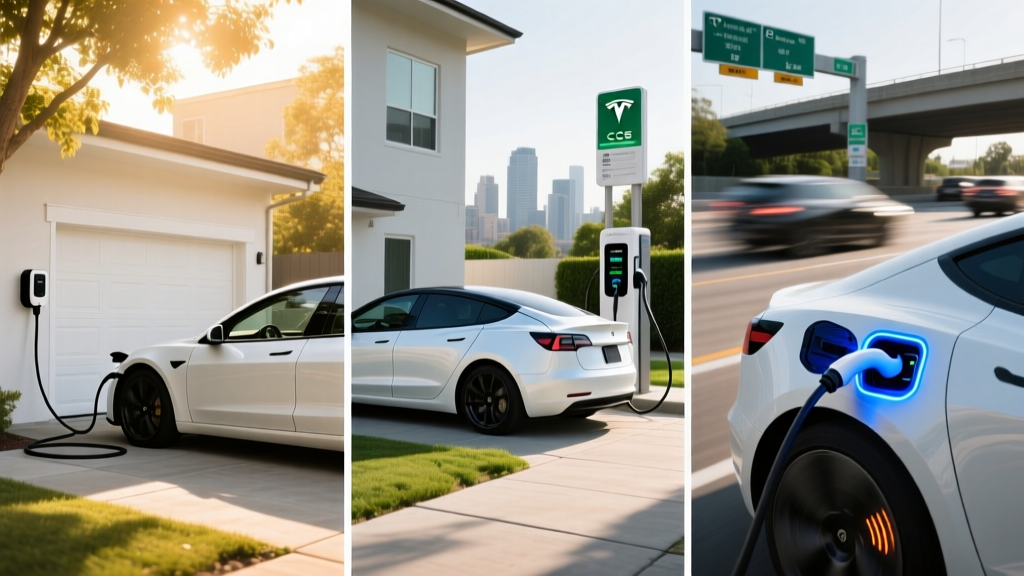
Before comparing costs, you need to understand the three charging levels and what they deliver. Power is measured in kW (kilowatts — the rate of energy flow), while battery capacity is measured in kWh (kilowatt-hours — the total energy stored). A 75 kWh battery charged at 11.5 kW takes roughly 6.5 hours from empty to full (minus taper at the top of the charge curve).
| Level | Voltage / Amperage | Max Power (kW) | Miles of Range Added per Hour | Typical Use |
|---|---|---|---|---|
| Level 1 | 120V / 12A | 1.4 kW | 3–5 mi/hr | Overnight trickle; PHEV top-ups |
| Level 2 (Home/Public AC) | 240V / 32–48A | 7.7–11.5 kW | 25–44 mi/hr | Daily home charging; workplace; destination |
| DC Fast Charging (incl. Supercharger) | 400–800V DC | 50–350 kW | 150–1,000+ mi/hr (peak) | Road trips; rapid top-ups |
- Tesla Model Y (75 kWh battery, NMC): ~18–22 minutes at a V3 Supercharger (250 kW peak), tapering significantly above 60% SoC
- Hyundai Ioniq 5 (77.4 kWh, NMC, 800V architecture): ~18 minutes at a 350 kW Electrify America station
- Ford F-150 Lightning Extended Range (131 kWh, NMC): ~38–42 minutes at a 150 kW DC charger; ~28 minutes at 350 kW
- Chevrolet Equinox EV (85 kWh, NMC): ~24 minutes at a 150 kW charger
Note: Peak kW is not sustained kW. Charge curves taper as the battery fills and as battery temperature rises. Expect average rates 30–50% below the peak number over a full 10–80% session.
How Much Does It Cost to Install a Home EV Charger?
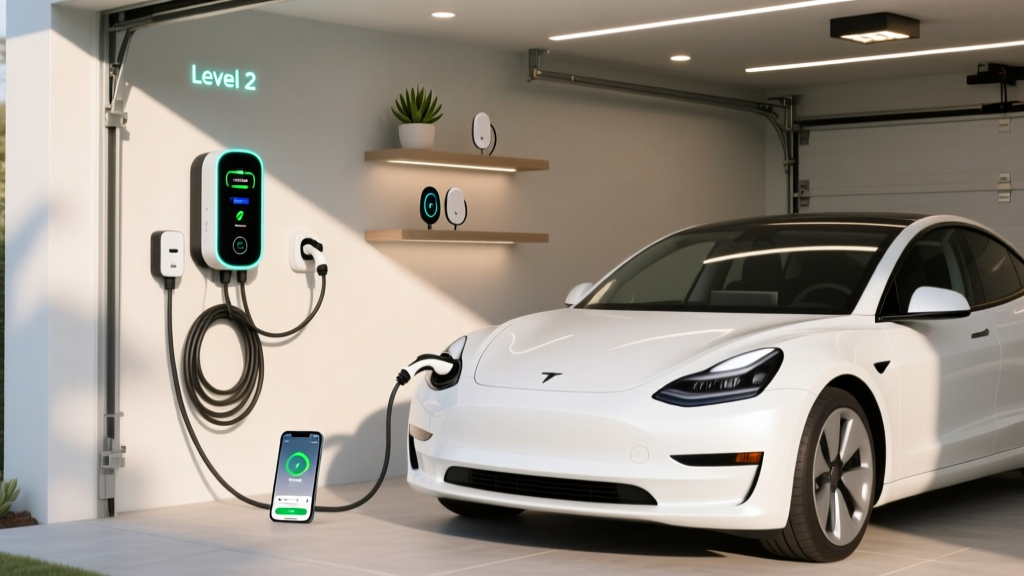
A home Level 2 charger (also called an EVSE — Electric Vehicle Supply Equipment) is where most EV owners do 80–90% of their charging. The total cost breaks into three components: the charger unit, the electrical labor, and permits.
| Component | Typical Range | Notes |
|---|---|---|
| Level 2 EVSE unit (hardwired or NEMA 14-50 plug) | $350–$750 | 32A–48A smart chargers; Wi-Fi-enabled models cost more |
| Electrician labor (new 240V/50A circuit, ~30–60 ft run) | $600–$2,000 | Depends on run length, wall material, conduit needs |
| Permit and inspection | $50–$250 | Required in most jurisdictions; varies by municipality |
| Electrical panel upgrade (if needed) | $1,500–$4,000 | Common in homes with 100A service; upgrading to 200A |
| Total (no panel upgrade) | $1,000–$3,000 | Most homes with 200A service and nearby panel |
| Total (with panel upgrade) | $2,500–$7,000 | Older homes, long wire runs, or full service upgrades |
Electrical Requirements for Home Level 2 Charging
Most home Level 2 installations use one of two configurations:
- NEMA 14-50 outlet (240V / 50A breaker / 40A continuous): Delivers up to 9.6 kW. Allows you to unplug and take the charger with you. Requires a GFCI breaker in most jurisdictions per NEC 2020+ code.
- Hardwired (240V / 60A breaker / 48A continuous): Delivers up to 11.5 kW. No GFCI breaker required (the EVSE has built-in ground-fault protection). More reliable connection, but the unit is fixed to the wall.
For outdoor installations, ensure your EVSE carries a NEMA 4 or NEMA 4X rating (weatherproof) and that the connector holster shields the plug from rain and debris.
Which Connector Is Compatible With My EV?
The connector landscape has shifted dramatically since Tesla opened its North American Charging Standard (NACS) to other automakers. Here's where things stand for 2026 model-year vehicles:
| Connector | Compatible Brands | Adapter Needed? |
|---|---|---|
| NACS (Tesla) | Tesla (all), Ford, GM, Rivian, Volvo, Polestar, Mercedes-Benz, Nissan (2026+), Honda (2026+), Fisker, BMW (2025+) | CCS-to-NACS adapters available (~$150–$250) for older CCS vehicles accessing Superchargers |
| CCS1 | Hyundai, Kia, Volkswagen, BMW (pre-2025), Stellantis, legacy models from Ford/GM | NACS-to-CCS adapter needed for Tesla Supercharger access |
| CHAdeMO | Nissan Leaf (pre-2026), Mitsubishi Outlander PHEV (older) | Limited adapter options; network shrinking |
Key takeaway for 2026 buyers: NACS is now the dominant standard in North America. If you're buying a new EV, prioritize a native NACS port to access Tesla's Supercharger network — the most reliable and extensive DC fast-charging network in the U.S. — without an adapter. For home Level 2 charging, most EVSEs ship with a J1772 connector (for CCS vehicles) or a NACS connector (for Tesla and NACS-native vehicles). Tesla's Mobile Connector and Wall Connector now offer both.
Cost Per Mile: EV Charging vs. Gasoline
The most meaningful comparison is dollars per mile, which accounts for both energy cost and vehicle efficiency. Here's how common scenarios stack up, using a mid-size EV averaging 3.0 miles/kWh (roughly 112 MPGe) and a comparable gas car averaging 28 MPG combined:
| Scenario | Energy Cost | Cost Per Mile | Annual Cost (12,000 mi) |
|---|---|---|---|
| Home Level 2 (national avg. $0.16/kWh) | $0.16/kWh | $0.053 | $636 |
| Home Level 2 (off-peak TOU rate $0.09/kWh) | $0.09/kWh | $0.030 | $360 |
| Tesla Supercharger (avg. $0.38/kWh) | $0.38/kWh | $0.127 | $1,524 |
| Electrify America (avg. $0.48/kWh) | $0.48/kWh | $0.160 | $1,920 |
| Gasoline car (28 MPG, $3.40/gal) | $3.40/gal | $0.121 | $1,452 |
| Gasoline car (28 MPG, $4.10/gal — CA/HI) | $4.10/gal | $0.146 | $1,752 |
Recommended Home EV Chargers for 2026
Based on reliability, features, and value, here are top picks across common use cases. All units below support 240V Level 2 charging and include smart scheduling features for time-of-use rate optimization.
Tesla Wall Connector (Gen 4)
- Power: 11.5 kW (48A hardwired)
- Connector: NACS native
- Cable: 24 ft
- Smart features: Wi-Fi, OTA updates, load sharing, Tesla app integration
- Price: ~$475
- Best for: Tesla owners and NACS-native EVs
ChargePoint Home Flex
- Power: Up to 12 kW (50A, configurable)
- Connector: J1772 (NACS adapter included)
- Cable: 23 ft
- Smart features: Wi-Fi, Alexa, scheduling, energy tracking, utility demand-response
- Price: ~$599
- Best for: Multi-EV households, CCS and NACS vehicles
Emporia Level 2 EV Charger
- Power: Up to 11.5 kW (48A)
- Connector: J1772 (NACS adapter available)
- Cable: 24 ft
- Smart features: Wi-Fi, solar integration, energy monitoring, scheduling
- Price: ~$399
- Best for: Budget-conscious buyers, solar-panel homes
Grizzl-E Smart
- Power: Up to 10 kW (40A)
- Connector: J1772 or NACS (selectable at order)
- Cable: 24 ft
- Smart features: Wi-Fi, OCPP, scheduling, extreme-cold rated (-40°F)
- Price: ~$449
- Best for: Cold-climate garages, outdoor installs
Safety, Code, and Installation Best Practices
EV charging draws sustained high current for hours — unlike a dryer or oven that cycles on and off. This makes proper installation non-negotiable. Key requirements per the National Electrical Code (NEC) Article 625:
- Dedicated circuit: Your EVSE must be on its own breaker — no sharing with other appliances.
- 80% continuous load rule: A 40A charger requires a 50A breaker. A 48A charger requires a 60A breaker.
- GFCI protection: Required for receptacle-based (NEMA 14-50) installations in most jurisdictions. Hardwired EVSEs with built-in GFCI are exempt.
- Outdoor rating: Outdoor EVSEs and outlets must be in weatherproof enclosures (NEMA 3R or 4 rated). The connector holster should keep the plug elevated and shielded.
- Permit and inspection: Nearly all municipalities require a permit and final inspection for new 240V circuits. Skipping this can void homeowner's insurance claims related to electrical fires.
Always hire a licensed electrician familiar with EVSE installations. Ask for a load calculation before committing to a charger amperage — there's no benefit to installing a 48A charger if your panel can only spare 30A of headroom.
Frequently Asked Questions
How much does it cost to use a Tesla Supercharger?
In 2026, Tesla Supercharger rates average $0.32–$0.45/kWh during peak hours and $0.24–$0.32/kWh off-peak, depending on location. For a Tesla Model Y with a 75 kWh battery, a 10–80% session (about 52 kWh added) costs roughly $17–$23 at peak rates. Non-Tesla vehicles pay a premium at Supercharger stalls.
Is home charging really cheaper than a Supercharger?
Yes, significantly. At the national average residential rate of ~$0.16/kWh, home charging costs about $0.05/mile. The same mile on a Supercharger at $0.38/kWh costs ~$0.13/mile — roughly 2.5× more. If your utility offers time-of-use rates and you charge overnight at $0.09/kWh, the gap widens to 4× cheaper at home.
Can I install a Level 2 charger myself?
If you're adding a NEMA 14-50 outlet and your panel has capacity, a skilled DIYer can do the wiring — but most jurisdictions require a licensed electrician to pull the permit and perform (or certify) the work. Hardwired installations should always be done by a professional. Improper EVSE wiring is a leading cause of residential electrical fires in the EV era.
Do I need a Tesla Wall Connector if I own a Tesla?
No. Any quality Level 2 EVSE with a NACS connector (or a J1772 unit with a NACS adapter) will charge a Tesla. However, the Tesla Wall Connector offers the cleanest integration — no adapter needed, native app control, and power-sharing capability if you install two units on one circuit for a two-EV garage.
What if my home only has a 100-amp electrical panel?
A 100A panel may support a 24A or 32A Level 2 charger (5.8–7.7 kW) if your existing loads are modest. A load calculation by an electrician will determine this. If you want a full 48A charger or already have heavy loads (electric heat, hot tub, double oven), expect to budget $1,500–$4,000 for a panel upgrade to 200A service.
Are there tax credits or rebates for home charger installation?
The federal §30C Alternative Fuel Vehicle Refueling Property Credit covers 30% of home EVSE equipment and installation costs, up to $1,000, but only for taxpayers in eligible census tracts (generally low-income or non-urban areas). Many utilities and state agencies offer additional rebates of $200–$750. Check your utility's website and the AFDC incentive database for local programs. Eligibility rules vary — consult a tax professional before claiming.