If you've searched "how long does a Supercharger take" and found conflicting answers, you're not alone. Charge time depends on your battery size, state of charge, ambient temperature, and the charger's actual power delivery — not just the peak kW number on the sign. This guide breaks down real-world charging speeds across every level, home installation requirements, connector compatibility, and what you'll actually pay per mile.
Charging Levels Explained: Speeds in kW and Miles Per Hour
Before comparing times, you need the distinction between kW (kilowatts — the rate of power delivery) and kWh (kilowatt-hours — the energy stored in your battery). A 72 kWh battery charged at 11 kW takes roughly 6.5 hours from empty. The same battery at 150 kW takes about 30 minutes to 80%. The charger's kW rating determines speed; the battery's kWh capacity determines how much energy it holds.
| Level | Voltage | Power (kW) | Miles Added/Hour | Typical Use |
|---|---|---|---|---|
| Level 1 | 120V AC | 1.0–1.4 kW | 3–5 mi/hr | Overnight trickle, PHEVs, emergencies |
| Level 2 | 240V AC | 3.3–19.2 kW | 12–75 mi/hr | Home daily charging, workplaces, hotels |
| DC Fast (CCS/NACS) | 400–800V DC | 50–350 kW | 150–1,200+ mi/hr (peak) | Road trips, quick top-ups |
| Tesla Supercharger V3 | ~400V DC | Up to 250 kW | ~1,000 mi/hr (peak) | Tesla network, NACS-equipped EVs |
| Tesla Supercharger V4 | Up to 800V DC | Up to 350 kW | ~1,200+ mi/hr (peak) | Newer deployments, high-voltage architectures |
The "miles per hour" column assumes an average efficiency of 3–4 miles per kWh. A heavy, less-efficient truck like the Rivian R1T (~2.0 mi/kWh) will add fewer miles per hour than a sleek sedan like the Hyundai Ioniq 6 (~4.3 mi/kWh) at the same charger.
How Long Does a Supercharger Take? Real 10–80% Charge Times
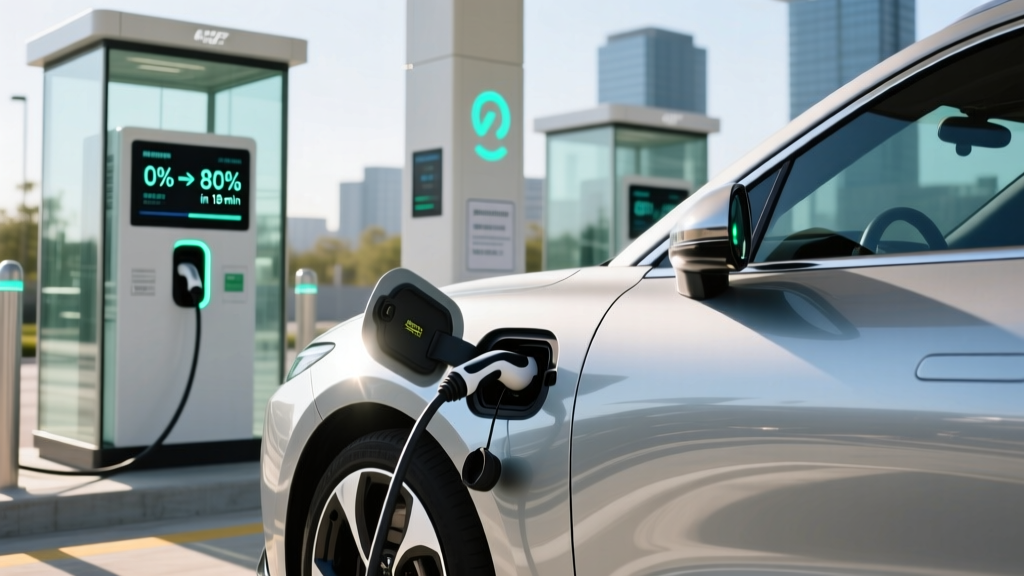
Tesla's marketing claim of "up to 200 miles in 15 minutes" applies to peak delivery on a V3 Supercharger (250 kW) under ideal conditions with a preconditioned battery. But charging isn't linear. The charge curve tapers significantly above 50–60% state of charge (SoC) to protect battery health. Here's what real-world 10–80% sessions look like across popular EVs at a 250 kW V3 Supercharger or equivalent DC fast charger:
| Vehicle | Battery (kWh usable) | Peak Charge Rate (kW) | 10–80% Time |
|---|---|---|---|
| Tesla Model 3 Long Range (2026) | 75 kWh (NMC) | ~250 kW | ~25–28 min |
| Tesla Model Y Long Range (2026) | 75 kWh (NMC) | ~250 kW | ~25–30 min |
| Hyundai Ioniq 5 (2026, 800V) | 77.4 kWh (NMC) | ~240 kW | ~18–20 min |
| Ford Mustang Mach-E ER (2026) | 91 kWh (NMC) | ~150 kW | ~38–42 min |
| Chevrolet Equinox EV (2026) | 85 kWh (NMC) | ~150 kW | ~35–40 min |
| Tesla Model 3 RWD (LFP) | 60 kWh (LFP) | ~175 kW | ~28–32 min |
| Kia EV6 GT-Line (2026, 800V) | 77.4 kWh (NMC) | ~240 kW | ~18–22 min |
The Hyundai Ioniq 5 and Kia EV6, with their 800-volt architectures, sustain high charge rates longer than 400V competitors. A Model 3 Long Range may peak at 250 kW but drops below 100 kW past 60% SoC, which is why the Ioniq 5's 18-minute 10–80% time beats the Model 3's ~26 minutes despite similar battery sizes.
Home Charging Installation: Requirements, Costs, and Panel Upgrades
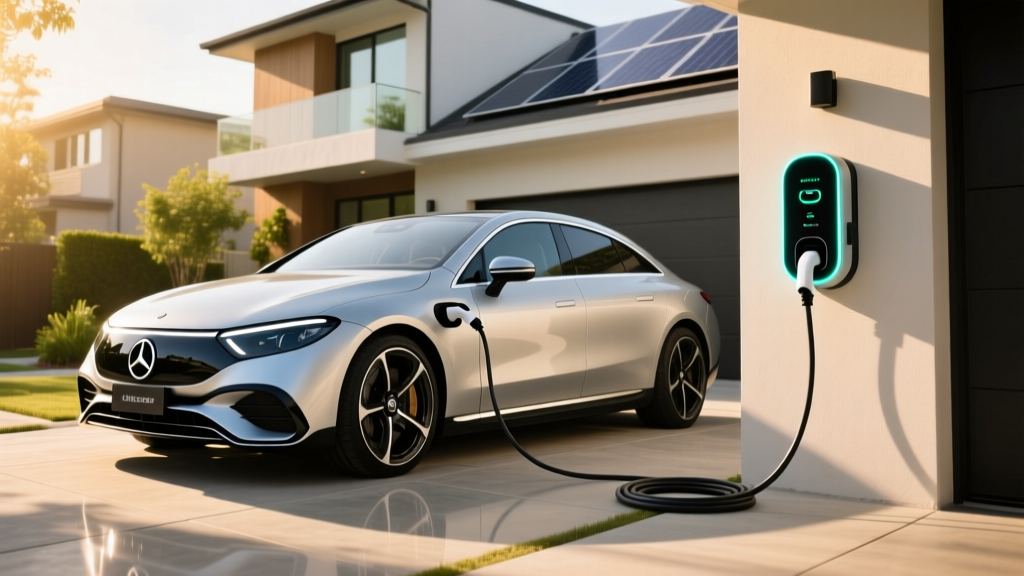
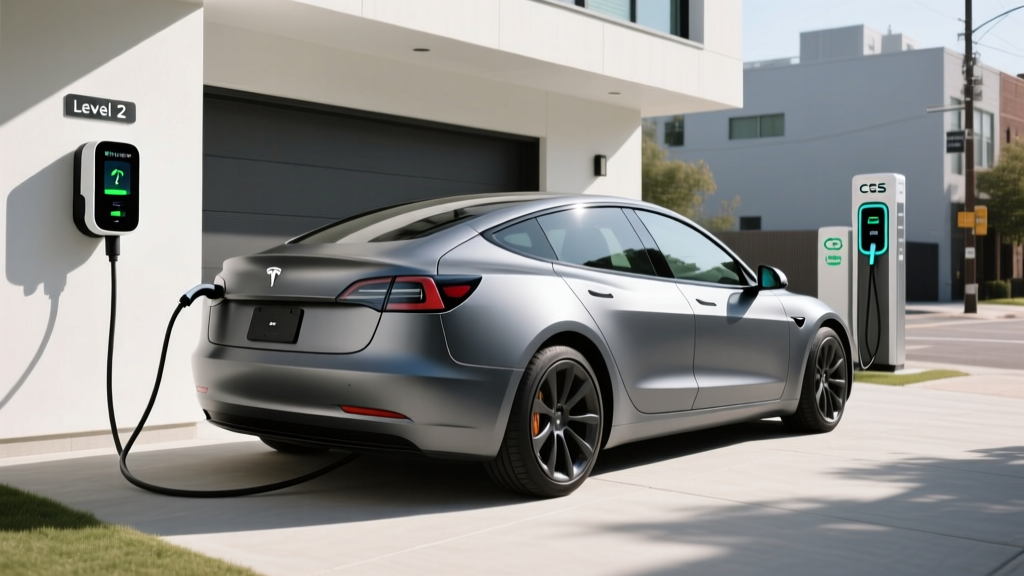
Most EV owners do 80% or more of their charging at home on Level 2. A typical home Level 2 setup delivers 7.7–11.5 kW on a 240V circuit, adding 25–45 miles of range per hour — enough to fully replenish most EVs overnight.
Electrical Requirements
- Circuit: A dedicated 40A or 50A, 240V circuit (NEMA 14-50 outlet or hardwired)
- Breaker sizing: EVSE must draw no more than 80% of circuit rating (e.g., 40A charger requires a 50A breaker)
- Wire gauge: 6 AWG copper for 50A circuits; 8 AWG for 40A (local code may vary)
- GFCI protection: Required by NEC 2020+ for outdoor receptacles; many hardwired EVSEs include internal ground-fault protection
- Outdoor rating: If mounted outside, the EVSE must carry a NEMA 4 or NEMA 4X rating
Panel Upgrade Considerations
Homes with a 100A electrical panel often cannot support a 50A EV circuit alongside existing loads (electric range, dryer, HVAC). A panel upgrade to 200A typically costs $1,500–$3,500 before the EV circuit itself. Some homeowners opt for a smart load-management device (like the Emporia Smart Load Center or Span panel) that dynamically shares capacity between the EVSE and other appliances — potentially avoiding a panel upgrade entirely. Consult a licensed electrician to assess your panel's spare capacity.
| Component | Low Estimate | High Estimate |
|---|---|---|
| Level 2 EVSE equipment (smart, 40–48A) | $350 | $700 |
| Electrician labor (2–6 hours) | $400 | $1,500 |
| Materials (wire, conduit, breaker, outlet) | $100 | $400 |
| Permit and inspection | $50 | $250 |
| Subtotal (no panel upgrade) | $900 | $2,850 |
| Panel upgrade to 200A (if needed) | $1,500 | $3,500 |
| Total with panel upgrade | $2,400 | $6,350 |
Factors that push costs higher: long wire runs from the panel to the garage (>50 feet), trenching for detached garages, upgrading from a 100A to 200A service, and local permit requirements. According to data from the U.S. Department of Energy, most straightforward installations fall between $1,000 and $2,500 when no panel upgrade is required.
Federal incentive note: The Alternative Fuel Vehicle Refueling Property Credit (IRS §30C) offers up to $1,000 (30% of cost) for home charging equipment installed in eligible census tracts through 2032. Check your address eligibility on the IRS site — this credit is location-dependent, not universal.
Connector Compatibility: NACS, CCS1, and CHAdeMO
The North American EV charging landscape consolidated significantly around the NACS (North American Charging Standard, originally Tesla's proprietary connector) through 2025–2026. Here's where things stand for 2026-model EVs:
| Connector | Brands Using It (2026) | DC Fast-Charge Availability |
|---|---|---|
| NACS (native) | Tesla, Ford, GM, Rivian, Volvo, Polestar, Mercedes, Nissan (new models) | Tesla Superchargers + NACS-equipped public stations |
| CCS1 | Hyundai, Kia, Volkswagen, BMW, Stellantis, Honda, Subaru, Toyota (bZ series) | Electrify America, EVgo, ChargePoint, Ionity |
| CHAdeMO | Nissan Leaf (legacy, 2025 was final model year) | Declining; limited new deployments |
Adapter needs: If you own a CCS1-equipped EV (like a 2026 Hyundai Ioniq 5) and want access to Tesla Superchargers, you'll need a CCS-to-NACS adapter. Tesla sells an official adapter for ~$250, and third-party options from Lectron and A2Z are available for $150–$200. Conversely, Tesla owners accessing CCS networks need a NACS-to-CCS adapter. Always verify that your adapter is rated for the DC fast-charge power level you plan to use — some adapters are limited to 150 kW or less.
For Level 2 home charging, the J1772 connector remains the standard for non-Tesla EVs, while Tesla uses its NACS connector for both AC and DC. Most Level 2 home chargers ship with a J1772 plug; Tesla owners use the included NACS mobile connector or a J1772-to-NACS adapter (included with the vehicle).
Charging Cost Per Mile: Home, Public, and DC Fast vs. Gasoline
The single biggest ownership advantage of an EV is fuel cost — but only if you're charging at home on off-peak rates. Public DC fast charging narrows the gap considerably.
| Scenario | Rate | Cost/Full Charge (75 kWh) | Cost Per Mile (3.5 mi/kWh) |
|---|---|---|---|
| Home off-peak (national avg.) | $0.12/kWh | $9.00 | $0.026 |
| Home peak (national avg.) | $0.22/kWh | $16.50 | $0.047 |
| Public Level 2 (avg.) | $0.25/kWh | $18.75 | $0.054 |
| Tesla Supercharger V3 (avg.) | $0.32/kWh | $24.00 | $0.069 |
| Electrify America DC (avg.) | $0.43/kWh | $32.25 | $0.092 |
| Gas vehicle (27 MPG avg., $3.40/gal) | $3.40/gal | — | $0.126 |
At home off-peak rates, an EV costs roughly $0.03 per mile — less than a quarter of the gasoline equivalent. Even at Tesla Supercharger rates (~$0.32/kWh national average in 2026), you're paying about $0.07 per mile, still roughly half the cost of gas. The gap narrows further at Electrify America's standard pricing, which is why a home charging setup is critical for maximizing EV savings. According to fueleconomy.gov, the average EV driver saves $600–$1,200 annually on fuel compared to a 27 MPG gas vehicle, depending on local electricity rates and driving patterns.
Time-of-use (TOU) tip: Most utilities offer TOU plans that drop electricity to $0.08–$0.14/kWh between 10 PM and 6 AM. Set your EVSE or vehicle's scheduled charging to these windows. Some utilities (PG&E, SCE, Xcel Energy) offer dedicated EV rate plans with even deeper off-peak discounts.
Recommended Home Level 2 Chargers (2026)
We evaluated chargers on power output, cable length, smart features, build quality, and price. All units below are UL-listed or ETL-certified, which is essential for insurance and code compliance.
ChargePoint Home Flex (2nd Gen)
- Power: Up to 11.5 kW (48A) on a 60A circuit; configurable down to 16A
- Connector: J1772 (NACS adapter available)
- Cable: 23 feet
- Smart features: Wi-Fi, app scheduling, Alexa integration, energy tracking
- Price: ~$599
- Best for: Most homeowners wanting flexible amperage and robust app control
Tesla Wall Connector (Gen 4)
- Power: Up to 11.5 kW (48A) on a 60A circuit
- Connector: NACS native (J1772 adapter included)
- Cable: 24 feet
- Smart features: Wi-Fi, OTA updates, power sharing with multiple units, vehicle integration
- Price: ~$475
- Best for: Tesla and NACS-equipped EV owners wanting seamless integration
Emporia Level 2 EV Charger
- Power: Up to 11.5 kW (48A) on a 60A circuit
- Connector: J1772
- Cable: 24 feet
- Smart features: Wi-Fi, solar integration, energy monitoring via Emporia app, load management
- Price: ~$399
- Best for: Budget-conscious buyers with solar panels or Emporia energy monitors
Grizzl-E Smart (United Chargers)
- Power: Up to 10.0 kW (40A) on a 50A circuit
- Connector: J1772 or NACS
- Cable: 24 feet
- Smart features: OCPP-compatible, app control, adjustable amperage, extreme cold rated (-40°F)
- Price: ~$549
- Best for: Cold-climate owners needing rugged build and outdoor installation
Safety, Code, and Installation Best Practices
Home EV charging involves sustained high-current draw for hours — more similar to running an electric furnace than plugging in a phone. Follow these safety principles:
- Dedicated circuit: Your EVSE must be on its own dedicated breaker — never share a circuit with another high-draw appliance.
- Hardwired vs. outlet: Hardwired installations are preferred for 48A+ chargers. A NEMA 14-50 receptacle is fine for 40A chargers but must be installed with proper torque specifications — loose connections are the leading cause of outlet overheating.
- GFCI: NEC 2020 and later requires GFCI protection for outdoor 240V receptacles. Many modern EVSEs include internal ground-fault protection that satisfies this requirement when hardwired.
- Outdoor rating: Outdoor-mounted units must be rated NEMA 4 (weatherproof). Check the IP or NEMA rating before purchasing for exterior installation.
- Permit and inspection: Most jurisdictions require an electrical permit and post-installation inspection. Skipping this can void homeowner's insurance coverage for electrical fires.
- UL/ETL certification: Only purchase chargers that are UL-listed or ETL-certified. Uncertified chargers from marketplace sellers may lack proper safety protections.
Frequently Asked Questions
How much does it cost to install a home EV charger?
A standard Level 2 home installation (40–48A, 240V) costs between $900 and $2,850 including equipment, electrician labor, materials, and permit — assuming your electrical panel has sufficient spare capacity. If a panel upgrade to 200A is needed, total costs range from $2,400 to $6,350. Always get 2–3 quotes from licensed electricians, and ask specifically about your panel's remaining amperage headroom before committing.
How fast will each charging level add range?
Level 1 (120V) adds 3–5 miles per hour — adequate for plug-in hybrids with small batteries but impractical for full EVs. Level 2 (240V, 40–48A) adds 25–45 miles per hour, fully recharging most EVs in 6–10 hours. DC fast charging (150–350 kW) can add 150–300+ miles in 15–30 minutes, depending on the vehicle's peak charge rate and battery preconditioning.
Which connector/charger is compatible with my EV?
For 2026 models: Tesla, Ford, GM, Rivian, Volvo, Polestar, and Nissan (new models) use NACS. Hyundai, Kia, VW, BMW, Honda, and most Stellantis vehicles use CCS1. The CHAdeMO connector is effectively discontinued for new vehicles. For home Level 2, non-Tesla EVs use J1772, while Teslas use NACS. Adapters are widely available for cross-compatibility at DC fast chargers.
How much does charging cost per mile vs. gas?
Home charging at off-peak rates costs approximately $0.03/mile — about 75% less than a 27 MPG gas vehicle at $3.40/gallon ($0.13/mile). Public DC fast charging at $0.32–$0.43/kWh costs $0.07–$0.09/mile, still 30–50% cheaper than gasoline. The savings multiply with higher annual mileage; a driver covering 15,000 miles/year saves roughly $900–$1,400 annually by charging at home.
What electrical upgrades might I need?
The most common upgrade is a panel capacity increase from 100A to 200A service, costing $1,500–$3,500. You may also need a new breaker slot (if your panel is full), heavier-gauge wiring for long runs, or a smart load-management system to share capacity between the EVSE and other appliances. Homes built after 2000 with 200A panels usually have sufficient capacity without upgrades. Have an electrician perform a load calculation before purchasing equipment.
Does charging to 100% damage my battery?
For NMC (nickel-manganese-cobalt) batteries, regularly charging to 100% accelerates degradation. Most manufacturers recommend daily charging to 80–90% and reserving 100% for road trips. LFP (lithium iron phosphate) batteries, found in the Tesla Model 3 RWD and some BYD models, tolerate regular 100% charges better and Tesla recommends periodic full charges for LFP to recalibrate the battery management system. Check your owner's manual for chemistry-specific guidance.
Why does my Supercharger session slow down above 60%?
Lithium-ion batteries cannot accept peak charge rates at high states of charge without risk of lithium plating and thermal damage. The battery management system (BMS) progressively reduces charge current above ~50–60% SoC. This is why a 10–80% charge might take 25 minutes, but 80–100% can take an additional 20–30 minutes. For road trips, charging multiple shorter sessions (10–80%) is faster than waiting for a single 10–100% session.