Can You Have a Supercharger and a Turbo? The Short Answer
In a traditional internal-combustion engine, yes — you can technically pair a supercharger and a turbocharger on the same engine. This setup, sometimes called "twin-charging," uses a belt-driven supercharger for low-RPM boost and an exhaust-driven turbocharger for high-RPM power. Volkswagen's 1.4L TSI twin-charged engine and the Zenvo ST1 are real-world examples. But the complexity, cost, and packaging challenges have kept this arrangement rare.
If you're asking this question in the context of electric vehicles, the terminology shifts entirely. EVs don't use superchargers or turbochargers because they don't have internal combustion engines. Electric motors deliver maximum torque from 0 RPM — there's no "boost" to add. When EV owners say "Supercharger," they're almost always referring to Tesla's DC fast-charging network, not a forced-induction component.
This guide clears up the terminology confusion, then walks through everything you actually need to know about charging an EV at home and on the road: charging levels, speeds, installation costs, connector types, and what it costs per mile compared to gasoline.
Supercharger vs Turbocharger: What Each Actually Does
Before we get into EV charging, let's define the gas-car terms precisely:
- Supercharger: A belt-driven air compressor mounted to the engine. It forces more air into the cylinders, allowing more fuel to burn and producing more power. It provides instant boost but parasitically consumes engine power to spin.
- Turbocharger: An exhaust-driven turbine that compresses intake air. It's more efficient than a supercharger because it uses waste exhaust energy, but it suffers from "turbo lag" — a delay before boost builds at low RPM.
- Twin-charging (both together): The supercharger covers low-RPM response while the turbo takes over at higher RPM. Effective but mechanically complex, heavy, and expensive to maintain.
In an EV, none of this applies. An electric motor like the one in a Tesla Model Y or Hyundai Ioniq 5 produces peak torque from standstill. There are no cylinders, no intake air, no exhaust gases. Performance comes from battery power delivery (measured in kW) and motor design — not forced induction.
EV "Supercharging" Means DC Fast Charging — Here's How It Works
When Tesla branded its fast-charging network "Supercharger," it created lasting confusion with the engine component. A Tesla Supercharger is a DC fast-charging station that bypasses the car's onboard charger and sends direct current straight to the battery at high power levels.
Here's the critical distinction every EV owner must understand:
- kW (kilowatts) = power, or the rate of energy transfer. Think of it like water flow rate from a hose.
- kWh (kilowatt-hours) = energy, or the total amount stored in the battery. Think of it like the total gallons in a tank.
A 250 kW Supercharger delivers energy at a rate of 250 kilowatts. If it sustained that rate for one full hour (it won't, due to charge-curve tapering), it would deliver 250 kWh of energy. Most EV batteries range from 50 to 100 kWh usable capacity.
Charging Levels Explained
| Level | Voltage | Power (kW) | Miles of Range per Hour | Typical Use |
|---|---|---|---|---|
| Level 1 | 120V AC | 1.0–1.4 kW | 3–5 mi/hr | Overnight trickle; emergency top-up |
| Level 2 | 240V AC | 3.3–19.2 kW | 12–75 mi/hr | Home daily charging; workplace; public L2 |
| DC Fast Charge | 400–800V DC | 50–350 kW | 150–1,000+ mi/hr (peak) | Road trips; rapid top-ups |
Home Level 2 Charger Installation: Costs, Electrical Requirements, and Gotchas
Most EV owners do 80% or more of their charging at home on a Level 2 charger. Here's what's required and what it actually costs in 2026.
Electrical Requirements
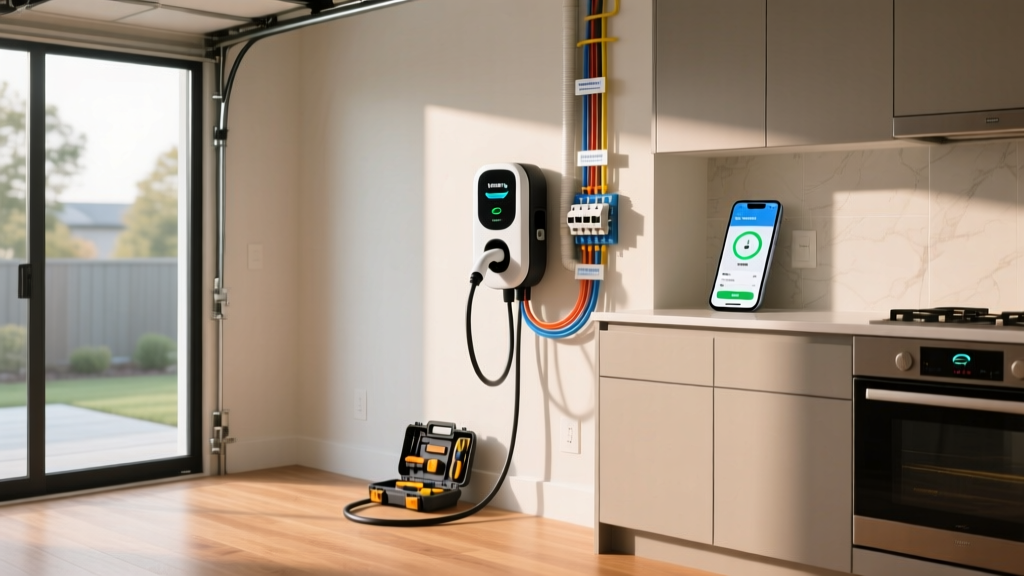
A Level 2 home charger requires a 240-volt dedicated circuit, identical in voltage to what your electric dryer or oven uses. Common amperage configurations:
- 40-amp circuit → delivers up to 32 amps continuous (9.6 kW) — the most common home setup
- 50-amp circuit → delivers up to 40 amps continuous (9.6–11.5 kW) — recommended for larger batteries
- 60-amp circuit → delivers up to 48 amps continuous (11.5 kW) — needed to max out some EVs' onboard chargers
The National Electrical Code (NEC) requires that continuous loads (including EV charging) not exceed 80% of the circuit's rated capacity. A 40A breaker therefore supports 32A continuous draw. Your licensed electrician will size the breaker and wire gauge accordingly.
Installation Cost Breakdown
| Component | Low End | High End | Notes |
|---|---|---|---|
| Level 2 charger hardware | $300 | $750 | Smart Wi-Fi chargers cost more; basic units are cheaper |
| Electrician labor (standard install) | $400 | $1,200 | Depends on run length from panel to garage/carport |
| Permit and inspection | $50 | $250 | Required in most jurisdictions; varies by locality |
| Electrical panel upgrade (if needed) | $1,500 | $4,000+ | Older homes with 100A service may need a 200A upgrade |
| Total (no panel upgrade) | $750 | $2,200 | Most homes with 200A service fall in this range |
| Total (with panel upgrade) | $2,250 | $6,200+ | Panel upgrades are the biggest cost surprise |
Safety and Code Requirements
- Dedicated circuit: Your EV charger must be on its own breaker — not shared with other appliances.
- GFCI protection: NEC 2020 and later require Ground Fault Circuit Interrupter protection for EV charging outlets. Many hardwired chargers have built-in GFCI; plug-in units require a GFCI breaker.
- Outdoor rating: If your charger is installed outside (carport, driveway), the unit must carry a NEMA 4 or IP65 weather rating. All major chargers listed below meet this standard.
- Wire gauge: Your electrician will select wire gauge based on amperage and run length — typically 6 AWG for 50A circuits, 8 AWG for 40A. Longer runs may require thicker wire to prevent voltage drop.
Connector Compatibility: NACS, CCS, and CHAdeMO in 2026
The EV charging connector landscape has consolidated significantly. Here's where things stand:
| Connector | Used By | Max DC Fast Charge Rate | Notes |
|---|---|---|---|
| NACS (North American Charging Standard) | Tesla (native); Ford, GM, Rivian, Hyundai, Kia, BMW, Volvo, and most others via adoption | Up to 350 kW (V4 Supercharger) | Now the dominant standard in North America; most new 2025+ EVs ship with NACS ports |
| CCS1 (Combined Charging System) | Older non-Tesla EVs; some 2024 and earlier models | Up to 350 kW | Being phased out on new vehicles; still widely available at public stations |
| CHAdeMO | Nissan Leaf (legacy); Mitsubishi Outlander PHEV | Up to 100 kW | Effectively discontinued for new vehicles; station availability declining |
Adapter needs: If you own a CCS-equipped EV (e.g., a 2023 Hyundai Ioniq 5), you'll need a CCS-to-NACS adapter to access Tesla Superchargers. Tesla sells an official adapter for approximately $250. Several third-party options from brands like Lectron and A2Z are also available. Starting with 2025 model years, most automakers have switched to native NACS ports, eliminating the adapter requirement.
For home Level 2 charging, all EVs use the J1772 connector (or a NACS port that accepts J1772 via the included adapter). Every Level 2 home charger ships with J1772 or a NACS-compatible plug.
What Charging Costs Per Mile vs. Gasoline
Electricity pricing varies enormously by location, time of day, and whether you're charging at home or on a public DC fast charger. Here are realistic 2026 scenarios:
| Scenario | Rate | Vehicle Efficiency | Cost Per Mile |
|---|---|---|---|
| Home charging (off-peak utility rate) | $0.09/kWh | 3.5 mi/kWh (e.g., Tesla Model 3) | $0.026 |
| Home charging (national avg. residential) | $0.17/kWh | 3.5 mi/kWh | $0.049 |
| Public Level 2 (network pricing) | $0.30/kWh | 3.5 mi/kWh | $0.086 |
| DC fast charging ( Electrify America, EVgo) | $0.48/kWh | 3.0 mi/kWh (highway driving) | $0.160 |
| Tesla Supercharger (avg. 2026) | $0.35/kWh | 3.5 mi/kWh | $0.100 |
| Gasoline (30 MPG combined, $3.50/gal) | $3.50/gal | 30 MPG | $0.117 |
| Gasoline (25 MPG combined, $3.50/gal) | $3.50/gal | 25 MPG | $0.140 |
The bottom line: Home charging at residential electricity rates is roughly 2–4× cheaper per mile than gasoline. Public DC fast charging narrows the gap considerably — in some cases matching or exceeding gas cost per mile. This is why home charging access is the single most important economic factor in EV ownership. According to EPA data on fueleconomy.gov, the average EV achieves 100–130 MPGe combined, translating to 3.0–4.0 miles per kWh.
Charging Time Examples: 10–80% for Common EV Battery Sizes
Here's what charging actually looks like in practice across common battery sizes and charger types. All times assume starting at 10% SoC and charging to 80% (the standard fast-charge window — charging above 80% slows dramatically to protect battery health).
- 58 kWh battery (e.g., Volkswagen ID.4 Standard): ~22 minutes on a 170 kW DC fast charger; ~5.5 hours on a 9.6 kW Level 2 home charger
- 75 kWh battery (e.g., Tesla Model 3 Long Range): ~25 minutes on a 250 kW Supercharger; ~7 hours on a 9.6 kW Level 2 home charger
- 84 kWh battery (e.g., Hyundai Ioniq 5 Long Range): ~18 minutes on a 350 kW charger (800V architecture); ~8 hours on a 9.6 kW Level 2 home charger
- 100 kWh battery (e.g., Ford F-150 Lightning Extended Range): ~35 minutes on a 150 kW DC fast charger; ~10 hours on a 9.6 kW Level 2 home charger
- 131 kWh battery (e.g., GMC Hummer EV): ~55 minutes on a 350 kW charger; ~14+ hours on a 9.6 kW Level 2 home charger
Recommended Home Level 2 Chargers for 2026
Based on reliability, features, and value, here are three chargers we recommend for home installation:
ChargePoint Home Flex
- Power: Up to 11.5 kW (48A on a 60A circuit)
- Connector: J1772 (NACS adapter included)
- Cable length: 23 feet
- Smart features: Wi-Fi, scheduling, Alexa integration, energy tracking
- Price: ~$550
- Best for: Flexible amperage settings that adapt to your circuit
Emporia Vue Smart EV Charger
- Power: Up to 11.5 kW (48A)
- Connector: J1772
- Cable length: 24 feet
- Smart features: Wi-Fi, solar integration, real-time energy monitoring, load management
- Price: ~$400
- Best for: Solar-panel owners; budget-conscious buyers who want smart features
Tesla Wall Connector
- Power: Up to 11.5 kW (48A)
- Connector: NACS (native Tesla); J1772 adapter available
- Cable length: 24 feet
- Smart features: Wi-Fi, power sharing (link multiple units on one circuit), OTA updates
- Price: ~$475
- Best for: Tesla owners; households with multiple Teslas needing power sharing
All three units are NEMA 4 rated for outdoor installation, UL-listed for safety, and compatible with hardwired or NEMA 14-50 plug-in installation (plug-in requires a 14-50 outlet installed by your electrician).
Frequently Asked Questions
Can an electric car have a turbocharger or supercharger?
No. Turbochargers and superchargers are components that compress intake air for internal combustion engines. EVs have no combustion process, no intake manifold, and no exhaust system. Electric motors produce peak torque from 0 RPM, so there's no performance gap that forced induction would fill. When EV owners reference a "Supercharger," they're talking about Tesla's DC fast-charging network.
How much does it cost to install a home EV charger?
A standard Level 2 home charger installation (40–50A circuit, charger within 30 feet of the panel, no panel upgrade) typically costs $750–$2,200 including hardware, electrician labor, and permits. If your home requires an electrical panel upgrade from 100A to 200A service, add $1,500–$4,000+. Always get a load calculation from a licensed electrician before purchasing equipment.
How fast will each charging level add range?
Level 1 (120V) adds roughly 3–5 miles of range per hour. Level 2 (240V, 9.6 kW) adds approximately 30–40 miles per hour for most EVs. DC fast charging at 150–250 kW can add 150–300+ miles in a 20–30 minute session (10–80% SoC). Exact rates depend on the vehicle's efficiency (miles per kWh) and the charge curve at a given State of Charge.
Which connector or charger is compatible with my EV?
For 2025 and newer vehicles, most EVs now use the NACS connector (Tesla's standard, now adopted industry-wide). Older non-Tesla EVs (2024 and earlier) typically use CCS1. The Nissan Leaf uses CHAdeMO. For home Level 2 charging, all EVs accept J1772 — or NACS with a J1772 adapter (included with most new NACS-equipped vehicles). Check your vehicle's charge port or owner's manual to confirm.
How much does charging cost per mile vs. gas?
Home charging at the national average residential rate (~$0.17/kWh) costs roughly $0.04–$0.05 per mile for a typical EV — about one-third the cost of gasoline at $3.50/gallon in a 30 MPG car ($0.12/mile). Public DC fast charging at $0.35–$0.48/kWh costs $0.10–$0.16 per mile, narrowing the savings gap. The economic advantage of an EV is maximized when you can charge at home, especially on time-of-use off-peak rates.
What electrical upgrades might I need for a home charger?
The most common upgrade is a panel capacity increase. Homes with 100A service often need to upgrade to 200A to accommodate a 40–50A EV circuit alongside existing loads. Other potential upgrades include: replacing a fuse box with a circuit breaker panel, adding a sub-panel in the garage, or upgrading service entrance wiring. Your electrician will determine requirements during a load calculation per NEC Article 220. Some utilities and state programs offer rebates of $500–$1,500 for panel upgrades — check with your provider and the IRS §30D clean vehicle credit guidelines for related incentives.