Why Your F-150 Lightning Charging Setup Matters More Than You Think
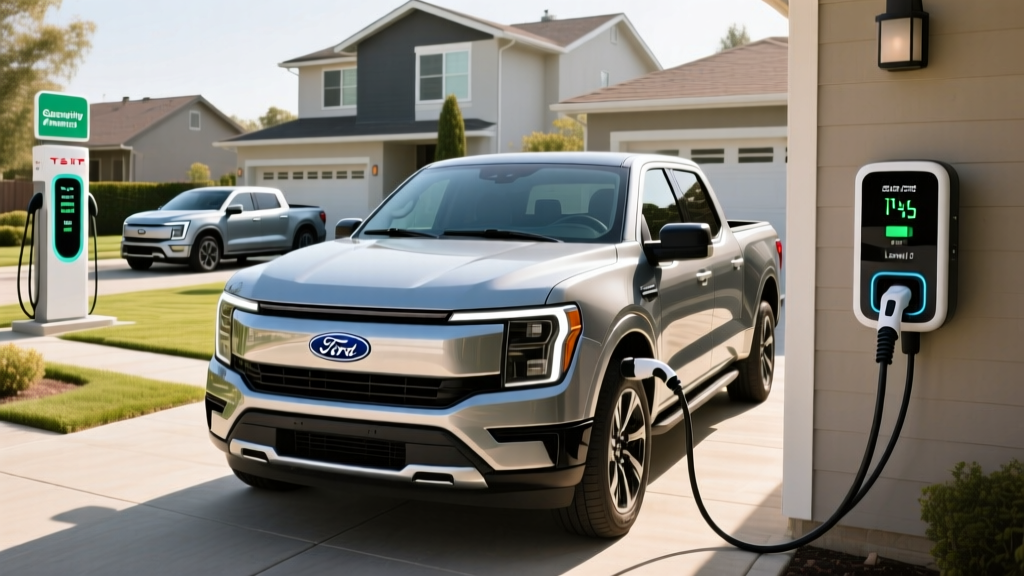
The Ford F-150 Lightning packs a usable battery of up to 131 kWh (Extended Range) — one of the largest in any consumer EV on the road. That massive pack delivers an EPA-estimated 320 miles of range, but it also means charging logistics are fundamentally different from a compact EV. Plug into a standard 120V outlet, and you'll add roughly 2 miles of range per hour — meaning a full 10-80% charge would take over three days. Get the right Level 2 home setup dialed in, and that same session completes overnight. Hit a 150+ kW DC fast charger, and you're back to 80% in about 41 minutes.
This guide breaks down every charging scenario for the F-150 Lightning (and the broader "supercharged F-150" search crowd, including those comparing the Lightning to supercharged gas trucks), with exact kW rates, installation costs, connector compatibility, and real cost-per-mile math so you can plan your electrical work and your road trips with confidence.
Charging Levels Explained: kW, Miles Per Hour, and 10-80% Times
Before evaluating chargers, it's critical to separate kW (kilowatts) — the rate of power flow — from kWh (kilowatt-hours) — the total energy stored in your battery. Think of kW as how fast water flows through a hose, and kWh as the total gallons your tank holds. A higher kW charger fills your battery faster, but the battery's total kWh capacity determines how much energy it stores.
| Level | Voltage | Max Power (kW) | Miles Added/Hour | 10-80% Time (Extended Range 131 kWh) |
|---|---|---|---|---|
| Level 1 (120V) | 120V / 12A | ~1.4 kW | ~2 mi/hr | ~75+ hours (impractical) |
| Level 2 (240V) | 240V / 32A–80A | 7.7–19.2 kW | 13–32 mi/hr | ~10–14 hours (32A) / ~5.5 hours (80A) |
| DC Fast Charge | 400V+ architecture | Peak 155 kW (Extended Range) | ~250+ mi/hr (peak) | ~41 minutes (150 kW station) |
The F-150 Lightning Extended Range can accept up to 19.2 kW on Level 2 AC using Ford's dual onboard charger option (standard on some trims, optional on others — verify your trim's onboard charger spec before purchasing a high-amperage home unit). The Standard Range model with the single onboard charger maxes at 10.5 kW on Level 2.
On DC fast charging, Ford rates the Extended Range at a peak of 155 kW (with the latest software updates on 2024+ models pushing closer to 160 kW at ideal conditions). Real-world charge curves show the Lightning sustains roughly 120–140 kW between 10–50% SoC, then tapers progressively. Expect a 150 kW-class station to deliver 10–80% in approximately 41 minutes, and a 350 kW station won't charge faster — the truck's architecture caps well below that ceiling.
Home Level 2 Installation: Electrical Requirements, Costs, and Panel Upgrades
Charging a 131 kWh battery at home is where the F-150 Lightning ownership experience is won or lost. Here's what your electrician needs to know:
Electrical Requirements by Charger Amperage
- 32A charger (7.7 kW): Requires a 240V / 40A dedicated circuit (NEC requires circuits rated at 125% of continuous load). Uses a NEMA 14-50 outlet or hardwired connection.
- 48A charger (11.5 kW): Requires a 240V / 60A dedicated circuit. Must be hardwired (no plug — NEC 2023+ code in many jurisdictions).
- 80A charger (19.2 kW): Requires a 240V / 100A dedicated circuit. Hardwired only. This is the setup needed to max out the Lightning Extended Range's dual onboard charger.
Panel Upgrade Reality Check
Many homes built before 2000 have 100A or 150A main service panels. Adding a 60A or 100A dedicated circuit for EV charging may exceed available capacity, especially if you're also running electric HVAC, a dryer, and an electric range. A panel upgrade to 200A is common and costs $1,500–$3,500 depending on your utility and jurisdiction. In some cases, a service upgrade to 300A or 400A is needed, running $3,000–$5,000+. Have your electrician perform a load calculation (NEC Article 220) before committing to a charger amperage.
Alternatives if a panel upgrade is cost-prohibitive:
- Smart load management: Devices like the Emporia VUE or Span panel can dynamically throttle charger amperage when other loads spike, allowing a 48A charger on a panel that couldn't otherwise support it.
- Lower-amperage charger: A 32A / 7.7 kW charger on a 40A circuit adds ~13 miles per hour — enough to replenish ~100 miles overnight, which covers most daily driving.
| Component | 32A / NEMA 14-50 | 48A / Hardwired | 80A / Hardwired |
|---|---|---|---|
| Charger Equipment | $400–$700 | $500–$750 | $600–$1,200 |
| Electrical Permit | $50–$200 | $50–$200 | $50–$250 |
| Electrician Labor (run + install) | $500–$1,500 | $600–$2,000 | $1,000–$3,000 |
| Panel Upgrade (if needed) | $0–$3,500 | $0–$3,500 | $1,500–$5,000 |
| Total Estimated Range | $950–$5,900 | $1,150–$6,450 | $2,650–$9,450 |
The wide range reflects the panel upgrade variable. If your panel has capacity, a straightforward 48A hardwired install with a short wire run typically lands in the $1,200–$2,500 range. Get three quotes and ask specifically about load calculations.
Connector Compatibility: NACS, CCS1, and What the F-150 Lightning Uses
Ford made a pivotal move for the 2025 model year: the F-150 Lightning transitioned to the NACS (North American Charging Standard) connector, the same physical plug used on Tesla vehicles. This grants native access to Tesla's Supercharger network — over 25,000 stalls in North America — without an adapter.
| Model Year | Native Connector | Tesla Supercharger Access | CCS1 Network Access |
|---|---|---|---|
| 2022–2024 F-150 Lightning | CCS1 | Requires Ford-approved NACS adapter | Native (Electrify America, EVgo, etc.) |
| 2025+ F-150 Lightning | NACS | Native (no adapter needed) | Requires CCS1 adapter |
If you own a 2022–2024 Lightning: Ford has offered a NACS adapter (approximately $200–$250) enabling Supercharger access. Verify adapter compatibility with your specific VIN through your Ford dealer, as early-production trucks had firmware requirements.
If you own a 2025+ Lightning: You plug natively into Superchargers. For Electrify America and other CCS1 networks, you'll need a CCS1 adapter. Carry one for road trips outside the Supercharger network.
For home Level 2 charging, most residential chargers come with either a J1772 connector (the legacy standard, which adapts to CCS1 via the vehicle's CCS inlet) or a NACS connector. Match your charger's connector to your truck's inlet, or use the appropriate adapter. Tesla's Wall Connector now ships with NACS; third-party options like ChargePoint and Emporia offer both connector variants.
Cost to Charge: Home vs. Public vs. Gas — The Real Per-Mile Math
The F-150 Lightning Extended Range consumes approximately 47–52 kWh per 100 miles in mixed driving (per fueleconomy.gov), or roughly 0.49 kWh per mile. That consumption figure is your baseline for cost calculations.
| Scenario | Rate | Cost per Full Charge (131 kWh) | Cost per Mile |
|---|---|---|---|
| Home Off-Peak (utility TOU rate) | $0.08–$0.12/kWh | $10.50–$15.70 | $0.04–$0.06 |
| Home Standard Rate | $0.14–$0.18/kWh | $18.35–$23.60 | $0.07–$0.09 |
| Public Level 2 (ChargePoint, etc.) | $0.25–$0.40/kWh | $32.75–$52.40 | $0.12–$0.20 |
| DC Fast Charging (Electrify America) | $0.35–$0.55/kWh | $45.85–$72.05 | $0.17–$0.27 |
| Tesla Supercharger (avg.) | $0.25–$0.40/kWh | $32.75–$52.40 | $0.12–$0.20 |
| Gas F-150 (3.5L EcoBoost, 18 MPG avg) | $3.30/gal | — | $0.18 |
The takeaway: Home charging on an off-peak utility rate cuts your per-mile fuel cost to roughly one-quarter of a comparable gas F-150. Even public DC fast charging at premium rates often breaks even or beats gasoline on a per-mile basis. But relying exclusively on DC fast charging erodes the cost advantage — home Level 2 is where the economics shine.
Check whether your utility offers a time-of-use (TOU) plan with discounted overnight rates. Many utilities offer EV-specific rate plans that drop to $0.06–$0.10/kWh between midnight and 6 AM. Scheduling your Lightning to charge during these windows (via the FordPass app or your charger's scheduling feature) maximizes savings.
Recommended Home Chargers for the F-150 Lightning
These chargers are selected based on power output, connector availability, smart features, and compatibility with the Lightning's onboard charging capabilities.
Tesla Wall Connector (NACS)
- Power Output: Up to 11.5 kW (48A) on a 60A circuit
- Connector: NACS (native for 2025+ Lightning)
- Cable Length: 24 feet
- Smart Features: Wi-Fi, OTA updates, power sharing between multiple units, access control
- Price: ~$425
- Best For: 2025+ Lightning owners who want a clean, reliable NACS-native setup. Note: does NOT support CCS1 without adapter.
ChargePoint Home Flex
- Power Output: Configurable up to 12 kW (50A) on a 60A circuit, or up to 9.6 kW (40A) on a 50A circuit
- Connector: Available in J1772 or NACS
- Cable Length: 23 feet
- Smart Features: Wi-Fi, app scheduling, amperage adjustment via dip switches, Alexa integration
- Price: ~$550–$650
- Best For: Flexibility across model years. J1772 version works with 2022–2024 Lightnings natively; NACS version for 2025+. Adjustable amperage is ideal if your panel capacity is uncertain.
Emporia Vue Level 2 Charger
- Power Output: Up to 11.5 kW (48A) on a 60A circuit
- Connector: J1772 (NACS version available)
- Cable Length: 24 feet
- Smart Features: Energy monitoring integration with Emporia VUE panel monitor, scheduling, load management
- Price: ~$400–$500
- Best For: Budget-conscious buyers and homes needing smart load management to avoid a panel upgrade. The whole-home energy monitoring is a standout.
Ford Charge Station Pro (80A)
- Power Output: Up to 19.2 kW (80A) on a 100A circuit
- Connector: NACS (2025+) / CCS-compatible J1772 (prior years)
- Cable Length: 25 feet
- Smart Features: FordPass integration, Pro Power Onboard synergy, scheduled charging, Vehicle-to-Home (V2H) capability with proper transfer switch
- Price: ~$800–$1,200 (often included or discounted with Lightning purchase)
- Best For: Extended Range owners who want maximum Level 2 speed and V2H backup power capability. Requires significant electrical capacity (100A circuit).
DC Fast Charging on the Road: Network Realities and Charge Curve Expectations
The F-150 Lightning's DC fast charging experience depends heavily on the network, the stall's power rating, and your battery's state of charge and temperature.
Preconditioning matters. The Lightning's battery thermal management system performs best when the pack is warm. Navigate to a DC fast charger using the truck's built-in navigation (FordPass or the SYNC screen), and the system will precondition the battery — heating or cooling it to the optimal temperature window for peak charge acceptance. In cold weather (below 40°F), preconditioning can mean the difference between peaking at 140 kW versus being stuck at 60 kW for the first 15 minutes.
Charge curve reality for the Extended Range (131 kWh):
- 10–30% SoC: Sustains ~140–155 kW (peak window)
- 30–50% SoC: Holds ~120–140 kW
- 50–70% SoC: Tapers to ~90–110 kW
- 70–80% SoC: Drops to ~60–80 kW
- 80%+ SoC: Sharp taper to ~30–40 kW (this is why 10–80% is the practical fast-charging window)
At a 150 kW Electrify America or comparable station, expect 10–80% in approximately 41 minutes. At a 350 kW station, the Lightning cannot use the extra headroom — it still peaks at ~155 kW, so times are nearly identical. At a 50 kW CHAdeMO or older CCS station, expect 10–80% to take roughly 2 hours — plan accordingly.
For road trips, the Ford EV charging network integration in the SYNC system will route you through compatible stations and pre-condition the battery. Tesla Superchargers (for NACS-equipped or adapter-equipped Lightnings) tend to offer the most reliable uptime, averaging 97%+ stall availability nationally.
Safety, Code, and Permit Considerations
EV charging is a high-draw, continuous electrical load — the National Electrical Code (NEC) treats it seriously, and so should you.
- Dedicated circuit required: Your EV charger must be on its own dedicated breaker — not shared with any other appliance or outlet. This is non-negotiable per NEC Article 625.
- GFCI protection: Outdoor installations and NEMA 14-50 receptacles require GFCI (Ground Fault Circuit Interrupter) breakers in most jurisdictions under NEC 2020+. Hardwired indoor installations may be exempt in some areas — check with your local AHJ (Authority Having Jurisdiction).
- Outdoor rating: If your charger is mounted outside, it must carry a NEMA 4 or NEMA 4X rating for weather resistance. All chargers listed above carry appropriate outdoor ratings.
- Permit and inspection: Virtually all jurisdictions require an electrical permit for a new 240V circuit. The permit fee typically runs $50–$200, and an inspector will verify wire gauge, breaker sizing, grounding, and GFCI compliance after installation. Do not skip this — unpermitted work can void homeowner's insurance coverage for electrical fires.
- Wire gauge: A 60A circuit requires 6 AWG copper wire (or 4 AWG aluminum). A 100A circuit for an 80A charger requires 3 AWG copper or 1 AWG aluminum. Your electrician will size this correctly, but if you're getting multiple quotes, confirm the wire gauge matches the breaker rating.
Frequently Asked Questions
How much does it cost to install a home EV charger for the F-150 Lightning?
A typical 48A hardwired Level 2 installation with adequate panel capacity runs $1,200–$2,500 including equipment, labor, and permit. If your home needs a panel upgrade (common in older homes with 100A or 150A service), add $1,500–$5,000 depending on the scope. An 80A circuit for the Ford Charge Station Pro requires more capacity and costs $2,650–$9,450 all-in.
How fast will each charging level add range to my F-150 Lightning?
Level 1 (120V) adds approximately 2 miles per hour — essentially useless for the Lightning's large battery. Level 2 at 48A (11.5 kW) adds roughly 19–22 miles per hour, replenishing ~150 miles overnight. Level 2 at 80A (19.2 kW) adds ~30–32 miles per hour. DC fast charging at 150 kW adds roughly 250+ miles per hour at peak, though the charge curve tapers significantly above 50% SoC.
Which connector and charger is compatible with my F-150 Lightning?
Model years 2022–2024 use the CCS1 connector natively and require a Ford-approved NACS adapter for Tesla Supercharger access. Model year 2025 and newer use the NACS connector natively and require a CCS1 adapter for non-Tesla DC fast networks. For home Level 2, match your charger's connector to your truck's inlet or use the appropriate adapter.
How much does charging the F-150 Lightning cost per mile versus a gas F-150?
At home on an off-peak utility rate ($0.10/kWh), the Lightning Extended Range costs approximately $0.05 per mile. A gas F-150 with the 3.5L EcoBoost averaging 18 MPG at $3.30/gallon costs about $0.18 per mile — roughly 3.5x more. Even at public DC fast charging rates ($0.40/kWh), the Lightning costs ~$0.20/mile, roughly breaking even with gasoline. The savings are maximized with consistent home charging.
What electrical upgrades might I need for home charging?
The most common upgrade is a main service panel upgrade from 100A or 150A to 200A, costing $1,500–$3,500. If you want an 80A charger (19.2 kW) and have significant existing loads, a 300A or 400A service upgrade ($3,000–$5,000) may be necessary. Smart load management devices can sometimes avoid a full panel upgrade by dynamically limiting charger draw. Always have a licensed electrician perform a NEC Article 220 load calculation before choosing your charger amperage.
Can I use the F-150 Lightning to power my home during an outage?
Yes — with the Ford Charge Station Pro (80A) and a professionally installed home transfer switch or the Ford Home Integration System, the Lightning Extended Range's 131 kWh battery can power an average home for approximately 3 days (based on ~30 kWh/day household consumption). This Vehicle-to-Home (V2H) capability requires specific equipment and electrical work — budget $3,000–$5,000 for the transfer switch installation on top of the charger cost. Consult Ford's official Pro Power resources for certified installer networks.