The Supercharged Camaro Benchmarks Every EV Has to Beat
The 2024 Chevrolet Camaro ZL1 (the last model year for this generation) packed a supercharged 6.2L LT4 V8 producing 650 horsepower and 650 lb-ft of torque, launching to 60 mph in roughly 3.5 seconds. Enthusiasts who've driven or owned a supercharged Camaro know the visceral appeal: instant throttle response, a blower whine, and an exhaust note no EV can replicate. But the fuel bill tells a different story — the ZL1's EPA rating sits at 13 mpg city / 21 mpg highway (source: fueleconomy.gov), meaning a 10-gallon tank barely clears 150 highway miles.
For performance-crossover shoppers weighing a used supercharged Camaro against a modern EV like the Tesla Model 3 Performance (450 hp, 0-60 in 2.9s, EPA 315 mi) or Hyundai Ioniq 5 N (640 hp, 0-60 in 3.4s, EPA 265 mi), the math goes far beyond horsepower. Charging speed, home electrical upgrades, connector compatibility, and cost per mile determine whether an EV fits your life — or whether that supercharged Camaro remains the smarter weekend toy. This guide breaks down every charging variable you need to compare the two worlds honestly.
Charging Levels Explained: How Fast Will Each Level Add Range?
EV charging happens at three distinct levels, measured in kilowatts (kW — the rate of power delivery). Don't confuse kW with kWh (kilowatt-hours), which measures the total energy stored in your battery. Think of kW as the width of the pipe and kWh as the size of the tank.
| Level | Voltage | Power (kW) | Miles Added/Hour | Typical Use |
|---|---|---|---|---|
| Level 1 | 120V AC | 1.0–1.9 kW | 3–5 mi/hr | Overnight trickle; PHEVs, emergencies |
| Level 2 | 240V AC | 7.2–19.2 kW | 25–65 mi/hr | Home daily charging; workplace; destination |
| DC Fast Charge | 400–800V DC | 50–350 kW | 150–1,000+ mi/hr (peak) | Road trips; 10–80% in 15–30 min |
A supercharged Camaro refuels in about 5 minutes at any gas station. A 2026 Tesla Model 3 Long Range (75 kWh usable battery, NMC chemistry) on a 250 kW Supercharger peaks at roughly 250 kW and charges 10–80% in approximately 25 minutes, but sustained rates taper significantly above 80%. The Hyundai Ioniq 5 N (84 kWh, NMC) on an 800V architecture can peak near 240 kW, reaching 10–80% in roughly 18 minutes under ideal thermal conditions.
Real-world caveat: Peak charge rates require battery preconditioning (warming the pack to optimal temperature). In cold weather (below 40°F), expect 10–80% times to stretch 30–50% longer unless your vehicle actively preconditions while navigating to the charger.
Home Charger Installation: Electrical Requirements, Costs & Panel Upgrades
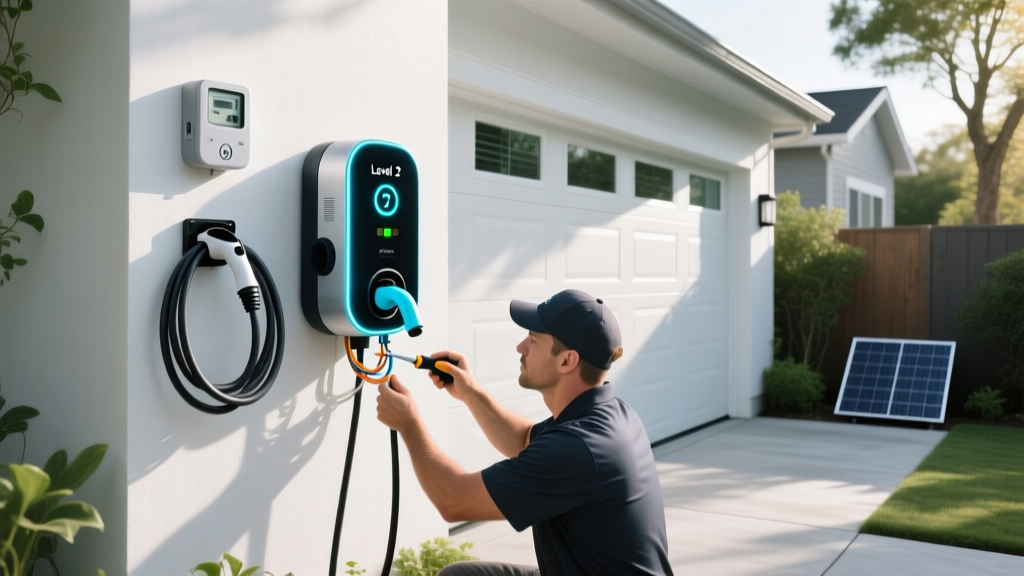
Installing a Level 2 home charger is where most EV ownership decisions succeed or fail. Here's what's involved, and what it actually costs.
Electrical Requirements
A standard Level 2 home charger requires a dedicated 240V circuit, typically at 40A or 50A (delivering up to 9.6 kW or 12.0 kW continuous, respectively — NEC code requires circuits rated 125% above continuous load, so a 40A charger needs a 50A breaker). The charger must be hardwired or plugged into a NEMA 14-50 outlet installed by a licensed electrician.
Panel Upgrade Reality
Homes built before 2000 often have 100A main panels. Adding a 50A EV circuit may push total load beyond capacity, requiring a panel upgrade to 200A. This is the single biggest variable in home charging cost — and one many online guides gloss over. A panel upgrade adds $1,500–$4,000 to your project.
Permits & Code
Most jurisdictions require an electrical permit ($50–$200) and a final inspection. Your electrician will pull this. GFCI protection is required for outdoor outlets per NEC 2023/2026. Hardwired chargers may also require GFCI breakers depending on local code.
| Item | Cost Range |
|---|---|
| Level 2 Charger Equipment (40A–48A) | $350–$700 |
| Electrician Labor (standard install, <50 ft run) | $500–$1,500 |
| NEMA 14-50 Outlet or Hardwire Materials | $50–$150 |
| Electrical Permit | $50–$200 |
| Total (No Panel Upgrade) | $950–$2,550 |
| Panel Upgrade to 200A (if needed) | $1,500–$4,000 |
| Total (With Panel Upgrade) | $2,450–$6,550 |
Compare this to the $0 "refueling infrastructure" of a supercharged Camaro — you just need a gas station. But once installed, a home Level 2 charger delivers 30–50 miles of range overnight at a fraction of gasoline cost, every single day.
Connector Compatibility: NACS, CCS1, CHAdeMO & Adapter Needs
As of 2026, the North American charging connector landscape has largely consolidated around NACS (the Tesla-standard connector, now SAE J3400), but CCS1 remains widespread and CHAdeMO persists on older Nissan Leafs.
| Connector | Brands Using It (Native) | Adapter Needed? |
|---|---|---|
| NACS (J3400) | Tesla, Ford, GM, Rivian, Volvo, Polestar, Fisker | CCS-to-NACS adapters available ($200–$400) for non-Tesla CCS vehicles at Superchargers |
| CCS1 | Hyundai, Kia, BMW, VW, Mercedes, Porsche, Stellantis | NACS-to-CCS adapter needed for Tesla Superchargers |
| CHAdeMO | Nissan Leaf (legacy), Mitsubishi Outlander PHEV | Limited adapter options; network shrinking |
If you're cross-shopping a supercharged Camaro with, say, a 2026 Ford Mustang Mach-E GT (480 hp, NACS native, EPA 290 mi), you'll have native access to Tesla's Supercharger network — over 25,000 stalls in North America. Hyundai/Kia owners on CCS1 can use Electrify America, EVgo, and Ionity (Europe), and can access Superchargers via a Ford-supplied adapter.
Cost Per Mile: EV Charging vs. Supercharged Camaro Fuel
This is where the supercharged Camaro's ownership math gets painful. Let's compare real fuel/energy costs.
| Scenario | Cost/kWh or Gal | Vehicle Efficiency | Cost Per Mile |
|---|---|---|---|
| Home Level 2 (off-peak, national avg) | $0.14/kWh | 3.5 mi/kWh (Model 3 LR) | $0.040 |
| Home Level 2 (peak rate) | $0.28/kWh | 3.5 mi/kWh | $0.080 |
| Public DC Fast (Electrify America avg) | $0.48/kWh | 3.5 mi/kWh | $0.137 |
| Tesla Supercharger (avg 2026) | $0.35/kWh | 3.5 mi/kWh | $0.100 |
| Supercharged Camaro ZL1 (premium 93 octane) | $4.50/gal | 16 mpg combined | $0.281 |
At 12,000 miles per year, the ZL1 costs roughly $3,375 in fuel. A Model 3 Long Range charged primarily at home off-peak costs about $480 — a $2,895 annual savings. Even exclusive public DC fast charging comes to roughly $1,644/year, still $1,731 less than the Camaro.
Caveat: These figures don't account for the Camaro's lower purchase price on the used market, higher EV insurance premiums (typically 15–25% above comparable ICE), or EV depreciation curves. Run a full 5-year total-cost-of-ownership calculation before deciding.
Charging Time Examples: 10–80% for Common Battery Sizes
Charge time depends on battery capacity (kWh), peak charge rate (kW), and the charge curve — most EVs taper significantly above 80% State of Charge to protect battery health.
- 60 kWh pack (base EVs, e.g., Chevy Equinox EV 2LT): ~22 minutes on a 150 kW DCFC, 10–80%
- 75 kWh pack (Tesla Model 3 LR, Ford Mach-E Extended Range): ~25 minutes on a 250 kW DCFC, 10–80%
- 84 kWh pack (Hyundai Ioniq 5 N, Kia EV6 GT): ~18 minutes on a 350 kW DCFC, 10–80% (800V architecture)
- 100+ kWh pack (GMC Hummer EV, Rivian R1T Max): ~35–45 minutes on a 350 kW DCFC, 10–80%
For comparison, a supercharged Camaro with a 19-gallon tank refills in under 5 minutes at any pump — yielding roughly 250–300 highway miles. No EV matches that refill speed yet, but the gap narrows on shorter daily commutes where home charging means you always start with a "full tank" every morning.
Recommended Home Level 2 Chargers for 2026
Based on reliability data, connector options, and smart features, here are top picks for home charging:
ChargePoint Home Flex (NACS or CCS1)
- Power: Up to 12.0 kW (50A circuit, 48A continuous)
- Connector: Available in NACS or CCS1
- Cable Length: 23 ft
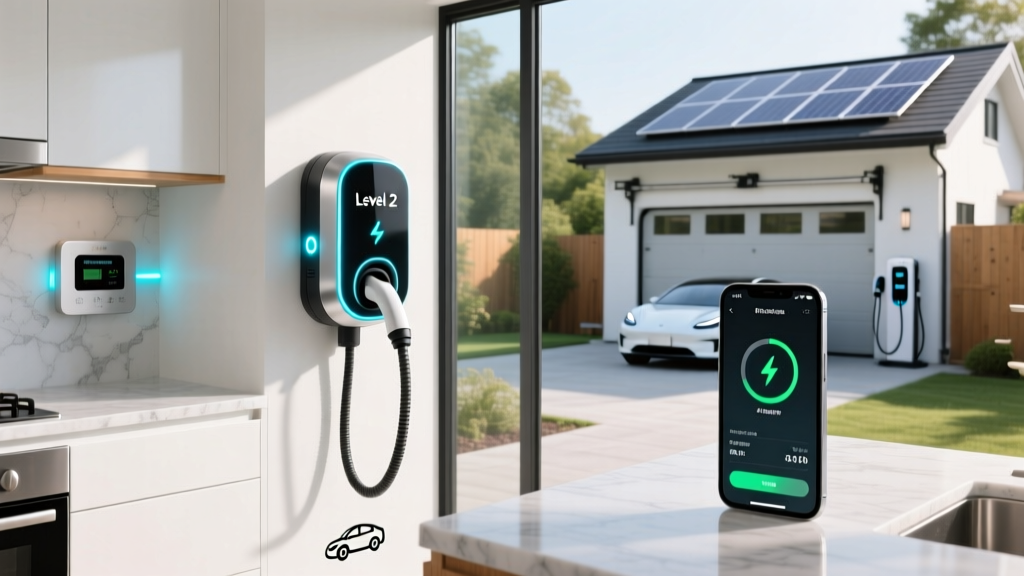
- Smart Features: Wi-Fi, app scheduling, Alexa, load sharing
- Price: ~$599
Tesla Wall Connector (NACS native)
- Power: Up to 11.5 kW (60A circuit, 48A continuous)
- Connector: NACS (J3400); includes J1772 adapter
- Cable Length: 24 ft
- Smart Features: Wi-Fi, OTA updates, Power-Share for dual units
- Price: ~$475
Emporia Vue Level 2 Charger
- Power: Up to 11.5 kW (48A)
- Connector: CCS1 or NACS
- Cable Length: 24 ft
- Smart Features: Energy monitoring, solar integration, app control
- Price: ~$399
All three support NEMA 14-50 plug-in or hardwired installation. Hardwiring allows the full 48A output on a 60A breaker; plug-in on a 50A breaker caps output at 40A (9.6 kW). Consult a licensed electrician for your specific setup.
Safety, Code & Outdoor Installation Considerations
EV chargers draw sustained high current for hours — more like an electric furnace than a phone charger. Code compliance isn't optional:
- Dedicated circuit: Your charger must have its own breaker — no sharing with dryers, HVAC, or kitchen outlets.
- GFCI protection: Required for all outdoor receptacles (NEC 625). Hardwired units may require a GFCI breaker depending on jurisdiction.
- Outdoor rating: If mounted outside, the charger must carry a NEMA 4 (or IP55+) weatherproof rating. All three recommendations above qualify.
- Cable management: Retractable cable reels or wall hooks prevent trip hazards and cord damage.
- Utility coordination: Some utilities offer time-of-use (TOU) rates that drop to $0.06–$0.10/kWh overnight — pair this with scheduled charging in your app for the lowest cost per mile.
Frequently Asked Questions
How much does it cost to install a home EV charger?
A standard Level 2 installation (40A–48A, <50 ft wire run, no panel upgrade) typically costs $950–$2,550 including equipment, electrician labor, and permit. If your home needs a 200A panel upgrade, add $1,500–$4,000. Get three quotes — prices vary significantly by region and electrician availability.
How fast will each charging level add range?
Level 1 (120V): 3–5 miles per hour. Level 2 (240V, 48A): 35–45 miles per hour for most EVs. DC Fast Charging: 150–1,000+ miles per hour at peak, though sustained rates taper above 50–60% State of Charge. A supercharged Camaro refuels ~300 miles in 5 minutes — still faster than any EV, but irrelevant for daily commuting if you charge at home.
Which connector/charger is compatible with my EV?
Check your vehicle's charge port. 2026 Teslas, Fords, GMs, and Rivians use NACS natively. Hyundai, Kia, BMW, and VW use CCS1. Nissan Leaf (through 2025) uses CHAdeMO. Adapters exist for cross-network charging but add $200–$400 and may limit peak charge speed.
How much does charging cost per mile vs. gas?
Home charging at off-peak rates averages $0.04/mile. Public DC fast charging runs $0.10–$0.14/mile. A supercharged Camaro ZL1 at 16 mpg combined on $4.50/gal premium costs $0.28/mile — roughly 3–7x more per mile than an EV, depending on your charging scenario.
What electrical upgrades might I need?
If your home has a 100A main panel (common in pre-2000 builds), you'll likely need a 200A upgrade ($1,500–$4,000). Homes with 200A panels and available breaker slots usually need only a dedicated 50A or 60A circuit. A load calculation by a licensed electrician will determine your exact requirements. Some utilities offer rebates covering $250–$500 of installation cost — check with your provider.