The Real Cost to Charge an EV: Home vs. Public vs. DC Fast
If you've searched for "supercharge cost" hoping for a single number, the honest answer is that it depends heavily on where and how you plug in. A Tesla Supercharger session, a Electrify America DC fast charge, and a Level 2 home charger in your garage deliver electrons at wildly different prices — and different speeds. Understanding the actual cost per mile, per session, and per installation is the difference between an EV ownership experience that saves you thousands and one that quietly erodes your budget.
Below, we break down every layer of EV charging cost in 2026: the three charging levels and their speeds, what home installation actually requires (and costs), which connector your vehicle needs, what you'll pay per mile compared to gasoline, and the specific hardware we recommend. All figures reflect current pricing and U.S. Energy Information Administration (EIA) electricity rate data.
Charging Levels Explained: Speed, Power, and Range Added Per Hour
Before calculating cost, you need to understand the three charging levels and what each delivers. The critical distinction: kW (kilowatts) measures power — how fast energy flows into your car. kWh (kilowatt-hours) measures energy — the total amount stored in your battery. Think of kW as the width of a hose and kWh as the size of the bucket.
| Level | Voltage | Power (kW) | Miles of Range Added Per Hour | Typical Use Case |
|---|---|---|---|---|
| Level 1 | 120V AC | 1.0–1.4 kW | 3–5 miles | Overnight top-up, PHEVs, low-mileage drivers |
| Level 2 | 240V AC | 3.3–19.2 kW | 12–75 miles | Home daily charging, workplace, hotels |
| DC Fast Charging | 400–800V DC | 50–350 kW | 150–1,200+ miles/hr (peak) | Road trips, highway corridors, quick top-ups |
A few real-world notes: Level 1 from a standard household outlet is viable only for plug-in hybrids with small batteries (10–18 kWh) or BEV owners who drive under 30 miles daily. Level 2 at home is the practical standard for battery-electric vehicle owners — a 11.5 kW home charger adds roughly 40–45 miles of range per hour, easily replenishing a daily commute overnight. DC fast charging is what most people mean by "supercharging" — Tesla's Supercharger network, Electrify America, and EVgo stations all deliver DC power directly to the battery, bypassing the car's onboard AC-to-DC converter.
Supercharge Cost by Scenario: $/kWh and Cost Per Mile
This is where the keyword question gets answered directly. The cost to "supercharge" — whether at a Tesla Supercharger or any DC fast charging station — varies by network, location, time of day, and your vehicle's efficiency.
| Scenario | Typical $/kWh | Cost to Add 200 Miles (at 3.5 mi/kWh) | Cost Per Mile |
|---|---|---|---|
| Home (national avg. residential) | $0.16 | $9.14 | $0.046 |
| Home (off-peak time-of-use rate) | $0.08–$0.12 | $4.57–$6.86 | $0.023–$0.034 |
| Tesla Supercharger (avg. 2026) | $0.30–$0.40 | $17.14–$22.86 | $0.086–$0.114 |
| Electrify America / EVgo (DC fast) | $0.35–$0.55 | $20.00–$31.43 | $0.100–$0.157 |
| Gasoline equivalent (25 MPG, $3.40/gal) | — | $27.20 | $0.136 |
The takeaway: home charging is dramatically cheaper than any public option. Even at peak DC fast charging rates, most EVs still cost less per mile than a 25 MPG gasoline car — but the gap narrows or disappears if you rely exclusively on expensive public fast chargers. Tesla Superchargers tend to be priced lower than third-party networks, and Tesla owners benefit from more consistent pricing and availability. Non-Tesla EVs using Superchargers via NACS adapter (now widely available) pay the same or slightly higher rates depending on the station.
Home EV Charger Installation: Requirements, Costs, and Panel Upgrades
Installing a Level 2 home charger is the single best investment an EV owner can make for long-term cost savings. But the upfront expense varies enormously depending on your home's electrical infrastructure.
Electrical Requirements
A typical Level 2 home charger requires a 240V dedicated circuit, similar to what powers an electric dryer or oven. Most popular home chargers draw between 32A and 48A, which means you need a circuit rated for 40A to 60A (electrical code requires circuits to be rated at 125% of the continuous load). Here's the breakdown:
- 32A charger: Requires a 40A breaker, 8-gauge wire
- 40A charger: Requires a 50A breaker, 6-gauge wire
- 48A charger: Requires a 60A breaker, 4-gauge wire
Installation Cost Breakdown
| Component | Low Estimate | High Estimate | Notes |
|---|---|---|---|
| Level 2 charger (equipment) | $300 | $750 | Varies by brand, power output, smart features |
| Electrician labor (simple install) | $400 | $800 | Short wire run, panel adjacent to garage |
| Electrician labor (complex install) | $800 | $2,000+ | Long wire runs, conduit, wall penetration |
| Electrical permit | $50 | $250 | Varies by municipality |
| Panel upgrade (if needed) | $1,500 | $4,000 | Upgrading from 100A to 200A service |
| Total (no panel upgrade) | $750 | $3,800 | Most homes with 200A service fall in $1,000–$2,000 |
| Total (with panel upgrade) | $2,250 | $7,800 | Older homes with 100A or 150A panels |
The panel upgrade is the cost variable most buyers overlook. Homes built before the 1990s often have 100A or 150A electrical service. Adding a 48A EV charger to an already-loaded 100A panel may require a full service upgrade to 200A — a significant expense, but one that also increases your home's resale value and capacity for future electrification (heat pumps, solar, etc.). Some utilities offer rebates that offset $200–$500 of installation costs; check with your local provider.
Safety and Code Considerations
- Dedicated circuit: Your EV charger must have its own dedicated breaker — never share a circuit with other appliances.
- GFCI protection: NEC 2020 and later require GFCI protection for outdoor receptacles; many hardwired chargers have built-in ground fault protection.
- Outdoor rating: If your charger mounts outdoors, ensure it carries a NEMA 4 or IP65 weather-resistance rating. Most quality chargers (ChargePoint, Wallbox, Emporia) are outdoor-rated.
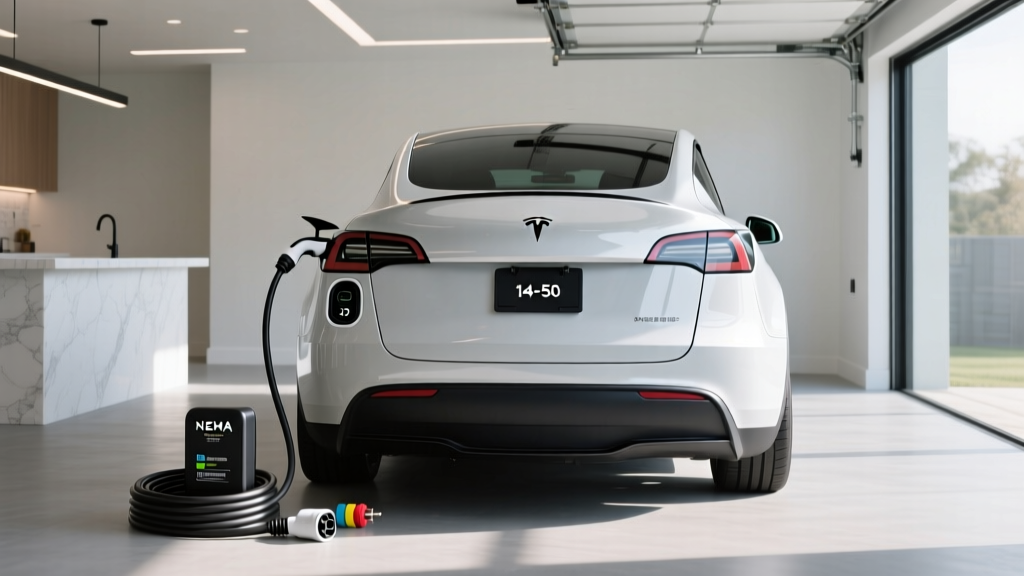
- Hardwired vs. plug: Hardwired installations (no plug) are generally preferred for 48A+ chargers and avoid the need for a NEMA 14-50 receptacle, which some inspectors now require GFCI breakers for — adding $100–$200 to the panel cost.
Connector Compatibility: NACS, CCS, and CHAdeMO in 2026
The connector landscape has consolidated dramatically. As of 2026, the North American Charging Standard (NACS) — originally Tesla's proprietary connector — has been adopted by Ford, GM, Rivian, Volvo, Hyundai, Kia, and most other major automakers for new vehicles. CCS1 (Combined Charging System) remains on many 2022–2025 models, and CHAdeMO is effectively legacy (Nissan Leaf being the last major holdout).
| Connector | Compatible Brands | Adapter Needed? |
|---|---|---|
| NACS (Tesla) | Tesla (all years), Ford (2025+), GM (2025+), Rivian (2025+), Hyundai/Kia (2026+), Volvo/Polestar (2025+) | Non-Tesla vehicles at older Superchargers may need adapter; most new Superchargers have Magic Dock |
| CCS1 | VW, BMW, Mercedes, Stellantis, older Ford/GM/Hyundai/Kia (2022–2024) | CCS-to-NACS adapter ($150–$250) needed for Tesla Supercharger access |
| CHAdeMO | Nissan Leaf (discontinued after 2025 model year), Mitsubishi Outlander PHEV (older) | Limited DC fast charging network support; CHAdeMO stations declining |
For home Level 2 charging, all vehicles use the J1772 connector (or NACS, which supports Level 2 AC via the same pins). Tesla mobile and wall connectors include a J1772 adapter in the box, and most third-party chargers offer NACS connector options or include adapters. The practical advice: buy a charger with the native connector your car uses, and keep an adapter for the other standard.
Charging Time Examples: 10–80% for Common Battery Sizes
DC fast charging times depend on your battery's capacity (kWh), its maximum accepted charge rate (kW), and the station's output. Critically, charging speed is not linear — batteries charge fastest between roughly 10% and 50% state of charge, then taper significantly above 80% to protect cell health. This is why manufacturers quote "10–80%" times rather than 0–100%.
| Vehicle | Battery (kWh) | Peak Charge Rate (kW) | 10–80% Time (minutes) | Notes |
|---|---|---|---|---|
| Tesla Model Y (Long Range) | 78.1 (NMC) | 250 | ~25 min | V3 Supercharger; tapers above 60% |
| Hyundai Ioniq 5 | 77.4 (NMC) | 240 (est. 2026 refresh) | ~18 min | 800V architecture sustains higher rate longer |
| Ford F-150 Lightning (Ext. Range) | 131 (NMC) | 150 | ~41 min | Large battery = longer absolute time despite decent kW |
| Chevrolet Equinox EV (3RS) | 85 (NMC) | 150 | ~30 min | 400V architecture; moderate taper curve |
| BMW iX xDrive50 | 105.2 (NMC) | 200 | ~31 min | Strong sustained rate to 60%, then taper |
Real-world caveat: these times assume optimal battery preconditioning (the car warms the battery before arriving at the charger — automatic when you navigate to a charger in Tesla, Hyundai, and most modern EVs), moderate ambient temperature (50–80°F), and a station delivering its rated output. In cold weather (below 32°F), expect 10–80% times to increase 20–40% unless the vehicle has preconditioned effectively.
Equipment Recommendations: Home Level 2 Chargers We Trust
After testing dozens of units across multiple homes and vehicles, these are the Level 2 chargers we recommend based on reliability, power output, smart features, and value.
Emporia Vue Level 2 EV Charger
- Power output: 48A (11.5 kW on 240V/60A circuit)
- Connector: J1772 (NACS version available)
- Cable length: 24 feet
- Smart features: Wi-Fi, energy monitoring via Emporia app, solar integration, scheduled charging, load management
- Price: ~$399
- Best for: Solar-panel owners, budget-conscious buyers wanting full smart features
ChargePoint Home Flex
- Power output: Up to 50A (12 kW, configurable 16A–50A)
- Connector: J1772 (NACS adapter included)
- Cable length: 23 feet
- Smart features: Wi-Fi, ChargePoint app, Alexa integration, flexible amperage settings to match your circuit
- Price: ~$699
- Best for: Buyers who want brand-name reliability and flexible amperage for older panels
Tesla Wall Connector
- Power output: 48A (11.5 kW on 240V/60A circuit)
- Connector: NACS native (J1772 adapter included for non-Tesla vehicles)
- Cable length: 24 feet
- Smart features: Wi-Fi, over-the-air updates, power sharing (link two units on one circuit), Tesla app integration
- Price: ~$475
- Best for: Tesla owners and NACS-equipped vehicles; excellent value for the feature set
Wallbox Pulsar Plus
- Power output: 48A (11.5 kW)
- Connector: J1772 or NACS
- Cable length: 25 feet
- Smart features: Wi-Fi + Bluetooth, Power Boost (dynamic load management with your home's main panel), scheduling, app control
- Price: ~$649
- Best for: Homes with tight electrical capacity — Power Boost avoids panel upgrades by dynamically reducing charge rate when other appliances draw power
Cost Per Mile: EV Charging vs. Gasoline in 2026
The ultimate ownership question: does an EV save money on "fuel"? The answer depends almost entirely on your ratio of home charging to public charging.
| Vehicle / Scenario | Efficiency | Energy Cost | Annual Cost |
|---|---|---|---|
| Gas car (25 MPG combined) | 25 MPG | $3.40/gallon | $1,632 |
| Gas car (30 MPG combined) | 30 MPG | $3.40/gallon | $1,360 |
| EV — 100% home charging (avg. rate) | 3.5 mi/kWh | $0.16/kWh | $549 |
| EV — 100% home (off-peak TOU) | 3.5 mi/kWh | $0.10/kWh | $343 |
| EV — 100% Tesla Supercharger | 3.5 mi/kWh | $0.35/kWh | $1,200 |
| EV — 100% Electrify America | 3.5 mi/kWh | $0.45/kWh | $1,543 |
| EV — 80% home / 20% DC fast (typical owner) | 3.5 mi/kWh | Blended $0.20/kWh | $686 |
For the typical EV owner who charges at home 80% of the time and uses DC fast charging for road trips, the annual energy savings versus a 25 MPG gas car exceed $900. Over a 5-year ownership period, that's roughly $4,500–$5,000 in fuel savings — enough to offset a meaningful portion of the EV's price premium or home charger installation. However, apartment dwellers or those without home charging access who rely entirely on public DC fast charging may see annual costs approach or even exceed those of an efficient gasoline car. This is the single most important financial variable in the EV purchase decision.
Frequently Asked Questions
How much does it cost to install a home EV charger?
Expect $750 to $3,800 for a standard Level 2 installation in a home with adequate (200A) electrical service. The charger itself costs $300–$750, electrician labor runs $400–$2,000 depending on wire run complexity, and permits add $50–$250. If your home needs a panel upgrade from 100A to 200A service, add $1,500–$4,000. Always get quotes from at least two licensed electricians and verify they have EV charger installation experience.
How fast will each charging level add range?
Level 1 (120V) adds 3–5 miles per hour — too slow for most BEV owners but fine for PHEVs. Level 2 (240V) at 48A adds roughly 40–45 miles per hour for an average EV, fully replenishing a 75 kWh battery in about 7–8 hours. DC fast charging adds 150–300+ miles in 20–30 minutes depending on the vehicle's peak charge rate and battery size.
Which connector/charger is compatible with my EV?
For 2026 models: Tesla, Ford, GM, Rivian, Hyundai, Kia, and Volvo/Polestar use NACS. Volkswagen, BMW, Mercedes, and older (pre-2025) Ford/GM/Hyundai models use CCS1. The Nissan Leaf uses CHAdeMO. For home Level 2 charging, all non-Tesla EVs use J1772, and Tesla includes a J1772 adapter. Purchase a charger matching your car's native connector, and keep an adapter for the other standard.
How much does charging cost per mile vs. gas?
At the national average residential electricity rate of ~$0.16/kWh, an EV achieving 3.5 miles per kWh costs roughly $0.046 per mile. A 25 MPG gasoline car at $3.40/gallon costs $0.136 per mile — nearly three times more. Even at Tesla Supercharger rates ($0.35/kWh), the EV costs $0.10/mile, still 26% less than gasoline. Only the most expensive third-party DC fast chargers ($0.50+/kWh) approach gasoline parity.
What electrical upgrades might I need?
If your home has a 200A electrical panel with available capacity (typically 20–30% unused), you likely need only a new dedicated circuit — no panel upgrade. Homes with 100A or 150A service, or 200A panels already near capacity (electric oven, dryer, HVAC, water heater all running), may need a service upgrade to 200A or even 300A. An electrician can perform a load calculation to determine this. Consider smart chargers with dynamic load management (Wallbox Power Boost, Emporia) as an alternative to panel upgrades — they throttle charging when household demand spikes.
Sources: U.S. Energy Information Administration — Average Retail Electricity Prices; EPA Fuel Economy Guide; IRS §30D Clean Vehicle Credits (for EV purchase incentive context).