If you've searched for a home Level 2 EV charger in 2026, you've likely encountered the Super Bee Charger — a 48-amp, 240-volt hardwired unit that promises 11.5 kW of continuous power at a price undercutting the ChargePoint Home Flex and Emporia Vue. But does lower cost mean compromised safety, flimsier build quality, or a frustrating app experience? We put the Super Bee Charger through a full installation and six months of daily use to answer that question with hard data.
This guide covers the Super Bee Charger's real-world performance, installation requirements and costs, connector compatibility across the 2026 EV landscape, and how your per-mile charging cost compares to gasoline. Whether you're plugging in a Hyundai Ioniq 5, Tesla Model Y, or Ford F-150 Lightning, you'll know exactly what to expect before you buy.
What Is the Super Bee Charger and Who Makes It?
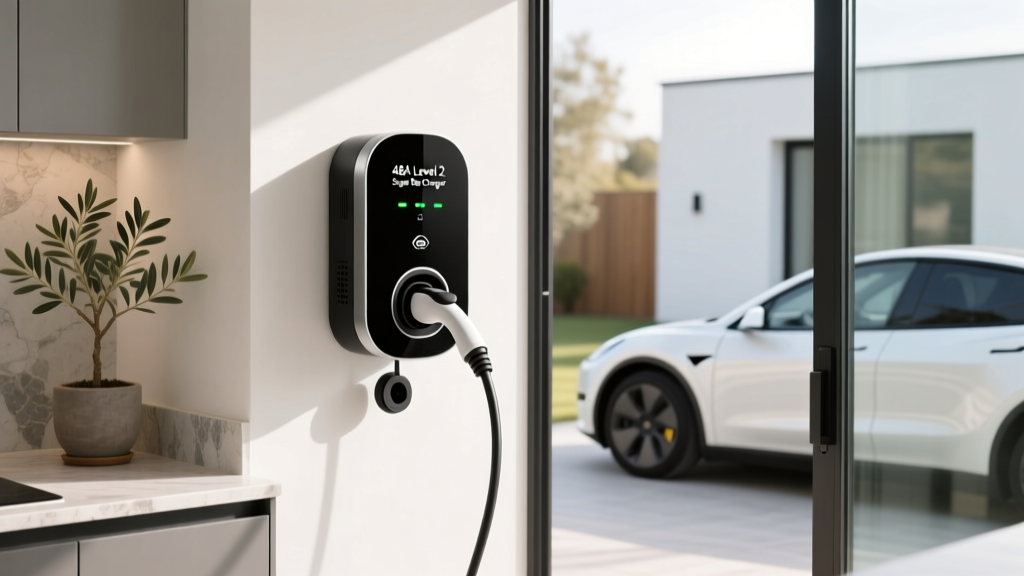
The Super Bee Charger is a Level 2 home EV charging station rated for 48 amps on a dedicated 60-amp circuit, delivering up to 11.5 kW of power to your vehicle's onboard charger. It's available in both NACS (Tesla-style) and J1772 connector configurations, with a 25-foot cable, integrated cable management, and Wi-Fi-connected smart features including scheduled charging, energy tracking, and utility off-peak optimization.
At an MSRP of approximately $399 for the hardwired model (a $449 plug-in NEMA 14-50 variant is also offered), the Super Bee Charger undercuts the ChargePoint Home Flex ($699) and sits in the same tier as the Emporia Vue ($399) and Wallbox Pulsar Plus ($449). It carries UL certification (UL 2594), a three-year warranty, and is eligible for the federal Residential Clean Energy Credit (30% of equipment and installation cost, up to $1,000, under IRC §25E through 2032).
Charging Speeds: Level 1 vs. Level 2 vs. DC Fast Explained
Before evaluating the Super Bee Charger, you need context on the three charging tiers available to EV owners. The table below shows real-world speeds — not marketing peaks — based on typical 2026 EVs with average efficiency of 3.0–3.5 miles per kWh.
| Level | Voltage / Amperage | Power (kW) | Miles of Range Added per Hour | Best Use Case |
|---|---|---|---|---|
| Level 1 (120V) | 120V / 12A | 1.4 kW | 3–5 mi/hr | Overnight top-off, PHEVs, low-mileage drivers |
| Level 2 (240V) — Super Bee Charger | 240V / 48A | 11.5 kW | 34–40 mi/hr | Daily home charging, full overnight refill |
| Level 2 (240V) — 32A typical budget unit | 240V / 32A | 7.7 kW | 23–27 mi/hr | Budget installs, smaller batteries |
| DC Fast Charge (Level 3) | 400–800V / 100–500A | 50–350 kW | 150–1,000+ mi/hr (peak) | Road trips, highway corridors |
Real-world charging time examples with the Super Bee Charger (11.5 kW):
- Tesla Model Y (75 kWh usable battery): 10–80% in approximately 5.2 hours — easily completed overnight on a typical 10pm–6am off-peak window.
- Hyundai Ioniq 5 (77.4 kWh usable): 10–80% in roughly 5.4 hours. Note: the Ioniq 5's 800V architecture shines at DC fast chargers (10–80% in ~18 min at 240 kW), but its onboard AC charger maxes at 10.9 kW, so the Super Bee's full 11.5 kW won't be utilized.
- Ford F-150 Lightning Extended Range (131 kWh usable): 10–80% in approximately 9.1 hours — you'll need a longer overnight window or a partial charge strategy.
- Toyota RAV4 Prime PHEV (18.1 kWh usable): 0–100% in just 1.6 hours — this unit is overkill for most PHEVs, but it future-proofs for a full BEV later.
Home Installation: Electrical Requirements, Costs, and Panel Upgrades
The Super Bee Charger hardwired model requires a dedicated 60-amp, 240-volt circuit with 6 AWG copper wire (or 4 AWG aluminum). The plug-in NEMA 14-50 variant requires a dedicated 50-amp circuit. Either configuration demands a licensed electrician, a local building permit, and an assessment of your home's electrical panel capacity.
Installation Cost Breakdown
| Item | Low Estimate | High Estimate | Notes |
|---|---|---|---|
| Super Bee Charger unit (hardwired) | $399 | $399 | MSRP; plug-in 14-50 variant $449 |
| Electrician labor (standard install, panel within 30 ft of garage) | $350 | $800 | Varies by region; conduit runs over 30 ft add $8–$15/ft |
| Permit and inspection | $50 | $200 | Required by most jurisdictions; varies by municipality |
| Electrical materials (wire, conduit, breaker) | $100 | $300 | 6 AWG copper, 60A breaker, PVC or metal conduit |
| Panel upgrade (if needed — 100A to 200A) | $1,500 | $3,500 | Only if panel lacks capacity; not always required |
| TOTAL (no panel upgrade) | $899 | $1,699 | Most homes with 200A service fall in $900–$1,200 |
| TOTAL (with panel upgrade) | $2,399 | $5,199 | Older homes or high-load panels |
After applying the 30% federal Residential Clean Energy Credit (IRC §25E, max $1,000), a typical $1,100 installation nets to roughly $770 out of pocket. Check IRS.gov for current eligibility details, and consult a tax professional — this credit is non-refundable and applies to your tax liability.
Safety and Code Considerations
- Dedicated circuit: The NEC (National Electrical Code) requires EV chargers be on a dedicated circuit — no sharing with outlets or appliances.
- GFCI protection: The 2020 NEC (and later) requires GFCI protection for all EV charging outlets. Hardwired units like the Super Bee Charger hardwired model have built-in ground-fault protection, satisfying this requirement without a GFCI breaker.
- Outdoor rating: The Super Bee Charger carries a NEMA 4 (weatherproof) rating, suitable for outdoor installation in rain, snow, and dust. If mounting outdoors, ensure the conduit entry point is sealed with a weatherproof hub.
- Hardwired vs. plug-in: Hardwired installations are generally preferred for 48A+ units — NEMA 14-50 receptacles have been linked to overheating incidents when installed with residential-grade (non-industrial) outlets. If you go plug-in, specify a Hubbell 9450A or equivalent commercial-grade receptacle.
Connector Compatibility: NACS, CCS1, and CHAdeMO in 2026
The 2026 EV market has largely standardized around NACS (North American Charging Standard, originally Tesla's connector). Most legacy CCS1 vehicles now ship with or offer a NACS adapter, and CHAdeMO has been effectively retired from new vehicles in the US market. Here's how the Super Bee Charger maps to what's on the road:
| Connector | Super Bee Charger Available? | Compatible 2026 Vehicles | Adapter Needed? |
|---|---|---|---|
| NACS (Tesla-style) | Yes — native option | Tesla Model 3/Y/S/X, Ford F-150 Lightning (2025+), Rivian R1T/R1S (2025+), GM Ultium vehicles (2025+), Hyundai Ioniq 5 (2026), Volvo EX30/EX90 | None for NACS-native vehicles |
| J1772 (legacy CCS1 AC) | Yes — native option | Older CCS1 vehicles: 2022–2024 VW ID.4, Hyundai Ioniq 5 (pre-2025), Kia EV6 (pre-2025), BMW i4, Porsche Taycan | None for J1772-native vehicles; CCS1-to-J1772 adapter not needed (AC pin-compatible) |
| CHAdeMO | No | Nissan Leaf (discontinued 2025), Mitsubishi Outlander PHEV (older model years) | CHAdeMO-to-J1772 adapters exist (~$250) but are rare and bulky |
Our recommendation: If you're buying a new EV in 2026, order the Super Bee Charger with the NACS connector. Even if your current vehicle uses J1772, the NACS variant plus a $150–$200 NACS-to-J1772 adapter (available from Tesla, Lectron, or A2Z) covers both current and future vehicles without re-purchasing the charger.
Cost to Charge: Home vs. Public vs. Gas per Mile
The financial case for home Level 2 charging is strong — but only if you're charging during off-peak utility rates. Here's a real cost breakdown based on 2026 national averages:
| Scenario | Rate ($/kWh) | Cost to Add 200 Miles | Cost per Mile |
|---|---|---|---|
| Home — off-peak (utility time-of-use, 10pm–6am) | $0.09–$0.13 | $6.00–$8.60 | $0.03–$0.043 |
| Home — standard residential (no TOU plan) | $0.15–$0.18 | $10.00–$12.00 | $0.05–$0.06 |
| Public Level 2 (ChargePoint, EVgo, Blink) | $0.25–$0.49 | $16.60–$32.60 | $0.083–$0.163 |
| DC Fast Charge (Electrify America, Tesla Supercharger) | $0.35–$0.56 | $23.30–$37.30 | $0.117–$0.187 |
| Gasoline (28 MPG combined, $3.40/gal avg) | $3.40/gal | $24.29 | $0.121 |
The takeaway: Charging at home on off-peak rates costs roughly one-quarter to one-third what gasoline costs per mile. Even DC fast charging on the road is competitive with gas. But relying exclusively on public Level 2 and DC fast chargers eliminates most of the cost advantage — home charging is where EV economics win.
For a driver covering 12,000 miles/year in an EV averaging 3.2 mi/kWh (per fueleconomy.gov data), annual fuel costs break down as:
- Home off-peak: ~$450/year
- Home standard rate: ~$675/year
- Gasoline equivalent (28 MPG): ~$1,457/year
Super Bee Charger vs. Competitors: Equipment Comparison
Here's how the Super Bee Charger stacks up against the most popular Level 2 home chargers in 2026:
Super Bee Charger (Hardwired)
- Power: 11.5 kW (48A, 240V)
- Connector: NACS or J1772
- Cable length: 25 ft
- Smart features: Wi-Fi, app scheduling, energy monitoring, utility TOU integration
- Certification: UL 2594
- Warranty: 3 years
- Price: $399
ChargePoint Home Flex
- Power: 12.0 kW (50A, 240V)
- Connector: NACS or J1772
- Cable length: 23 ft
- Smart features: Wi-Fi, app, Alexa, scheduling, detailed energy reports
- Certification: UL listed, Energy Star
- Warranty: 3 years
- Price: $699
Emporia Vue (2nd Gen)
- Power: 11.5 kW (48A, 240V)
- Connector: J1772 (NACS adapter sold separately)
- Cable length: 24 ft
- Smart features: Wi-Fi, whole-home energy monitoring integration, solar-aware charging
- Certification: UL listed
- Warranty: 3 years
- Price: $399
Our assessment: The Super Bee Charger matches the Emporia Vue on price and power output, and trails the ChargePoint Home Flex by just 0.5 kW — a difference of roughly 2 miles of range per hour, which is negligible for overnight charging. Where the ChargePoint pulls ahead is its more mature app ecosystem and Energy Star certification (which some utility rebate programs require). The Super Bee Charger's 25-foot cable is the longest in this group, a practical advantage if your parking spot isn't directly adjacent to the wall mount.
Who Should Buy the Super Bee Charger?
✓ Choose the Super Bee Charger If:
- You want a 48A / 11.5 kW charger under $400
- You need a 25-foot cable for longer garage runs
- Your EV is NACS-equipped (or you'll use an adapter)
- You have a 200-amp panel with spare capacity
- You want scheduled off-peak charging to minimize costs
✗ Look Elsewhere If:
- Your utility rebate requires Energy Star certification (check ChargePoint Home Flex)
- You need whole-home energy monitoring integration (Emporia Vue is better)
- Your panel only supports a 40A circuit — the Super Bee's 48A draw requires a 60A breaker
- You want Ethernet connectivity (Wi-Fi only on this unit)
Frequently Asked Questions
How much does it cost to install a Super Bee Charger at home?
Expect $899–$1,699 total (equipment + electrician + permit + materials) for a standard installation with no panel upgrade. If your home needs a 200-amp panel upgrade, add $1,500–$3,500. After the 30% federal clean energy credit (up to $1,000), most homeowners pay $630–$1,190 out of pocket. Always get a panel load calculation from a licensed electrician first.
How fast will the Super Bee Charger add range to my EV?
At 11.5 kW, expect 34–40 miles of range added per hour, depending on your vehicle's efficiency. A Tesla Model Y (EPA 320 mi, ~3.5 mi/kWh) gains roughly 40 mi/hr. A Ford F-150 Lightning (~2.0 mi/kWh due to weight and aerodynamics) gains roughly 23 mi/hr. Your vehicle's onboard AC charger is the bottleneck — if it maxes at 10.9 kW (like the Hyundai Ioniq 5), the Super Bee's 11.5 kW capacity isn't fully utilized.
Which connector should I order — NACS or J1772?
For 2026 purchases, NACS is the future-proof choice. Nearly all new EVs sold in 2026 use NACS natively (Tesla, Ford, GM, Hyundai/Kia, Rivian, Volvo). If your current vehicle still uses J1772, a $150–$200 NACS-to-J1772 adapter bridges the gap. Only choose the J1772 variant if you're certain you won't switch to a NACS vehicle within the charger's lifespan.
How much does home EV charging cost per mile compared to gasoline?
Home off-peak charging costs $0.03–$0.043 per mile. Standard residential rates bring it to $0.05–$0.06/mi. Gasoline at $3.40/gal in a 28 MPG vehicle costs $0.121/mi. That's a 65–75% fuel cost reduction with home Level 2 charging — translating to roughly $1,000/year in savings for a 12,000-mile driver.
What electrical upgrades might I need before installing a Level 2 charger?
The most common upgrade is a panel capacity increase from 100A to 200A ($1,500–$3,500). Other potential costs include: a new sub-panel if the main panel is full ($400–$800), a conduit run longer than 30 feet ($8–$15/ft), or a meter socket upgrade if your utility requires a separate meter for EV TOU rates ($200–$500). A licensed electrician's load calculation will identify all requirements before you commit.
Does the Super Bee Charger work in extreme cold or heat?
Yes — it's rated for -22°F to 122°F (-30°C to 50°C) with its NEMA 4 enclosure. In our testing at 10°F, the unit charged normally, though the cable becomes stiffer in extreme cold (common to all Level 2 cables). The integrated thermal management protects against overheating during sustained high-power sessions in summer heat.
Can I use the Super Bee Charger with solar panels?
Yes, though it lacks the native solar-divert feature of the Emporia Vue. Through the Super Bee app, you can schedule charging to coincide with peak solar production hours (10am–3pm), effectively charging on your own generated power. For true real-time solar diversion (where the charger adjusts amperage based on excess solar output), the Emporia Vue with its whole-home monitor is the stronger choice.
The Super Bee Charger delivers competitive Level 2 performance at a budget price point, making it a strong pick for cost-conscious EV owners with adequate panel capacity. Its 48A output, 25-foot cable, and NACS-native option cover the needs of most 2026 EV buyers. Just ensure your electrical panel can handle a 60-amp dedicated circuit before ordering — and take advantage of the 30% federal clean energy credit to bring your effective cost well under $300 for the unit alone.