Quick Verdict: Is the Sunrun EV Charger Worth It?
If you're already a Sunrun solar customer or planning to pair rooftop solar with EV charging, the Sunrun EV charger (a rebranded Wallbox Pulsar Plus or similar 48A smart charger bundled through Sunrun's installation network) offers a convenient, single-vendor solution. But convenience comes with trade-offs: Sunrun's bundled installation pricing typically runs higher than sourcing your own Level 2 hardware and hiring an independent electrician. For a standalone charger purchase, you'll find more flexibility — and often lower total cost — by selecting equipment yourself.
This guide breaks down exactly what the Sunrun EV charger delivers in power output, connector compatibility, installation requirements, and total cost — while also benchmarking it against the best standalone Level 2 chargers available in 2026.
Charging Levels Explained: How Fast Will You Actually Gain Range?
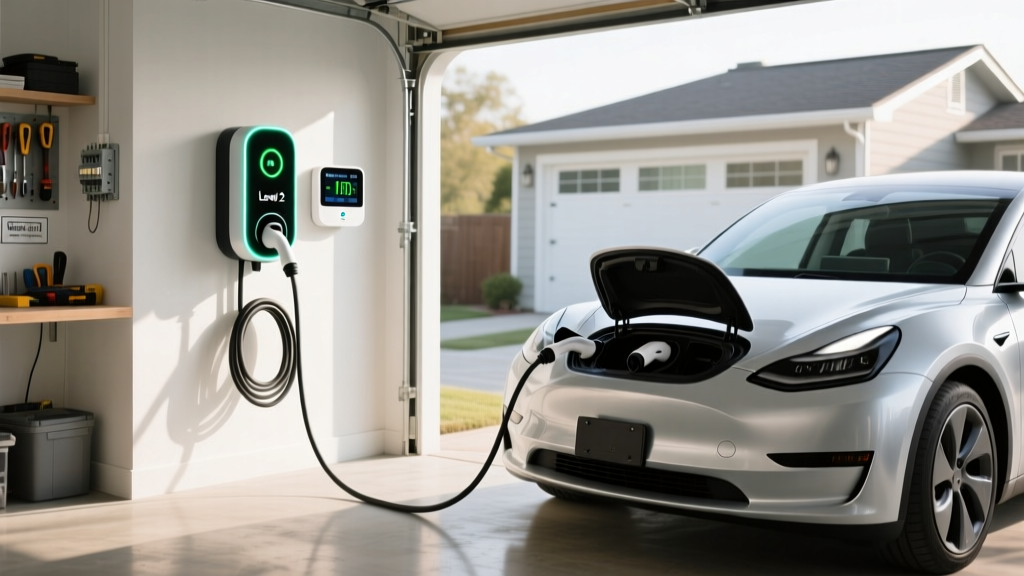
Before evaluating any home charger, understand the three charging tiers and what they deliver in real-world miles per hour. The critical distinction: kW (kilowatts) measures power — the rate of energy flow — while kWh (kilowatt-hours) measures energy — the total capacity stored in your battery. A 48A Level 2 charger delivers up to 11.5 kW of power; a 75 kWh battery holds 75 kWh of energy.
| Level | Voltage | Max Power (kW) | Miles Added per Hour | Typical Use Case |
|---|---|---|---|---|
| Level 1 | 120V AC | 1.4–1.9 kW | 3–5 mi/hr | Overnight top-ups, PHEVs, emergency |
| Level 2 | 240V AC | 7.2–19.2 kW | 20–60+ mi/hr | Home daily charging, workplace |
| DC Fast | 400–800V DC | 50–350 kW | 150–1,000+ mi/hr | Road trips, highway corridors |
For a 75 kWh battery (common in vehicles like the Tesla Model Y or Hyundai Ioniq 5), a Level 2 charger at 11.5 kW will add roughly 40–45 miles of range per hour and achieve a 10–80% charge in approximately 5–6 hours. Level 1 at 1.4 kW would take over 40 hours for the same charge — impractical for most BEV owners.
Sunrun EV Charger: Specs, Power Output, and Connector Compatibility
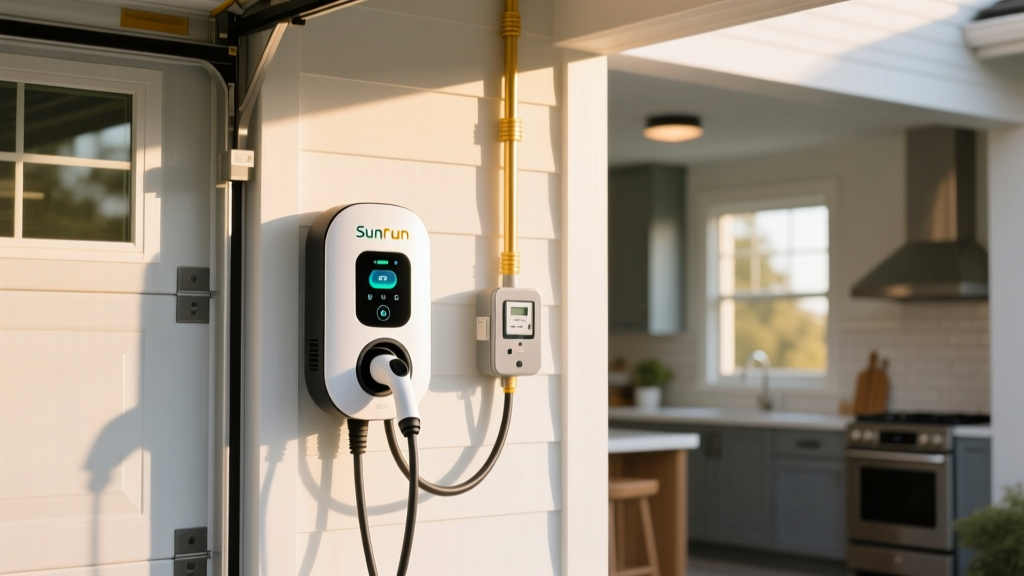
Sunrun typically offers a 48-amp smart Level 2 charger (historically a white-labeled Wallbox Pulsar Plus or equivalent) that delivers up to 11.5 kW on a 240V/60A dedicated circuit. Here's what that means in practice:
- Power output: 11.5 kW peak (48A × 240V)
- Cable length: 25 feet (sufficient for most garage and driveway setups)
- Connector: J1772 standard (compatible with CCS1 vehicles); NACS/Tesla vehicles require an adapter
- Smart features: Wi-Fi connectivity, scheduling via app, solar integration with Sunrun systems, energy tracking
- Enclosure rating: NEMA 4 (indoor/outdoor rated)
- Warranty: Typically 3 years through Sunrun's service agreement
Connector Compatibility: Will It Fit Your EV?
The North American EV market in 2026 is split between three primary connectors. The Sunrun charger ships with a J1772 plug, which directly fits CCS1-port vehicles but requires an adapter for Tesla/NACS-port vehicles.
| Connector | Brands Using It (2026) | Adapter Needed for Sunrun Charger? |
|---|---|---|
| NACS (Tesla) | Tesla (all), Ford, GM, Rivian, Hyundai, Kia (2025+ models) | Yes — J1772-to-NACS adapter (~$150–$250) |
| CCS1 | Legacy VW ID.4, BMW iX, older Ford/GM EVs | No — direct plug |
| CHAdeMO | Nissan Leaf (legacy) | No direct adapter available; CHAdeMO is DC-only |
If you drive a 2025+ Ford, GM, Hyundai, or Kia EV that has switched to the NACS port, you'll need a J1772-to-NACS adapter for home Level 2 charging with the Sunrun unit. Tesla provides this adapter with new vehicles; aftermarket options from Tesla or third-party brands like Lectron run $150–$250.
Home Installation Cost: What You'll Actually Pay
Sunrun's bundled EV charger installation — which includes hardware, electrician labor, permit, and any minor panel work — typically ranges from $1,500 to $3,500 depending on your home's electrical setup. Existing Sunrun solar customers may receive discounted bundled pricing.
For comparison, here's a breakdown of what a standalone installation costs if you source your own equipment:
| Cost Component | Simple Install (Panel Nearby) | Complex Install (Long Run / Panel Upgrade) |
|---|---|---|
| Level 2 Charger (48A smart) | $500–$700 | $500–$700 |
| Electrician Labor (60A circuit, 240V) | $400–$800 | $1,200–$2,500 |
| Permit & Inspection | $50–$200 | $50–$200 |
| Panel Upgrade (100A → 200A) | $0 (not needed) | $1,500–$3,000 |
| Conduit & Wiring (long runs 50+ ft) | $0–$100 | $300–$800 |
| Total | $950–$1,800 | $3,550–$7,200 |
What Electrical Upgrades Might You Need?
A 48A charger requires a dedicated 60A, 240V circuit (NEC code mandates that continuous loads not exceed 80% of circuit capacity, so 48A continuous needs a 60A breaker). Your electrician will assess:
- Panel capacity: A 200A main panel typically has enough headroom. A 100A panel in an older home may require an upgrade to 200A — a $1,500–$3,000 job.
- Available breaker slots: You need two adjacent slots for a 240V double-pole breaker.
- Wire gauge: 6 AWG copper for runs up to 50 feet; 4 AWG for longer runs to minimize voltage drop.
- GFCI protection: NEC 2020+ requires GFCI protection for EV charging circuits in garages and outdoor locations. Your electrician will install a GFCI breaker or ensure the charger has built-in ground-fault protection.
Charging Cost Per Mile: Home vs. Public vs. Gas
One of the strongest economic arguments for home Level 2 charging is the per-mile fuel cost. Here's how common scenarios compare, assuming a vehicle efficiency of 3.5 miles per kWh (typical for a mid-size crossover EV like the Model Y or Ioniq 5):
| Charging Scenario | Cost per kWh | Cost per Mile | Annual Cost (12,000 mi) |
|---|---|---|---|
| Home (off-peak utility rate) | $0.08–$0.14 | $0.023–$0.040 | $275–$480 |
| Home (standard rate, no TOU) | $0.15–$0.20 | $0.043–$0.057 | $515–$685 |
| Home (solar, net-metered) | $0.00–$0.05 | $0.00–$0.014 | $0–$170 |
| Public Level 2 (ChargePoint, EVgo) | $0.25–$0.49 | $0.071–$0.140 | $855–$1,680 |
| DC Fast (Electrify America, Tesla) | $0.35–$0.55 | $0.100–$0.157 | $1,200–$1,885 |
| Gasoline (25 MPG avg, $3.40/gal) | — | $0.136 | $1,630 |
Home off-peak charging at $0.10/kWh delivers a per-mile cost of roughly $0.029 — about 5x cheaper than gasoline and 4–5x cheaper than public DC fast charging. This is where the Sunrun EV charger's solar integration becomes compelling: if you're charging from your own rooftop solar with net metering, your effective fuel cost approaches zero during daylight hours.
Best Level 2 Chargers Compared: Sunrun vs. Standalone Options
If you're evaluating the Sunrun EV charger against standalone alternatives, here's how the top 48A smart chargers compare in 2026:
Wallbox Pulsar Plus (48A)
Power: 11.5 kW (48A/240V) | Cable: 25 ft | Connector: J1772 | Price: $599–$699
Compact design, Wi-Fi + Bluetooth, load balancing for homes with limited panel capacity. This is often the hardware Sunrun rebrands. Excellent app with solar-aware scheduling.
ChargePoint Home Flex (up to 50A)
Power: Up to 12 kW (50A/240V, configurable 16–50A) | Cable: 23 ft | Connector: J1772 or NACS | Price: $649–$749
Amperage adjustable via DIP switches — useful if your panel can't support a full 60A circuit. Available with native NACS plug (no adapter needed for Tesla/Ford/GM). ChargePoint app is reliable with strong scheduling and utility integration.
Emporia Level 2 Smart Charger (48A)
Power: 11.5 kW (48A/240V) | Cable: 24 ft | Connector: J1772 | Price: $399–$499
Budget-friendly smart charger with excellent energy monitoring. Pairs well with Emporia's whole-home energy monitor. Less polished app than ChargePoint or Wallbox but solid value.
Tesla Wall Connector (48A)
Power: 11.5 kW (48A/240V) | Cable: 24 ft | Connector: NACS native | Price: $475
Best value if you exclusively drive NACS-port vehicles. No adapter needed for Tesla, Ford, GM, Rivian, or 2025+ Hyundai/Kia EVs. Load sharing between two units on one circuit. No J1772 option — CCS1 vehicles need a NACS-to-J1772 adapter (rare and expensive).
Charging Time Examples: 10–80% for Common Battery Sizes
Here's how long a 10–80% charge takes on a 48A/11.5 kW Level 2 charger for popular 2026 EV battery sizes. Note: charging time assumes the vehicle's onboard charger can accept the full 11.5 kW.
| Vehicle (2026) | Battery (kWh usable) | Onboard Charger | 10–80% Time at 11.5 kW | 10–80% Time at 7.7 kW |
|---|---|---|---|---|
| Tesla Model Y Long Range | 75 kWh | 11.5 kW | ~4 hr 30 min | N/A (accepts full rate) |
| Hyundai Ioniq 5 (Long Range) | 77.4 kWh | 10.9 kW | ~4 hr 45 min | N/A (accepts near full rate) |
| Ford Mustang Mach-E (ER) | 91 kWh | 10.5 kW | ~5 hr 25 min | N/A |
| Chevrolet Equinox EV | 85 kWh | 11.5 kW | ~5 hr 10 min | N/A |
| VW ID.4 (Pro S) | 77 kWh | 11 kW | ~4 hr 40 min | N/A |
| Toyota bZ4X | 71.4 kWh | 7.7 kW | N/A | ~5 hr 30 min |
For daily driving of 30–50 miles, you'll only need 1–2 hours of Level 2 charging to replenish what you used. The full 10–80% times above apply mainly to road-trip recovery or days with unusually high mileage.
Safety, Code Compliance, and Smart Features
Any permanently installed Level 2 charger must comply with NEC Article 625 (Electric Vehicle Charging System Equipment). Key requirements:
- Dedicated circuit: The charger must be on its own breaker — no sharing with other appliances.
- GFCI protection: Required for indoor (garage) and outdoor installations per NEC 2020+. Most modern smart chargers include built-in GFCI, which may eliminate the need for a GFCI breaker (check with your electrician and local AHJ).
- Outdoor rating: If mounted outside, the charger and all connections must be rated NEMA 3R or NEMA 4 for weather resistance. The Sunrun unit and most premium chargers carry a NEMA 4 rating.
- Cable management: NEC requires that the charging cable not create a tripping hazard. Wall-mounted holsters or cable retractors are recommended for driveway installations.
Smart features on the Sunrun charger (and comparable units) include:
- Scheduled charging: Set charging to begin at 10 PM or whenever your utility's off-peak rate begins — this alone can cut your charging cost by 30–50%.
- Solar integration: If paired with a Sunrun solar system, the charger can prioritize excess solar production, effectively charging for free during peak sun hours.
- Load management: Some units support dynamic load balancing — if your home's total draw approaches panel capacity, the charger automatically reduces its draw to prevent tripping the main breaker.
- Energy tracking: Monitor kWh consumed per session and per month through the app — useful for tracking efficiency and utility billing.
Is the Sunrun EV Charger Right for You? Decision Framework
Choose the Sunrun EV charger if:
- You're an existing Sunrun solar customer and want a single-vendor solution for solar + EV charging
- You value solar-aware scheduling and want the charger integrated into your Sunrun energy dashboard
- You prefer a turnkey installation with one point of contact for warranty and service
- You don't want to research standalone hardware or vet electricians
Choose a standalone charger + independent electrician if:
- You want to minimize total installed cost (sourcing your own hardware saves $300–$800+)
- You drive a NACS-port vehicle and want a native NACS charger (Tesla Wall Connector or ChargePoint Home Flex NACS) without needing an adapter
- You need adjustable amperage (ChargePoint Home Flex) to match a limited electrical panel
- You want to compare multiple electrician quotes for the best labor rate
Frequently Asked Questions
How much does it cost to install a Sunrun EV charger at home?
Sunrun's bundled installation typically costs $1,500–$3,500 including the charger, electrician labor, and permit. Existing Sunrun solar customers may receive discounted pricing. For comparison, sourcing your own 48A charger and hiring an independent electrician typically runs $950–$1,800 for a straightforward install, or $3,500–$7,200 if a panel upgrade is needed.
How fast will each charging level add range to my EV?
Level 1 (120V) adds 3–5 miles per hour. Level 2 (240V, 48A) adds 35–45 miles per hour depending on vehicle efficiency. DC fast charging at 150+ kW can add 150–300+ miles in 20–30 minutes, though charging speed tapers significantly above 80% state of charge.
Which connector is compatible with my EV?
Most 2025+ EVs from Ford, GM, Hyundai, Kia, and Rivian use the NACS (Tesla) connector. The Sunrun charger ships with a J1772 plug, so NACS vehicles require a J1772-to-NACS adapter ($150–$250). Older CCS1-port vehicles plug in directly. Check your vehicle's charge port or owner's manual to confirm.
How much does home EV charging cost per mile compared to gas?
At the national average residential electricity rate of ~$0.16/kWh and a vehicle efficiency of 3.5 mi/kWh, home charging costs about $0.046 per mile. A comparable gas vehicle at 25 MPG and $3.40/gallon costs $0.136 per mile — roughly 3x more. Off-peak or solar charging reduces the EV cost further.
What electrical upgrades might my home need for a Level 2 charger?
A 48A charger needs a dedicated 60A, 240V circuit. Homes with a 200A main panel usually have sufficient capacity. Older homes with 100A panels may need a panel upgrade ($1,500–$3,000). Long wire runs (50+ feet from panel to charger location) increase material costs. A licensed electrician can assess your panel during a site visit — many offer free or low-cost evaluations.
Does the Sunrun EV charger qualify for a tax credit?
The federal Alternative Fuel Vehicle Refueling Property Credit (IRC §30C) offers up to 30% of the cost of home EV charging equipment and installation, capped at $1,000. This credit has specific requirements: the equipment must be installed at your primary residence, and eligibility depends on whether your census tract qualifies as a "low-income" or "non-urban" area per IRS guidelines. Consult a tax professional and review current IRS guidance for your situation.
Can I charge my EV with just a standard 120V outlet?
Yes, but Level 1 charging at 120V delivers only 1.4–1.9 kW — roughly 3–5 miles of range per hour. For a 75 kWh battery, a full charge from empty would take 40+ hours. Level 1 is practical for PHEVs with small batteries (10–20 kWh) or as a backup, but most BEV owners find it insufficient for daily needs exceeding 30 miles.