If you own or are considering a Subaru Solterra, understanding how charging choices affect your daily Solterra range is the single most important ownership decision you'll make. The Solterra's 71.4 kWh usable lithium-ion battery (NMC chemistry, co-developed with Toyota on the e-TNGA platform) delivers an EPA-estimated 222 to 227 miles depending on trim and wheel size. But real-world range and how quickly you replenish it depend heavily on your charging setup at home and on the road.
This guide breaks down exactly how to charge a Solterra at every level, what a home Level 2 installation actually costs in 2026, which connectors you need, and how charging costs compare to gas — all with precise numbers, not marketing fluff.
EPA estimate: 227 mi (Limited trim, 18" wheels) / 222 mi (Touring trim, 20" wheels)
Real-world highway (70 mph, moderate temps): ~190–205 mi
Cold weather (below 30°F, highway): ~155–175 mi
Source: EPA fueleconomy.gov
The Solterra's standard all-wheel-drive system and 8.3 inches of ground clearance add drag and weight. Expect 10–15% range loss on sustained highway driving and up to 30% in deep cold without preconditioning.
Charging Levels Explained: How Fast Each Adds Solterra Range
Before we get to equipment and costs, let's establish the three charging levels and what they mean in practical terms for the Solterra's 71.4 kWh battery. A critical distinction: kW (kilowatts) measures power — the rate of energy flow, like water pressure from a hose. kWh (kilowatt-hours) measures energy — the total amount stored, like gallons in a tank. Charging speed is rated in kW; your battery capacity is rated in kWh.
| Level | Voltage / Amperage | Max Power (kW) | Miles of Range Added per Hour | Solterra 10–80% Time |
|---|---|---|---|---|
| Level 1 (120V household) | 120V / 12A | ~1.4 kW | ~3–4 mi/hr | ~50+ hours (impractical) |
| Level 2 (240V home/public) | 240V / 32–48A | 7.7–11.5 kW | ~22–33 mi/hr | ~7–9 hours |
| DC Fast Charging | 400V architecture | Peak ~100 kW (sustained ~55–70 kW) | ~150–220 mi/hr (at peak) | ~55–65 minutes |
Key Solterra charging reality: The Solterra uses a 400V battery architecture (not the 800V systems found in the Hyundai Ioniq 5 or Kia EV6). Its peak DC fast-charge rate is approximately 100 kW, but the charge curve tapers significantly after 50% State of Charge (SoC). In real-world testing at 150 kW+ chargers, expect an average sustained rate closer to 55–70 kW across a 10–80% session. That translates to roughly 55–65 minutes — noticeably slower than 800V competitors that complete the same session in 18–25 minutes. For road trips, plan accordingly.
Home Level 2 Installation: Electrical Requirements and Costs
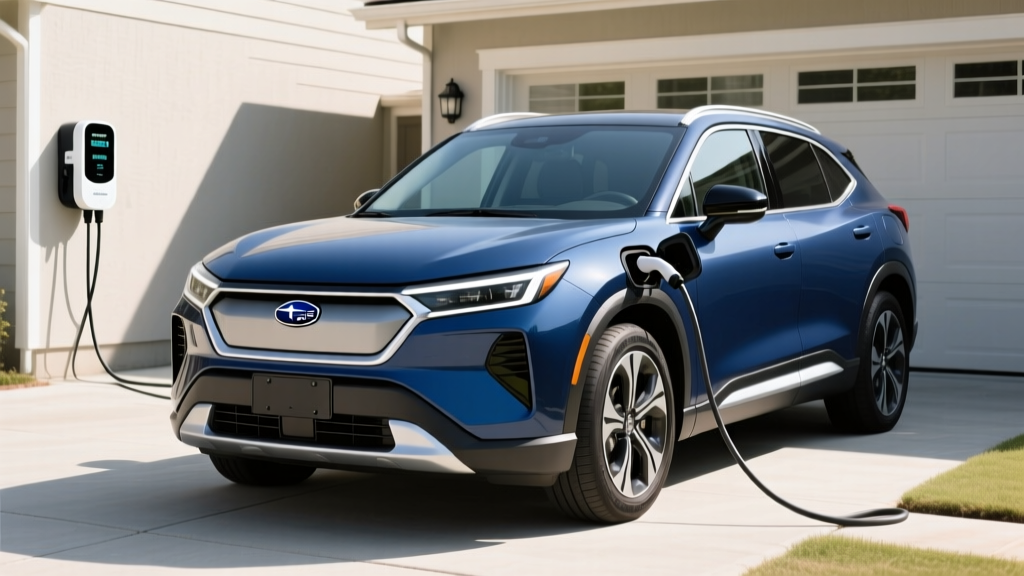
Level 2 home charging is where most Solterra owners will do 90%+ of their charging. It's also where installation variables can make costs swing wildly. Here's what you need to know before calling an electrician.
Electrical Specifications for Solterra Level 2 Charging
- Circuit requirement: Dedicated 40A or 50A breaker (240V)
- Charger amperage: 32A (on a 40A circuit) or 40A (on a 50A circuit) — NEC code requires circuits rated at 125% of continuous load
- Solterra onboard charger: 7.2 kW max (approximately 32A at 240V). This means even a 48A charger will only deliver 32A to the Solterra — but installing a higher-capacity circuit future-proofs for your next EV
- Wire gauge: 6 AWG copper for 50A circuits; 8 AWG for 40A circuits
- Outlet vs. hardwired: NEMA 14-50 outlet offers portability; hardwired avoids the $50–$100 outlet cost and is required for circuits above 50A in many jurisdictions
Will You Need a Panel Upgrade?
This is the cost wildcard most online guides gloss over. Your home's electrical panel has a total amperage capacity — typically 100A, 150A, or 200A in modern homes. Adding a 40–50A dedicated EV circuit consumes a significant chunk of that capacity.
You likely need a panel upgrade if:
- Your panel is 100A and you already run electric range, dryer, and central A/C
- Your panel has no available breaker slots
- Your home has older wiring (aluminum or knob-and-tube) that doesn't meet current code
- An electrician's load calculation shows you'd exceed 80% of panel capacity
A panel upgrade from 100A to 200A typically costs $1,500–$3,500 depending on your utility's requirements, local permitting, and whether a new service drop is needed. This can double or triple your total install cost — get a load calculation done before committing to equipment.
Home Charger Installation Cost Breakdown
| Component | Low-End Estimate | High-End Estimate | Notes |
|---|---|---|---|
| Level 2 charger (equipment) | $350 | $700 | 32A–48A smart chargers |
| Electrician labor (install) | $400 | $1,200 | Varies by run length, conduit, wall type |
| Permit and inspection | $50 | $250 | Required in most jurisdictions |
| NEMA 14-50 outlet (if not hardwired) | $50 | $150 | Industrial-grade receptacle recommended |
| Panel upgrade (if needed) | $1,500 | $3,500 | 100A → 200A service upgrade |
| Total (no panel upgrade) | $850 | $2,300 | Most common scenario |
| Total (with panel upgrade) | $2,350 | $5,800 | Older homes with 100A service |
Federal incentive note: The IRS Residential Clean Energy Credit (Form 5695) does not cover EV charger equipment for most taxpayers after 2022. However, the Alternative Fuel Vehicle Refueling Property Credit (§30C) was revived under the Inflation Reduction Act and can cover up to 30% of charger equipment and installation costs, capped at $1,000 — but only if you live in an eligible census tract (typically rural or low-income areas). Check your eligibility on the IRS site before counting on this credit.
Connector Compatibility: What Plugs Into a Solterra?
The 2025–2026 Subaru Solterra comes equipped with a CCS1 (Combined Charging System) port for both Level 2 AC and DC fast charging. However, the North American charging landscape is rapidly shifting toward NACS (North American Charging Standard), the Tesla-designed connector now adopted by nearly every major automaker.
| Connector Type | Use Case | Solterra Compatibility | Adapter Needed? |
|---|---|---|---|
| J1772 | Level 2 AC (public/home) | ✅ Native — top portion of CCS port | No |
| CCS1 | DC fast charging | ✅ Native | No |
| NACS (Tesla) | Tesla Superchargers (Level 2 & DC) | ⚠️ Via adapter | Yes — CCS-to-NACS adapter (~$200–$300) |
| CHAdeMO | Legacy DC fast charging | ❌ Not compatible | N/A — standard is essentially retired |
Practical advice for Solterra owners: As of 2026, Subaru has not transitioned to a native NACS port (that shift is expected for the next-generation model). To access Tesla Superchargers — the most reliable and widespread DC fast-charging network in the US — you'll need a CCS-to-NACS adapter. Subaru and Toyota have offered these adapters through dealerships; third-party options from brands like A2Z and Lectron are also available. Verify that any adapter supports the Solterra's maximum charge rate and is UL-listed for safety.
Charging Cost: Solterra Per-Mile Cost vs. Gas
The economic case for EVs hinges on fuel-cost savings. Let's run real numbers for the Solterra, which has a combined EPA efficiency of approximately 104 MPGe (roughly 32 kWh per 100 miles).
| Scenario | Rate | Cost per Full Charge (71.4 kWh) | Cost per Mile |
|---|---|---|---|
| Home — off-peak utility rate | $0.10/kWh | $7.14 | $0.032 |
| Home — national average | $0.17/kWh | $12.14 | $0.054 |
| Public Level 2 (ChargePoint, etc.) | $0.25–$0.39/kWh | $17.85–$27.85 | $0.080–$0.124 |
| DC fast charging (Electrify America, EVgo) | $0.35–$0.56/kWh | $24.99–$39.98 | $0.111–$0.178 |
| Gasoline equivalent (25 MPG SUV, $3.50/gal) | $3.50/gallon | $14.00 per 100 mi | $0.140 |
The verdict: Charging at home on off-peak rates, the Solterra costs roughly one-quarter what a comparable 25 MPG gas SUV costs per mile. Even on the national average residential rate, you're saving about 60%. However, exclusive reliance on DC fast charging at peak public rates can actually exceed gasoline costs per mile. Home charging access is the economic linchpin of EV ownership.
Best Level 2 Chargers for the Solterra: Equipment Picks
Since the Solterra's onboard charger maxes out at 7.2 kW (~32A), you don't technically need a 48A charger. But installing a 40A or 48A circuit gives you headroom for future vehicles with higher onboard chargers (many new EVs accept 11.5 kW or more). Here are three proven options:
ChargePoint Home Flex
- Power: Up to 12 kW (50A) — adjustable via dip switches
- Connector: J1772 (CCS compatible)
- Cable length: 23 feet
- Smart features: Wi-Fi, app scheduling, Alexa, utility integration
- Price: ~$550–$650
- Best for: Flexible amperage settings let you match your circuit exactly
Emporia Level 2 EV Charger
- Power: Up to 11.5 kW (48A)
- Connector: J1772 (CCS compatible)
- Cable length: 24 feet
- Smart features: Wi-Fi, energy monitoring, solar integration, time-of-use scheduling
- Price: ~$350–$400
- Best for: Budget-conscious buyers who want energy monitoring
Grizzl-E Smart
- Power: Up to 10 kW (40A)
- Connector: J1772 (CCS compatible)
- Cable length: 24 feet
- Smart features: OCPP protocol, app control, works with multiple networks
- Price: ~$450–$550
- Best for: Cold-climate durability — rated to -40°F, built in Canada
For Solterra owners specifically, the Emporia offers the best value. Its 48A output exceeds the Solterra's 32A acceptance rate, so you'll charge at the car's maximum 7.2 kW while keeping the circuit future-proof. The built-in energy monitoring helps you track exactly how much your EV is adding to your electric bill.
Safety and Electrical Code Considerations
A Level 2 charger draws continuous high current for hours — this is not a DIY-friendly installation unless you're a licensed electrician. Here's what code compliance looks like:
- Dedicated circuit: Your EV charger must have its own dedicated breaker — no sharing with other appliances. A 40A charger requires a 50A breaker (NEC 125% continuous-load rule).
- GFCI protection: The 2020 NEC (and most 2023/2026 adoptions) requires GFCI protection for outdoor receptacles used for EV charging. Hardwired installations may be exempt in some jurisdictions — ask your inspector.
- Outdoor rating: If your charger is installed outdoors or in an unenclosed carport, both the charger (NEMA 4 or NEMA 4X rated) and any receptacle must be rated for wet locations.
- Wire sizing: Undersized wire on a high-amperage circuit is a fire hazard. Your electrician will calculate the correct gauge based on run length and ambient temperature.
- Permit and inspection: Most municipalities require an electrical permit for a new 240V circuit. The inspection verifies wire gauge, breaker sizing, grounding, and GFCI compliance. Skipping the permit risks insurance denial if an electrical fire occurs.
Solterra Charging FAQ
How much does it cost to install a home EV charger for my Solterra?
Expect $850–$2,300 for a standard Level 2 installation (equipment, electrician labor, and permit) if your electrical panel has sufficient capacity. If you need a panel upgrade from 100A to 200A, total costs can reach $2,350–$5,800. Always get a load calculation from a licensed electrician before purchasing equipment.
How fast will each charging level add range to my Solterra?
Level 1 (120V) adds about 3–4 miles per hour — only useful for overnight top-ups on low-mileage days. Level 2 (240V) adds approximately 22–33 miles per hour, fully replenishing the Solterra's battery overnight. DC fast charging peaks around 100 kW but averages 55–70 kW across a session, adding roughly 150–220 miles per hour at peak — expect a 10–80% charge in about 55–65 minutes.
Which connector and charger is compatible with my Solterra?
The Solterra uses a CCS1 port natively, accepting J1772 for Level 2 and CCS1 for DC fast charging. To use Tesla Superchargers, you need a CCS-to-NACS adapter (~$200–$300). CHAdeMO is not compatible and is being phased out across North America.
How much does charging a Solterra cost per mile compared to gas?
At the national average residential electricity rate of ~$0.17/kWh, the Solterra costs about $0.054 per mile to charge at home. A comparable 25 MPG gas SUV at $3.50/gallon costs $0.14 per mile. That's roughly a 60% savings per mile — or about $860 saved annually for a driver covering 10,000 miles per year. Public DC fast charging at $0.40–$0.56/kWh narrows or eliminates that advantage.
What electrical upgrades might I need for a home charger?
The most common upgrade is a panel increase from 100A to 200A service ($1,500–$3,500). You may also need additional breaker slots, a new conduit run from panel to garage (if the panel is far from the charging location), or a service drop upgrade from your utility. Older homes with aluminum wiring or Federal Pacific/Zinsco panels may require full rewiring — a significant cost that should be evaluated before purchasing an EV.
Does cold weather affect Solterra charging speed?
Yes, significantly. Below 40°F, the battery management system limits charge rate to protect the cells until the battery warms up. In sub-freezing conditions, expect DC fast charging to take 20–40% longer unless you use the Solterra's battery preconditioning feature (activated via navigation to a charger). Cold weather also reduces range by 15–30% depending on temperature and cabin heating use.
Final Take: Optimizing Your Solterra Range Through Smart Charging
The Subaru Solterra's 222–227 miles of EPA range is adequate for most daily driving, but its 400V architecture and ~100 kW peak charge rate mean road-trip charging stops take longer than competitors with 800V systems. The economics and convenience overwhelmingly favor home Level 2 charging — budget $850–$2,300 for installation (more if you need a panel upgrade), choose a quality 40A–48A smart charger, and charge on off-peak utility rates to keep your per-mile cost below $0.05. For road trips, invest in a CCS-to-NACS adapter to access Tesla's Supercharger network, the most reliable DC fast-charging option available in 2026.