The Pump vs The Plug: What Subaru Gas and Tesla Charging Actually Cost in 2026
Shoppers cross-shopping a Subaru Outback (starting around $33,000) against a Tesla Model Y (starting near $44,990) often hit the same wall: the EPA window sticker tells you MPG for the Subaru and MPGe for the Tesla, but it doesn't tell you what you'll actually spend per mile in 2026. With national gas prices hovering near $3.35/gallon and public DC fast charging averaging $0.48/kWh, the answer depends almost entirely on where and how you charge — not whether you charge.
This guide breaks down Subaru gas vs Tesla charging with real numbers: cost per mile at home, on the road, and at a Supercharger; how fast each charging level adds range; what a Level 2 home install actually costs (including the panel upgrade most guides skip); and which connectors and chargers are compatible with today's EVs. Whether you're comparing a 2026 Outback 2.5i to a Model Y Long Range or just trying to understand what "charging at home" really means, the math below is what matters.
Charging Levels Explained: Speeds in kW and Miles Per Hour
Before comparing costs, you need the vocabulary straight. kW (kilowatts) is power — how fast energy flows into the battery, like gallons-per-minute at a hose. kWh (kilowatt-hours) is energy — how much the battery holds, like the size of the gas tank. Confusing them is the single most common EV mistake; every charger spec and electricity bill uses both.
| Level | Voltage / Amps | Power (kW) | Miles of Range Added Per Hour | Typical Use Case |
|---|---|---|---|---|
| Level 1 | 120V / 12A | ~1.4 kW | 3–5 mi/hr | Overnight trickle, PHEVs, emergency top-ups |
| Level 2 (Home) | 240V / 32–48A | 7.7–11.5 kW | 25–44 mi/hr | Daily home charging, the practical baseline |
| DC Fast (Public) | 400–800V DC | 50–350 kW | 150–1,000+ mi/hr (peak) | Road trips, quick top-ups away from home |
For a Tesla Model Y Long Range (75 kWh usable battery, EPA 320 miles), a full Level 2 charge from 10% to 90% takes roughly 8–10 hours on a 48A (11.5 kW) wall connector — perfect for overnight. On a 250 kW V3 Supercharger, 10–80% takes about 18–22 minutes, though the charge curve tapers sharply above 80%, so the last 20% can take as long as the first 80%.
For context, a Subaru Outback 2.5i with its 18.5-gallon tank refills in ~3 minutes at any gas station and delivers an EPA 28 MPG combined — about 518 miles of range per fill. That speed and range advantage is real, and it's why honest EV guides acknowledge road-trip friction instead of pretending it doesn't exist.
Subaru Gas vs Tesla Charging: Cost Per Mile Head-to-Head
Here's where the comparison gets concrete. We'll use a 2026 Subaru Outback 2.5i (28 MPG combined) and a 2026 Tesla Model Y Long Range (3.5 miles per kWh, roughly 120 MPGe combined) across four realistic fueling scenarios.
| Scenario | Input Cost | Vehicle Efficiency | Cost Per Mile | Annual Cost (12,000 mi) |
|---|---|---|---|---|
| Subaru Outback @ $3.35/gal | $3.35/gallon | 28 MPG combined | $0.120 | $1,440 |
| Tesla Model Y, home off-peak | $0.14/kWh | 3.5 mi/kWh | $0.040 | $480 |
| Tesla Model Y, home peak | $0.28/kWh | 3.5 mi/kWh | $0.080 | $960 |
| Tesla Model Y, Supercharger V3 | $0.38/kWh (avg) | 3.5 mi/kWh | $0.109 | $1,308 |
| Tesla Model Y, Electrify America | $0.48/kWh (avg) | 3.5 mi/kWh | $0.137 | $1,644 |
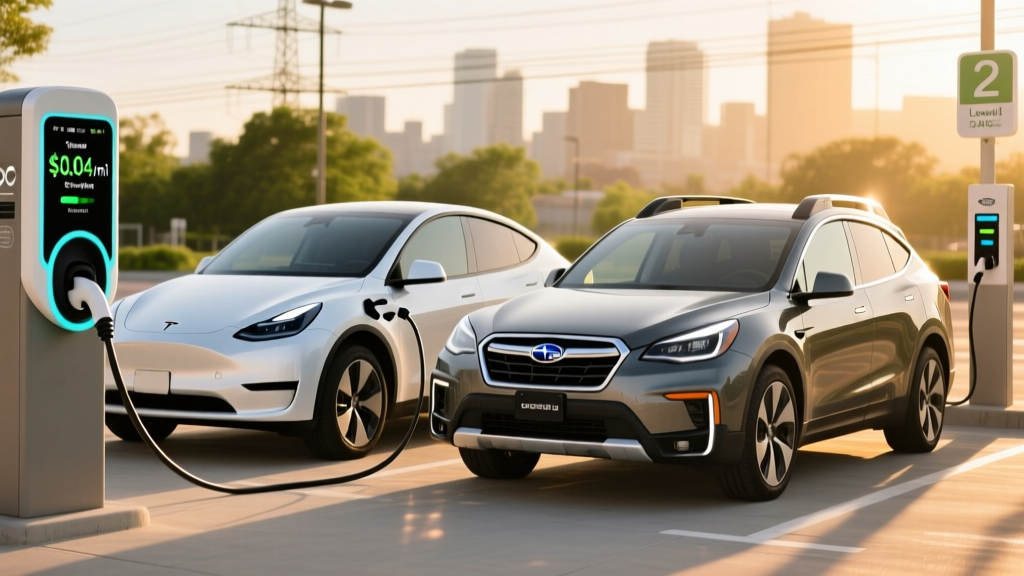
The takeaway is blunt: home-charged Tesla owners pay roughly one-third what Subaru owners pay per mile. But a Tesla owner who relies exclusively on third-party DC fast chargers like Electrify America can actually spend more per mile than the Subaru. This is the single most important variable in the Subaru gas vs Tesla charging debate — access to cheap home charging flips the economics entirely.
Tesla's Supercharger network remains the most reliable and broadly priced public option, with V3 stalls delivering a peak 250 kW and typical pricing between $0.30–$0.45/kWh depending on location and time-of-use. Third-party networks have improved dramatically since 2024, but pricing is less predictable and idle fees can add up. According to fueleconomy.gov, electricity rates vary by more than 3x between states — Hawaii averages ~$0.43/kWh while Louisiana sits near $0.10/kWh — so plug your local rate into the math above before committing.
Home EV Charger Installation: Real Costs, Electrical Requirements, and Panel Upgrades
Most home-charging cost comparisons quietly assume you already have a 240V circuit ready to go. Most homes don't. Here's the full picture of what a Level 2 installation actually costs in 2026, broken down the way an electrician would quote it.
Electrical Requirements for a Level 2 Charger
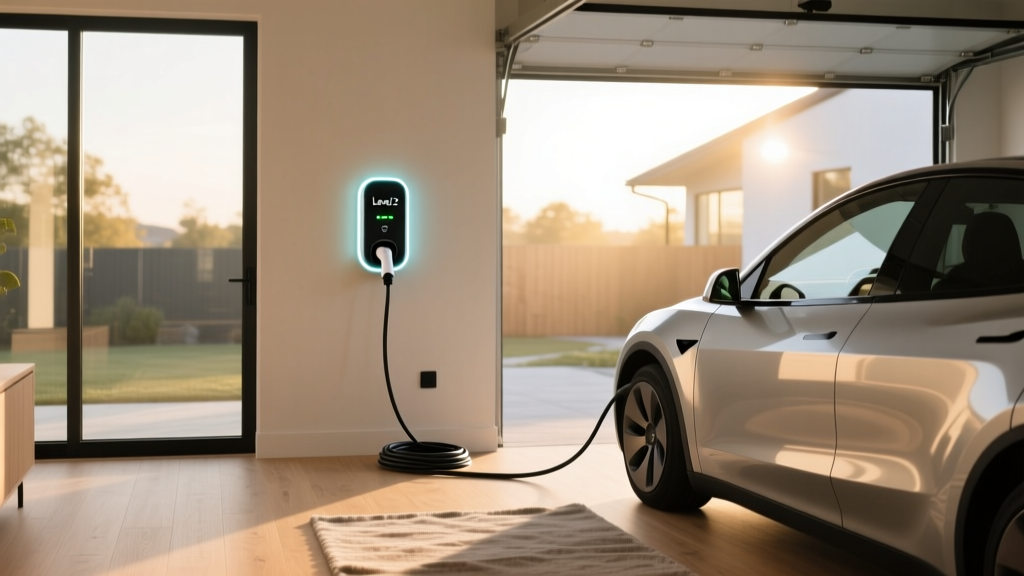
A proper Level 2 home charger runs on a dedicated 240V circuit — the same voltage as an electric dryer or oven. The most common and future-proof setup is a NEMA 14-50 outlet on a 50A breaker, which supports up to 40A continuous draw (National Electrical Code requires a 20% headroom, so a 50A breaker serves a 40A load). This delivers 9.6 kW on a single-phase residential system, enough to fully replenish a Model Y overnight.
If your electrical panel is near the garage (within ~20 feet), installation is straightforward. If the panel is on the opposite side of the house, in the basement, or already near capacity, costs climb fast. Homes built before 1990 often have 100A service panels that simply cannot spare 50A for an EV without a service upgrade to 200A — a $2,000–$4,500 project on its own.
| Item | Basic Install (panel nearby) | Complex Install (long run / panel upgrade) |
|---|---|---|
| Level 2 charger (hardware) | $400–$700 | $400–$700 |
| Electrician labor (2–4 hrs basic, 6–12 hrs complex) | $400–$900 | $1,200–$2,800 |
| Conduit, wire, NEMA 14-50 or hardwire | $150–$350 | $500–$1,200 |
| Permit & inspection | $75–$250 | $150–$400 |
| Panel upgrade (if needed, 100A → 200A) | — | $2,000–$4,500 |
| Total | $1,025–$2,200 | $4,250–$9,600 |
The Panel-Upgrade Gotcha Most Guides Skip
Before you buy a charger, pull up your panel and check the amperage rating (printed on the main breaker). Then run a simple load calculation: add up the amperage of your largest simultaneous loads — HVAC, electric range, dryer, water heater — and see if 40A for EV charging pushes you past 80% of panel capacity. If it does, a licensed electrician will require either a panel upgrade or a smart load-management device like the Emporia V2 with automatic EV curtailment (~$300 hardware), which throttles the charger when other big loads kick on. This is cheaper than a panel swap and increasingly accepted by inspectors.
Safety and Code Considerations
- Dedicated circuit: Level 2 chargers must have their own breaker — no sharing with dryers or HVAC.
- GFCI protection: NEC 2023 and later require GFCI breakers for outdoor receptacles used for EV charging; hardwired chargers often sidestep this requirement and are generally more reliable outdoors.
- Outdoor rating: If the charger lives outside, it must carry a NEMA 4 (weatherproof) rating. Every charger recommended below meets this.
- Permit: Nearly every US jurisdiction requires a permit and inspection for a new 240V circuit. Skipping it risks insurance denial if an electrical fire occurs.
Connector Compatibility: NACS, CCS1, CHAdeMO, and Adapter Reality
As of 2026, the North American connector landscape has consolidated heavily around NACS (North American Charging Standard) — Tesla's native plug, now adopted by Ford, GM, Rivian, Hyundai, Kia, Volvo, BMW, and most other major OEMs. CCS1 is still present on older vehicles and some public chargers, while CHAdeMO is effectively legacy (Nissan Leaf being the last major holdout, now discontinued in the US).
| Connector | Native Vehicles (2026) | Public Network Support | Adapter Needed? |
|---|---|---|---|
| NACS (Tesla) | Tesla, Ford, GM, Rivian, Hyundai, Kia, Volvo, BMW | Tesla Supercharger, Electrify America (partial), ChargePoint | None for NACS-native; CCS→NACS adapter ~$200 for legacy CCS cars |
| CCS1 | Older VW ID.4, legacy BMW i4/iX, some Stellantis | Electrify America, EVgo, ChargePoint | NACS→CCS adapter required for Supercharger access (~$199) |
| CHAdeMO | Legacy only (Nissan Leaf discontinued) | Shrinking rapidly; avoid for new purchases | No viable adapter to NACS |
For the Subaru vs Tesla question specifically: Tesla ships with a native NACS port and seamless Supercharger access. Subaru's upcoming EV offerings (the Solterra, co-developed with Toyota's bZ4X) use CCS1 and require a NACS adapter to access Tesla Superchargers — which Tesla has opened to non-Tesla vehicles via the Supercharger network expansion. The Solterra's peak charge rate of ~100 kW is modest compared to the Model Y's 250 kW, meaning even with adapter access, charging sessions are longer.
Equipment Recommendations: Best Home Chargers for 2026
These are the three Level 2 chargers I recommend most often, based on power output, cable length, smart features, outdoor durability, and real-world reliability. All carry NEMA 4 outdoor ratings and UL certification.
Tesla Wall Connector (Gen 4) — Best for Tesla Owners
- Power output: 11.5 kW (48A on 60A breaker) or 9.6 kW (40A on 50A breaker)
- Connector: Native NACS, 24-ft cable
- Smart features: Wi-Fi updates, load sharing between two units, scheduled charging, energy tracking via Tesla app
- Price: ~$475
- Best for: Tesla owners who want seamless integration and the longest cable on the market
Emporia V2 — Best Value with Energy Management
- Power output: Up to 11.5 kW (48A), configurable down to match panel capacity
- Connector: NACS native (J1772 with adapter included)
- Smart features: Built-in load management, solar integration, real-time energy monitoring, automatic curtailment to avoid panel overload
- Price: ~$399 (charger) + ~$300 for load-management module if needed
- Best for: Homes with tight panel capacity or solar arrays; the load-management feature alone can save a $3,000 panel upgrade
ChargePoint Home Flex (Gen 2) — Best Universal Pick
- Power output: Up to 12 kW (50A), DIP-switch adjustable from 16A–50A
- Connector: Ships NACS; J1772 version available
- Smart features: Alexa/Google Home integration, detailed app scheduling, utility demand-response programs, 25-ft cable
- Price: ~$649
- Best for: Multi-EV households or buyers who want the widest smart-home integration
All three support hardwired installation (preferred outdoors) or NEMA 14-50 plug connection. Hardwired avoids the GFCI-breaker requirement and eliminates the most common failure point — a loose plug under sustained high-amperage load.
Charging Time Examples: 10–80% for Common Battery Sizes
Real charging times are longer than marketing claims because of the charge curve: EVs charge fastest between 10–50% state of charge, then taper progressively to protect the battery. Peak kW numbers are only sustained for a few minutes at low SoC.
| Vehicle (2026) | Battery (kWh usable) | Peak DC Rate | 10–80% Time (DC Fast) | 10–80% Time (Level 2, 11.5 kW) |
|---|---|---|---|---|
| Tesla Model Y Long Range | 75 kWh (NMC) | 250 kW | ~20 min (V3 Supercharger) | ~4.5 hours |
| Hyundai Ioniq 5 | 77.4 kWh (NMC) | 350 kW (800V) | ~18 min (350 kW station) | ~5 hours |
| Ford F-150 Lightning Ext. Range | 131 kWh (NMC) | 150 kW | ~41 min | ~8 hours |
| Chevrolet Equinox EV | 85 kWh (NMC) | 190 kW | ~24 min | ~5.5 hours |
| Subaru Solterra | 71.4 kWh (NMC) | ~100 kW | ~38 min | ~5 hours |
For daily driving, Level 2 at home is all most owners need — you plug in when you get home and wake up to a full battery. DC fast charging is a road-trip tool, and the 10–80% time matters more than peak kW because that's the usable window you'll actually sit through.
Tax Credits and Incentives That Offset Installation
The IRS §30C Alternative Fuel Vehicle Refueling Property Credit covers 30% of home EV charger hardware and installation costs, up to $1,000 per tax year — but only if you live in a qualifying census tract (lower-income or rural areas, per the Inflation Reduction Act). This is separate from the §30D new-vehicle credit and applies specifically to the charger and its installation. Check eligibility with a tax professional, as the census-tract map is specific and changes aren't always obvious.
Many utilities also offer rebates of $250–$750 for Level 2 charger installations, and some (like PG&E, ConEd, and Xcel Energy) offer time-of-use rates that push off-peak electricity below $0.10/kWh — dramatically improving the cost-per-mile math above.
FAQ: Subaru Gas vs Tesla Charging — The Questions Buyers Actually Ask
How much does it cost to install a home EV charger?
A straightforward Level 2 install with a panel nearby runs $1,025–$2,200 all-in (charger, electrician, permit, materials). Homes needing long wire runs or a 100A→200A panel upgrade can see $4,250–$9,600. Always get a load calculation before committing.
How fast will each charging level add range?
Level 1 (120V): 3–5 miles per hour. Level 2 (240V, 48A): 25–44 miles per hour depending on vehicle efficiency. DC fast charging: 150–1,000+ miles per hour at peak, but sustained rates taper above 80% SoC. For a Tesla Model Y, Level 2 adds roughly 35 miles per hour of charging.
Which connector/charger is compatible with my EV?
2026 Teslas use native NACS and need no adapter. Most non-Tesla EVs sold new in 2026 also use NACS. Older CCS1 vehicles (2022–2024 model years) need a NACS adapter (~$199) for Supercharger access. CHAdeMO vehicles have no viable adapter path and should be avoided for new purchases.
How much does charging cost per mile vs gas?
A Tesla Model Y charged at home off-peak (~$0.14/kWh) costs about $0.04 per mile — roughly one-third the $0.12/mile of a 28-MPG Subaru Outback at $3.35/gallon gas. However, exclusive public DC fast charging ($0.48/kWh average) pushes the Tesla to $0.14/mile, more expensive than the Subaru. Home charging access is the deciding factor.
What electrical upgrades might I need?
If your home has a 100A service panel (common pre-1990), you'll likely need a 200A upgrade ($2,000–$4,500) to support a 50A EV circuit. Alternatively, a smart load-management device (~$300) can throttle the charger when other loads are active, avoiding the upgrade entirely. An electrician's load calculation will determine which path is required.
The Subaru gas vs Tesla charging decision ultimately comes down to one question: can you charge at home? If yes, the Tesla's per-mile cost collapses to a fraction of gas. If no — apartment living, no garage, no panel capacity — the Subaru's predictable fill-up economics remain hard to beat until public charging pricing and density catch up.