Stellantis Joins the Supercharger Network — What It Means for Your Charging Routine
If you drive a Jeep Wrangler 4xe, Chrysler Pacifica Hybrid, Dodge Hornet R/T, or the upcoming battery-electric Jeep Wagoneer S, the 2026 charging landscape looks fundamentally different than it did two years ago. Stellantis officially adopted the North American Charging Standard (NACS) for its new battery-electric vehicles and secured Supercharger network access for existing CCS1-equipped models through an approved adapter. That means roughly 20,000 additional Tesla Supercharger stalls — the most reliable DC fast-charging network in North America — are now reachable for Stellantis EV owners.
But network access is only half the equation. The other half is understanding what happens when you plug in at home, how fast each charging level actually replenishes your battery, whether your electrical panel can handle a Level 2 install, and what the real per-mile cost looks like versus pumping gas. This guide covers Stellantis Supercharger access specifics and then walks through every charging decision you'll face as an owner.
Stellantis Supercharger Access: How It Works in 2026
Stellantis announced its NACS adoption timeline in mid-2024, aligning with Ford, GM, Rivian, Volvo, and most other major automakers. Here's how access breaks down by vehicle generation:
| Vehicle | Native Port | Supercharger Access | Adapter Required? |
|---|---|---|---|
| 2026 Jeep Wagoneer S | NACS | Native — plug directly in | No |
| 2026 Jeep Recon | NACS | Native — plug directly in | No |
| 2024–2025 Jeep Wrangler 4xe | J1772 (L2) / CCS1 (DC) | Via CCS1-to-NACS adapter | Yes (~$200–$250) |
| 2024–2026 Chrysler Pacifica Hybrid | J1772 (L2 only — no DC) | Not applicable (PHEV, no DC port) | N/A |
| 2024–2026 Dodge Hornet R/T | J1772 (L2 only — no DC) | Not applicable (PHEV, no DC port) | N/A |
Critical distinction for PHEV owners: Plug-in hybrids like the Wrangler 4xe, Pacifica Hybrid, and Hornet R/T have relatively small battery packs (12–17 kWh usable). They charge via J1772 Level 2 only and lack a DC fast-charge port entirely. Supercharger stalls deliver DC power, so even with an adapter, a PHEV cannot use them. These vehicles are designed for overnight home charging and occasional public Level 2 top-ups.
How to activate Supercharger access on a NACS-equipped Stellantis BEV: Download the Tesla app or use the in-vehicle infotainment (on supported 2026 models with integrated routing). Payment is handled through the Tesla app linked to a credit card. Pricing at Superchargers varies by location and time of day — expect $0.25–$0.48/kWh in most markets, with idle fees of $0.50–$1.00/minute if you remain plugged in after reaching your charge limit.
Charging Levels Explained: Speeds, kW, and Miles Per Hour
Before evaluating home equipment or public networks, you need clarity on the three charging levels and what they deliver. kW (kilowatts) measures power — the rate at which energy flows into your battery. kWh (kilowatt-hours) measures energy — the total capacity of your battery. Think of kW as the width of a hose and kWh as the size of the bucket.
| Level | Power (kW) | Voltage / Amps | Miles of Range / Hour | Best For |
|---|---|---|---|---|
| Level 1 | 1.0–1.4 kW | 120V / 12A | 3–5 mi/hr | PHEVs, overnight trickle |
| Level 2 | 3.3–19.2 kW | 240V / 16–80A | 12–60 mi/hr | Daily home charging |
| DC Fast Charge | 50–350 kW | 200–900V DC | 150–1,200+ mi/hr | Road trips, quick top-ups |
Real-world charging time examples (10% to 80% SoC):
- Jeep Wagoneer S (~100 kWh battery, peak ~175 kW DC): 10–80% in approximately 28–32 minutes at a V3 Supercharger (250 kW stall), tapering significantly above 80%.
- Jeep Recon (~85 kWh battery, peak ~150 kW DC): 10–80% in approximately 30–35 minutes at a 250 kW stall.
- Wrangler 4xe (17 kWh battery, Level 2 at 7.2 kW): 0–100% in roughly 2.5 hours on a 240V/32A circuit. DC fast charging is not available.
Charging curve reality check: Peak kW ratings are just that — peaks. Most EVs sustain peak charge rate only between roughly 10–40% State of Charge (SoC). Above 60%, the rate tapers to protect battery longevity. Above 80%, charging slows dramatically. On a road trip, plan your stops around 10–80% charges rather than waiting for a full battery — the last 20% can take as long as the first 70%.
Home Level 2 Installation: Electrical Requirements and Costs
Home Level 2 charging is where 80% or more of your charging will happen. It's also where installation complexity and cost vary enormously depending on your home's electrical infrastructure.
Electrical Requirements
A typical Level 2 home charger operates on a 240-volt dedicated circuit, the same voltage as your electric dryer or oven. The most common residential setup is a NEMA 14-50 outlet on a 50-amp breaker, which supports continuous draw of 40 amps (National Electrical Code requires circuits be loaded to no more than 80% of breaker rating for continuous loads). This delivers up to 9.6 kW.
If you want faster charging — say, 11.5 kW (48A continuous) or 19.2 kW (80A continuous) — you'll need a 60-amp or 100-amp breaker respectively, heavier-gauge wiring, and likely a hardwired connection rather than a plug-in outlet.
Panel Upgrade Considerations
Most modern homes with a 200-amp electrical panel can accommodate a 50-amp EV circuit without a panel upgrade. However, older homes with 100-amp or 150-amp service may already be near capacity with existing loads (HVAC, electric range, dryer, water heater). A licensed electrician will perform a load calculation per NEC Article 220 to determine whether your panel can handle the additional draw.
If a panel upgrade is needed — typically from 100A to 200A — expect costs of $1,500–$4,000 depending on your utility's requirements, whether a new meter base is needed, and local labor rates. In rare cases involving underground service lateral upgrades, costs can exceed $5,000.
| Component | Low-End Estimate | High-End Estimate | Notes |
|---|---|---|---|
| Level 2 charger unit (40A–48A) | $350 | $700 | Smart Wi-Fi models cost more |
| Electrician labor (outlet install) | $300 | $1,200 | Depends on run length from panel |
| Electrical permit | $50 | $200 | Required in most jurisdictions |
| Wiring / conduit materials | $50 | $400 | Longer runs = more copper |
| Panel upgrade (if needed) | $1,500 | $4,000 | 100A → 200A service upgrade |
| TOTAL (no panel upgrade) | $750 | $2,500 | Typical scenario |
| TOTAL (with panel upgrade) | $2,250 | $6,500 | Older homes |
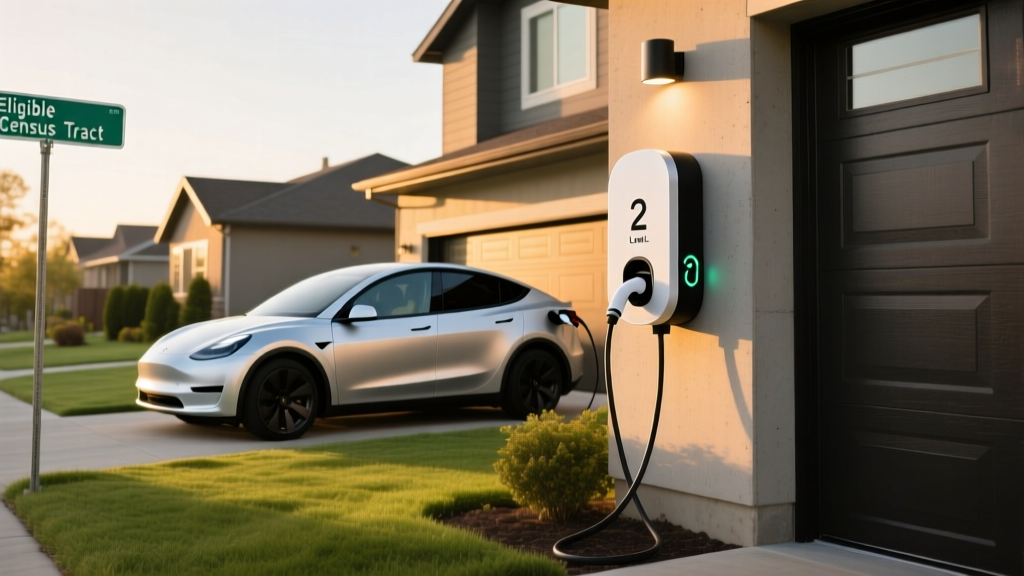
Federal incentive note: The Alternative Fuel Vehicle Refueling Property Credit (IRS Form 8911) may cover up to 30% of home charger equipment and installation costs, capped at $1,000. Eligibility depends on census-tract requirements and income thresholds. Consult a tax professional for your specific situation.
Safety and Code Considerations
- Dedicated circuit: Your EV charger must be on its own dedicated breaker — never share a circuit with other appliances.
- GFCI protection: NEC 2020 and later require GFCI protection for all 240V receptacles used for EV charging. Hardwired chargers may not require a GFCI breaker (the charger itself often includes ground-fault protection).
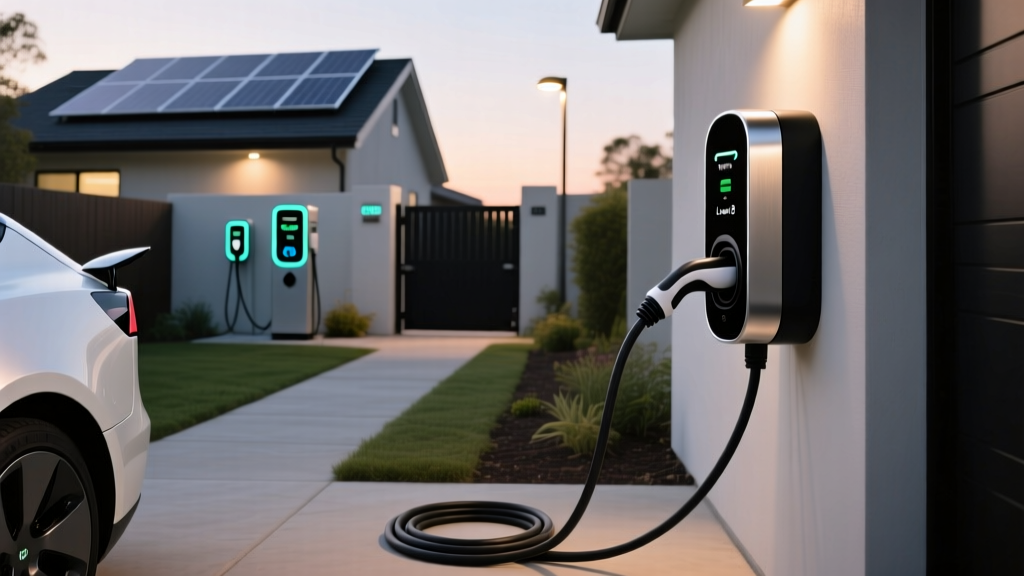
- Outdoor rating: If your charger is installed outdoors (carport, driveway), ensure the unit carries a NEMA 4 or NEMA 4X weather-resistance rating. The NEMA 14-50 outlet must also be in a weatherproof enclosure.
- Cable management: Choose a charger with at least 18–25 feet of cable to reach your vehicle's charge port from various parking orientations.
- Always hire a licensed electrician. DIY electrical work on 240V circuits carries serious shock and fire risk, and unpermitted work can void your homeowner's insurance.
Level 2 Charger Equipment Recommendations for 2026
Not all Level 2 chargers are equal. The key differentiators are power output (amps/kW), connector type, cable length, smart features (Wi-Fi scheduling, energy monitoring), and build quality. Here are three proven options across different budgets:
Emporia Level 2 Smart Charger
- Power: 48A / 11.5 kW (hardwired) or 40A / 9.6 kW (NEMA 14-50 plug)
- Connector: J1772 (NACS adapter included in 2026 kit)
- Cable: 24 ft
- Smart features: Wi-Fi, solar integration, energy dashboard, scheduled charging
- Price: ~$400–$500
- Best for: Budget-conscious buyers wanting full smart features and energy monitoring
ChargePoint Home Flex
- Power: Configurable 16A–50A / 3.8–12 kW (NEMA 14-50 or hardwired)
- Connector: J1772 (NACS adapter available)
- Cable: 23 ft
- Smart features: Wi-Fi, Alexa integration, ChargePoint app scheduling, usage reports
- Price: ~$550–$700
- Best for: Flexible amperage settings to match your circuit capacity
Tesla Wall Connector
- Power: 48A / 11.5 kW (hardwired, 60A breaker)
- Connector: Native NACS (J1772 adapter available for non-Tesla vehicles)
- Cable: 24 ft
- Smart features: Wi-Fi, over-the-air updates, power-sharing with second unit, Tesla app
- Price: ~$475
- Best for: Stellantis NACS-native vehicles (Wagoneer S, Recon) — plug in without any adapter
Editor's pick for Stellantis owners: If you're driving a 2026 Wagoneer S or Recon with a native NACS port, the Tesla Wall Connector is the most seamless home solution — no adapter needed, competitive pricing, and excellent build quality. If you drive a CCS1-equipped model or want cross-brand compatibility for guests, the ChargePoint Home Flex with its configurable amperage is the most adaptable choice.
Cost to Charge: Per-Mile Economics vs. Gasoline
The financial case for home charging is compelling, but public DC fast charging narrows the gap. Here's how costs break down across scenarios, using a midsize SUV efficiency baseline of approximately 3.0 miles/kWh (roughly equivalent to a Wagoneer S or similar BEV):
| Charging Scenario | Rate ($/kWh) | Cost per Mile | Cost for 300 mi |
|---|---|---|---|
| Home — off-peak utility rate | $0.08–$0.12 | $0.03–$0.04 | $8–$12 |
| Home — standard rate (no TOU) | $0.14–$0.18 | $0.05–$0.06 | $14–$18 |
| Public Level 2 (workplace, retail) | $0.20–$0.35 | $0.07–$0.12 | $20–$35 |
| Tesla Supercharger (avg. 2026) | $0.28–$0.42 | $0.09–$0.14 | $28–$42 |
| Electrify America / EVgo DC | $0.35–$0.55 | $0.12–$0.18 | $35–$55 |
| Gasoline baseline (25 MPG SUV, $3.40/gal) | — | $0.14 | $41 |
Key takeaways:
- Home off-peak charging is roughly 70–75% cheaper per mile than gasoline.
- Even at standard residential rates, EV charging costs about 60% less per mile than gas.
- Exclusive reliance on DC fast charging at peak Supercharger or Electrify America rates can approach or even exceed gasoline costs per mile — the economic advantage depends heavily on home charging access.
- Time-of-use (TOU) utility plans that offer overnight rates below $0.10/kWh maximize savings. Check with your utility about EV-specific rate plans.
For PHEV owners (Wrangler 4xe, Pacifica Hybrid), the calculus is different. Your electric-only range is 25–32 miles, after which you're burning gasoline at 20–30 MPG combined. The per-mile cost advantage only applies to those electric miles. If you can charge at home nightly and your commute is under 30 miles, you'll rarely visit a gas station. If your daily driving exceeds your electric range, the PHEV operates as a conventional hybrid with MPG in the mid-20s to low-30s — still efficient, but not BEV-level cheap.
Public Charging Beyond Superchargers: CCS1 and Network Reality
While Supercharger access is a significant advantage, Stellantis owners should also understand the broader public charging ecosystem:
- Electrify America: Operates CCS1-equipped DC fast chargers at up to 350 kW. NACS-native Stellantis BEVs will need a NACS-to-CCS1 adapter (~$200) to use these stations. EA reliability has improved but still trails Tesla in uptime.
- EVgo: Mix of CCS1 and NACS stalls as of 2026, with ongoing retrofit. Check the EVgo app for connector availability at specific stations.
- ChargePoint / Blink / Shell Recharge: Predominantly Level 2 public chargers using J1772. All EVs can use these with no adapter (or a NACS-to-J1772 adapter for NACS-native vehicles).
For road-trip planning, the Tesla in-app navigation (on NACS-native Stellantis vehicles with Supercharger integration) or third-party apps like A Better Routeplanner (ABRP) will route you through Supercharger stops and pre-condition the battery for optimal charge speed upon arrival.
Frequently Asked Questions
How much does it cost to install a home EV charger?
For a standard Level 2 installation on an existing 200-amp panel with a short wiring run, expect $750–$2,500 total (charger unit + electrician labor + permit + materials). If your home requires a panel upgrade from 100A to 200A service, total costs can range from $2,250–$6,500. Get at least three quotes from licensed electricians, and confirm the quote includes permit filing and inspection.
How fast will each charging level add range?
Level 1 (120V standard outlet) adds 3–5 miles of range per hour — adequate for PHEVs with small batteries but impractical for BEVs. Level 2 (240V, 40–48A) adds 12–40 miles per hour depending on your vehicle's onboard charger capacity, easily replenishing a full battery overnight. DC fast charging at a Supercharger or comparable station adds 150–1,200+ miles per hour at peak rate, enabling 10–80% charges in 25–35 minutes for most Stellantis BEVs.
Which connector and charger is compatible with my Stellantis EV?
2025–2026 Stellantis battery-electric vehicles (Wagoneer S, Recon) use a native NACS connector. Older Stellantis BEVs use CCS1 for DC fast charging and J1772 for Level 2. All Stellantis PHEVs (Wrangler 4xe, Pacifica Hybrid, Hornet R/T) use J1772 only and have no DC fast-charge capability. For home Level 2 charging, any J1772 or NACS charger will work with the appropriate adapter. For Supercharger access, NACS-native vehicles plug in directly; CCS1 vehicles need a CCS1-to-NACS adapter.
How much does charging cost per mile compared to gas?
At home on off-peak electricity rates ($0.08–$0.12/kWh), EV charging costs $0.03–$0.04 per mile — roughly 70–75% less than a 25 MPG SUV burning $3.40/gallon gasoline ($0.14/mile). Even on standard residential rates, you'll save about 60%. Public DC fast charging at $0.28–$0.55/kWh costs $0.09–$0.18 per mile, which narrows or eliminates the savings versus gas. The economic case for EVs depends heavily on reliable home charging access.
What electrical upgrades might I need for a home charger?
The most common upgrade is adding a 240V/50A dedicated circuit with a NEMA 14-50 outlet — straightforward if your panel has spare capacity. If your electrical panel is already near its rated capacity (common in older homes with 100A service running electric HVAC, range, and dryer), you may need a panel upgrade to 200A, costing $1,500–$4,000. In some cases, a smart load-management device (like the Emporia Smart Panel or Span drive) can avoid a full panel upgrade by dynamically limiting charger draw when other loads are active. Your electrician's load calculation will determine which path is needed.
Can I charge my Stellantis PHEV at a Tesla Supercharger?
No. Stellantis plug-in hybrids (Wrangler 4xe, Pacifica Hybrid, Dodge Hornet R/T) do not have a DC fast-charge port. They charge exclusively via Level 1 (120V) or Level 2 (240V, J1772 connector). Supercharger stalls deliver DC power that PHEVs cannot accept. For PHEV owners, a home Level 2 charger is the primary charging solution, and a full charge takes 2–3 hours on a 240V/32A circuit.
Does the federal tax credit cover home charger installation?
Possibly. The Alternative Fuel Vehicle Refueling Property Credit (26 USC §30C) covers up to 30% of qualified home EV charging equipment and installation costs, with a maximum credit of $1,000. However, eligibility is restricted to equipment installed in qualifying census tracts (generally low-income or non-urban areas). Check the IRS guidance and consult a tax professional to determine whether your address qualifies.
Sources: EPA fuel-economy data via fueleconomy.gov; IRS tax credit guidance via irs.gov; Stellantis NACS adoption and Supercharger access details from manufacturer press releases and stellantis.com.