If you've ever searched for "SRT8 Charger HP" and ended up wondering how that compares to the power flowing into a modern electric vehicle, you're not alone. The 2015 Dodge Charger SRT8 produced 470 horsepower from its 6.4-liter HEMI V8. That's an impressive output, but horsepower and kilowatts measure fundamentally different things in the EV world. HP describes mechanical work at the wheels; kW describes electrical power flowing from a charger into a battery. Understanding this distinction is the first step to mastering EV charging at home and on the road.
This guide breaks down every charging level, the real costs of home installation, which connector your EV needs, and exactly how much you'll pay per mile compared to gasoline — all from a practical, data-driven perspective for 2026 buyers.
Charging Levels Explained: kW Speeds and Miles Per Hour
EV charging operates across three distinct levels, each defined by voltage, amperage, and the resulting power output measured in kilowatts (kW). Remember: kW measures the rate of energy transfer, while kWh (kilowatt-hours) measures the total energy stored in your battery. A 75 kWh battery charged at 11.5 kW will take roughly 6.5 hours from empty to full, minus charge-curve tapering above 80% state of charge.
| Level | Voltage | Max Power (kW) | Miles of Range Per Hour | Best Use Case |
|---|---|---|---|---|
| Level 1 | 120V AC | 1.4 kW (12A) | 3–5 mi/hr | Overnight top-ups, PHEVs, emergency use |
| Level 2 | 240V AC | 7.7–19.2 kW (32–80A) | 25–70 mi/hr | Daily home charging, workplace, shopping centers |
| DC Fast Charging | 400–800V DC | 50–350 kW | 180–1,200+ mi/hr (peak) | Road trips, highway corridors, rapid top-ups |
A critical reality most marketing glosses over: DC fast chargers rarely sustain peak output. A station rated at 350 kW may only deliver that rate between 10–30% state of charge, then taper progressively. Expect a 10–80% session on a 250 kW-capable vehicle (like the Hyundai Ioniq 5 or Tesla Model 3 Long Range) to take approximately 18–22 minutes, not the theoretical minimum. Cold batteries charge even slower — preconditioning your EV before arriving at a DC fast charger can cut session time by 30–50% in winter conditions.
Home EV Charger Installation: Electrical Requirements and Costs
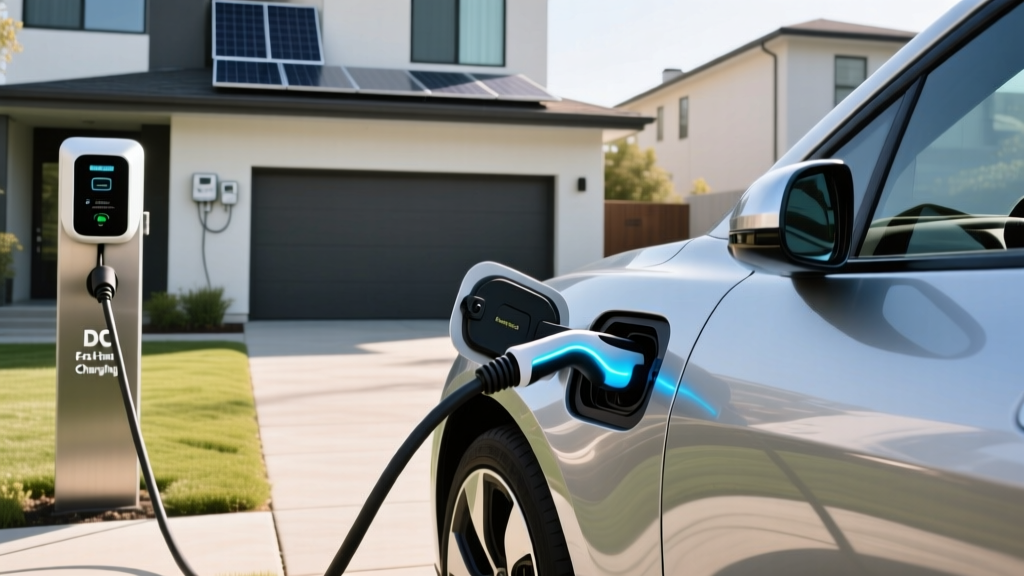
Installing a Level 2 home charger is the single highest-impact upgrade for daily EV ownership. Most EV owners do 80–90% of their charging at home, waking up to a full battery every morning. But installation costs vary wildly based on your electrical panel, wiring distance, and local permit requirements.
What Electrical Service Do You Need?
A standard Level 2 charger requires a dedicated 240V circuit, similar to an electric dryer or oven. The most common home setup is a 240V/48A circuit supporting an 11.5 kW charger (hardwired), or a 240V/40A circuit for a NEMA 14-50 outlet supporting up to 7.7 kW (with a 32A charger). Your electrical panel must have enough spare capacity — typically 200A service for modern homes, though 100A panels in older builds may require an upgrade.
The NEC 80% rule means a 50A breaker can only support a continuous 40A load, and a 60A breaker supports a continuous 48A load. Always size your breaker 25% above your charger's rated amperage.
| Component | Cost Range | Notes |
|---|---|---|
| Level 2 Charger (Equipment) | $350–$750 | Smart WiFi-enabled, 32–48A, 240V |
| Electrician Labor | $500–$2,000 | Depends on run length, wall type, conduit |
| Electrical Permit | $50–$300 | Varies by municipality; required for code compliance |
| Panel Upgrade (if needed) | $1,500–$4,000 | 100A → 200A upgrade; not needed in most modern homes |
| Total (No Panel Upgrade) | $900–$3,050 | Typical range for most homes |
| Total (With Panel Upgrade) | $2,400–$7,050 | Older homes with 100A service |
Before hiring an electrician, check your panel for spare breaker slots and calculate your existing load. If your panel is near capacity — running electric heat, a dryer, and an oven on a 100A service — a panel upgrade becomes necessary. Some utilities offer rebates or load-management devices that let you avoid a panel upgrade by throttling charger amperage when household demand peaks.
Safety and Code Requirements
Every Level 2 installation must comply with NEC Article 625 and local building codes. Key requirements include:
- Dedicated circuit: Your charger must have its own breaker — no sharing with other appliances.
- GFCI protection: Required for outdoor outlets (NEMA 14-50); hardwired chargers with built-in GFCI are preferred.
- Outdoor rating: If mounted outside, the charger must carry a NEMA 4 or IP65 rating for weather resistance.
- Cable management: NEC requires strain relief and proper cable routing; avoid running cords across walkways.
- Permit and inspection: Skipping the permit risks insurance denial in the event of an electrical fire.
Connector Compatibility: NACS, CCS1, and CHAdeMO in 2026
The connector landscape has consolidated significantly since Ford, GM, Rivian, and most major automakers adopted Tesla's North American Charging Standard (NACS) starting in 2025. By 2026, NACS is the dominant connector for new EVs sold in North America, though CCS1 remains widely available at public stations and CHAdeMO persists on older Nissan Leaf models.
| Connector | Also Known As | 2026 Vehicle Examples | DC Fast Max kW | Adapter Needed? |
|---|---|---|---|---|
| NACS | Tesla connector, J3400 | Tesla Model 3/Y/S/X, Ford F-150 Lightning, GM Equinox EV, Rivian R1S/R1T, Hyundai Ioniq 5 (2025+) | Up to 350 kW | No — native on new models |
| CCS1 | Combined Charging System | VW ID.4 (pre-2026), older Hyundai/Kia EVs, BMW iX (pre-NACS transition) | Up to 350 kW | CCS-to-NACS adapter ($150–$250) for Tesla Superchargers |
| CHAdeMO | — | Nissan Leaf (legacy), Mitsubishi Outlander PHEV (older) | Up to 100 kW (typical 50 kW) | Increasingly rare at public stations; plan for CCS/NACS adapter |
If you're buying a 2026 model-year EV, it almost certainly ships with a native NACS port. Owners of 2022–2024 CCS-equipped vehicles can purchase manufacturer-approved adapters (Ford and Rivian offer them directly) to access the Tesla Supercharger network, which now numbers over 25,000 stalls in North America. For home Level 2 charging, all connectors use the J1772 standard for AC — or NACS for newer vehicles — so compatibility is straightforward.
Cost to Charge: Per-Mile Electricity vs. Gasoline
The economic case for EV charging hinges on your local electricity rates, whether you charge at home or publicly, and the efficiency of your vehicle. Let's run the numbers against a gasoline baseline.
| Scenario | Rate | Vehicle Efficiency | Cost Per Mile |
|---|---|---|---|
| Home Level 2 (off-peak utility rate) | $0.09/kWh | 3.5 mi/kWh (120 MPGe) | $0.026/mi |
| Home Level 2 (national avg. residential) | $0.17/kWh | 3.5 mi/kWh (120 MPGe) | $0.049/mi |
| Public Level 2 (network pricing) | $0.30/kWh | 3.5 mi/kWh (120 MPGe) | $0.086/mi |
| DC Fast Charging (Electrify America, EVgo) | $0.48/kWh | 3.5 mi/kWh (120 MPGe) | $0.137/mi |
| Gasoline Vehicle (30 MPG combined) | $3.40/gal | 30 MPG | $0.113/mi |
| Gasoline Vehicle (20 MPG combined) | $3.40/gal | 20 MPG | $0.170/mi |
Home charging at off-peak rates delivers fuel costs roughly one-quarter of what a 30 MPG gas car pays. Even at the national average residential rate of $0.17/kWh (per U.S. EIA data), EVs maintain a clear per-mile advantage. However, exclusive reliance on DC fast charging erases that advantage — at $0.48/kWh, you're paying more per mile than a 30 MPG gas vehicle. This is why home Level 2 installation isn't optional for cost-conscious EV ownership; it's foundational.
For a concrete example: a driver covering 12,000 miles/year with home off-peak charging at $0.09/kWh spends approximately $312 annually on electricity. That same distance in a 20 MPG gasoline vehicle costs $2,040 at $3.40/gallon — a $1,728 annual savings with the EV.
Recommended Home Level 2 Chargers for 2026
After evaluating reliability, smart features, cable length, and power output across dozens of units, these are the chargers we recommend for most EV owners in 2026:
ChargePoint Home Flex
- Power Output: Up to 12 kW (50A, 240V) — configurable down to 16A for lower-capacity panels
- Connector: J1772 (NACS adapter available)
- Cable Length: 23 feet
- Smart Features: WiFi, Alexa integration, scheduled charging, energy tracking via app
- Price: ~$549
- Best For: Most homeowners; adjustable amperage avoids panel upgrades
Wall Connector (Tesla)
- Power Output: Up to 11.5 kW (48A, 240V)
- Connector: NACS native (J1772 adapter included for non-Tesla EVs)
- Cable Length: 24 feet
- Smart Features: WiFi, OTA updates, power sharing between multiple units, vehicle-integrated scheduling
- Price: ~$450
- Best For: Tesla owners and NACS-equipped 2025+ EVs
Emporia Level 2 EV Charger
- Power Output: Up to 11.5 kW (48A, 240V)
- Connector: J1772 (NACS version available)
- Cable Length: 24 feet
- Smart Features: Real-time energy monitoring, solar integration, load management, detailed app analytics
- Price: ~$399
- Best For: Budget-conscious buyers with solar panels or energy monitoring needs
For most homes, a 48A hardwired charger on a 60A breaker provides the best balance of charging speed and electrical compatibility. If your panel is tight on capacity, the ChargePoint Home Flex's adjustable amperage (down to 16A/3.8 kW) lets you install without upgrading your service — though charging speed drops to roughly 14 miles of range per hour at that setting.
Charging Time Examples for Common Battery Sizes
Charging time depends on three variables: battery capacity (kWh), charger power (kW), and the charge curve. Most EVs accept peak power only between roughly 10–50% state of charge, then taper to protect the battery. Here are real-world estimates for popular 2026 EV models:
| Vehicle | Usable Battery (kWh) | Level 2 at 11.5 kW (0–100%) | DC Fast 10–80% | Peak DC kW |
|---|---|---|---|---|
| Tesla Model 3 Long Range | 75 kWh | ~7 hours | ~22 min | 250 kW |
| Hyundai Ioniq 5 (Long Range) | 77.4 kWh | ~7.2 hours | ~18 min | 240 kW (800V) |
| Ford F-150 Lightning (Extended) | 131 kWh | ~12 hours | ~41 min | 150 kW |
| Chevrolet Equinox EV | 85 kWh | ~7.8 hours | ~25 min | 190 kW |
| Toyota RAV4 Prime (PHEV) | 14.9 kWh | ~2.5 hours (at 3.3 kW) | N/A (no DC fast) | N/A |
Note that PHEVs like the RAV4 Prime typically lack DC fast charging capability and accept only 3.3–6.6 kW on Level 2. Their smaller batteries make this less consequential — a 2.5-hour Level 2 charge fully replenishes the pack — but it does mean public DC fast chargers are irrelevant for PHEV-only electric driving.
Frequently Asked Questions
How much does it cost to install a home EV charger?
A typical Level 2 home charger installation costs between $900 and $3,050 when no panel upgrade is needed. This includes the charger itself ($350–$750), electrician labor ($500–$2,000), and a permit ($50–$300). Homes with older 100A electrical panels may need a panel upgrade adding $1,500–$4,000, bringing the total to $2,400–$7,050. Always get multiple quotes from licensed electricians and verify they pull the required permit.
How fast will each charging level add range?
Level 1 (120V) adds 3–5 miles of range per hour — adequate for PHEVs or overnight top-ups of less than 40 miles. Level 2 (240V) adds 25–70 miles per hour depending on amperage, fully recharging most EVs overnight. DC fast charging adds 180–1,200+ miles per hour at peak rates, though sustained speeds taper significantly above 80% state of charge. A 10–80% DC fast charge typically takes 18–40 minutes depending on the vehicle and charger.
Which connector/charger is compatible with my EV?
For 2026 model-year EVs, NACS is now the dominant standard across Tesla, Ford, GM, Rivian, Hyundai, and Kia. Older 2022–2024 EVs may have CCS1 ports but can use manufacturer-approved adapters to access NACS/Supercharger networks. CHAdeMO is limited to legacy Nissan Leaf models and is increasingly unsupported at public stations. For home Level 2 charging, all EVs use either a J1772 or NACS connector — check your vehicle's port before ordering a charger.
How much does charging cost per mile vs gas?
At the national average residential electricity rate of $0.17/kWh, an efficient EV achieving 3.5 miles per kWh costs approximately $0.049 per mile. A 30 MPG gasoline vehicle at $3.40/gallon costs $0.113 per mile — more than double. With off-peak home charging at $0.09/kWh, the EV cost drops to $0.026/mile. However, exclusive reliance on public DC fast charging at $0.48/kWh pushes EV costs to $0.137/mile, exceeding a 30 MPG gas vehicle.
What electrical upgrades might I need?
Most modern homes with 200A electrical service can support a Level 2 charger without upgrades. However, if your home has a 100A panel, electric baseboard heating, an electric dryer, and an electric oven, you may need a panel upgrade to 200A ($1,500–$4,000). Some utilities offer load-management devices that automatically reduce charger amperage when household demand peaks, avoiding the need for a panel upgrade entirely. Always have a licensed electrician perform a load calculation before installation.
Whether you're coming from a 470 HP Dodge Charger SRT8 or a fuel-sipping compact, transitioning to EV charging is a shift from measuring power in horsepower to measuring energy in kilowatt-hours. The infrastructure is mature, the costs are predictable, and with a properly installed Level 2 home charger, you'll rarely think about "filling up" again. The key is doing the math up front — your panel capacity, your daily mileage, your local electricity rates — so your charging setup matches your actual driving life.