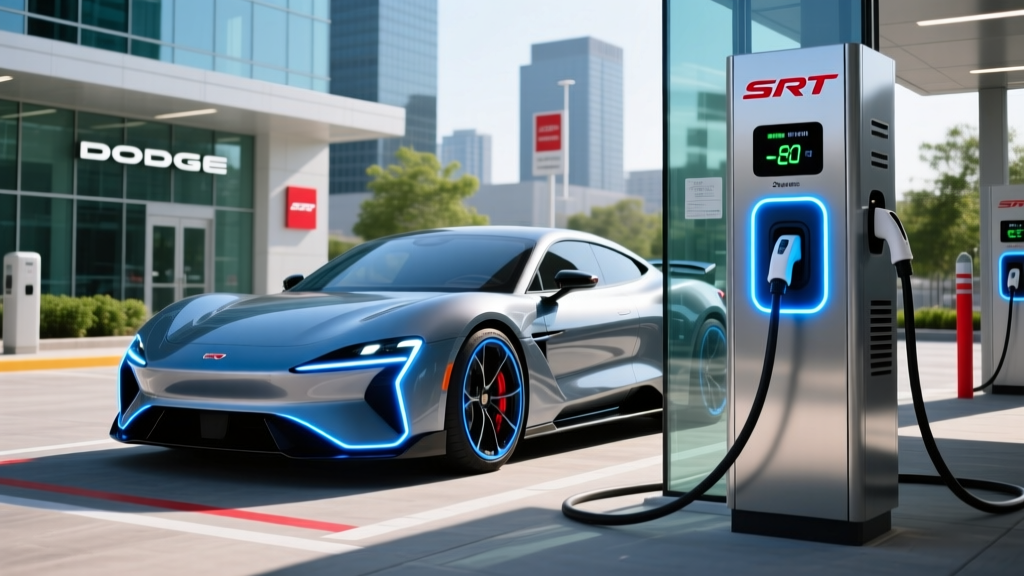
Dodge's entry into the electric muscle segment — the Charger Daytona EV — carries the SRT badge into a new era. The top-tier Scat Pack variant, often referenced by enthusiasts as the "SRT Supercharger" for its electric instant-torque character, promises 670 horsepower and a 0–60 mph time in the low-3-second range. But for buyers accustomed to refueling a Hellcat in five minutes, understanding the charging ecosystem is critical before signing the order sheet.
This guide breaks down the Charger Daytona's charging architecture, what you'll actually spend on home installation, and how public DC fast charging compares to the pump in real-world cost and convenience.
Dodge Charger Daytona EV: Range, Battery & Charging Specs
The 2024–2026 Dodge Charger Daytona is built on Stellantis' STLA Large platform with a 100.5 kWh (usable ~95 kWh) nickel-manganese-cobalt (NMC) battery pack. Here's the spec snapshot buyers need:
| Attribute | R/T (496 hp) | Scat Pack (670 hp) |
|---|---|---|
| Usable Battery | ~95 kWh (NMC) | ~95 kWh (NMC) |
| EPA Range (est.) | ~317 mi | ~260 mi |
| Peak DC Fast Charge | ~185 kW | ~185 kW |
| 10–80% DC Time | ~27 min | ~27 min |
| Level 2 (240V) Rate | ~11.5 kW | ~11.5 kW |
| Level 2 10–80% Time | ~7.5 hrs | ~7.5 hrs |
| 0–60 mph | 4.7 sec | 3.3 sec |
| Base MSRP | $59,590 | $73,590 |
| Drivetrain Warranty | 8 yr / 100,000 mi | 8 yr / 100,000 mi |
Charging Levels Explained: kW, Miles per Hour & Time
Before installing anything, you need to understand the three charging levels. The critical distinction: kW (kilowatts) measures power — how fast energy flows. kWh (kilowatt-hours) measures energy — how much the battery holds. Think of kW as the flow rate of a hose and kWh as the size of the bucket.
| Level | Voltage | Power (kW) | Miles Added/Hour | Best For |
|---|---|---|---|---|
| Level 1 | 120V | 1.4–1.9 kW | 3–5 mi/hr | Overnight trickle, PHEVs |
| Level 2 | 240V | 7.2–19.2 kW | 20–55 mi/hr | Daily home charging |
| DC Fast | 400–800V | 50–350 kW | 150–400+ mi/hr (peak) | Road trips, rapid top-ups |
For the Charger Daytona's ~95 kWh battery, Level 1 is impractical — a full charge would take 50+ hours. Level 2 at 11.5 kW (the car's onboard charger limit) adds roughly 30 miles per hour of charging, meaning a full overnight session restores the battery. DC fast charging at 185 kW peak can push from 10% to 80% in roughly 27 minutes, though the charge curve tapers significantly above 80% to protect the NMC cells.
Home Level 2 Installation: Costs, Electrical Requirements & Panel Upgrades
A Level 2 home charger is the backbone of practical EV ownership. For the Charger Daytona, you'll want a 240V circuit capable of delivering at least 48 amps to maximize the car's 11.5 kW onboard charger (which requires a 60A circuit per the 80% continuous-load NEC rule).
Electrical Requirements
- Circuit: 60A dedicated breaker (for 48A continuous charging)
- Voltage: 240V split-phase (standard US residential)
- Wire gauge: 6 AWG copper (THHN in conduit or NM-B)
- Outlet vs. hardwired: NEMA 14-50 outlet offers flexibility; hardwired is cleaner and may not require GFCI breaker (check local code)
- Permit: Required in virtually all US jurisdictions — typically $50–$250
Panel Upgrade Reality
If your home has a 100A main panel — common in houses built before the 1990s — adding a 60A EV circuit may require a panel upgrade to 200A. This is the single biggest variable in installation cost and can push the total well above $3,000. A licensed electrician will perform a load calculation to determine if your existing panel can accommodate the charger alongside HVAC, electric range, and dryer loads.
| Component | Low End | High End | Notes |
|---|---|---|---|
| Level 2 Charger (hardware) | $350 | $750 | 40A–48A smart charger |
| Electrician labor | $400 | $1,500 | Varies by run length, wall type |
| Electrical materials (wire, conduit, breaker) | $150 | $500 | Longer runs cost more |
| Permit & inspection | $50 | $250 | Local jurisdiction fees |
| Panel upgrade (if needed) | $1,500 | $3,500 | 100A → 200A service upgrade |
| Total (no panel upgrade) | $950 | $3,000 | Typical install |
| Total (with panel upgrade) | $2,450 | $6,500 | Older homes |
Connector Compatibility: NACS, CCS & What the Charger Daytona Uses
The 2024–2026 Dodge Charger Daytona uses the CCS1 (Combined Charging System) connector for DC fast charging and a J1772 inlet for Level 2 AC charging. This is the legacy standard shared by most non-Tesla EVs sold in North America through 2025.
However, the industry is rapidly shifting to NACS (North American Charging Standard, the Tesla connector). Stellantis has announced that future models will adopt NACS, but current Charger Daytona owners will need adapters to access Tesla Supercharger stalls.
| Connector | Native to Charger Daytona? | Adapter Available? | Network Access |
|---|---|---|---|
| CCS1 | Yes (native) | N/A | Electrify America, EVgo, ChargePoint, Ionity |
| NACS (Tesla) | No | Yes (~$200–$400) | Tesla Supercharger network (via adapter) |
| CHAdeMO | No | Rare, expensive | Largely deprecated in US |
| J1772 (Level 2) | Yes (native) | N/A | All public Level 2 stations |
For home Level 2 charging, any J1772 charger works natively. For public DC fast charging, your best coverage comes from Electrify America and EVgo's CCS networks. A CCS-to-NACS adapter (such as the Lectron or A2Z EV adapter) unlocks Tesla Superchargers, though at potentially reduced peak speeds due to protocol translation.
Cost to Charge: Home vs. Public vs. Gas Comparison
The Charger Daytona's 95 kWh battery makes cost-per-mile a meaningful calculation, especially for the Scat Pack's lower efficiency under aggressive driving.
| Scenario | $/kWh | Efficiency (kWh/mi) | Cost/Mile |
|---|---|---|---|
| Home Level 2 (off-peak utility rate) | $0.12 | 0.36 (Scat Pack) | $0.043 |
| Home Level 2 (standard rate) | $0.17 | 0.36 | $0.061 |
| Public Level 2 (ChargePoint/EVgo) | $0.25 | 0.36 | $0.090 |
| DC Fast (Electrify America) | $0.48 | 0.36 | $0.173 |
| DC Fast (Tesla Supercharger, avg) | $0.35 | 0.36 | $0.126 |
| Gas Comparison: Dodge Challenger R/T (5.7L V8, 18 MPG combined) | |||
| Gasoline ($3.50/gal) | — | — | $0.194 |
| Gasoline ($4.25/gal) | — | — | $0.236 |
At home off-peak rates, the Charger Daytona Scat Pack costs roughly $0.04 per mile — less than a quarter of the gas Challenger R/T. Even at peak DC fast-charging rates, the EV remains competitive with or cheaper than gasoline. Over 15,000 annual miles, home-charging savings can exceed $2,500 per year versus premium fuel.
Recommended Home Chargers for the Charger Daytona
Given the car's 11.5 kW onboard charger, you'll want a 48A-capable unit on a 60A circuit to maximize charge speed. Here are proven picks for 2025–2026:
ChargePoint Home Flex
- Power: Up to 50A (12 kW at 240V)
- Connector: J1772 (NACS version available)
- Cable: 23 ft
- Smart features: Wi-Fi, scheduling, Alexa, energy dashboard
- Price: ~$649
- Best for: Flexibility — dip-switch adjustable from 16A to 50A for panel-constrained homes
Wallbox Pulsar Plus
- Power: 48A (11.5 kW at 240V)
- Connector: J1772
- Cable: 25 ft
- Smart features: Wi-Fi + Bluetooth, Power Sharing (daisy-chain two units), app scheduling
- Price: ~$599
- Best for: Compact form factor, dual-charger garages
Emporia Level 2 EV Charger
- Power: 48A (11.5 kW at 240V)
- Connector: J1772
- Cable: 24 ft
- Smart features: Wi-Fi, real-time energy monitoring, solar integration, load management
- Price: ~$399
- Best for: Budget-conscious buyers who still want full smart features
Grizzl-E Smart
- Power: 40A (9.6 kW at 240V)
- Connector: J1772
- Cable: 24 ft
- Smart features: OCPP, app control, adjustable amperage
- Price: ~$449
- Best for: Extreme cold climates — rated to -40°F, rugged Canadian build
For Charger Daytona owners, the ChargePoint Home Flex or Wallbox Pulsar Plus are top picks — both hit the 11.5 kW ceiling. The Emporia is the best value if you want energy monitoring without paying a premium. Note that a 40A charger (Grizzl-E) will charge slightly slower (~9.6 kW vs. 11.5 kW), adding roughly 30 extra minutes to a full overnight session.
Safety, Code & Installation Best Practices
EV charging draws sustained high current — this is not a DIY outlet swap. Key safety and code considerations:
- Dedicated circuit: Your charger must be on its own breaker — never shared with other appliances.
- GFCI protection: NEC 2023+ requires GFCI for outdoor receptacles. Hardwired installations may not need a GFCI breaker in all jurisdictions — confirm with your inspector.
- Outdoor rating: If your charger is outside, it must be NEMA 4-rated (weatherproof). All chargers listed above meet this standard.
- Cable management: Use a wall-mounted holster or retractable reel to prevent tripping hazards and cable damage.
- Load management: If your panel is near capacity, consider a smart charger with load-shedding capability (Emporia, Wallbox) that reduces charge rate when other circuits spike.
- Utility rebates: Many utilities offer $250–$1,000 rebates for Level 2 installations, especially with smart/scheduled charging. Check energy.gov for current programs.
Public DC Fast Charging: What to Expect on Road Trips
The Charger Daytona's 185 kW peak DC charge rate is competitive but not class-leading (the Hyundai Ioniq 5 peaks at ~240 kW, and the Lucid Air at ~300 kW). Here's what real-world road-trip charging looks like:
- 10–80% time: ~27 minutes at a 200+ kW capable station (Electrify America 350 kW stall, for example)
- 80–100% time: An additional 25–35 minutes — the charge curve tapers sharply above 80% to protect NMC chemistry. Plan to charge to 80% and move on.
- Cold weather impact: Below 30°F, the battery must precondition before accepting peak charge rates. Without preconditioning (triggered by navigating to a charger), expect 10–80% to stretch to 35–45 minutes.
- Station reliability: Per J.D. Power's 2025 EV Experience Index, DC fast-charger uptime averages ~82% across major networks. Tesla Superchargers lead at ~95%. A CCS-to-NACS adapter expands your reliable options significantly.
Federal Tax Credit & Charger Incentives
The Charger Daytona's eligibility for the federal §30D tax credit depends on several factors that change annually. As of 2026, key requirements include:
- MSRP cap: Vehicle must be under $55,000 (sedans) — the Charger Daytona R/T at $59,590 and Scat Pack at $73,590 currently exceed this cap and are likely ineligible for the full $7,500 credit.
- Buyer income cap: AGI must be under $150,000 (single) / $300,000 (joint).
- Battery sourcing: Critical minerals and battery components must meet phased-in domestic/free-trade sourcing requirements per IRS §30D rules.
- Point-of-sale transfer: Eligible credits can be transferred to the dealer at purchase, reducing the out-of-pocket price immediately.
For the home charger itself, the Alternative Fuel Infrastructure Tax Credit (30C) was reinstated and covers 30% of charger hardware and installation costs, up to $1,000 for residential installations. Consult a tax professional to confirm eligibility.
Frequently Asked Questions
How much does it cost to install a home EV charger for the Charger Daytona?
Expect $950–$3,000 for a standard installation (equipment + electrician + permit) if your electrical panel has sufficient capacity. If a panel upgrade from 100A to 200A is needed, add $1,500–$3,500, pushing the total to $2,450–$6,500.
How fast will each charging level add range?
Level 1 (120V) adds 3–5 miles per hour — impractical for a 95 kWh battery. Level 2 (240V at 48A) adds roughly 30 miles per hour. DC fast charging at 185 kW peak adds 150–200 miles in 20–25 minutes before tapering.
Which connector is compatible with the Dodge Charger Daytona?
The Charger Daytona uses CCS1 for DC fast charging and J1772 for Level 2 AC. To access Tesla Superchargers, you'll need a CCS-to-NACS adapter (~$200–$400). CHAdeMO is largely deprecated and not natively supported.
How much does charging cost per mile vs. gas?
At home off-peak rates ($0.12/kWh), the Scat Pack costs about $0.043/mile. A gas Challenger R/T at 18 MPG and $3.50/gallon costs $0.194/mile — roughly 4.5× more. Even peak DC fast charging ($0.48/kWh) at $0.173/mile undercuts gasoline.
What electrical upgrades might I need?
A 60A dedicated 240V circuit is required for maximum 48A charging. Homes with 100A panels may need a $1,500–$3,500 upgrade to 200A. Your electrician will perform a load calculation per NEC Article 220 to determine if your panel can support the additional load without upgrade.
Does the Charger Daytona support vehicle-to-home (V2H) or bidirectional charging?
As of the 2026 model year, Stellantis has not enabled V2H/V2L on the Charger Daytona. This may change with future software updates, but do not purchase expecting bidirectional capability today.
Can I use a Tesla Supercharger with the Charger Daytona?
Yes, but only with a CCS-to-NACS adapter. Peak charge rates may be slightly lower than native CCS stations due to protocol translation, but access to Tesla's ~25,000+ Supercharger stalls dramatically improves road-trip coverage.
Bottom Line: Is the SRT Supercharger-Era Charger Daytona Practical to Charge?
The Dodge Charger Daytona Scat Pack delivers muscle-car thrills with a charging profile that's adequate but not exceptional. The 185 kW DC peak and 11.5 kW Level 2 rate are functional for daily use and road trips, though rivals like the Ioniq 5 N charge noticeably faster. Home Level 2 installation remains the most cost-effective strategy — budget $1,500–$3,000 for a clean install, factor in potential panel upgrades for older homes, and take advantage of the 30C infrastructure tax credit to offset costs.
The real advantage shows up on your monthly energy bill: at $0.04/mile home-charging, this 670-hp electric muscle car costs less to "fuel" than a Toyota Corolla. That's the SRT Supercharger era's most compelling argument.