What Is the Span EV Charger System?
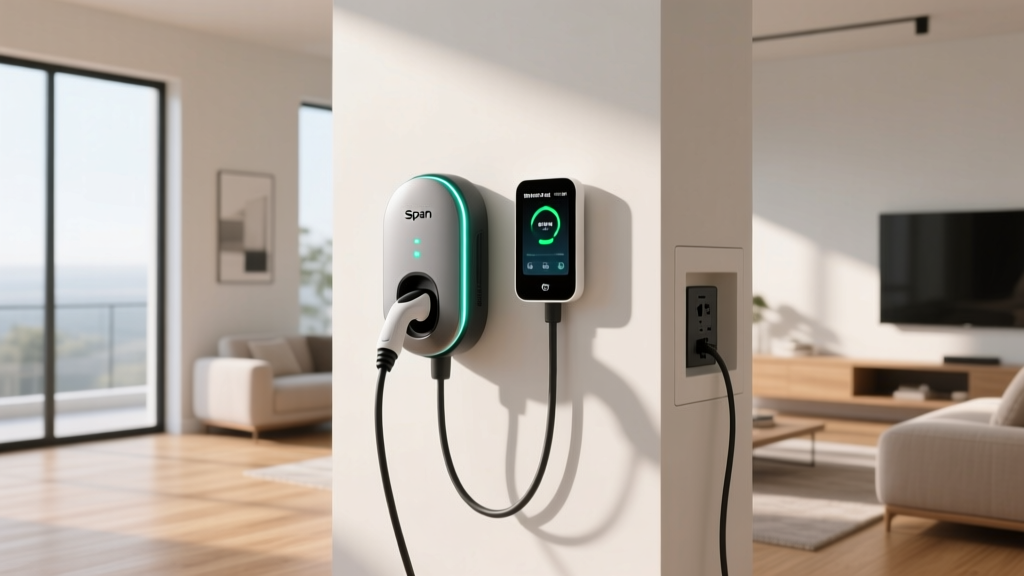
When EV owners search for a Span EV charger, they're usually looking at one of two things: the Span Drive smart electrical panel that manages home energy and EV charging, or the Span Drive+ Level 2 wallbox that pairs with it. Span isn't just another charger brand — it's a whole-home energy management platform that treats your EV as part of a larger electrical ecosystem, integrating solar, battery storage (like the Tesla Powerwall), and circuit-level control.
For EV buyers in 2026, the appeal is clear: instead of simply adding a 240V outlet and hoping your 100-amp panel can handle it, Span's system monitors every circuit in real time, dynamically adjusting charge rate to avoid tripping breakers — and can even prioritize charging when solar production is high or electricity rates are low.
Charging Levels Explained: kW, Speeds, and Real-World Range Added
Before evaluating any charger, you need to understand the three charging levels and what they actually deliver. Note: kW (kilowatts) measures power — the rate of energy flow. kWh (kilowatt-hours) measures energy — the total amount stored in your battery. A 48 kW charger delivers 48 kWh of energy in one hour at peak rate.
| Level | Voltage / Amps | Max Power (kW) | Miles of Range Per Hour | Typical Use Case |
|---|---|---|---|---|
| Level 1 | 120V / 12–16A | 1.4–1.9 kW | 3–5 mi/hr | Overnight top-off, PHEVs, emergencies |
| Level 2 (Home) | 240V / 32–48A | 7.7–11.5 kW | 25–44 mi/hr | Daily home charging, primary EV fueling |
| DC Fast Charge | 400–800V DC | 50–350 kW | 150–1,200+ mi/hr (peak) | Road trips, quick top-ups on the go |
Real-world context: The Span Drive+ delivers up to 11.5 kW (48A on a 60A circuit). For a vehicle like the Hyundai Ioniq 5 (84 kWh usable battery, ~3.5 mi/kWh), that translates to roughly 40 miles of range added per hour — enough to fully replenish a depleted battery in about 8 hours overnight. For a larger battery like the Ford F-150 Lightning's 131 kWh pack, expect closer to 12–13 hours for a full charge at 11.5 kW.
Span Drive+ Hardware: Power Output, Connector, and Smart Features
The Span Drive+ is the physical wallbox in the Span ecosystem. Here are the exact specs that matter:
- Max power output: 11.5 kW (240V, 48A continuous)
- Connector: NACS (Tesla-style) native as of 2025+ models; J1772 available or via adapter
- Cable length: 25 feet
- Smart features: Circuit-level energy monitoring via Span panel, solar-aware scheduling, utility rate optimization, remote start/stop via Span app
- Outdoor rating: NEMA 4 (suitable for outdoor installation)
- Price: ~$699 for the wallbox unit (panel sold separately)
Span Drive+ vs. Competitors (48A Level 2)
| Feature | Span Drive+ | ChargePoint Home Flex | Tesla Wall Connector |
|---|---|---|---|
| Max Power | 11.5 kW (48A) | 12 kW (50A) | 11.5 kW (48A) |
| Connector | NACS / J1772 | J1772 (NACS adapter) | NACS native |
| Cable Length | 25 ft | 23 ft | 24 ft |
| Energy Monitoring | Circuit-level (via panel) | Charger-level only | Charger-level only |
| Smart Scheduling | Solar + rate aware | Basic schedule | Basic schedule |
| Unit Price | ~$699 | ~$549 | ~$475 |
The Span Drive+ justifies its premium over a Tesla Wall Connector or ChargePoint primarily through panel-level integration. If you already have a Span panel or plan to install one (typically $3,000–$5,000 for the panel itself plus installation), the charger becomes part of an orchestrated system. Without the Span panel, the Drive+ functions as a standard smart Level 2 charger — capable, but without its distinguishing energy-management layer.
Home Installation: Electrical Requirements, Panel Upgrades, and Cost Breakdown
Installing any 48A Level 2 charger requires a dedicated 60A, 240V circuit. Here's where many homeowners discover that the charger itself is the cheapest part of the equation.
Electrical Requirements for the Span Drive+
- Circuit: Dedicated 60A breaker, 240V
- Wire gauge: 6 AWG copper (or 4 AWG aluminum) for runs up to ~50 feet; thicker for longer runs
- Panel capacity: Minimum 200A main service recommended; 100A panels often need an upgrade
- GFCI protection: Required by NEC 2020+ for EV receptacles; hardwired chargers may be exempt depending on local code
- Permit: Required in nearly all US jurisdictions; typical cost $50–$200
What Electrical Upgrades Might You Need?
This is the question that separates a $500 install from a $5,000 install. Homes built before 2000 frequently have 100A or 150A main panels. Adding a continuous 48A load (which the NEC requires calculating at 125%, so 60A of panel capacity) can exceed available headroom.
| Component | Scenario A: Simple Install (200A panel, short run) | Scenario B: Moderate (longer wire run, sub-panel) | Scenario C: Full Upgrade (panel replacement + Span panel) |
|---|---|---|---|
| Span Drive+ unit | $699 | $699 | $699 |
| Span Panel (if adding) | $0 (existing panel) | $0 (existing panel) | $3,000–$5,000 |
| Electrician labor | $500–$1,000 | $1,200–$2,500 | $2,500–$5,000 |
| Wire, conduit, breaker | $150–$400 | $500–$1,200 | $800–$1,500 |
| Permit and inspection | $50–$150 | $100–$200 | $150–$300 |
| Panel upgrade (if needed) | $0 | $0–$2,000 (sub-panel) | $2,500–$5,000 (main service) |
| Total estimated range | $1,399–$2,249 | $2,499–$6,599 | $9,649–$17,499 |
Panel upgrade gotcha: If your home has a 100A main service, an electrician will likely recommend upgrading to 200A before adding a 48A continuous EV load. This can add $2,500–$5,000 on its own. The Span panel sometimes replaces this need by using intelligent load management — it can throttle the charger dynamically so total home draw stays within your existing service. Ask your electrician whether Span's load-shedding capability can defer a panel upgrade in your specific situation.
Connector Compatibility: NACS, CCS1, CHAdeMO, and Adapter Needs
The connector landscape has consolidated heavily since 2024, when Ford, GM, Rivian, Volvo, and others adopted NACS (the Tesla connector) for their North American vehicles. By 2026, nearly all new EVs sold in the US ship with a native NACS charge port. The legacy CCS1 connector remains on vehicles from the 2021–2024 model years, and CHAdeMO persists only on older Nissan Leafs.
| Connector | Vehicles Using It | Span Drive+ Compatibility | Adapter Needed? |
|---|---|---|---|
| NACS (Tesla-style) | Tesla (all), Ford (2025+), GM (2025+), Rivian (2025+), Hyundai/Kia (2025+), most new EVs | Native (2025+ Span Drive+ units) | No |
| J1772 (Level 2) | All EVs (Level 2 standard pre-2025); still used at public Level 2 stations | Available as J1772 variant or via NACS-to-J1772 adapter | Yes, for NACS-equipped vehicles at J1772 stations |
| CCS1 | Ford/GM/VW/Hyundai 2021–2024 models; Electrify America stations | Not native; use CCS-to-NACS adapter (~$200–$300) | Yes |
| CHAdeMO | Nissan Leaf (all years), Mitsubishi Outlander PHEV (older) | Not compatible; CHAdeMO adapters extremely rare/expensive | Not practically available |
Practical advice: If you drive a 2023–2024 EV with a CCS1 port (like the Hyundai Ioniq 5 pre-refresh or the Ford Mustang Mach-E pre-2025), order the Span Drive+ in J1772 configuration and use a J1772-to-CCS adapter, or get a CCS-to-NACS adapter if you're buying the NACS variant. Tesla owners and 2025+ EV buyers should get the NACS-native Span Drive+ — no adapter needed at home or at Superchargers.
Cost to Charge: Home vs. Public vs. Gas — Per-Mile Comparison
The economics of EV charging depend almost entirely on where you charge. Here's a realistic cost-per-mile breakdown using a mid-efficiency EV at 3.0 miles per kWh (roughly the EPA combined efficiency of a Tesla Model Y or Hyundai Ioniq 5).
| Scenario | Electricity Rate ($/kWh) | Cost Per Mile | Annual Cost (12,000 mi) |
|---|---|---|---|
| Home off-peak (utility TOU rate) | $0.08–$0.12 | $0.027–$0.040 | $320–$480 |
| Home standard rate | $0.15–$0.20 | $0.050–$0.067 | $600–$800 |
| Home with solar (net cost) | $0.03–$0.06 | $0.010–$0.020 | $120–$240 |
| Public Level 2 (ChargePoint, EVgo) | $0.25–$0.49 | $0.083–$0.163 | $1,000–$1,960 |
| DC Fast Charging (Electrify America, Tesla Supercharger) | $0.30–$0.55 | $0.100–$0.183 | $1,200–$2,200 |
| Gasoline (30 MPG combined, $3.40/gal) | — | $0.113 | $1,360 |
The takeaway: Home charging on an off-peak rate saves 70–80% versus gasoline per mile. Even at standard residential rates, EVs cost roughly half what a 30 MPG gas car costs to fuel. Public DC fast charging approaches or exceeds gas costs — which is exactly why a reliable home Level 2 setup like the Span Drive+ is the economic backbone of EV ownership. According to fueleconomy.gov, the average EV owner who charges primarily at home spends $500–$700 per year on electricity versus $1,200–$1,800 on gasoline.
The Span system's solar-aware scheduling amplifies this advantage: if you have rooftop solar, the Span app can direct the charger to run only when your panels are producing excess energy, pushing your effective cost per mile toward zero.
Charging Time Examples: What to Expect With Real Battery Sizes
Charge time depends on battery capacity (kWh) and the charger's sustained power output (kW). Note that EVs taper charge speed above ~80% State of Charge to protect battery health, so 10–80% times are the most useful real-world metric.
| Vehicle (2026) | Usable Battery (kWh) | Energy for 10–80% (kWh) | Estimated Time at 11.5 kW |
|---|---|---|---|
| Tesla Model 3 (Long Range) | 75 kWh | 52.5 kWh | ~4.5 hours |
| Hyundai Ioniq 5 (Long Range) | 84 kWh | 58.8 kWh | ~5.1 hours |
| Ford F-150 Lightning (Extended) | 131 kWh | 91.7 kWh | ~8.0 hours |
| Chevrolet Equinox EV | 85 kWh | 59.5 kWh | ~5.2 hours |
| Toyota RAV4 Prime (PHEV) | 18.1 kWh | 12.7 kWh | ~1.1 hours |
For DC fast charging context, the Hyundai Ioniq 5 peaks at 240 kW on a 350 kW charger, reaching 10–80% in approximately 18 minutes — but this requires an 800V-capable DC station and a preconditioned battery. The Span Drive+ at home won't match that speed, but it will have your car fully charged every morning without a detour to a fast-charging station.
Safety, Code, and the Span Panel Advantage
EV charging safety isn't just about the wallbox — it's about the entire circuit from your utility meter to your car. The National Electrical Code (NEC) has specific requirements, and Span's architecture addresses several of them at the panel level.
Key Safety and Code Considerations
- Dedicated circuit: The NEC requires EV chargers to be on their own dedicated circuit — no sharing with dryers, ovens, or HVAC. The Span Drive+ requires a dedicated 60A breaker.
- Continuous load calculation: EV charging is classified as a continuous load (3+ hours), so the NEC requires the circuit to be rated at 125% of the charger's max draw. A 48A charger requires a 60A circuit. Span's panel monitors this continuously.
- GFCI protection: NEC 2020 and later requires GFCI protection for EV charging receptacles (NEMA 14-50 outlets). Hardwired installations like the Span Drive+ may be exempt depending on local amendments — confirm with your electrician and local inspector.
- Outdoor rating: If installing outdoors, the charger must be rated NEMA 3R or NEMA 4. The Span Drive+ carries a NEMA 4 rating, suitable for rain and dust exposure.
- Load management: This is Span's core advantage. The Span panel monitors total household draw in real time. If your dryer, oven, and EV charger all run simultaneously and approach your main breaker's limit, the panel can automatically throttle the charger to prevent a trip — a feature no standalone charger can match.
According to the National Fire Protection Association (NFPA), electrical fires from EV charging are exceedingly rare when installations follow code — but the leading cause of incidents is undersized circuits or shared breakers. Span's real-time monitoring adds a layer of protection that goes beyond minimum code requirements.
Who Should Buy the Span EV Charger System?
Decision Framework
Choose the Span Drive+ with Span Panel if:
- You have or plan to install solar panels and want solar-optimized EV charging
- Your home has a 100A or 150A panel and you want intelligent load management instead of a costly service upgrade
- You want circuit-level energy visibility across your entire home (not just the charger)
- You have or plan to add a home battery (Tesla Powerwall, Enphase IQ) and want integrated management
- You're building a new home or doing a major renovation where the Span panel can replace a standard panel
Choose a standalone Level 2 charger (Tesla Wall Connector, ChargePoint Home Flex) if:
- You have a 200A panel with sufficient headroom and just need a reliable charger
- Your budget is under $1,500 all-in (equipment + install)
- You don't have solar and don't plan to add it
- You rent or may move within a few years (standalone chargers are easier to uninstall)
Frequently Asked Questions
How much does it cost to install a Span EV charger at home?
The Span Drive+ wallbox costs ~$699. A simple hardwired installation on an existing 200A panel with a short wire run typically totals $1,400–$2,250 all-in (equipment, electrician, wire, permit). If you're adding the Span smart panel itself, expect the total project to range from $5,000 to $12,000+ depending on your home's electrical complexity. Always get a site-specific quote from a licensed electrician.
How fast will each charging level add range to my EV?
Level 1 (120V) adds 3–5 miles per hour — fine for PHEVs with small batteries but impractical for full EVs. Level 2 at 11.5 kW (the Span Drive+ maximum) adds roughly 35–44 miles per hour depending on your vehicle's efficiency. DC fast charging at 150–350 kW can add 200+ miles in 15–20 minutes but is intended for road trips, not daily use.
Which connector is compatible with my EV?
If your EV is a 2025+ model from Tesla, Ford, GM, Rivian, Hyundai, Kia, or most other brands, it uses the NACS connector natively — get the Span Drive+ in NACS configuration. If your EV is a 2021–2024 model with CCS1 (older Ioniq 5, Mach-E, ID.4), you'll need a CCS-to-NACS adapter or the J1772 variant with an appropriate adapter. CHAdeMO vehicles (Nissan Leaf) are not practically compatible with the Span Drive+ without rare, expensive adapters.
How much does EV charging cost per mile compared to gas?
Charging at home on off-peak rates costs roughly $0.03–$0.04 per mile — about 70% less than gasoline at $3.40/gallon and 30 MPG. At standard residential rates ($0.15–$0.20/kWh), it's about $0.05–$0.07 per mile, still roughly half the cost of gas. Public DC fast charging ($0.30–$0.55/kWh) approaches gas costs, which is why home charging is the economic sweet spot.
What electrical upgrades might I need before installing a home EV charger?
The most common upgrade is a main panel replacement from 100A to 200A service, which costs $2,500–$5,000. You may also need a new dedicated 60A breaker, 6 AWG wire run (longer runs require thicker wire or a sub-panel), and a permit. The Span panel's load-management feature can sometimes avoid a full service upgrade by dynamically limiting the charger's draw — discuss this with your electrician during the site assessment.
Does the Span Drive+ work without the Span smart panel?
Yes, but you lose its primary differentiator. Without the Span panel, the Drive+ functions as a standard 11.5 kW Level 2 charger with app-based scheduling. The circuit-level energy monitoring, solar-aware charging, and dynamic load management all require the Span panel. If you're not installing the panel, consider whether a less expensive charger like the Tesla Wall Connector (~$475) or ChargePoint Home Flex (~$549) better fits your budget.