Fleet managers evaluating electric vehicles for corporate lease programs face a unique charging calculus. Unlike retail EV buyers who charge at home overnight, corporate fleets must balance depot charging infrastructure, employee take-home charging policies, public network reliability, and per-mile energy costs across dozens or hundreds of vehicles. Smart charging for corporate lease programs means right-sizing equipment, understanding electrical requirements, and building a charging strategy that scales with your fleet — not against it.
This guide breaks down the exact charging levels, installation costs, connector compatibility, and per-mile economics you need to spec a corporate EV charging program in 2026.
Charging Levels Explained: Speeds, Power, and Fleet Use Cases
Every charging decision starts with understanding the three charging levels. The critical distinction: kW (kilowatts) measures power — how fast energy flows into the battery. kWh (kilowatt-hours) measures energy — the total capacity stored in the battery. A 80 kWh battery charged at 10 kW takes roughly 8 hours; at 150 kW, it takes under 40 minutes.
| Level | Voltage | Power (kW) | Miles Added/Hour | Best Fleet Use Case |
|---|---|---|---|---|
| Level 1 | 120V AC | 1.0–1.9 kW | 3–5 mi/hr | Emergency/trickle; PHEV top-offs |
| Level 2 | 240V AC | 7.2–19.2 kW | 25–65 mi/hr | Depot overnight; take-home employee charging |
| DC Fast | 400–800V DC | 50–350 kW | 150–1,200+ mi/hr | Route replenishment; corridor travel |
For most corporate lease fleets, Level 2 depot charging is the backbone. A vehicle with a 75 kWh battery (like the Tesla Model Y or Hyundai Ioniq 5) gaining 40 miles of range per hour on a 10 kW Level 2 circuit will fully replenish overnight. DC fast charging supplements for drivers who exceed daily range or lack depot access.
Depot and Home Installation: Electrical Requirements and Costs
Whether you're wiring a 20-stall depot or reimbursing employees for home charger installation, the electrical requirements follow the same physics. A Level 2 charger drawing 40 amps continuous load requires a 50-amp dedicated circuit (National Electrical Code mandates circuits be rated at 125% of continuous load). Most installations use a 240V/48A circuit with a 60-amp breaker for maximum Level 2 throughput.
Here's the honest cost breakdown — and yes, older commercial buildings and residential panels may need upgrades that double or triple these figures.
| Component | Typical Range | Notes |
|---|---|---|
| Level 2 EVSE hardware (smart/networked) | $500–$1,500 | Fleet-grade networked units run $1,000–$2,500 |
| Electrician labor (run circuit, mount unit) | $600–$2,500 | Varies with conduit run length and wall type |
| Electrical permit | $50–$300 | Required in virtually all US jurisdictions |
| Panel upgrade (if needed) | $1,500–$5,000+ | Older 100A panels often need 200A upgrade |
| Load management system (multi-unit) | $1,000–$4,000 | Shares circuit capacity across multiple chargers |
| Total (simple install, no panel upgrade) | $1,150–$4,300 | |
| Total (complex install with panel upgrade) | $4,650–$13,800+ |
For corporate lease programs where employees charge at home, many fleet operators offer a $1,500–$2,500 installation stipend covering hardware and standard electrician labor. Employees in older homes may exceed this — plan for exceptions.
Connector Compatibility: NACS, CCS, and CHAdeMO in 2026
The connector landscape has consolidated significantly since Ford, GM, Rivian, Volvo, and others adopted the North American Charging Standard (NACS) starting in 2024–2025. By 2026, the practical reality for fleet procurement:
| Connector | Brands Using It (Native) | DC Fast Network Access |
|---|---|---|
| NACS (Tesla standard) | Tesla, Ford, GM, Rivian, Volvo, Polestar, Mercedes, Nissan (new), Honda | Tesla Supercharger + growing NACS public stations |
| CCS1 | Hyundai/Kia (some 2025 carryover), BMW, VW (ID.4 2025+), Stellantis | Electrify America, EVgo, ChargePoint |
| CHAdeMO | Nissan Leaf (legacy only — discontinued for new sales) | Declining network; limited new installations |
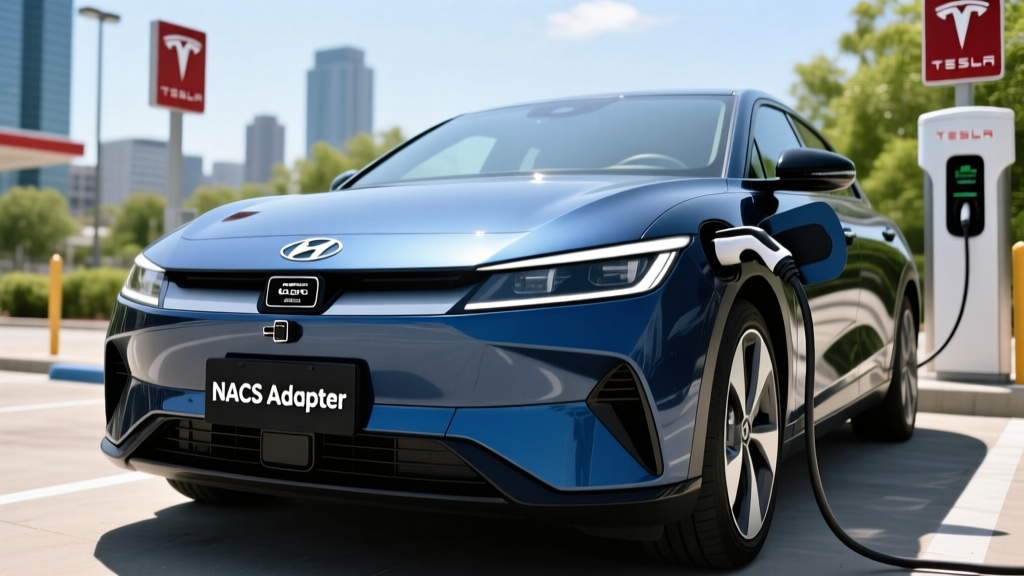
Fleet procurement advice: If your corporate lease vehicles are predominantly NACS-equipped (increasingly the default), specify NACS Level 2 chargers for depot and home installations. CCS vehicles can use a CCS-to-NACS adapter ($200–$350) at Tesla Superchargers, but verify adapter compatibility with your specific model year. Avoid specifying CHAdeMO infrastructure for any new fleet deployment.
Charging Cost per Mile vs. Gas: The Fleet Economics
The cost advantage of electric corporate lease vehicles depends heavily on where and when they charge. Here's a data-driven comparison using 2026 national averages:
| Scenario | Rate | Cost per Mile* | Annual Cost (15,000 mi) |
|---|---|---|---|
| Home/depot off-peak (utility rate) | $0.08–$0.14/kWh | $0.024–$0.042 | $360–$630 |
| Home/depot standard rate | $0.15–$0.22/kWh | $0.045–$0.066 | $675–$990 |
| Public Level 2 (networked) | $0.25–$0.49/kWh | $0.075–$0.147 | $1,125–$2,205 |
| DC fast charging (public) | $0.35–$0.65/kWh | $0.105–$0.195 | $1,575–$2,925 |
| Gas vehicle (28 MPG avg, $3.45/gal) | — | $0.123 | $1,845 |
*Based on 3.0 kWh/mile fleet average efficiency (typical for midsize EV sedans/SUVs like the Tesla Model 3, Hyundai Ioniq 6, or BMW i4). High-efficiency models like the Lucid Air achieve ~2.4 kWh/mile; large SUVs like the Rivian R1S consume ~3.5 kWh/mile.
The takeaway for fleet managers: depot or home-charged corporate EVs save $900–$1,500 per vehicle annually versus gas equivalents. But fleets relying primarily on public DC fast charging may see costs approach or exceed gasoline — making depot Level 2 infrastructure a financial necessity, not a luxury.
For detailed utility rate data and efficiency figures by model, consult the EPA Fuel Economy site and your local utility's commercial EV rate schedules.
Charging Time Examples: What to Expect by Battery Size
Fleet scheduling depends on predictable charge times. These examples assume charging from 10% to 80% State of Charge — the practical window for daily operations, since charging slows dramatically above 80% to protect battery health.
| Battery Size | Example Vehicle | 7.7 kW (32A L2) | 11.5 kW (48A L2) | 150 kW DC | 250 kW DC |
|---|---|---|---|---|---|
| 58 kWh | VW ID.4 Std Range | 5.3 hrs | 3.5 hrs | ~22 min | ~18 min |
| 75 kWh | Tesla Model Y LR | 6.8 hrs | 4.6 hrs | ~26 min | ~20 min |
| 84 kWh | Hyundai Ioniq 5 LR | 7.7 hrs | 5.1 hrs | ~18 min | ~14 min |
| 100 kWh | BMW iX xDrive50 | 9.1 hrs | 6.1 hrs | ~32 min | ~22 min |
| 131 kWh | Ford F-150 Lightning Ext | 11.9 hrs | 8.0 hrs | ~42 min | ~30 min |
Fleet scheduling insight: A 48A Level 2 charger replenishes virtually any passenger EV overnight (8–10 hours covers 10–80% even for 100+ kWh batteries). For vehicles on multi-shift rotations, a mid-shift DC fast top-up of 15–25 minutes adds 150–250 miles — enough for most urban route completions.
Equipment Recommendations: Smart Chargers for Fleet Deployments
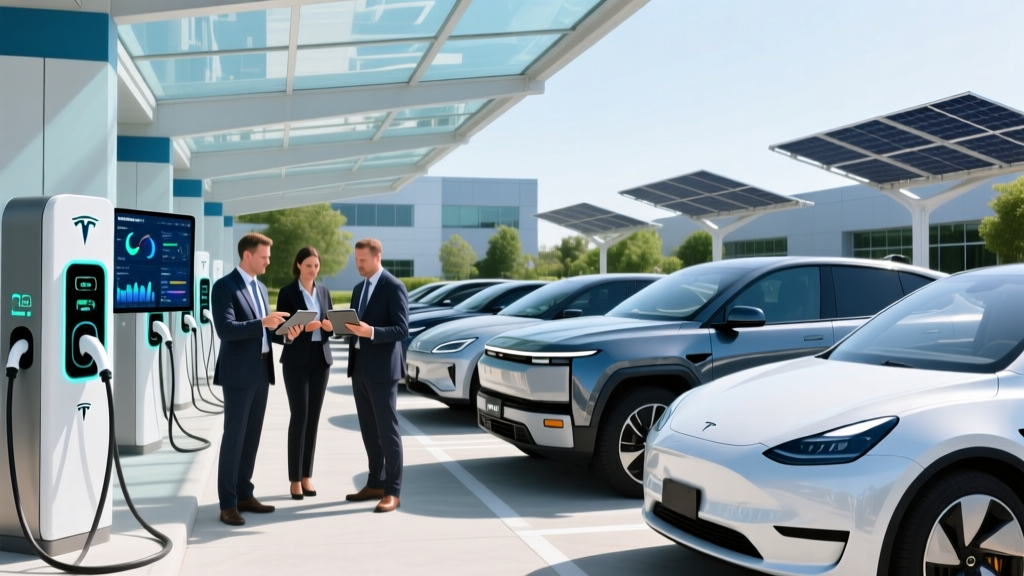
Corporate lease programs benefit from networked (smart) chargers that offer RFID authentication, energy metering, remote management, and load balancing. Here are proven options for 2026 fleet deployments:
ChargePoint CT4000 (Commercial Dual-Port)
- Power: Up to 19.2 kW per port (dual-port shares 38.4 kW total)
- Connector: NACS or CCS1 (configurable)
- Cable: 18 ft or 23 ft options
- Smart features: Cloud management, RFID access, energy reporting, CPO-ready
- Price: $2,200–$3,800 per unit (network subscription additional)
- Best for: Multi-vehicle depot installations with access control
Wallbox Pulsar Max (Commercial/Residential Hybrid)
- Power: Up to 11.5 kW (48A) on 240V
- Connector: NACS (native) or J1772 with adapter
- Cable: 16 ft or 25 ft
- Smart features: Wi-Fi, Power Sharing (load balance up to 25 units on one circuit), app control
- Price: $650–$850 per unit
- Best for: Employee take-home charging reimbursement programs
Enel X JuiceBox Pro (Commercial Single-Port)
- Power: Up to 19.2 kW (80A) on 240V
- Connector: NACS or CCS1
- Cable: 25 ft
- Smart features: Networked fleet management, OCPP 1.6J protocol, revenue-grade metering
- Price: $1,100–$1,800 per unit
- Best for: Mixed-use commercial parking with billing capability
Emporia Vue Level 2 (Budget Smart Charger)
- Power: Up to 11.5 kW (48A) on 240V
- Connector: NACS or J1772
- Cable: 24 ft
- Smart features: Wi-Fi scheduling, solar integration, energy monitoring, no subscription
- Price: $400–$550 per unit
- Best for: Small fleet (5–10 vehicles) or employee home installations
Spec tip: For depot installations with 4+ chargers on a single electrical service, choose equipment that supports dynamic load management (Wallbox Power Sharing, ChargePoint circuit sharing). This lets multiple chargers share a single 100A or 200A circuit, dynamically allocating power as vehicles connect and disconnect — avoiding costly panel upgrades.
Safety, Code, and Compliance for Fleet Charging
Commercial EV charging installations must comply with NEC Article 625 (Electric Vehicle Charging Equipment) plus local amendments. Key requirements that fleet managers should verify with their licensed electrician:
- Dedicated circuit: Each Level 2 charger requires its own branch circuit — no sharing with HVAC, lighting, or other loads.
- GFCI protection: Required for all EVSE on circuits 150V to ground or less (effectively all Level 1 and Level 2 installations). Many modern EVSE units have built-in ground-fault protection, but the breaker should also be GFCI-rated where code mandates.
- Outdoor rating: Any charger installed outdoors must carry a NEMA 4 (weatherproof) rating. Indoor units with NEMA 1 are not suitable for exterior walls exposed to rain.
- Cable management: Commercial installations should include cable retractors or holsters to prevent tripping hazards and cable damage — an OSHA consideration for workplace charging.
- ADA compliance: Public-facing or employee-accessible charging stations must meet ADA reach-range and clear-floor-space requirements per the Americans with Disabilities Act.
- Ventilation: Not required for modern lithium-ion EV charging (unlike lead-acid battery spaces), but enclosed charging closets benefit from ambient temperature control — extreme heat degrades charge speeds.
Always pull permits and schedule inspections. Unpermitted charging installations create liability exposure for corporate programs and may void equipment warranties.
Tax Credits and Incentives for Fleet Charging Infrastructure
Fleet operators installing commercial EV charging may qualify for the §30C Alternative Fuel Vehicle Refueling Property Credit — a federal tax credit covering up to 30% of hardware and installation costs, capped at $100,000 per item of property. Eligibility depends on installation in a qualifying census tract (low-income or non-urban) and prevailing-wage/apprenticeship requirements for projects exceeding $1,000.
Separately, employees who install home chargers for take-home corporate lease vehicles may be eligible for the residential energy credit (also §30C) at 30% up to $1,000. Consult IRS guidance on §30C and a tax professional for your specific corporate structure — eligibility varies by entity type and location.
- Equipment placed in service in a qualifying low-income or non-urban census tract
- Prevailing wage and apprenticeship requirements met (for projects >$1,000)
- 30% of total cost (hardware + installation), up to $100,000 per single item of property
- Must be depreciable property used in a trade or business
- File IRS Form 8911 with your business tax return
- State and utility rebates may stack on top — check DSIRE database
Frequently Asked Questions
How much does it cost to install a home EV charger for a corporate lease vehicle?
A standard home Level 2 installation (48A, 240V, no panel upgrade) costs $1,150–$4,300 including hardware, electrician labor, and permit. If the home's electrical panel requires an upgrade from 100A to 200A service, add $1,500–$5,000. Most fleet programs budget a $2,000–$2,500 per-employee installation reimbursement.
How fast will each charging level add range to fleet vehicles?
Level 1 (120V) adds 3–5 miles per hour — impractical for daily fleet use. Level 2 (240V, 48A) adds 35–45 miles per hour, fully replenishing most EVs overnight. DC fast charging (150–250 kW) adds 150–400+ miles in a 20–30 minute session, depending on battery size and vehicle charge acceptance rate.
Which connector is compatible with my corporate lease EV fleet?
For 2026 model-year vehicles: Tesla, Ford, GM, Rivian, Volvo, Polestar, and most new Honda/Nissan models use NACS. Hyundai/Kia and some BMW/VW models still use CCS1. CHAdeMO is legacy-only (Nissan Leaf discontinued). Order chargers in the connector your fleet primarily uses; CCS-to-NACS adapters ($200–$350) provide Supercharger access for CCS vehicles.
How much does EV charging cost per mile versus gasoline for fleet vehicles?
Depot or home-charged EVs cost $0.024–$0.066 per mile (depending on utility rates), versus $0.123 per mile for a 28 MPG gas vehicle at $3.45/gallon. That's a 46–80% per-mile fuel savings when charging at controlled rates. Public DC fast charging at $0.35–$0.65/kWh raises EV costs to $0.105–$0.195 per mile — narrowing or eliminating the advantage.
What electrical upgrades might my depot or employee homes need?
The most common upgrade is a panel capacity increase (100A to 200A residential; 200A to 400A+ commercial). An electrician performs a load calculation to determine spare capacity. For multi-charger depots, a load management system can avoid panel upgrades by dynamically distributing available amperage across chargers. Commercial sites may also need utility transformer upgrades for 4+ high-power chargers — plan 6–12 months lead time for utility coordination.
Can we use smart charging software to reduce fleet electricity costs?
Yes. Networked chargers with scheduling software (ChargePoint, Wallbox, or third-party platforms like AmpUp or EV Connect) can shift charging to off-peak utility hours (typically 10 PM–6 AM), reducing per-kWh costs by 30–60%. Some utilities offer commercial EV demand-response programs that pay fleets to curtail charging during grid peak events — an additional revenue stream for smart-charging-enabled corporate lease programs.