Chevrolet Silverado EV Record Range: What 440 Miles Means for Charging
The 2024–2026 Chevrolet Silverado EV 4WT and RST trims carry a usable battery capacity of roughly 200 kWh — one of the largest packs ever fitted to a production light-duty pickup. The EPA-estimated range tops out at 440 miles on the RST First Edition (with the larger Ultium pack), a figure Chevrolet calls a record for a production electric pickup. In real-world mixed driving, expect 360–400 miles depending on payload, speed, and temperature; highway towing will compress that further. But a 200-kWh battery also means charging logistics matter more than on smaller EVs. This guide walks through exactly how to charge a Silverado EV at home and on the road, with real numbers for time, cost, and equipment.
Charging Levels Explained: Speeds in kW and Miles per Hour
Before choosing equipment, clarify the difference between kW (kilowatts) and kWh (kilowatt-hours). kW measures power — the rate at which energy flows into the battery, like water pressure from a hose. kWh measures energy — the total amount stored, like gallons in a tank. The Silverado EV's ~200-kWh battery holds a lot of energy; the kW rating of your charger determines how fast you refill it.
| Level | Voltage / Amps | Power (kW) | Miles Added per Hour | Typical Use |
|---|---|---|---|---|
| Level 1 | 120V / 12A | ~1.4 kW | ~4–5 mi/hr | Emergency / trickle |
| Level 2 (standard home) | 240V / 32–48A | 7.7–11.5 kW | ~25–40 mi/hr | Daily home charging |
| Level 2 (Silverado max onboard) | 240V / 80A | 19.2 kW | ~60–70 mi/hr | High-power home/workshop |
| DC Fast Charging | 400–800V DC | Up to 350 kW (peak) | ~1,000+ mi/hr (peak) | Road trips, rapid top-ups |
The Silverado EV supports an onboard AC charger rated up to 19.2 kW (80 amps at 240V), which is among the highest in any consumer EV. That means a properly equipped home charger can add roughly 60–70 miles of range per hour — enough to fully replenish the 200-kWh pack in about 10–12 hours from near-empty. On DC fast charging, GM quotes a peak rate of 350 kW on compatible CCS/NACS stations, which can add approximately 100 miles of range in 10 minutes under ideal conditions. Real-world 10–80% charging on a 350-kW-capable station typically takes 35–45 minutes, because charge speed tapers significantly above 80% state of charge to protect battery health.
Home Charger Installation: Electrical Requirements and Costs
Charging a 200-kWh battery at home is practical, but the Silverado EV's appetite rewards a high-power Level 2 setup. Here's what's required:
Electrical Requirements
- Standard Level 2 (48A / 11.5 kW): Requires a dedicated 60-amp, 240V circuit (NEMA 14-60 outlet or hardwired). This is the most common home install and adds ~35–40 miles per hour.
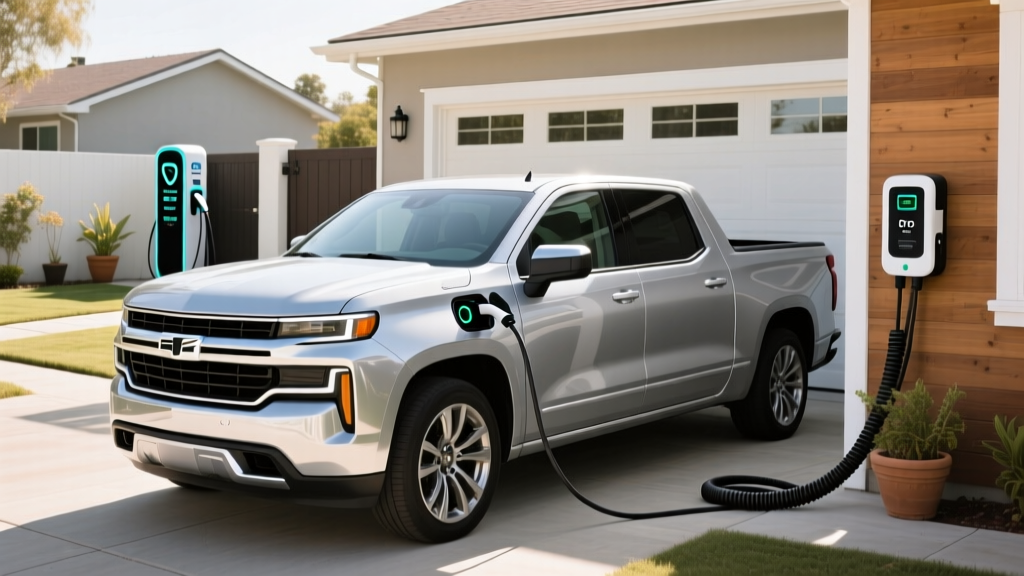
- High-power Level 2 (80A / 19.2 kW): Requires a dedicated 100-amp, 240V circuit, hardwired. This unlocks the Silverado EV's maximum onboard AC charging rate, adding ~60–70 miles per hour.
- Panel capacity: Most modern 200-amp residential panels can support a 60-amp EV circuit if load calculations allow. A 100-amp EV circuit may require a panel upgrade to 300–400 amps, especially in homes with electric heating, dryers, or ranges.
Panel Upgrade Considerations
Older homes with 100-amp or 150-amp service will likely need an electrical panel upgrade before adding any high-power Level 2 charger. Even some 200-amp panels may be near capacity. A licensed electrician will perform a NEC Article 220 load calculation to determine available headroom. Panel upgrades add significant cost but are a one-time investment that also benefits future electrification (heat pumps, solar, etc.).
| Item | Standard Install (48A / 60A circuit) | High-Power Install (80A / 100A circuit) |
|---|---|---|
| EVSE equipment (Level 2 charger) | $400–$750 | $700–$1,200 |
| Electrician labor (wiring, conduit, breaker) | $600–$1,500 | $1,000–$2,500 |
| Electrical permit | $50–$200 | $100–$300 |
| Panel upgrade (if needed) | $1,500–$3,000 | $2,000–$5,000 |
| Total estimated cost | $1,050–$2,450 (no panel upgrade) $2,550–$5,450 (with panel upgrade) |
$1,800–$4,000 (no panel upgrade) $3,800–$9,000 (with panel upgrade) |
These ranges reflect national averages as of 2026. Costs vary widely by region, run length from panel to garage, and local permitting requirements. Always get at least two quotes from licensed electricians and confirm they pull permits — unpermitted work can void insurance and create safety hazards.
Connector Compatibility: NACS, CCS, and Adapters
The Silverado EV launched with a CCS1 (Combined Charging System) connector for DC fast charging and a J1772 inlet for Level 1/2 AC charging. However, GM has been transitioning its EV lineup to the NACS (North American Charging Standard) — the Tesla-designed connector now adopted by most major automakers. Depending on your model year and build date, your Silverado EV may have CCS1 or NACS natively.
| Connector | AC Level 2 | DC Fast Charging | Network Access |
|---|---|---|---|
| CCS1 (original Silverado EV) | J1772 inlet | CCS1 plug | Electrify America, EVgo, ChargePoint, non-Tesla networks |
| NACS (newer builds / adapter) | NACS inlet | NACS plug | Tesla Supercharger network + other NACS stations |
| CCS-to-NACS adapter | N/A | Allows CCS vehicles to use NACS Superchargers | GM-approved adapters (~$200–$300) enable Supercharger access |
| CHAdeMO | N/A | Not compatible (legacy standard, largely discontinued) | Not relevant for Silverado EV |
Key takeaway: If your Silverado EV has CCS1, you can access Tesla Superchargers using a GM-approved CCS-to-NACS adapter. GM has confirmed Supercharger network access for its EVs via adapter, unlocking over 20,000 additional fast-charging stalls. For home Level 2 charging, any J1772-compatible EVSE works with CCS1 vehicles; NACS-equipped vehicles need a NACS home charger or a J1772-to-NACS adapter.
Charging Cost: Home vs. Public vs. Gas Comparison
One of the strongest ownership arguments for the Silverado EV is cost per mile. Electricity prices vary by region and time of use, but home charging almost always undercuts gasoline. Here's a realistic breakdown:
| Scenario | Rate ($/kWh) | Cost to Add 200 Miles | Cost per Mile |
|---|---|---|---|
| Home off-peak (utility time-of-use rate) | $0.10–$0.15 | $7.00–$10.50 | $0.035–$0.053 |
| Home standard residential average | $0.16–$0.20 | $11.20–$14.00 | $0.056–$0.070 |
| Public Level 2 (ChargePoint, workplace) | $0.25–$0.40 | $17.50–$28.00 | $0.088–$0.140 |
| DC Fast Charging (Electrify America, EVgo) | $0.35–$0.55 | $24.50–$38.50 | $0.123–$0.193 |
| Gas truck baseline (Silverado 1500, 19 MPG combined, $3.50/gal) | N/A | $36.84 | $0.184 |
At home off-peak rates, the Silverado EV costs roughly 3.5–5.3 cents per mile to "fuel" — about one-quarter to one-third the cost of a comparable gas Silverado 1500. Even on DC fast chargers at highway rates, the EV can match or beat gas per mile, though convenience and time penalties apply. The Silverado EV's efficiency is approximately 2.0–2.3 kWh/mile (roughly 48–50 MPGe combined per fueleconomy.gov), which is competitive for a full-size electric truck.
Equipment Recommendations: Level 2 Chargers for the Silverado EV
Because the Silverado EV supports up to 19.2 kW AC charging, you have a wider range of home charger options than most EV owners. Here are proven picks as of 2026:
ChargePoint Home Flex (Best Overall)
- Power output: Up to 12 kW (50A) on a 60A circuit, or up to 19.2 kW (80A) on a 100A circuit — configurable via DIP switches
- Connector: J1772 (works with CCS1 Silverado EV natively; NACS vehicles need adapter)
- Cable length: 23 feet
- Smart features: Wi-Fi, app scheduling, utility demand-response integration, energy tracking
- Price: ~$550–$700
- Outdoor rating: NEMA 4 (weather-resistant)
Tesla Wall Connector (Best for NACS-equipped trucks)
- Power output: Up to 11.5 kW (48A) on a 60A circuit
- Connector: NACS native — ideal for newer Silverado EV builds with NACS inlets
- Cable length: 24 feet
- Smart features: Wi-Fi, over-the-air updates, power sharing between multiple units, load management
- Price: ~$475–$550
- Outdoor rating: NEMA 4
FLO Home X5 (Best for High-Power 80A Charging)
- Power output: Up to 19.2 kW (80A) on a 100A circuit — maximizes Silverado EV's onboard charger
- Connector: J1772
- Cable length: 25 feet
- Smart features: Wi-Fi, FLO app, scheduled charging, utility program compatibility
- Price: ~$900–$1,100
- Outdoor rating: NEMA 4X (corrosion-resistant)
Emporia Level 2 EV Charger (Budget Pick)
- Power output: Up to 11.5 kW (48A) on a 60A circuit
- Connector: J1772
- Cable length: 24 feet
- Smart features: Wi-Fi, Emporia energy monitoring ecosystem, solar integration
- Price: ~$350–$450
- Outdoor rating: NEMA 4
For the Silverado EV's massive battery, a 48-amp (11.5 kW) charger is the practical minimum for overnight replenishment. If you regularly deplete the battery significantly — for example, towing or long work days — investing in an 80A/19.2-kW setup cuts overnight charging time nearly in half. Budget $500–$750 for equipment and $600–$2,500 for professional installation depending on your panel and wiring run.
Charging Time Examples: How Long to Refill the Silverado EV
With a ~200-kWh usable battery, charging times scale directly with your charger's kW output. Here are realistic estimates:
- Level 1 (120V, 1.4 kW): 0–100% in approximately 140+ hours. Essentially impractical except for maintaining charge during storage.
- Level 2 at 11.5 kW (48A): 10–80% in roughly 11–12 hours; 0–100% in about 17 hours. Ideal for overnight charging after a typical day of driving.
- Level 2 at 19.2 kW (80A): 10–80% in roughly 7 hours; 0–100% in about 10.5 hours. Best for heavy-use days or commercial fleet applications.
- DC Fast Charging at 350 kW peak: 10–80% in approximately 35–45 minutes. Peak rate applies only in the 10–40% SoC window; above 60%, the charge curve tapers substantially. Expect 80–100% to take an additional 25–35 minutes.
The Silverado EV's Ultium battery uses preconditioning when you navigate to a DC fast charger via the vehicle's built-in navigation. This warms the battery to optimal temperature for faster charging — critical in cold weather, where charge speeds can drop 30–50% without preconditioning.
Safety, Code, and Installation Best Practices
Home EV charging involves high-current electrical work that must comply with the National Electrical Code (NEC) and local amendments. Key requirements:
- Dedicated circuit: Your EV charger must be on its own dedicated breaker — no sharing with other appliances.
- GFCI protection: NEC 2020 and later require GFCI protection for 240V receptacles used for EV charging in garages and outdoors. Hardwired installations may have different requirements depending on jurisdiction.
- Outdoor rating: If your charger is installed outside, the EVSE must carry a NEMA 4 or NEMA 4X rating for weather and corrosion resistance.
- Wire gauge: A 60-amp circuit requires minimum 6 AWG copper wire; a 100-amp circuit requires 3 AWG or 1/0 AWG depending on wire type and run length. Your electrician will size appropriately.
- Permit and inspection: Virtually all jurisdictions require an electrical permit and post-installation inspection. Never skip this — it protects your home and ensures insurance coverage in the event of a fault.
For the Silverado EV's high-power capability, consider future-proofing your install: run conduit and wire rated for 100 amps even if you initially install a 48-amp charger. Upgrading the EVSE later becomes a simple swap rather than a full rewire.
Federal Tax Credits and Incentives for Home Charging
The federal Alternative Fuel Vehicle Refueling Property Credit (IRS Form 8911) covers 30% of home EV charger equipment and installation costs, up to $1,000. This credit applies to both the charger hardware and electrician labor, though eligibility depends on your census tract meeting certain income or access criteria per the Inflation Reduction Act. Some states and utilities offer additional rebates — check your local utility's EV programs and the IRS credit page for current rules. Note: this is separate from the §30D new-vehicle tax credit, which has its own MSRP, income, and battery-sourcing requirements.
Frequently Asked Questions
How much does it cost to install a home EV charger for the Silverado EV?
A standard 48-amp Level 2 installation typically costs $1,050–$2,450 including equipment, electrician labor, and permit — assuming no panel upgrade. A high-power 80-amp installation runs $1,800–$4,000. If your home needs an electrical panel upgrade (common in homes with 100–150 amp service), add $1,500–$5,000 depending on complexity.
How fast will each charging level add range to the Silverado EV?
Level 1 (120V) adds roughly 4–5 miles per hour — essentially unusable for daily needs on a 200-kWh battery. Level 2 at 48 amps (11.5 kW) adds about 35–40 miles per hour. Level 2 at 80 amps (19.2 kW) adds about 60–70 miles per hour. DC fast charging at peak 350 kW can add 100 miles in roughly 10 minutes, but sustained rates average lower due to charge-curve taper.
Which connector and charger is compatible with my Silverado EV?
Early Silverado EV models use CCS1 for DC fast charging and J1772 for AC Level 2. Newer builds may feature NACS natively. Check your vehicle's charge port. For home charging, any J1772-compatible Level 2 charger works with CCS1 trucks; NACS trucks need a Tesla Wall Connector or NACS-native EVSE. A GM-approved CCS-to-NACS adapter enables Supercharger access for CCS1 vehicles.
How much does charging the Silverado EV cost per mile compared to gas?
At home off-peak rates ($0.10–$0.15/kWh), the Silverado EV costs approximately 3.5–5.3 cents per mile. A comparable gas Silverado 1500 at 19 MPG combined and $3.50/gallon costs about 18.4 cents per mile. Even on expensive public DC fast chargers ($0.35–$0.55/kWh), the EV costs roughly 12–19 cents per mile — comparable to or less than gas.
What electrical upgrades might I need for a Silverado EV home charger?
If your home has a 200-amp electrical panel with available capacity, you can likely add a 60-amp circuit (for 48A charging) without upgrades. An 80-amp circuit (for 19.2-kW charging) may require a panel upgrade to 300–400 amps, especially in all-electric homes. Homes with 100-amp or 150-amp service almost certainly need a panel upgrade for any Level 2 charger. A licensed electrician's load calculation is the definitive answer.
Does the Silverado EV's record 440-mile EPA range hold up in real driving?
The 440-mile EPA estimate applies to the RST trim with the largest Ultium pack under favorable test conditions. Real-world highway driving at 70+ mph typically yields 360–400 miles. Cold weather (below freezing) can reduce range by 15–30% due to battery heating demands and cabin climate use. Towing a trailer will compress range significantly — expect 200–280 miles depending on trailer weight and aerodynamics. The Silverado EV's range remains best-in-class for electric pickups, but plan charging stops around 300 miles for comfortable margins on road trips.