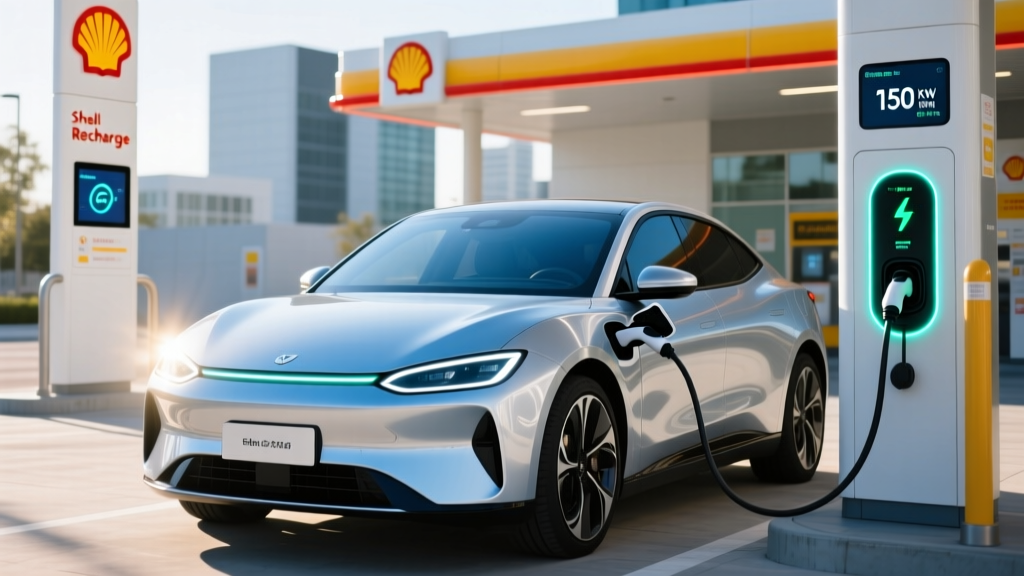
Shell Recharge has quietly become one of the most visible public EV charging brands in North America, with stations sprouting up at Shell gas stations, Walmart parking lots, and highway travel plazas. But visibility doesn't always equal reliability or value. This guide breaks down exactly what you'll find at Shell Recharge charging stations in 2026 — from DC fast charger speeds and connector types to real-world pricing and how the network stacks up for daily drivers and road-trippers alike.
Whether you're considering relying on Shell Recharge as your primary public network or just want to know what to expect when you pull up to one, here's the data-driven breakdown.
Shell Recharge Network Overview: Where You'll Find Stations
Shell Recharge operates a hybrid network strategy: proprietary Shell-branded DC fast chargers at select Shell fuel stations, plus a broader deployment of chargers at retail partners (Walmart, grocery chains, travel centers). As of early 2026, the network includes over 1,500 DC fast charging ports across the U.S., with a concentration in California, Texas, the Northeast corridor, and major interstate routes.
Shell also offers Level 2 destination chargers at some locations, but the network's core value proposition is DC fast charging for on-the-go top-ups. Many Shell Recharge stations feature 2-4 charging ports per site, though newer flagship locations along I-5, I-95, and I-10 corridors have expanded to 6-8 ports with higher-power hardware.
Charging Speeds at Shell Recharge: What Each Level Delivers
Understanding charging speed starts with the difference between kW (kilowatts) and kWh (kilowatt-hours). kW measures power — how fast energy flows into your battery. kWh measures energy — the total capacity stored. Think of kW as the width of a hose and kWh as the size of the bucket.
Here's what each charging level delivers in practical terms:
| Level | Power (kW) | Voltage / Amps | Miles of Range Added Per Hour | Typical Use Case |
|---|---|---|---|---|
| Level 1 | 1.4–1.9 kW | 120V / 12–16A | 3–5 miles/hr | Overnight trickle (PHEVs, low-mileage commutes) |
| Level 2 | 7.2–19.2 kW | 240V / 30–80A | 20–60 miles/hr | Home daily charging, workplace, destination |
| DC Fast | 50–350 kW | 400–800V DC | 150–1,000+ miles/hr (peak) | Road trips, quick top-ups (Shell Recharge territory) |
Most Shell Recharge DC fast stations in 2026 are equipped with chargers rated between 50 kW and 180 kW, with a growing number of newer sites offering up to 350 kW units (typically branded as Shell Recharge Ultra). The 50 kW units are legacy installations; the 150-180 kW chargers represent the bulk of the current network.
Real-World Charging Times at Shell Recharge
Peak kW ratings don't tell the full story. DC fast charging follows a charge curve — the battery accepts maximum power at low state of charge (SoC), then tapers significantly above 80% to protect cell health. Here's what 10-80% charging actually looks like at Shell Recharge hardware:
| Vehicle (Battery Size) | At 50 kW Station | At 150 kW Station | At 350 kW Station (if vehicle supports) |
|---|---|---|---|
| Tesla Model 3 (75 kWh usable) | ~55 min | ~25 min | ~18 min |
| Hyundai Ioniq 5 (77.4 kWh, 800V) | ~58 min | ~28 min | ~18 min |
| Ford F-150 Lightning (131 kWh extended) | ~95 min | ~42 min | ~35 min |
| Chevrolet Equinox EV (85 kWh) | ~65 min | ~30 min | ~25 min |
Connector Compatibility: Will Shell Recharge Work With Your EV?
The connector landscape shifted dramatically in 2024-2025 when most major automakers adopted the North American Charging Standard (NACS), originally developed by Tesla. Here's where Shell Recharge stands on connector availability in 2026:
| Connector Type | Vehicles That Use It (2026 Models) | Shell Recharge Availability | Adapter Needed? |
|---|---|---|---|
| NACS (Tesla) | Tesla (all), Ford, GM, Rivian, Hyundai/Kia, BMW, Volvo (2025+ models) | Available at most new/updated Shell Recharge sites | No (for NACS-native vehicles) |
| CCS1 | Older Ford/GM/Hyundai/Kia (pre-2025), VW ID.4, BMW i4 (pre-2025) | Still present at majority of Shell Recharge stations | NACS-to-CCS adapter if driving a newer NACS vehicle |
| CHAdeMO | Nissan Leaf (legacy), Mitsubishi Outlander PHEV (older) | Very limited — being phased out at most sites | No adapter widely available; use CCS/NACS sites instead |
Shell Recharge has been actively retrofitting stations with NACS connectors alongside existing CCS1 cables. If you drive a 2025+ model with a native NACS port (which now includes most major brands), you'll find compatible plugs at updated Shell Recharge locations. Always check the Shell Recharge app or your vehicle's built-in navigation for real-time connector availability before driving to a station.
Shell Recharge Pricing: Cost Per kWh and Cost Per Mile
Public DC fast charging is the most expensive way to power an EV, and Shell Recharge is no exception. Pricing varies by location, time of day, and state utility rates, but here's what to expect in 2026:
| Scenario | Cost Per kWh | Cost Per Mile (3.5 mi/kWh avg) | Full Charge Cost (75 kWh battery) |
|---|---|---|---|
| Home Level 2 (national avg electricity) | $0.16/kWh | $0.046/mi | $12.00 |
| Home Level 2 (off-peak TOU rate) | $0.09/kWh | $0.026/mi | $6.75 |
| Shell Recharge DC Fast (off-peak) | $0.35–$0.43/kWh | $0.10–$0.12/mi | $26–$32 |
| Shell Recharge DC Fast (peak) | $0.48–$0.59/kWh | $0.14–$0.17/mi | $36–$44 |
| Gasoline equivalent (25 MPG, $3.40/gal) | — | $0.136/mi | — |
The takeaway: home charging at off-peak rates costs roughly one-third to one-fifth what Shell Recharge DC fast charging costs per mile. During peak pricing, Shell Recharge can actually exceed the per-mile cost of gasoline for a 25 MPG vehicle. This is why public DC fast charging should be treated as a road-trip and convenience tool, not a daily charging strategy.
Shell Recharge also offers a subscription plan (Shell Recharge Plus) for approximately $4.99/month that discounts per-kWh pricing by roughly 10-15% at participating stations. For frequent road-trippers who rely on the network, the subscription pays for itself after about 3-4 charging sessions per month.
Home Charging Setup: Electrical Requirements and Installation Costs
While Shell Recharge handles public charging, most EV owners do 80%+ of their charging at home. If you're pairing Shell Recharge road-trip stops with a home Level 2 setup, here's what installation actually requires and costs.
Electrical Requirements for Level 2 Home Charging
A Level 2 home charger requires a dedicated 240V circuit, similar to what powers an electric dryer or oven. Common configurations:
- 240V / 40A circuit → delivers up to 9.6 kW (most common residential setup)
- 240V / 48A circuit → delivers up to 11.5 kW (requires 60A breaker)
- 240V / 60A circuit → delivers up to 14.4 kW (requires 75A breaker; needs robust panel)
The National Electrical Code (NEC) requires that continuous loads (like EV charging) use no more than 80% of a circuit's rated capacity. So a 40A breaker supports a 32A continuous charge (7.7 kW), and a 60A breaker supports 48A continuous (11.5 kW).
Panel Upgrade: The Hidden Cost
Many homes built before 2000 have 100A or 125A electrical panels. Adding a 40-60A dedicated EV circuit may exceed your panel's spare capacity. A licensed electrician will perform a load calculation to determine if your panel can handle the additional draw. If not, a panel upgrade to 200A typically costs $1,500–$3,500 before the charger circuit is even installed.
| Cost Component | Low Estimate | High Estimate | Notes |
|---|---|---|---|
| Level 2 charger hardware | $300 | $700 | Varies by brand, power, smart features |
| Electrician labor (circuit + outlet/hardwire) | $400 | $1,800 | Depends on run length, wall type, conduit |
| Permit and inspection | $50 | $250 | Required in most jurisdictions |
| Panel upgrade (if needed) | $1,500 | $3,500 | 100A → 200A service upgrade |
| Total (no panel upgrade) | $750 | $2,750 | Typical for modern 200A homes |
| Total (with panel upgrade) | $2,250 | $6,250 | Older homes with 100A/125A panels |
Always hire a licensed electrician and pull a permit. Unpermitted EV charger installations can void home insurance claims and create fire hazards. The National Electrical Code (NEC Article 625) governs EV charging installations specifically.
Recommended Home Chargers to Pair With Public Networks
Since Shell Recharge doesn't manufacture home equipment, here are three proven Level 2 chargers that complement a public-charging-heavy lifestyle — each selected for reliability, connector flexibility, and smart features:
Emporia Vue Level 2 Smart Charger
- Power output: Up to 48A (11.5 kW) on a 60A circuit
- Connector: J1772 (NACS adapter included in 2026 kit)
- Cable length: 24 feet
- Smart features: Wi-Fi, app scheduling, solar integration, energy monitoring
- Price: ~$399
- Best for: Budget-conscious buyers who want full smart features without subscription fees
ChargePoint Home Flex
- Power output: Configurable 16A–50A (up to 12 kW)
- Connector: J1772 or NACS (select at purchase)
- Cable length: 23 feet
- Smart features: Wi-Fi, Alexa integration, scheduled charging, usage reports
- Price: ~$549 (NACS version ~$599)
- Best for: Flexible amperage configuration for homes with limited panel capacity
Tesla Wall Connector (Universal)
- Power output: Up to 48A (11.5 kW) on a 60A circuit
- Connector: NACS native + J1772 adapter integrated
- Cable length: 24 feet
- Smart features: Wi-Fi, OTA updates, power sharing between multiple units, Tesla/non-Tesla switching
- Price: ~$599
- Best for: Multi-EV households with a mix of Tesla and non-Tesla vehicles
Safety, Code, and Installation Best Practices
EV charging draws sustained high current for hours — making proper installation non-negotiable. Key safety and code considerations:
- Dedicated circuit: Your Level 2 charger must be on its own dedicated circuit, not shared with other appliances. This prevents overloads and tripped breakers.
- GFCI protection: NEC 2023 and later require Ground Fault Circuit Interrupter (GFCI) protection for all EV charging outlets. Hardwired installations may have different requirements — confirm with your electrician and local code.
- Outdoor rating: If installing outside, ensure the charger carries a NEMA 4 or NEMA 4X rating for weather resistance. All three chargers recommended above meet this standard.
- NEMA 14-50 vs. hardwire: A NEMA 14-50 outlet offers portability (take the charger when you move), but hardwired installations eliminate the outlet failure point and may be required for circuits above 50A in some jurisdictions.
- Cable management: Use a wall-mounted holster or cable reel to prevent trip hazards and protect the connector from ground moisture and damage.
Shell Recharge Reliability: What Owners Report
Network reliability matters as much as speed. Based on aggregated owner reports and third-party PlugShare check-in data through late 2025, Shell Recharge stations average approximately 85-90% uptime — competitive with Electrify America but below Tesla Supercharger's reported 95%+ uptime.
Common issues reported at Shell Recharge stations include:
- Occasional payment terminal failures (the Shell Recharge app is a reliable backup)
- Reduced power output at older 50 kW sites that haven't been upgraded
- Limited stall counts (2-4 ports) leading to wait times at popular highway locations during peak travel
- Connector holster wear at high-traffic sites, particularly on CCS cables
Shell has been investing in its Ultra charger deployments (180-350 kW) at high-traffic corridor locations, which tend to have better reliability and more ports. For the best experience, plan stops at newer Ultra-equipped Shell Recharge sites when possible.
Frequently Asked Questions
How much does it cost to install a home EV charger?
A typical Level 2 home charger installation costs $750–$2,750 for homes with an adequate electrical panel (200A service). If your home needs a panel upgrade from 100A to 200A, total costs range from $2,250–$6,250. This includes the charger hardware ($300–$700), electrician labor ($400–$1,800), and permit fees ($50–$250). Always get multiple quotes from licensed electricians.
How fast will each charging level add range?
Level 1 (120V) adds roughly 3–5 miles per hour. Level 2 (240V, 40A) adds 25–35 miles per hour for most EVs. DC fast charging at 150 kW can add 150–250 miles in 20–30 minutes depending on battery size and charge curve. Actual rates vary by vehicle efficiency (mi/kWh) and battery acceptance rate.
Which connector/charger is compatible with my EV?
Check your vehicle's charge port. 2025+ models from Ford, GM, Hyundai, Kia, Rivian, BMW, and Volvo use NACS (Tesla-style). Older models (pre-2025) from most non-Tesla brands use CCS1. The Nissan Leaf uses CHAdeMO. Shell Recharge stations increasingly offer both NACS and CCS1 connectors — always verify in the Shell Recharge app before your trip.
How much does charging cost per mile vs. gas?
Home Level 2 charging costs approximately $0.03–$0.05 per mile (at $0.09–$0.16/kWh). Shell Recharge DC fast charging costs $0.10–$0.17 per mile depending on peak/off-peak pricing. A comparable gasoline vehicle at 25 MPG and $3.40/gallon costs about $0.14 per mile. Home charging delivers clear savings; public DC fast charging during peak hours can match or exceed gas costs.
What electrical upgrades might I need?
The most common upgrade is a panel capacity increase from 100A or 125A to 200A ($1,500–$3,500). Other potential upgrades include running new conduit from the panel to the garage or driveway ($200–$800 depending on distance), installing a sub-panel if the main panel is far from the charging location, or upgrading the utility service drop if your home's total service is below 100A. A licensed electrician's load calculation will determine exactly what's needed — the Department of Energy recommends getting this assessment before purchasing equipment.
Is the Shell Recharge app required to use their stations?
No, but it's strongly recommended. Most Shell Recharge stations accept credit cards at the terminal, but payment hardware failures are the most commonly reported issue. The app provides a reliable backup payment method, plus real-time station status, pricing, and session history. Some locations also offer discounted rates exclusively through the app or Shell Recharge Plus subscription.