The Two "Superchargers": 760 HP vs. 250 kW
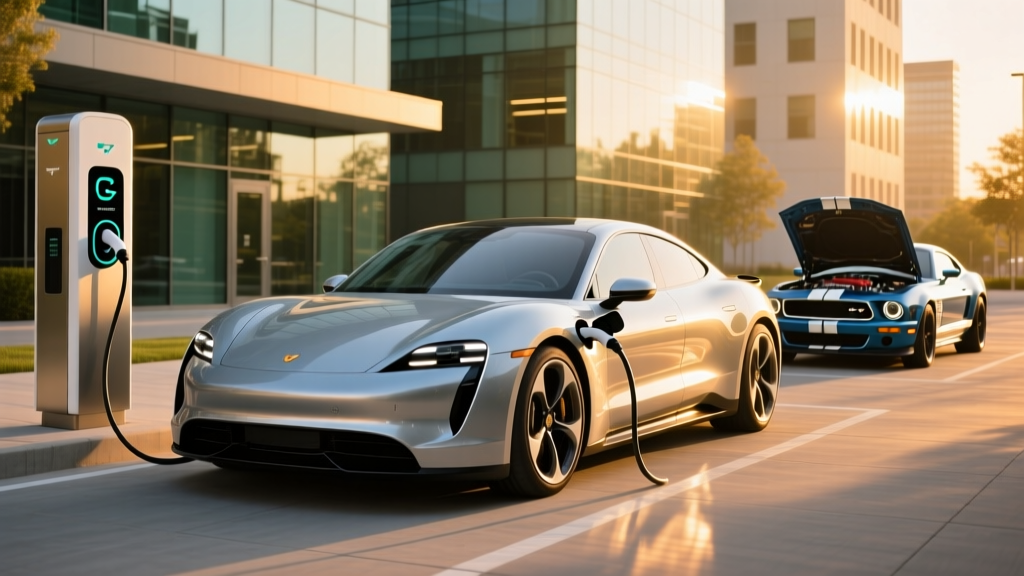
The phrase "supercharger" means very different things depending on which side of the garage you stand on. A Shelby GT supercharged Mustang—like the Shelby GT500's 5.2-liter Predator V8—uses a mechanical Eaton TVS supercharger to force-feed air into the engine, producing 760 horsepower and burning premium gasoline at roughly 12 mpg combined. An EV Supercharger (Tesla's DC fast-charging network) pushes up to 250 kW of electrical power into a battery pack, adding roughly 200 miles of range in 15 minutes.
If you're cross-shopping a Shelby GT supercharged muscle car against a performance EV—or just curious how the economics and engineering stack up—this guide breaks down exactly what each "supercharger" costs per mile, how fast each delivers energy, and what ownership actually looks like in 2026.
Charging Levels Explained: Level 1, Level 2, and DC Fast
Before comparing a Shelby GT supercharged V8 to any EV, you need to understand the three tiers of EV charging. Each level delivers energy at a different rate, and your daily routine determines which matters most.
| Level | Voltage / Amps | Power (kW) | Miles of Range Added per Hour | Typical Use |
|---|---|---|---|---|
| Level 1 | 120V / 12A | ~1.4 kW | 3–5 mi/hr | Overnight trickle, PHEVs, emergencies |
| Level 2 | 240V / 32–48A | 7.7–11.5 kW | 25–44 mi/hr | Home daily charging, workplace |
| DC Fast | 400–800V DC | 50–350 kW | 150–1,200+ mi/hr (peak) | Road trips, highway corridors |
A Level 2 home charger is where 80–90% of EV charging happens. At 11.5 kW (48A on a 60A circuit), a 75 kWh battery charges from 10% to 80% in roughly 5 hours—ideal for overnight replenishment. DC fast charging at a Tesla Supercharger V3 (250 kW) can take a Model 3 Long Range from 10% to 80% in about 25–30 minutes, though the charge curve tapers significantly above 80% to protect battery health.
How Much Does It Cost to Install a Home EV Charger?
Installing a Level 2 home charger is the single biggest infrastructure decision an EV owner makes. The total cost depends on your electrical panel's capacity, the distance from panel to garage or driveway, and local permitting.
| Component | Typical Range | Notes |
|---|---|---|
| Level 2 Charger Equipment | $350 – $750 | Smart Wi-Fi chargers (ChargePoint, WallConnector, Emporia) |
| Electrician Labor (240V/50A circuit) | $600 – $2,500 | Varies by run length, conduit, wall material |
| Electrical Permit | $50 – $250 | Required in most jurisdictions; inspected post-install |
| Panel Upgrade (if needed) | $1,500 – $4,000 | Upgrading from 100A to 200A service for older homes |
| Total (no panel upgrade) | $1,000 – $3,500 | Most homes with 200A service |
| Total (with panel upgrade) | $2,500 – $7,500 | Homes with older 100A panels or maxed capacity |
Panel upgrade reality check: If your home has a 100-amp main panel that's already near capacity (common in pre-1990 builds), adding a 50A dedicated circuit for EV charging will require a service upgrade to 200A. This is a significant cost but adds long-term home value and is often required by code. Some utilities offer rebates of $200–$500 for panel upgrades tied to EV adoption. Always have a licensed electrician perform a load calculation before assuming your panel can handle a new 240V circuit.
Electrical requirements for a typical Level 2 install: a dedicated 240V circuit with a 50A breaker (supporting 40A continuous draw per NEC 80% rule), 6 AWG copper wire for runs under 50 feet, a NEMA 14-50 outlet or hardwired connection, and GFCI protection per NEC 2020+ code for outdoor installations.
Connector Compatibility: NACS, CCS1, and CHAdeMO
The connector landscape has shifted dramatically. As of 2026, the North American Charging Standard (NACS), originally developed by Tesla, has become the dominant connector. Nearly every major automaker—Ford, GM, Rivian, Volvo, Hyundai, and others—has adopted NACS for new vehicles. The legacy CCS1 connector remains on many 2021–2024 models, while CHAdeMO is effectively discontinued outside of older Nissan Leafs.
| Connector | Brands Using It (2026) | Adapter Needed? |
|---|---|---|
| NACS (Tesla) | Tesla, Ford, GM, Rivian, Volvo, Polestar, Hyundai/Kia (new), Mercedes | CCS→NACS adapter (~$150–$200) for legacy CCS vehicles at NACS stalls |
| CCS1 | VW ID.4 (pre-2025), older BMW i4/iX, Stellantis EVs, some 2022–2024 models | NACS→CCS adapter for Tesla Supercharger access |
| CHAdeMO | Nissan Leaf (discontinued in US after 2025), Mitsubishi Outlander PHEV (older) | Limited DC fast network; plan for Level 2 primarily |
If you own or are buying a 2025–2026 EV, it almost certainly uses NACS. Tesla Superchargers now welcome non-Tesla EVs with native NACS ports, and adapters from Ford and GM allow their CCS-equipped 2023–2024 vehicles to access Superchargers. For home Level 2 charging, all vehicles use the J1772 standard (or NACS, which includes J1772 signaling), so any Level 2 home charger will work with any EV sold in the US.
Shelby GT Supercharged Fuel Cost vs. EV Charging Cost Per Mile
Here's where the "two superchargers" comparison gets concrete. Let's pit the Shelby GT500's supercharged 5.2L V8 against a performance EV like the Tesla Model 3 Performance or Hyundai Ioniq 5 N.
| Vehicle | Energy Source | Efficiency | Cost Per Unit | Cost Per Mile |
|---|---|---|---|---|
| Shelby GT500 (supercharged V8) | Premium gasoline (93 octane) | 12 mpg combined | $4.80/gal (2026 avg premium) | $0.40/mile |
| EV — Home Level 2 (off-peak) | Electricity | 3.5 mi/kWh (28.6 kWh/100mi) | $0.13/kWh (off-peak utility rate) | $0.037/mile |
| EV — Home Level 2 (peak) | Electricity | 3.5 mi/kWh | $0.22/kWh (peak/TOU rate) | $0.063/mile |
| EV — Public Level 2 | Electricity | 3.5 mi/kWh | $0.30/kWh (typical public L2) | $0.086/mile |
| EV — DC Fast (Tesla Supercharger) | Electricity | 3.5 mi/kWh | $0.35/kWh (2026 avg) | $0.10/mile |
| EV — DC Fast (Electrify America) | Electricity | 3.5 mi/kWh | $0.48/kWh (peak pricing) | $0.137/mile |
The numbers are stark. Even at the most expensive public DC fast-charging rates, an EV costs roughly $0.10–$0.14 per mile—about one-quarter to one-third what the Shelby GT supercharged V8 demands at $0.40/mile. Home charging at off-peak rates drops that to under four cents per mile, making the EV roughly 10x cheaper to fuel than the supercharged Mustang.
Over 12,000 annual miles, the Shelby GT500's fuel bill lands around $4,800 (premium gas). A comparable EV charged primarily at home off-peak costs roughly $450/year. That's a $4,350 annual savings—enough to cover a premium Level 2 home install in the first year.
Charging Time: 10–80% Examples for Common Battery Sizes
Charging speed depends on battery capacity (kWh), the charger's peak power (kW), and the vehicle's charge curve. Peak kW rates only apply at low state-of-charge; above 50–60%, most EVs taper charge speed to protect battery cells. Here are realistic 10–80% times for popular 2026 EVs:
| Vehicle | Battery (kWh usable) | Peak DC kW | DC Fast 10–80% | Level 2 (11.5 kW) 10–80% |
|---|---|---|---|---|
| Tesla Model 3 Long Range | 75 kWh (NMC) | 250 kW | ~25 min | ~5 hrs |
| Hyundai Ioniq 5 (84 kWh) | 77.4 kWh (NMC, 800V) | 233 kW | ~18 min | ~5 hrs |
| Ford F-150 Lightning Ext. Range | 131 kWh (NMC) | 150 kW | ~41 min | ~8.5 hrs |
| Chevrolet Equinox EV | 85 kWh (NMC) | 150 kW | ~32 min | ~5.5 hrs |
| Tesla Model Y (LFP Standard) | 60 kWh (LFP) | 170 kW | ~28 min | ~4 hrs |
Charge curve reality: That "250 kW peak" on a Tesla Supercharger V3 only sustains for roughly the first 15–20% of the session. By 60% state-of-charge, speed drops to ~100 kW; by 80%, it may slow to 40–50 kW. This is why 10–80% is the standard benchmark—charging beyond 80% takes disproportionately longer and is best reserved for when you absolutely need maximum range. For daily driving, charging to 80% at home overnight is the sweet spot for battery longevity.
Level 2 Home Charger Recommendations (2026)
Not all Level 2 chargers are equal. Here are top picks based on power output, build quality, smart features, and value:
Tesla Wall Connector (Gen 4)
Power: 11.5 kW (48A) | Connector: NACS (J1772 adapter included)
Cable: 24 ft | Wi-Fi: Yes, OTA updates
Smart Features: Power sharing (link multiple units), access control, scheduling
Price: ~$475 | Best For: Tesla owners, NACS-native EVs
ChargePoint Home Flex
Power: Up to 12 kW (50A configurable) | Connector: J1772 (NACS adapter avail.)
Cable: 23 ft | Wi-Fi: Yes, ChargePoint app
Smart Features: Adjustable amperage (16–50A), Alexa, energy tracking, scheduling
Price: ~$699 | Best For: Multi-EV households, flexible amperage needs
Emporia Vue Level 2 Charger
Power: 11.5 kW (48A) | Connector: J1772
Cable: 24 ft | Wi-Fi: Yes, Emporia app
Smart Features: Energy monitoring, solar integration, TOU scheduling, load management
Price: ~$399 | Best For: Budget-conscious, solar-home owners
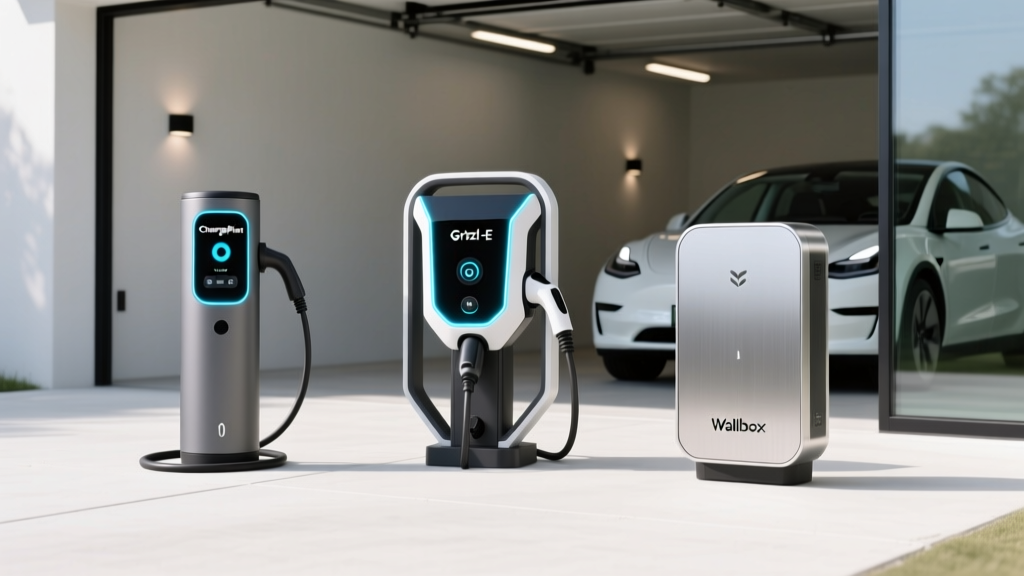
Grizzl-E Smart
Power: 10 kW (40A) | Connector: J1772 or NACS
Cable: 24 ft | Wi-Fi: Yes, OCPP-compatible
Smart Features: Extreme cold rated (-40°F), rugged aluminum case, adjustable output
Price: ~$549 | Best For: Cold-climate, outdoor installs, durability
For most EV owners in 2026, the Tesla Wall Connector offers the best value if your vehicle has a NACS port—it's compact, reliable, and supports power-sharing if you plan to charge two EVs on a single circuit. The ChargePoint Home Flex wins for households with mixed connectors or those who want to dial amperage down to match a smaller circuit breaker.
Safety, Code, and Electrical Considerations
EV charging involves sustained high-current draw—hours at 40–48 amps. This is fundamentally different from intermittent appliance use. Key safety and code requirements include:
- Dedicated circuit: Your Level 2 charger must have its own dedicated 240V circuit. Never share a circuit with other high-draw appliances (dryer, oven, HVAC).
- NEC 80% rule: Continuous loads (defined as 3+ hours) cannot exceed 80% of breaker rating. A 50A breaker supports 40A continuous; a 60A breaker supports 48A.
- GFCI protection: NEC 2020 and later requires GFCI protection for outdoor receptacles. Hardwired chargers may avoid this requirement in some jurisdictions—check local code.
- Outdoor rating: If mounting outside, ensure the charger carries a NEMA 4 or IP65 rating for weather resistance.
- Permit and inspection: Most municipalities require an electrical permit for new 240V circuits. The installation must pass inspection before use. Skipping permits risks insurance coverage denial in the event of an electrical fire.
- Wire gauge: 6 AWG copper for 50A circuits with runs under 50 feet; 4 AWG for longer runs or 60A circuits. Aluminum wire requires upsizing.
A licensed electrician should always perform the load calculation and installation. DIY 240V work is dangerous, often illegal, and voids homeowner's insurance if unpermitted.
The Real Question: Performance Per Dollar
The Shelby GT supercharged engine delivers 760 horsepower through sheer mechanical force—a visceral, analog experience that no EV replicates in feel, if not in numbers. A Tesla Model S Plaid hits 0–60 in 1.99 seconds for $89,990; the Shelby GT500 does it in ~3.3 seconds for roughly $80,000+ on the used market (discontinued after 2022). Both are thrilling. But the ongoing cost equation diverges sharply.
| Vehicle | Annual Energy Cost | 5-Year Energy Cost | Maintenance (5-Year Est.) |
|---|---|---|---|
| Shelby GT500 (supercharged V8) | ~$4,800 (premium gas) | $24,000 | $4,500–$7,000 (oil, brakes, supercharger belt, tires) |
| EV (home off-peak charging) | ~$450 | $2,250 | $1,000–$1,500 (tires, cabin filter, wipers) |
| EV (mixed home + DC fast) | ~$900 | $4,500 | $1,000–$1,500 |
Over five years, the EV saves $19,500–$21,750 in energy alone, plus another $3,000–$5,500 in maintenance (no oil changes, no supercharger belt service, regenerative braking saves brake pads). That's a total ownership savings of $22,500–$27,250—money that could fund a premium home solar + Level 2 charging setup and still leave change for a road trip.
Source: EPA fuel economy data at fueleconomy.gov; IRS EV tax credit rules at irs.gov.
Frequently Asked Questions
How much does it cost to install a home EV charger?
A typical Level 2 home charger installation costs $1,000–$3,500 including equipment ($350–$750), electrician labor ($600–$2,500), and a permit ($50–$250). If your home needs a panel upgrade from 100A to 200A service, add $1,500–$4,000. Homes built after 2000 with 200A panels rarely need upgrades.
How fast will each charging level add range?
Level 1 (120V) adds 3–5 miles per hour. Level 2 (240V, 48A) adds 25–44 miles per hour depending on vehicle efficiency. DC fast charging adds 150–1,200+ miles per hour at peak rates, though real sessions average 200–300 miles added in 20–30 minutes due to charge-curve taper above 50% SoC.
Which connector/charger is compatible with my EV?
For 2025–2026 EVs: most use NACS (Tesla's standard, now adopted industry-wide). Older 2021–2024 EVs may use CCS1. CHAdeMO is limited to older Nissan Leafs. For home Level 2 charging, all EVs accept J1772 or NACS (which includes J1772 signaling). Adapters ($150–$200) bridge CCS vehicles to NACS Superchargers.
How much does charging cost per mile vs gas?
Home off-peak EV charging costs ~$0.04/mile. Public DC fast charging runs $0.10–$0.14/mile. A Shelby GT supercharged V8 at 12 mpg with premium gas at $4.80/gallon costs ~$0.40/mile—roughly 3–10x more than an EV depending on your charging setup.
What electrical upgrades might I need?
The most common upgrade is a panel service increase from 100A to 200A ($1,500–$4,000), needed in older homes with limited spare capacity. You may also need a new conduit run if your panel is far from the garage (adds $200–$800). Some utilities require a "smart" load-management device if you add EV charging alongside existing high-draw systems like heat pumps.