If you live in Shelby or the surrounding area and are considering an electric vehicle, understanding your charging options is the single most important factor in daily EV satisfaction. Whether you're looking at home installation, public networks, or just trying to figure out which plug fits your car, this guide covers the exact numbers you need to make a decision.
Let's start with the fundamental distinction every EV owner must know: kW (kilowatts) measures charging power — how fast energy flows into your battery. kWh (kilowatt-hours) measures energy capacity — how much total energy your battery stores. A 48-amp Level 2 charger delivers roughly 11.5 kW of power; a typical EV battery holds 60-100 kWh of energy. Confusing these two is the most common mistake new EV buyers make.
Understanding EV Charging Levels: Speed and Range Added
Every EV charging scenario falls into one of three categories. Here's what each level actually delivers in real-world conditions:
| Charging Level | Voltage | Max Power (kW) | Miles of Range Added Per Hour | Typical Use Case |
|---|---|---|---|---|
| Level 1 (120V) | 120V AC | 1.4-1.9 kW | 3-5 miles | Overnight top-ups, PHEVs, low daily mileage |
| Level 2 (240V) | 240V AC | 7.2-19.2 kW | 20-60 miles | Daily home charging, workplace, destinations |
| DC Fast Charging | 400-800V DC | 50-350 kW | 150-1,000+ miles (equivalent) | Road trips, rapid top-ups, commercial fleets |
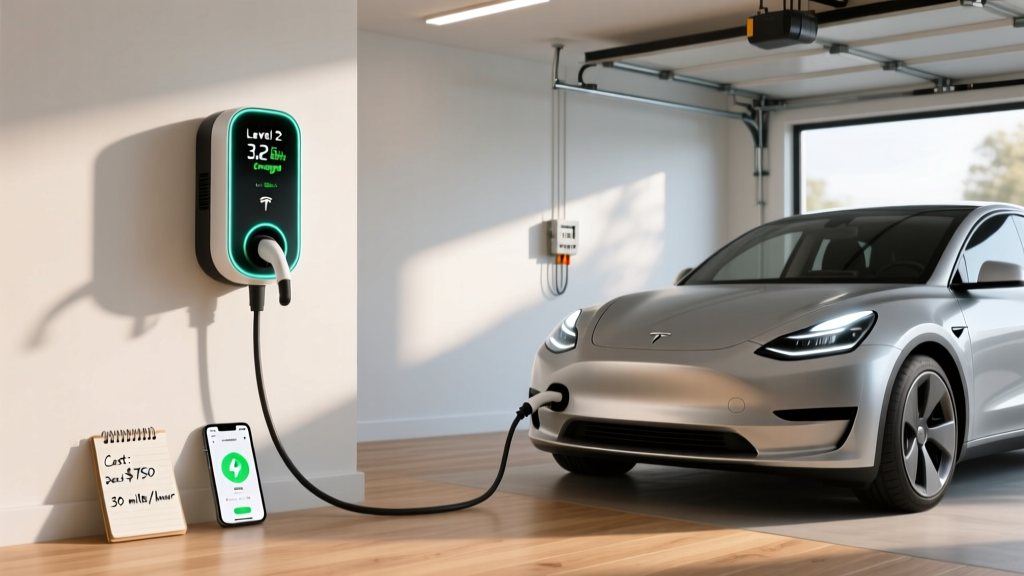
For most Shelby EV owners, Level 2 home charging is the sweet spot. A 48-amp (11.5 kW) home charger will fully replenish a 75 kWh battery overnight in roughly 7-8 hours. DC fast charging is for road trips — a 150 kW station can take a typical EV from 10% to 80% in 20-25 minutes, though charging speed tapers significantly above 80% to protect battery health.
Real-world charging time examples:
- 60 kWh battery (e.g., base Nissan Ariya): 10-80% on a 150 kW DC fast charger in ~22 minutes; full charge on 11.5 kW Level 2 in ~5.5 hours
- 82 kWh battery (e.g., Tesla Model Y Long Range): 10-80% on a 250 kW Supercharger in ~18 minutes; full charge on 11.5 kW Level 2 in ~7.5 hours
- 100 kWh battery (e.g., Ford F-150 Lightning Extended Range): 10-80% on a 150 kW DC fast charger in ~35 minutes; full charge on 11.5 kW Level 2 in ~9 hours
Home EV Charger Installation in Shelby: Costs and Electrical Requirements
Installing a Level 2 home charger is the single best investment for EV convenience. But costs vary dramatically depending on your home's electrical infrastructure. Here's what Shelby homeowners should expect:
Electrical Requirements
A standard Level 2 home charger requires a 240-volt dedicated circuit, typically rated at 40-60 amps. Most hardwired chargers draw 48 amps continuous, which requires a 60-amp breaker (electrical code mandates the breaker be rated at 125% of continuous load).
Your home's electrical panel must have sufficient spare capacity. If you have a 200-amp panel with room for a double-pole breaker, you're likely good to go. Older homes with 100-amp panels or panels already near capacity may need a panel upgrade, which significantly increases cost.
Installation Cost Breakdown
| Component | Simple Install (Panel Nearby) | Complex Install (Long Run / Panel Upgrade) |
|---|---|---|
| Level 2 Charger Equipment | $350-$700 | $350-$700 |
| Electrician Labor | $300-$800 | $1,200-$3,000 |
| Electrical Permit | $50-$150 | $50-$200 |
| Panel Upgrade (if needed) | $0 | $1,500-$3,500 |
| Conduit/Wiring Materials | $50-$150 | $200-$600 |
| Total Estimated Cost | $750-$1,800 | $3,300-$8,000 |
The wide range reflects real variability. A garage with the panel 10 feet away and spare capacity might cost under $1,000 total. A home needing a 70-foot conduit run through finished walls plus a panel upgrade can exceed $6,000. Always get 2-3 quotes from licensed electricians before committing.
Federal incentive note: The §30D tax credit applies to EV purchases, not home charger equipment. However, some utility companies and local programs offer rebates for Level 2 charger installation. Check with your local utility for current incentive availability — these vary by jurisdiction and change frequently.
Safety and Code Considerations
Any Level 2 installation should meet these requirements:
- Dedicated circuit: Your EV charger must have its own breaker — never share a circuit with other major appliances
- GFCI protection: Required for outdoor installations and recommended for garages per NEC 2023/2026 updates
- NEMA 14-50 outlet vs. hardwired: A NEMA 14-50 receptacle offers portability (take your charger when you move), but hardwired connections are more reliable for high-amperage continuous use and eliminate the outlet as a failure point
- Outdoor rating: If mounting outside, ensure the charger carries a NEMA 4 or IP65 weather-resistance rating
- Permit and inspection: Most jurisdictions require an electrical permit and final inspection — don't skip this; it protects you and is required for insurance coverage
Connector Compatibility: NACS, CCS1, and CHAdeMO
The charging connector landscape has shifted dramatically. Here's what fits what in 2025-2026:
| Connector Type | Brands Using It | Notes |
|---|---|---|
| NACS (North American Charging Standard / Tesla) | Tesla (all models), Ford, GM, Rivian, Volvo, Polestar, Mercedes-Benz, BMW, Hyundai, Kia (2025+ models) | Now the dominant standard; native access to Tesla Supercharger network |
| CCS1 (Combined Charging System) | VW, Audi, older Hyundai/Kia models (pre-2025), some BMW, legacy non-Tesla EVs | Still widely available at Electrify America, ChargePoint, EVgo stations; adapters to NACS available |
| CHAdeMO | Nissan Leaf (all years), Mitsubishi Outlander PHEV (older) | Being phased out; few new vehicles use this standard |
Key takeaway for Shelby buyers: If you're purchasing a new EV in 2025-2026, it almost certainly uses NACS. If you own an older CCS1-equipped vehicle, you can purchase a CCS-to-NACS adapter (~$200-$300) to access Tesla Superchargers. CHAdeMO owners (primarily Nissan Leaf drivers) have fewer fast-charging options as networks prioritize NACS and CCS.
For home Level 2 charging, all EVs use the J1772 connector (or NACS, which is backward-compatible with J1772 via adapter). Most home chargers ship with a J1772 plug; NACS-equipped vehicles include an adapter in the trunk.
Cost to Charge: Home vs. Public vs. Gas Comparison
Charging costs depend on electricity rates, charging speed, and location. Here are realistic scenarios for Shelby-area drivers:
| Charging Scenario | Cost per kWh | Cost to Add 200 Miles* | Cost per Mile |
|---|---|---|---|
| Home Level 2 (off-peak/utility rate) | $0.11-$0.14 | $6.60-$8.40 | $0.033-$0.042 |
| Home Level 2 (standard rate) | $0.14-$0.18 | $8.40-$10.80 | $0.042-$0.054 |
| Public Level 2 (ChargePoint, etc.) | $0.25-$0.40 | $15.00-$24.00 | $0.075-$0.120 |
| DC Fast Charging (Electrify America, Tesla Supercharger) | $0.32-$0.55 | $19.20-$33.00 | $0.096-$0.165 |
| Gas Vehicle (25 MPG combined, $3.20/gallon) | $3.20/gallon | $25.60 | $0.128 |
| Gas Vehicle (30 MPG combined, $3.20/gallon) | $3.20/gallon | $21.33 | $0.107 |
*Based on an EV averaging 3.0-3.3 miles per kWh (e.g., Tesla Model Y, Hyundai Ioniq 5), per fueleconomy.gov data.
The bottom line: Home charging saves 60-75% compared to gas. Public Level 2 and DC fast charging are more expensive — sometimes comparable to or exceeding gas costs — which is why home installation is the economic linchpin of EV ownership.
For a driver covering 12,000 miles annually:
- Home charging at $0.13/kWh: ~$480/year in electricity
- Gas at 25 MPG and $3.20/gallon: ~$1,536/year in fuel
- Annual savings: ~$1,056/year (before accounting for higher EV insurance or purchase price)
Recommended Home EV Chargers for Shelby Homes
Based on reliability, features, and value, these are the Level 2 chargers worth considering:
ChargePoint Home Flex
- Power Output: Up to 12 kW (50 amps) on a 60-amp circuit; configurable down to 16 amps
- Connector: J1772 (NACS adapter included or available)
- Cable Length: 23 feet
- Smart Features: Wi-Fi, app scheduling, Alexa integration, energy tracking, utility demand-response compatible
- Price: ~$550-$650
- Best For: Most Shelby homes; flexible amperage accommodates older panels
Emporia Level 2 EV Charger
- Power Output: Up to 11.5 kW (48 amps) on a 60-amp circuit
- Connector: J1772 (NACS version now available)
- Cable Length: 24 feet
- Smart Features: Wi-Fi, app control, solar integration, energy monitoring, load management with Emporia Vue panel monitor
- Price: ~$400-$500
- Best For: Budget-conscious buyers; solar-home integration; load management without panel upgrades
Tesla Wall Connector
- Power Output: Up to 11.5 kW (48 amps) on a 60-amp circuit
- Connector: NACS native (J1772 adapter available for non-Tesla EVs)
- Cable Length: 24 feet
- Smart Features: Wi-Fi, power sharing (multiple units on one circuit), OTA updates, sleek design
- Price: ~$425-$475
- Best For: Tesla owners or households with multiple NACS-equipped vehicles
Grizzl-E Smart
- Power Output: Up to 10 kW (40 amps) on a 50-amp circuit
- Connector: J1772 or NACS (select at purchase)
- Cable Length: 24 feet
- Smart Features: OCPP-compatible, app control, adjustable amperage, extreme cold rating (-40°F)
- Price: ~$450-$550
- Best For: Cold-climate durability; Canadian-built quality; adjustable output for panel-constrained homes
Installation tip: All of these chargers support both hardwired and NEMA 14-50 plug configurations. Hardwired is recommended for 48+ amp continuous use — it eliminates the outlet as a potential overheating point and doesn't require a GFCI breaker (the charger has built-in ground-fault protection).
Public Charging Near Shelby: Networks and Reliability
For road trips or occasional top-ups away from home, Shelby drivers have access to several major networks:
- Tesla Supercharger network: Now open to non-Tesla EVs (via Magic Dock or NACS-native vehicles). Typically 150-250 kW. Reliability: 95%+ uptime. Pricing: ~$0.28-$0.45/kWh depending on location and time of day.
- Electrify America: CCS1 stations (with NACS adapters increasingly available). 50-350 kW chargers. Reliability has improved but still trails Tesla (~85-90% uptime). Pricing: ~$0.36-$0.55/kWh; membership plans reduce per-kWh cost.
- ChargePoint: Mix of Level 2 and DC fast. Widely available at retail locations. Pricing varies by host (~$0.25-$0.45/kWh for DC fast).
- EVgo: Primarily DC fast charging. Partnership with GM for new stations. Pricing: ~$0.32-$0.48/kWh.
Pro tip: Download the PlugShare app before any road trip. It aggregates all networks, shows real-time availability, and includes user reviews noting broken chargers or reliability issues at specific locations.
Frequently Asked Questions
How much does it cost to install a home EV charger in Shelby?
Expect $750-$1,800 for a straightforward installation (short wire run, adequate panel capacity) or $3,300-$8,000 if you need a long conduit run, panel upgrade, or extensive electrical work. Always get multiple quotes from licensed electricians. The charger itself costs $400-$700; labor and materials make up the rest.
How fast will each charging level add range to my EV?
Level 1 (120V) adds 3-5 miles per hour — fine for plug-in hybrids with small batteries, inadequate for full EVs. Level 2 (240V, 48 amps) adds 30-45 miles per hour, sufficient for overnight charging of any EV. DC fast charging (150+ kW) can add 150-250 miles in 15-20 minutes, but speed tapers above 80% state of charge to protect battery health.
Which connector and charger is compatible with my EV?
If your EV is a 2025-2026 model from Tesla, Ford, GM, Rivian, Hyundai, Kia, or most other major brands, it uses NACS. Older non-Tesla EVs (2020-2024) typically use CCS1. The Nissan Leaf uses CHAdeMO. For home Level 2 charging, all vehicles are compatible with J1772 stations (NACS vehicles use an included adapter). Check your vehicle's charge port or owner's manual to confirm.
How much does EV charging cost per mile compared to gas?
Home charging at typical utility rates ($0.11-$0.18/kWh) costs $0.03-$0.05 per mile — roughly 60-75% less than gas at $3.20/gallon and 25 MPG. Public DC fast charging ($0.35-$0.55/kWh) costs $0.10-$0.17 per mile, which can equal or exceed gas costs. The economic case for EVs depends heavily on reliable home charging access.
What electrical upgrades might I need for a Level 2 charger?
Most homes with a 200-amp electrical panel and spare breaker slots can accommodate a Level 2 charger without upgrades. You may need a panel upgrade ($1,500-$3,500) if you have a 100-amp service, your panel is already near capacity (common in homes with electric heat, AC, and appliances), or your panel is an obsolete model (Federal Pacific, Zinsco) that an electrician won't touch. A load calculation by a licensed electrician will determine your exact situation.
Can I use a regular 120V outlet to charge my EV?
Yes, but it's slow. Level 1 charging adds only 3-5 miles of range per hour. For a 75 kWh battery, a full charge from empty takes 40-50 hours. Level 1 works for plug-in hybrids (small batteries) or EV owners who drive less than 30 miles daily and can charge overnight. For any real-world EV lifestyle, Level 2 is strongly recommended.
Do I need a smart charger, or is a basic unit fine?
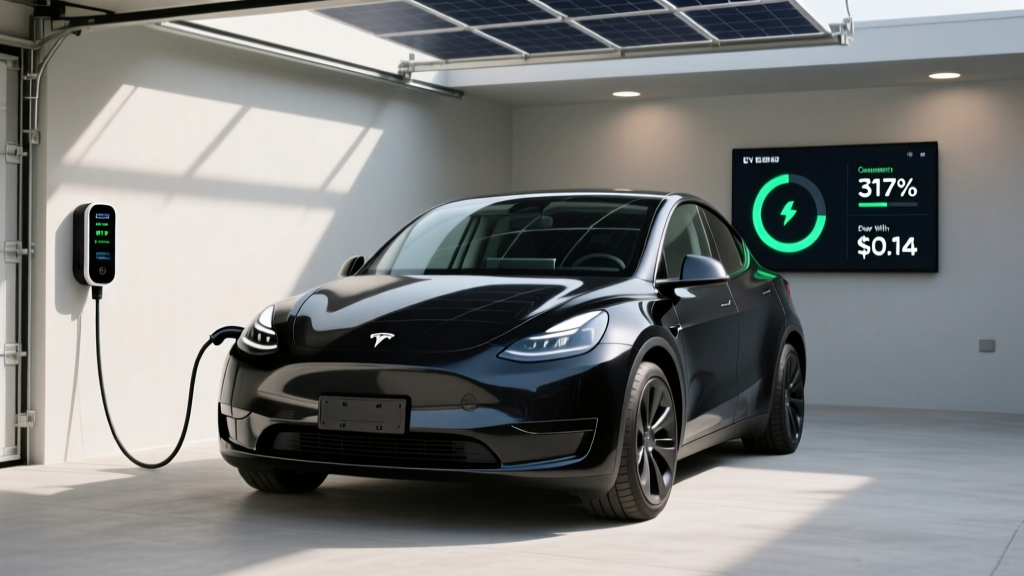
Smart features (Wi-Fi, app scheduling, energy tracking) are valuable if your utility offers time-of-use rates — you can schedule charging during off-peak hours when electricity costs $0.08-$0.11/kWh instead of $0.18-$0.25/kWh. If you have solar panels, smart chargers can prioritize solar-generated electricity. For simple "plug in overnight" use, a basic charger works fine, but the price premium for smart features is typically only $50-$150.
Key Takeaways for Shelby EV Charger Buyers
- Home Level 2 is essential: Budget $750-$1,800 for simple installs; up to $8,000 if your panel needs upgrading. Get a load calculation first.
- kW ≠ kWh: kW is charge speed; kWh is battery capacity. Know both for your vehicle.
- NACS is now standard: Most 2025-2026 EVs use NACS; CCS1 adapters are available for legacy vehicles.
- Home charging saves $1,000+/year vs. gas — but only if you can install Level 2 at home.
- Permit and inspect: Don't skip the electrical permit; it protects your home and insurance coverage.
- Check utility incentives: Some utilities offer $200-$500 rebates for Level 2 charger installation or discounted off-peak electricity rates.
For official efficiency data on specific EV models, consult fueleconomy.gov. For current federal tax credit rules on EV purchases (not charger installation), see IRS §30D guidelines.